
Building Survey London: A Practical Guide for Buyers
Your offer's been accepted on a Victorian terrace in Peckham. The estate agent wants the memorandum out, the lender's pushing its valuation through and you're wondering if a survey is just another bill.
It isn't. On London property, the right survey often decides whether you proceed, renegotiate or walk away.
That matters more here because London's housing stock is huge and mixed. The Greater London Authority reports almost 3.8 million homes in 2023, with stock spanning different ages, types and heights, and it also notes continued growth over time in the city's dwelling stock, which is exactly why condition checks and defect diagnosis stay so relevant in this market (GLA housing stock research). A flat in Bermondsey, a villa conversion in Blackheath and a 1930s semi in Bromley do not carry the same risks.
Table of Contents
- What a Building Survey Actually Is
- Building Survey vs HomeBuyer Report vs Condition Report
- What a Building Survey Covers in a London Property
- What a Building Survey Does Not Cover
- Cost, Timing and How to Instruct a Surveyor
- Choosing the Right Survey for Your London Property
- How to Pick and Instruct a London Surveyor
- Building Survey Questions London Buyers Ask
What a Building Survey Actually Is
A building survey is the modern RICS Level 3 Home Survey. It is the fullest pre-purchase survey RICS offers for residential property. If you're buying an older terrace in Forest Hill, a converted flat in Camberwell or a house that's been extended twice and patched up badly, this is usually the one that makes sense.
A surveyor spends time on site inspecting the visible and accessible parts of the building. Then you get a written report that explains the construction, records defects, shows the likely cause where that can be judged from a visual inspection and tells you what needs doing first.
What you actually receive
You're not paying for a vague opinion. You're paying for a report you can use.
It should set out:
- Condition ratings: usually traffic-light style, so urgent issues stand out.
- Defect detail: cracking, damp, timber decay, roof spread, movement, poor alterations and maintenance failures.
- Limits of inspection: blocked lofts, concealed timbers, sealed voids and anything else the surveyor could not inspect.
- Next steps: what needs a builder, what needs a damp specialist and what needs legal follow-up.
RICS provides the framework for home surveys, but the point of a Level 3 is practical decision-making. You should be able to hand it to your solicitor, use it in price talks and refer to it when getting repair quotations.
Practical rule: A building survey is for you. A mortgage valuation is not.
What it is not
A lender's valuation is there to protect the lender's security. It won't tell you the things you need to know about rotten joist ends, slipped slates, bridged damp-proof courses or a rear addition that looks like it was built with optimism rather than skill.
If you want a plain-English overview of the buying process before the survey stage, these property survey tips are a sensible starting point. Then match the advice to the actual building in front of you.
Building Survey vs HomeBuyer Report vs Condition Report
Most buyers aren't choosing between good and bad. They're choosing between too little information and enough information. That's the issue.
RICS says a Level 2 Home Survey suits conventional properties in reasonable condition, while a Level 3 Home Survey is the most detailed option and is intended for large, older, altered, run-down or unusual properties, or where major works are planned (RICS survey guide). That fits London exactly. A clean-looking conversion in New Cross can still hide poor structural alterations and moisture problems.
RICS Survey Levels Compared
| Feature | Level 1 Condition Report | Level 2 HomeBuyer Report | Level 3 Building Survey |
|---|---|---|---|
| Best suited to | Newer, conventional homes in reasonable order | Conventional properties in reasonable condition | Older, altered, run-down, unusual or larger properties |
| Depth of inspection | Basic visual summary | Mid-level visual inspection | Detailed visual inspection of accessible elements |
| Condition ratings | Yes | Yes | Yes |
| Repair advice | No real depth | Some advice on urgent defects | Detailed repair priorities and defect analysis |
| Valuation included | No | Often included in the product format | Not usually the point of the report |
| Rebuild cost | No | Often included | May be referred to separately depending on instruction |
| Good for listed or heavily altered property | No | Usually no | Yes |
| Damp and defect explanation | Limited | Moderate | Much fuller analysis |
| Report style | Short summary | Standard format | Flexible, detailed narrative with photos |
| When to pick it | Straightforward newer home | Standard flat or house with no obvious complexity | Period house, conversion, unusual build or major alterations |
The practical difference
A Level 1 is for basic reassurance. If you want repair advice, it's too thin.
A Level 2 works well on a straightforward flat in a purpose-built block in places like Woolwich, Sutton or parts of Bermondsey, where the construction is conventional and there isn't much evidence of alteration or neglect.
A Level 3 is the one for Victorian terraces in Peckham, Edwardian houses in Dulwich, conversion flats in Islington and awkward mixed-age stock in Hackney. It gives room to explain the building properly. That matters because “looks fine” is not a diagnosis.
Buy the survey that fits the building. Don't buy the cheapest report and hope it stretches.
For buyers comparing Corinthian's own survey options, the relevant pages are the RICS Homebuyer Surveys, the RICS Building Surveys and the RICS Home Condition Surveys.
What a Building Survey Covers in a London Property
Take a typical Victorian terrace in Brockley or Forest Hill. Solid brick walls. Pitched slate roof. Bay window. Rear addition. Maybe a loft conversion. Maybe a cellar. That's where a proper building survey in London earns its fee.
The inspection starts outside. Roof coverings, ridge lines, chimney stacks, parapets, flashings, rainwater goods, render, pointing and wall surfaces all get checked from ground level and from any accessible vantage points. The surveyor is looking for slipped slates, open joints, cracked render, failed pointing and leaks that have been ignored for years.
Defects that turn up again and again
On London stock brick, you often see failed pointing and hard cement repairs trapping moisture where the wall should breathe. On terraces and conversions, you regularly find raised external ground levels bypassing the damp-proof course, so internal damp at low level isn't always true rising damp. In replacement-window flats, poor ventilation often leads to condensation, especially in kitchens, bathrooms and cold corners.
Inside, the surveyor looks at walls, ceilings, floors, joinery and signs of movement or moisture. Springy floors can point to undersized joists, notching, decay or badly planned knock-throughs. Cracks over openings can indicate lintel issues, historic settlement or movement linked to alteration.
Lofts, cellars and altered structures
The loft often tells the truth. You can see roof spread, cut rafters, poor insulation, staining from historic leaks and the quality of any conversion work. In cellars and lower-ground areas, the key concerns are moisture, timber decay and ventilation.
Where internal walls have been removed, the surveyor looks for signs of overloaded floor joists, inadequate support and distortion. Chimney breast removals in Camberwell, Catford and Walthamstow deserve particular attention because the problem isn't the missing chimney. It's what's now carrying the load.
- Roof defects: slipped slates, failing flashings, patch repairs and water entry.
- Moisture issues: penetrating damp, condensation and dampness caused by bridging.
- Timber concerns: rot in roof voids, cellar timbers and suspended floors.
- Alteration risks: knocked-through walls, unsupported masonry and poor extensions.
Each finding should be pinned to a location, described in plain terms and paired with a recommendation. Good reports don't just say there's damp in the rear reception. They say where, what pattern, what likely mechanism and what sort of follow-up is sensible.
What a Building Survey Does Not Cover
You're buying a Victorian terrace in Forest Hill. The rear bedroom wall feels cold, the seller has a wardrobe fixed across the chimney breast, and the loft hatch is painted shut. A Level 3 survey will still help. It will not answer every question hiding behind finishes, furniture and locked access.
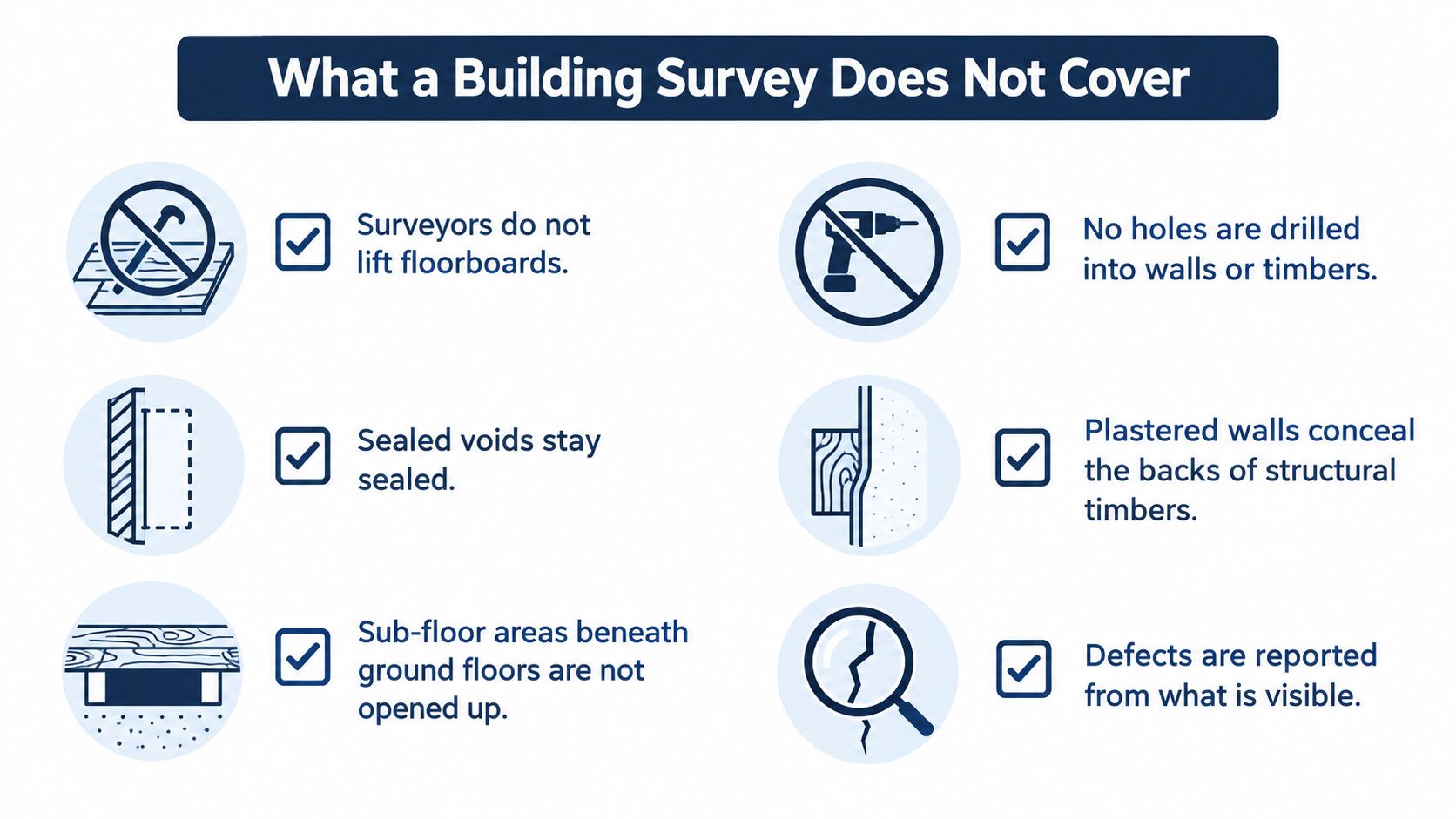
A building survey is a visual inspection. Detailed, yes. Destructive, no.
That matters because buyers in London often hear “get a Level 3” as if it settles the lot. It doesn't. A Level 3 inspects the building as seen on the day. It does not include opening up works, testing services, or specialist legal and neighbour matters that sit alongside the survey rather than inside it.
Start with access. Surveyors do not lift floorboards as standard, drill into walls, remove fitted panels, or expose buried steel. If a flat roof is only reachable by ladder from a rear outrigger, access may be restricted. If stored belongings block the understairs area or a tenant refuses entry to a room, the report can only comment on what was visible.
Damp is where buyers get confused fastest. A surveyor can identify staining, tide marks, mould growth, defective rainwater goods, bridged external ground levels and meter readings taken during the inspection. That is useful. It still falls short of a proper fault-finding exercise where the cause needs separating with specialist methods such as calibrated moisture meters, thermal imaging and salt analysis, as set out in specialist damp surveys.
The same line applies to building services. A surveyor will usually note old consumer units, dated wiring, missing test certificates, corrosion to pipework, sluggish boiler performance, poor extractor provision or suspect drainage smells. None of that amounts to electrical testing, a Gas Safe inspection, or a CCTV drain survey.
So if you need certainty, order the right extra report rather than trying to force the building survey to do a different job.
Common areas outside scope include electrical installations, gas appliances, boilers, underground drains, asbestos sampling, arboricultural advice and formal boundary disputes. Japanese knotweed sits in the same bracket. A surveyor may comment if growth is visible, but no pre-purchase survey gives a guarantee that invasive plants are absent across the whole site or next door.
London buyers also mix up pre-purchase surveying with party wall and conservation issues. Keep them separate. A building survey can flag that a loft conversion, rear extension or basement dig may raise party wall questions. It does not serve notice, agree an award or decide whether a neighbour's work complies with the Party Wall etc. Act 1996. The government's explanatory booklet sets out the notice process and time limits.
The same goes for planning and heritage controls. In Blackheath, Greenwich, Hampstead or parts of Dulwich, conservation area rules and listed building consent can shape what you can alter far more than the survey itself. The survey should spot signs of unauthorised-looking changes and advise checks. It does not replace your solicitor's enquiries or a planning search.
Use the Level 3 for what it is good at. Condition, defect diagnosis from visible evidence, risk, repair priority and sensible next steps. Use specialists for hidden moisture sources, service testing, legal boundaries, asbestos confirmation, party wall procedure and heritage consent. That is how you avoid paying for the wrong advice and still missing the core problem.
Cost, Timing and How to Instruct a Surveyor
You agree a price on a house in Forest Hill on Monday, the agent wants your surveyor's details by Tuesday, and you still do not know whether the place is a straightforward Level 2 job or a slower, more detailed Level 3. That is when buyers waste time and money.
Price follows risk and workload. A modern two-bed flat with good access is usually cheaper to inspect than a tall Victorian terrace in Greenwich with a loft conversion, rear addition, patched roof coverings and locked cellars. The report type matters, but the building matters more.
Here is the practical London picture.
| Property Type | Typical Fee Range | Typical Turnaround |
|---|---|---|
| Two-bed flat | £500 to £800 | Five to ten working days |
| Victorian terrace or maisonette | £700 to £1,200 | Five to ten working days |
| Larger or awkward property | Over £1,500 | Varies, often longer if access is difficult |
Those ranges shift for reasons buyers can usually spot in advance. Height, floor area, poor access, short notice, multiple alterations, roof terraces, basements, listed status and split-level layouts all push the job up. If you want a fuller fee breakdown, read this guide to building survey cost in London.
Timing is straightforward. Booking the inspection is often quicker than getting the report. Access has to be arranged, tenants may be involved, and some London blocks only allow entry at fixed times. Then the surveyor has to write up what was found, not fire over a rushed template because exchange is looming.
Before you instruct, send the surveyor enough detail to price the job properly. Use one email and include the address, the estate agent's contact, the sales particulars, the asking price, and any concern already on your radar. Say if there is cracking, damp staining, a basement, a flat roof, a converted loft, or a lease with known issues. Those details affect both fee and scope.
Then ask three direct questions.
First, which report are you quoting for: Level 2 or Level 3?
Second, will you inspect the main roof coverings from ground level only, from communal parts, or from a terrace or rear garden if available?
Third, does the fee include a proper post-report call so you can go through defects, repair priority and whether you need damp, timber, roofing or structural follow-up?
If the answers are vague, keep looking.
A good instruction is short and clear. Confirm the report level, the fee, the property address, who arranges access, and when the written report lands. That avoids the usual London problem where the buyer thinks they have ordered a full pre-purchase diagnosis and the surveyor has only been asked for a cheaper report on a tight deadline.
Choosing the Right Survey for Your London Property
Most London advice online collapses everything into “just get a Level 3”. That's lazy. The right answer depends on the building in front of you.
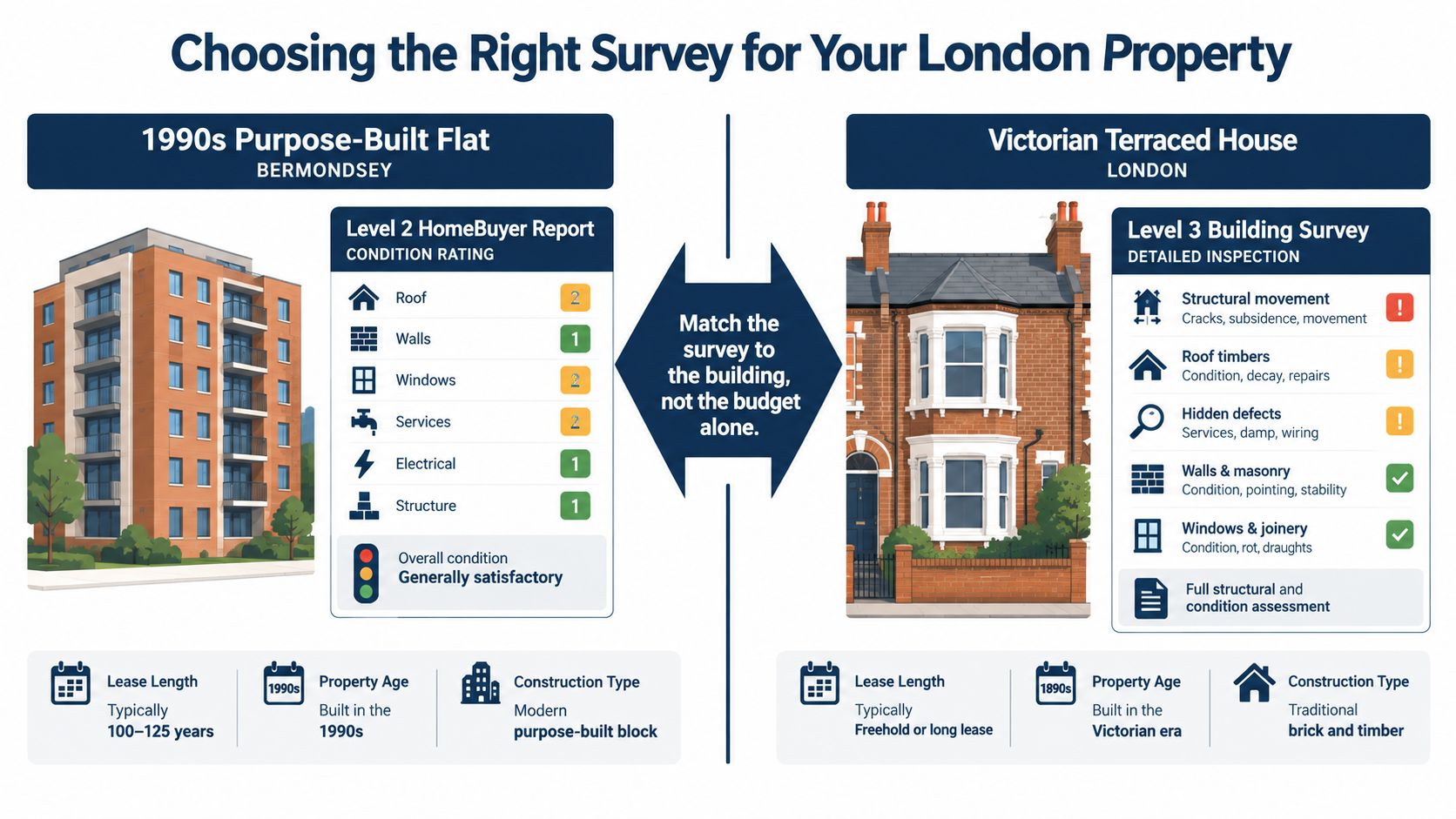
A purpose-built flat from the 1990s in Bermondsey, with conventional construction and no obvious signs of distress, often suits a Level 2. You still need clear defect reporting, but you may not need the extra narrative depth of a Level 3.
A Victorian terrace in Forest Hill, Herne Hill or Walthamstow is different. Solid walls, bay roofs, rear additions, suspended timber floors and decades of piecemeal alteration create enough uncertainty to justify a Level 3 straight away.
Where Level 3 is usually the sensible call
Conversion flats in Camden, warehouse splits in Hackney and older houses in Greenwich or Dulwich usually need fuller scrutiny. The original structure may be old, the services may be modern and the interface between the two is often where defects hide.
Listed property is another category again. Repair methods, breathable materials, movement history and conservation constraints all need more careful explanation than a standard format report tends to allow.
Here's a useful explainer on what a Level 3 survey is if you're weighing that decision now.
When not to overbuy
New-build flats are the main exception. A snagging inspection is usually more relevant than a full building survey, because the key issues are workmanship, finishing defects and incomplete items rather than old fabric decay.
Match the survey to the building, not the budget alone.
That's the rule. The older, stranger or more altered the property, the more a Level 3 earns its keep.
How to Pick and Instruct a London Surveyor
You are buying a flat in Camberwell. The agent says, “We've got a surveyor we use all the time.” Stop there and choose your own.
The right surveyor is not just the one who can book you in fastest. You need someone who inspects this sort of London stock every week, writes plainly, and knows the limits of the job. A Level 3 survey is about the building fabric and visible defects. It is not a party wall award, a specialist damp investigation, a valuation for your lender, or consent advice for listed and conservation work.
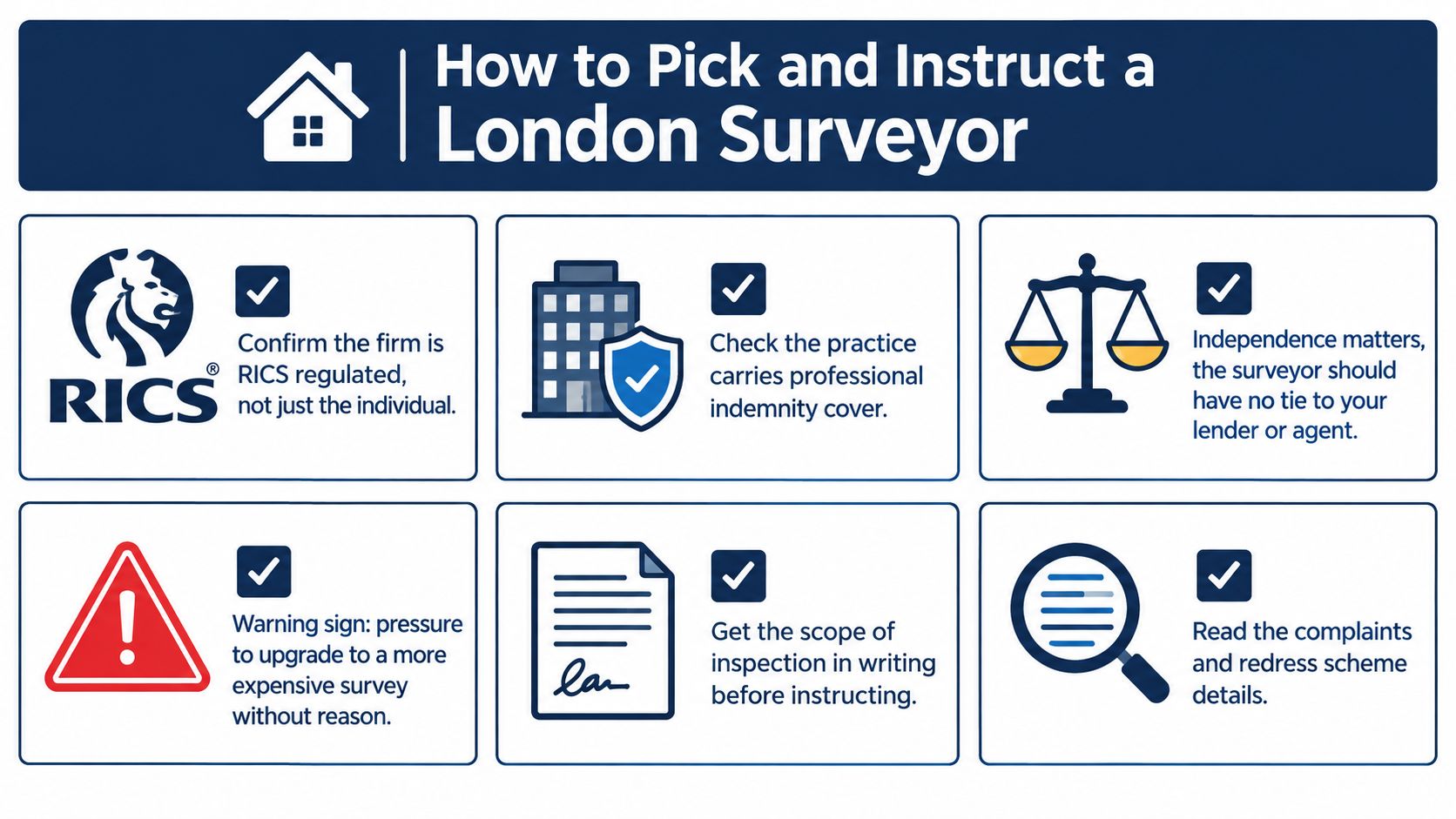
Start with regulation and independence. Use a firm that is RICS regulated, not just a sole practitioner who once qualified and now does a bit of everything. If an estate agent, broker or developer is steering you toward one name, ask whether there is a referral arrangement. Then decide whether you want advice from someone introduced by a party who needs the deal to keep moving.
Then test their local grip. Ask what they inspect most often. A surveyor who spends their week on Surrey new-builds is not my pick for a stucco conversion in Bayswater, an ex-local authority flat in Southwark, or a damp-prone lower-ground flat in Stoke Newington. London defects are repetitive, but the pattern changes by area and building type.
Three questions sort the good firms from the weak ones.
First, ask for a sample report. You are checking whether they identify defects properly, not whether the PDF looks polished. I want to see plain references to slipped slates, failed flashings, chimney stack movement, beetle-damaged floor timbers, high external ground levels, cement render on solid walls, and poor alterations to rear additions.
Second, ask what happens after inspection day. You need the report, photographs, and a follow-up call. Buyers in Forest Hill, Blackheath and Islington usually have the same problem after reading a survey. They want to know which items are urgent, which need a quote, and which are just part of owning an older London building.
Third, ask what they need from you before they attend. This matters more than buyers expect. Flats often need access to the roof space, meter cupboards, boiler, terrace, cellar, or common parts. If the managing agent will only release keys on notice, deal with that early or your surveyor will inspect around the gaps.
RICS describes the profession more broadly than many buyer guides do, which is why people get confused about where survey work ends and specialist advice begins. Residential pre-purchase reports sit alongside party wall work, dilapidations and other building matters, not inside one catch-all service. For a plain-English check on credentials, see this guide to RICS building surveyors.
Corinthian Surveyors London LTD is one example of an independent residential practice in this market. It is RICS regulated, based in Forest Hill, run by Clive Thompson, and has no ties to lenders, estate agents or developers. That is the model to look for. Clear scope, local experience, and no pressure to keep a sale alive.
Building Survey Questions London Buyers Ask
Does a mortgage valuation mean I can skip the survey
No.
The lender's valuer is looking after the lender. In weaker pricing conditions, that distinction matters even more. In the RICS UK Residential Survey for February 2026, London recorded a house-price net balance of -40%, compared with a national headline balance of -12%, and RICS said London was among the regions under the most downward pressure (RICS residential survey February 2026). If your survey finds serious defects, you may have room to renegotiate. A mortgage valuation will not do that job for you.
Does a new-build London flat need a survey
Usually not a full Level 3.
What you generally need is a snagging inspection focused on workmanship and finishing defects. If the flat is unusual, heavily altered from its approved form or already showing signs of water entry or cracking, that's different. But most new-build purchases don't justify paying for the deepest pre-purchase report.
Which survey findings justify renegotiation
Focus on defects that affect structure, water ingress, safety or major cost. Roof failure, structural movement, rotten concealed timbers suggested by visible symptoms, widespread damp with uncertain cause and unauthorised alterations all belong in that conversation.
Cosmetic wear doesn't. Old decorations, dated kitchens and hairline shrinkage cracks are not strong renegotiation points. If the report calls for a specialist inspection, get that before exchanging. Don't try to bluff your way through on half a diagnosis.
How long should I keep the report
Keep it for as long as you own the place.
If you buy a leasehold flat in a conversion in Brixton or Stoke Newington, that report may help later when service charge disputes arise over roofs, external walls or damp repairs. It's also useful when you plan works, revisit old recommendations or sell and want to understand what changed since purchase.
If you need clear advice on a building survey in London, Corinthian Surveyors London LTD carries out RICS Home Surveys, including Level 2 and Level 3 inspections, across London and the South East, with local knowledge of the stock buyers struggle with. For straight answers on the right survey for the property you're buying, visit Corinthian Surveyors London LTD or call 0800 00 16 422.