
Cost of RICS HomeBuyer Report in London
A RICS HomeBuyer Report, also called a Level 2 Home Survey, in London typically costs £400 to £900, with most standard flats and houses falling in the £450 to £700 band. The exact fee depends on the property's size, age, condition, construction and location.
The popular advice is to search for one national average and choose the lowest quote. That's the wrong approach. RICS doesn't set a single consumer fee for a Level 2 report. The price reflects the work involved, and a surveyor inspecting a modern flat in Bermondsey isn't taking on the same job as one inspecting an altered Victorian house in Forest Hill.
The sensible question isn't only, “What does the report cost?” It's, “What might I miss if the inspection is too limited?”
Table of Contents
- What a RICS HomeBuyer Report Actually Costs in London
- The Factors That Change Your Survey Price
- What You Get for Your Money in a Level 2 Report
- How the HomeBuyer Report Compares to Other Surveys
- How to Get an Accurate Quote for Your London Property
- Why the Cheapest Survey Is Rarely the Cheapest Outcome
- Common Questions About HomeBuyer Report Costs
What a RICS HomeBuyer Report Actually Costs in London
UK pricing guides place a Level 2 HomeBuyer Report in a broad national range. Current guidance puts typical prices around £400 to £700, while wider quoted ranges run from £400 to £900 or £400 to £1,000, depending on location and the property itself. You can compare the wider context with this guide to average home inspection prices, but London buyers should avoid treating any national figure as a fixed quotation.
RICS says a Home Survey Level 2 starts at a few hundred pounds, with the cost rising according to the level of detail and the complexity of the property. RICS also identifies Level 2 as the popular mid-level option between Level 1 and Level 3. RICS consumer guidance explains the different survey types and costs.
For a standard one-bedroom flat in Lewisham, Croydon or Greenwich, the fee may sit nearer the lower part of the London range if access is straightforward and the building is modern. A larger house in Dulwich, Blackheath or Forest Hill may require more inspection time and a higher fee. Period features, extensions, visible defects and difficult roof or loft access can all change the quote.
Practical rule: A low quote only makes sense when the property itself is straightforward. Compare like with like, not just the headline price.
A Level 2 survey is usually appropriate for a conventional flat or house in reasonable condition. It's not automatically suitable for every older London property. A Victorian terrace with chimney breast alterations, damp staining or structural movement may justify a Level 3 Building Survey instead.
RICS pricing is therefore a useful starting point, not a promise. London's labour costs, property values and survey demand often place fees towards the upper end of national ranges, particularly for larger or older homes. The report fee remains only one part of the buying decision.
The Factors That Change Your Survey Price
Two London properties can both need a Level 2 report and still receive different quotations. The reason is simple. The surveyor is pricing the inspection required for the building, not selling a standard product at one national rate.
Size and layout
A compact modern flat is usually quicker to inspect than a house with several floors, outbuildings, roof spaces or extensive alterations. A one-bedroom apartment in a newer Bermondsey development has a different inspection profile from a four-bedroom Victorian terrace near Forest Hill station.
The surveyor needs to consider accessible rooms, external walls, roofs, common parts where relevant and visible services. More areas mean more time recording condition and explaining defects.
Age and condition
Age matters because older buildings often contain materials and details that need closer attention. A Victorian house in Catford or Brockley may have lime mortar, lath and plaster, original chimney breasts or timber elements. Those features don't automatically mean the property is defective, but they can make the inspection more involved.
A 1930s semi in Bromley or Beckenham may have a different risk profile. The surveyor may need to assess roof coverings, render, drainage, later extensions and signs of movement. A property showing damp, cracking or timber decay will normally demand more careful reporting than one in clean visible condition.
Construction and alterations
Non-standard construction, converted buildings and heavily altered homes can move a quote upwards. A flat conversion in Peckham may raise questions about roof rights, separating walls, alterations and the condition of shared areas. A warehouse conversion in Bermondsey may require a different understanding of its structure and previous use.
Listed buildings and homes in conservation areas can also need more careful interpretation. Original features may be protected, while modern repairs may be unsuitable for the building. The survey fee reflects the time needed to identify and describe what can be seen. It doesn't include every specialist investigation that might later be recommended.
Location and access
Location affects local pricing pressure, but access can matter just as much. A surveyor may face restricted parking, occupied rooms, locked cupboards, limited loft access or difficult communal arrangements. Those practical details affect the time required to complete a proper inspection.
Give the surveyor the full address, property type, approximate age, floor area if known and any details about extensions or defects. A quote based on accurate information is more useful than an attractive figure based on assumptions.
What You Get for Your Money in a Level 2 Report
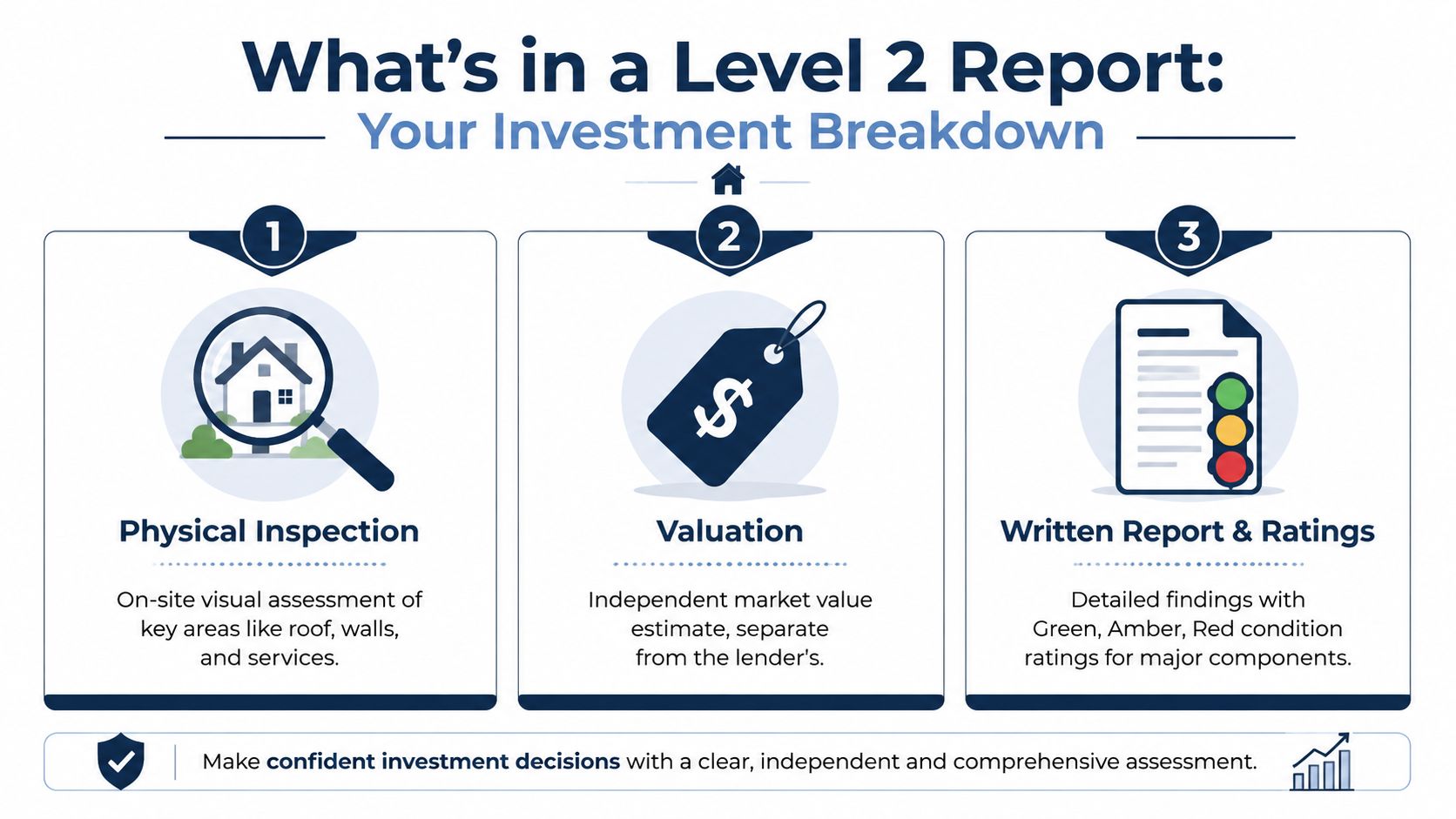
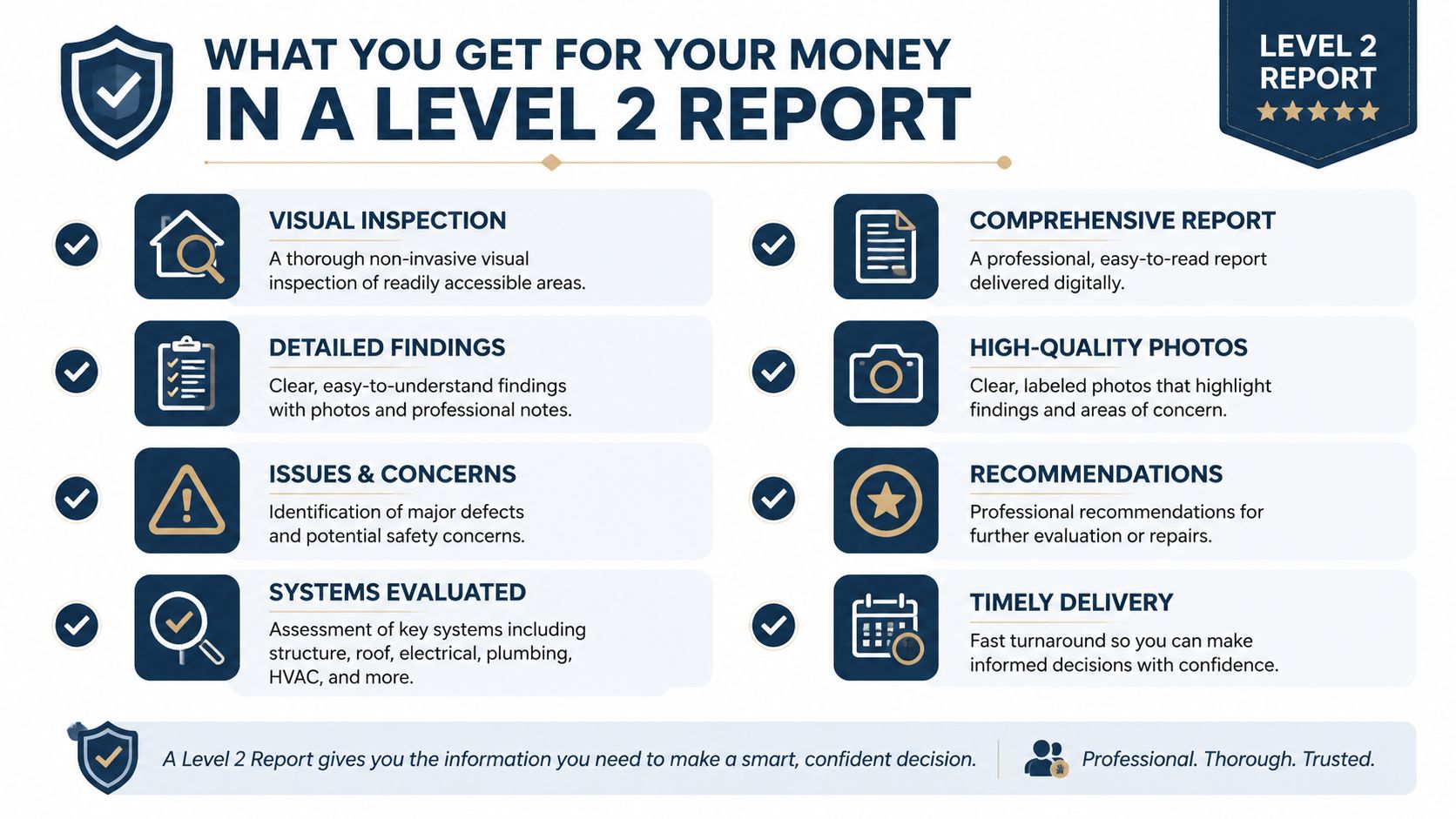
RICS describes the Level 2 service as three core parts: a physical inspection, a written report and a valuation. The report is based on what the surveyor can see and access at the inspection.
The inspection is visual and non-invasive. The surveyor examines relevant parts of the building without dismantling construction. They won't normally lift floorboards, move heavy furniture or open up concealed areas to search for hidden defects.
The physical inspection
The surveyor looks at the main building elements and records visible concerns. Depending on the property, that can include the roof, walls, ceilings, windows, doors, floors, drainage, external areas and permanent outbuildings.
Common issues include damp, roof defects, timber decay, subsidence indicators and structural movement. The report may also identify matters that need further investigation, but it isn't a guarantee that concealed defects don't exist.
The written report
The findings are set out in a structured report. Condition ratings help you see which elements appear satisfactory, which need attention and which present more serious concerns.
The report also includes problems the surveyor believes may affect the property's value. That matters during negotiations. A defect isn't merely a maintenance note if it changes what a reasonable buyer should pay or what future repair work may involve.
You can read a plain explanation of the service in what a Level 2 survey includes.
The valuation and reinstatement figure
A Level 2 report with valuation includes the surveyor's professional opinion of the property's market value. RICS also states that the service provides an insurance reinstatement figure, which is the estimated cost of rebuilding the property and associated structures after a serious loss.
These figures serve different purposes. Market value relates to the property's worth in the open market. Reinstatement cost relates to insurance cover and isn't the same as the purchase price.
Before instructing anyone, check whether the quotation includes the valuation. Some buyers assume every Level 2 product includes it, but the precise service should be confirmed in writing.
How the HomeBuyer Report Compares to Other Surveys
The Level 2 HomeBuyer Report sits between a basic condition report and a more detailed Building Survey. It's often the right choice for a conventional London property, but the building's age and construction should decide the survey level.
A Level 1 Home Condition Survey is the simplest option. It can suit a modern, conventional flat where the buyer wants a basic visual overview and doesn't need a valuation or detailed repair advice. It's less suitable for a Victorian terrace, a listed property or a home with visible defects.
A Level 3 Building Survey goes further. It's the sensible choice for older, altered or non-standard properties, particularly where you're planning substantial works. Buyers considering a basement excavation, loft conversion or major extension should think carefully before choosing a Level 2 report.
A mortgage valuation is different again. It's produced for the lender's lending decision. It doesn't give you the same independent condition assessment or practical explanation of defects. The lender's valuation should never be treated as a substitute for your own survey.
| Survey Type | Typical Cost Range | Best For |
|---|---|---|
| Level 1 Home Condition Survey | From a few hundred pounds | Modern, conventional properties in apparently good condition |
| Level 2 HomeBuyer Report | £400 to £900, with common pricing around £400 to £700 | Standard flats and houses where a visual inspection, report and valuation are suitable |
| Level 3 Building Survey | Can exceed £1,000 | Older, listed, altered or non-standard properties |
| Mortgage valuation | Set by the lender or mortgage arrangement | The lender's assessment of value, not the buyer's building survey |
The figures for Level 1 and Level 3 are not fixed national fees. RICS confirms that Level 1 starts at a few hundred pounds and Level 3 can exceed £1,000, with complexity affecting the price. For more detail on the higher-level option, see Building Survey pricing and scope.
The decision is straightforward in many cases. Choose Level 2 for a conventional flat or house without obvious complexity. Choose Level 3 when the property's history, structure or planned works make a visual mid-level assessment too limited.
How to Get an Accurate Quote for Your London Property
Start with the property details, not the price question. Give each surveyor the address, property type, approximate age, number of storeys, known extensions and any visible concerns. Mention if it's a conversion, listed building, maisonette or property in a conservation area.
Ask what the quotation includes. Confirm the survey level, valuation, reinstatement figure, inspection scope, report format, VAT and any likely additional fees. You should also ask who will carry out the inspection and what qualifications they hold.
Check independence and credentials
An independent surveyor should be able to explain their professional status clearly. Look for RICS regulation, relevant surveying experience and, where valuation work is involved, membership of the RICS Valuers Registration Scheme. CABE qualifications can also indicate useful built-environment expertise.
Corinthian Surveyors London LTD is an independent practice based in Forest Hill. Clive Thompson holds RICS and CABE qualifications and has over 30 years of experience in the built environment. The firm has no ties to lenders, estate agents or developers, which helps keep the advice separate from the transaction itself.
Independence matters because the surveyor should report what they find, not what helps another party complete a sale. RICS regulation and professional indemnity insurance provide further safeguards, but you still need to check that the service matches the property.

Compare the scope, not just the fee
A quotation that arrives without basic property details may be unreliable. Be cautious if the surveyor promises an unusually fast report without asking about access, age or construction. A fee that seems too low for a large period house deserves a clear explanation.
Ask how the surveyor handles serious findings. You need a report that explains the defect, its apparent significance and sensible next steps. It should help you decide whether to proceed, renegotiate or obtain specialist advice.
For practical guidance on selecting a local professional, use this resource on finding surveyors near you.
Get at least a few comparable quotations where possible. Ask the same questions each time. You're looking for a like-for-like service, not the shortest email or the lowest number.
Why the Cheapest Survey Is Rarely the Cheapest Outcome
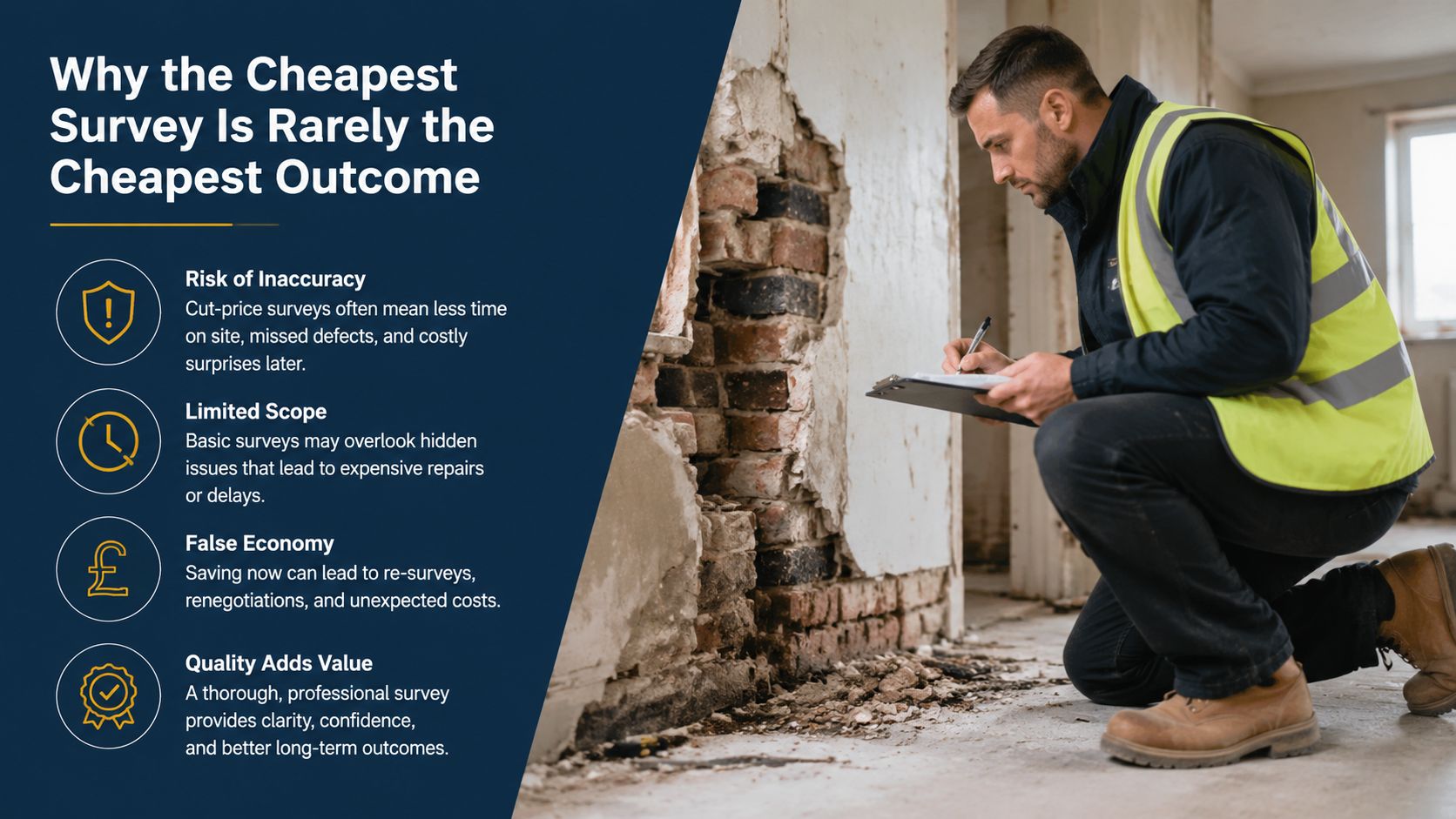
The cheapest survey can become expensive when it fails to explain a defect that affects the purchase. A Level 2 report may identify damp in a Victorian terrace, roof deterioration in a 1930s semi or signs of movement in a converted flat. Those findings can give you time to seek specialist advice, adjust your offer or budget properly before exchange.
A surveyor doesn't need to find a dramatic structural failure for the report to be valuable. Clear notes about defective gutters, poor external pointing, roof coverings or timber decay can prevent small problems becoming larger repair liabilities. The report gives you information before the transaction becomes difficult to unwind.
The real comparison is not fee against fee. It's survey cost against the cost of making an uninformed purchase.
A report can also expose a mismatch between the asking price and the property's condition. RICS says the Level 2 valuation includes a professional opinion of market value and a list of problems that may affect value. That combination gives the buyer a stronger basis for a discussion with the seller.
The right response depends on the defect. Damp may need a specialist diagnosis. Suspected subsidence may require structural advice. Roof defects may need a roofer's quotation. The survey doesn't replace those specialists, but it tells you where their input is needed.
Corinthian Surveyors London LTD provides independent Level 2 surveys and other residential surveying services across London, the Home Counties and the South of England. If you're comparing quotes for a property in Lewisham, Greenwich, Bromley, Croydon or elsewhere in London, call 0800 00 16 422 with the address and property details ready.
Common Questions About HomeBuyer Report Costs
Does the buyer or seller pay for the report?
The buyer normally arranges and pays for a pre-purchase survey. The seller isn't responsible for commissioning your independent inspection.
Is the valuation included?
It can be included in a Level 2 Home Survey with valuation. Confirm this in the written quotation, along with the reinstatement figure and report scope.
What happens if serious defects appear?
Ask for clarification before exchange. You may renegotiate, obtain specialist reports, budget for repairs or decide not to proceed.
Is Level 2 suitable for an old London house?
Not always. A Victorian, listed or heavily altered property may need a Level 3 Building Survey because a Level 2 inspection is visual and non-invasive.
Corinthian Surveyors London LTD provides independent RICS HomeBuyer Reports, Level 3 Building Surveys and residential valuations across London and the surrounding Home Counties. Visit Corinthian Surveyors London LTD with your property address and details to request advice on the appropriate survey and a clear quotation.