
Building Survey Price in London: A Clear Cost Guide
A Level 3 Building Survey in London usually sits around £1,000 to £1,500+ for straightforward homes, and it goes higher for more complex or higher-value properties. A Level 2 HomeBuyer Report in London usually falls between £600 and £1,000.
If you're buying a flat in Bermondsey, a Victorian terrace in Forest Hill or a house in Bromley, that price is the first thing to get straight. The wrong survey can leave you with a cheap report and an expensive repair bill.
Table of Contents
- What You Will Pay for a Building Survey in London
- The Three RICS Survey Levels Explained
- Typical Building Survey Prices in London
- What Pushes the Price Up or Down
- What Is Included and What Is Not
- When a Higher Survey Fee Pays for Itself
- Choosing a Surveyor and Requesting a Quote
- Frequently Asked Questions About Building Survey Prices
What You Will Pay for a Building Survey in London
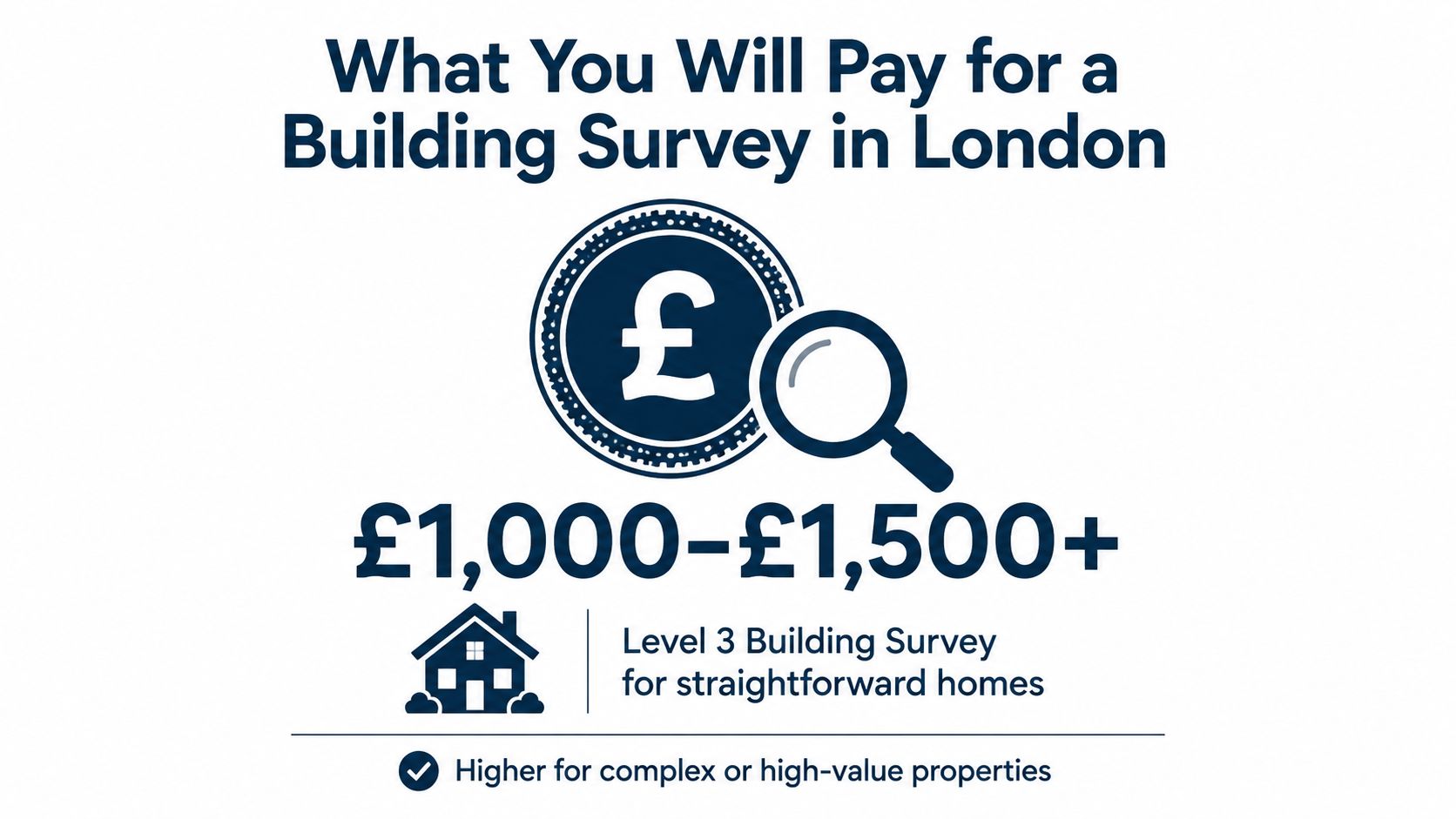
A Level 3 Building Survey in London is usually the one people ask about when the property looks older, altered or a bit awkward. For a straightforward home, expect £1,000 to £1,500+. If the place is larger, more complex or higher value, the fee goes up.
A Level 2 HomeBuyer Report is the cheaper option and usually sits around £600 to £1,000 in London. That is fine for many conventional flats and houses in decent condition. It is not the right answer for a house with history, movement or a lot of tinkering by previous owners.
If you want a rough starting budget, work from the property itself, not from a generic brochure. A good independent firm, such as Corinthian Surveyors, will price per property rather than throw out a lazy one-size-fits-all number. That is how it should be done.
For a quick practical shopping list, the basic moving advice from Standby Self Storage moving tips is useful, because survey costs often land in the same week as removals, deposits and legal fees. Keep the survey fee separate in your head. It is not spare change.
The Three RICS Survey Levels Explained
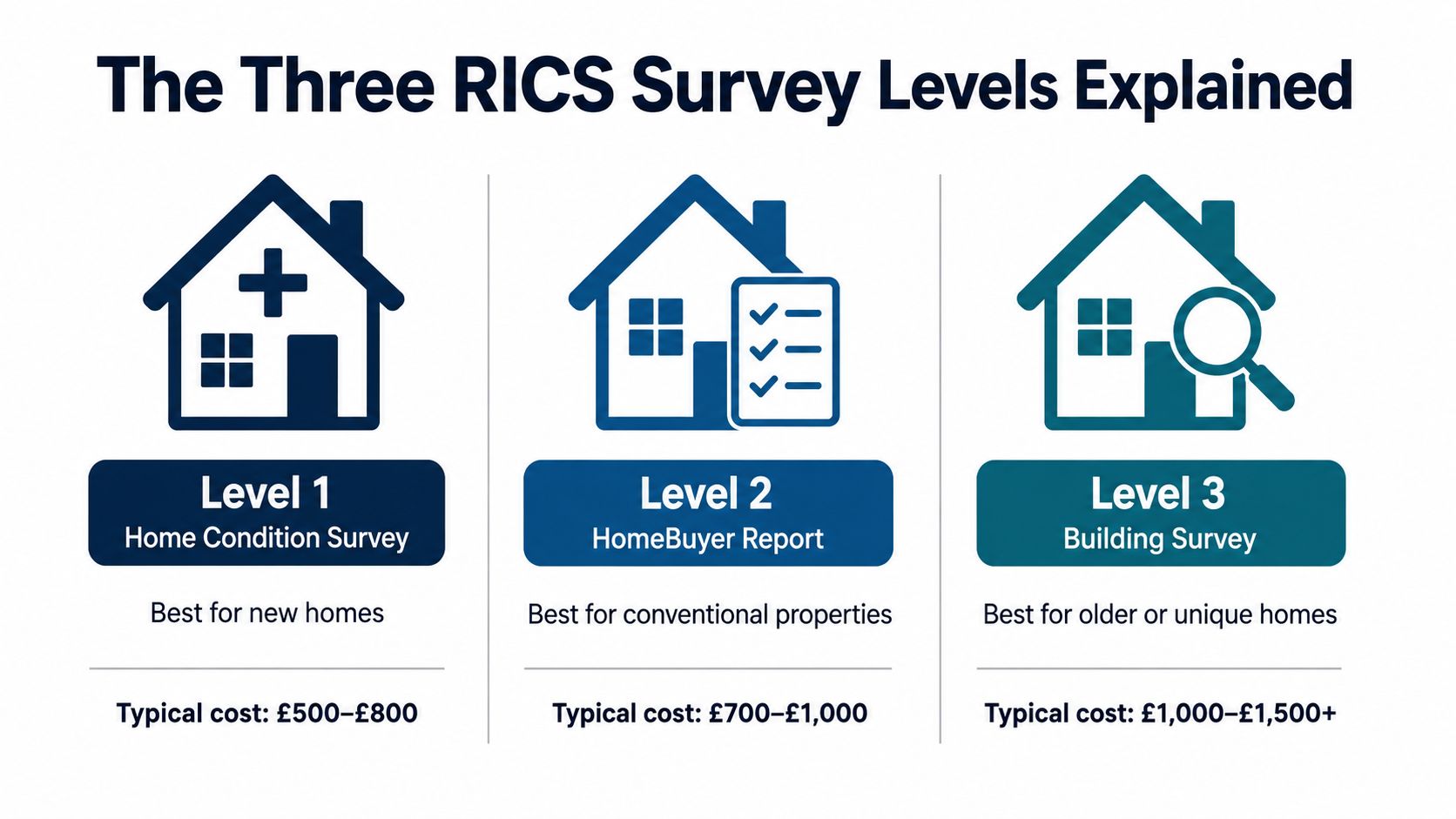
The RICS system is simple once you strip away the jargon. Level 1 is the lightest check, Level 2 is the middle ground and Level 3 is the full building survey. The trick is matching the level to the risk profile of the property, not to the lowest quote on your screen.
Level 1 for simple, modern condition
A Home Condition Survey is for homes that are broadly standard and look to be in fair order. It suits newer properties, or those where the buyer mainly wants a clear condition summary. It is the most basic of the three RICS levels.
A two-year-old flat in Bermondsey with a warranty may only need this level if there are no obvious red flags. That said, a warranty is not a free pass. If the flat has awkward alterations, drainage concerns or visible workmanship problems, you need to think again.
Level 2 for conventional homes
A HomeBuyer Report suits many standard houses and flats that are not giving obvious trouble. Think of a 1930s semi in Bromley that looks well kept, with no major alterations and no signs of structural nonsense. That is the sort of property where Level 2 often fits.
It gives you a sensible buyer's report without the depth of a full building inspection. It is usually enough when the property is conventional and accessible, and when you do not need the surveyor crawling through every corner.
Level 3 for older or changed properties
A Building Survey is the right call for older, altered, listed or non-standard homes. A Victorian terrace in Forest Hill with a rear extension is a classic Level 3 job. So is a converted flat where you want proper attention on structure, damp, roof coverings and past alterations.
If you want a plain-English explanation of the difference, read what is a building survey. The point is simple. Pick the level that matches the risk, or you pay twice.
Practical rule: if the property has been extended, converted or patched up over the years, assume you need Level 3 until a surveyor tells you otherwise.
Typical Building Survey Prices in London
The London market is not priced like the rest of the country. A standard Level 3 Building Survey on a flat often starts around £600 to £800. On a house, the starting point is commonly £700 to £1,000. Larger or more complex homes move into £1,000 to £1,500+, and specialist cases can reach £1,300 to £2,200.
That spread exists because London has higher property values, higher operating costs and more difficult stock to inspect. A simple suburban box is one thing. A split-level conversion in Southwark with a loft alteration and a questionable rear extension is another.
| Typical London Building Survey Prices by Property Type | Flat | Standard house | Older or complex house |
|---|---|---|---|
| Level 1 | Lower cost than Level 2 or Level 3 | Lower cost than Level 2 or Level 3 | Rarely the right choice |
| Level 2 | Usually around the middle range | Usually around the middle range | Often not enough detail |
| Level 3 | £600 to £800 | £700 to £1,000 | £1,000 to £1,500+, sometimes £1,300 to £2,200 |
Property value also matters. Guidance from House Owners Association puts many homes worth £100,000 to £250,000 in the £630 to £800 band, while homes worth £500,000 to £1 million usually sit around £1,000 to £1,500. That is why a flat in Woolwich and a larger house in Dulwich do not cost the same to survey, even before you get into access or condition.
Measured building surveys use a different pricing method altogether. One UK schedule quotes £1.00 per sq m for a standard measured survey, £1.55 per sq m for a detailed survey and £95 per elevation for detailed building elevations SV Surveying pricing. You usually need that when plans matter, for example with a conversion, refurbishment or an architect's brief.
Bottom line: the London premium is real, but it is tied to risk, access and complexity, not just postcode vanity.
What Pushes the Price Up or Down
Six things move a quote. Property value, size, age and construction, alterations, location and access, and the level of report required. Ignore any quote that pretends those things do not matter.
A leasehold flat in a converted Victorian house in Camberwell is not the same job as a post-war purpose-built block in Woolwich. The former needs more scrutiny because old conversions often hide issues in the roof, fire separation, party walls and drainage runs. The latter is usually more straightforward, so the fee can be lower for the same survey level.
Location and access change the bill
A property in a conservation area in Greenwich or Dulwich may need more care because the surveyor has to understand listed-building and conservation considerations. That can affect both fee and turnaround. A straightforward third-floor walk-up in Catford can be cheaper to inspect than a four-bedroom detached house in Bromley if the first one is easier to access and less complex.
Condition and complexity matter more than the wallpaper
A house with original timber windows, old roof coverings, a rear addition and signs of movement takes longer to inspect properly. That time costs money. The better surveyor spends it because a rushed look at the roof or loft is where expensive misses happen.
Practical rule: the cheapest quote is rarely the best value if the surveyor is being asked to inspect a property that clearly needs time on the roof, in the loft and around the extension.
What Is Included and What Is Not
A buyer needs a survey that tells the truth about risk, not a report that flatters the property. On a Forest Hill Victorian terrace, a Level 3 report should identify roof covering condition, chimney stack defects, damp readings, timber decay, signs of subsidence and the state of the rear extension. It should also give you traffic-light ratings and a clear action list, so you can see what is urgent and what is just wear and tear.
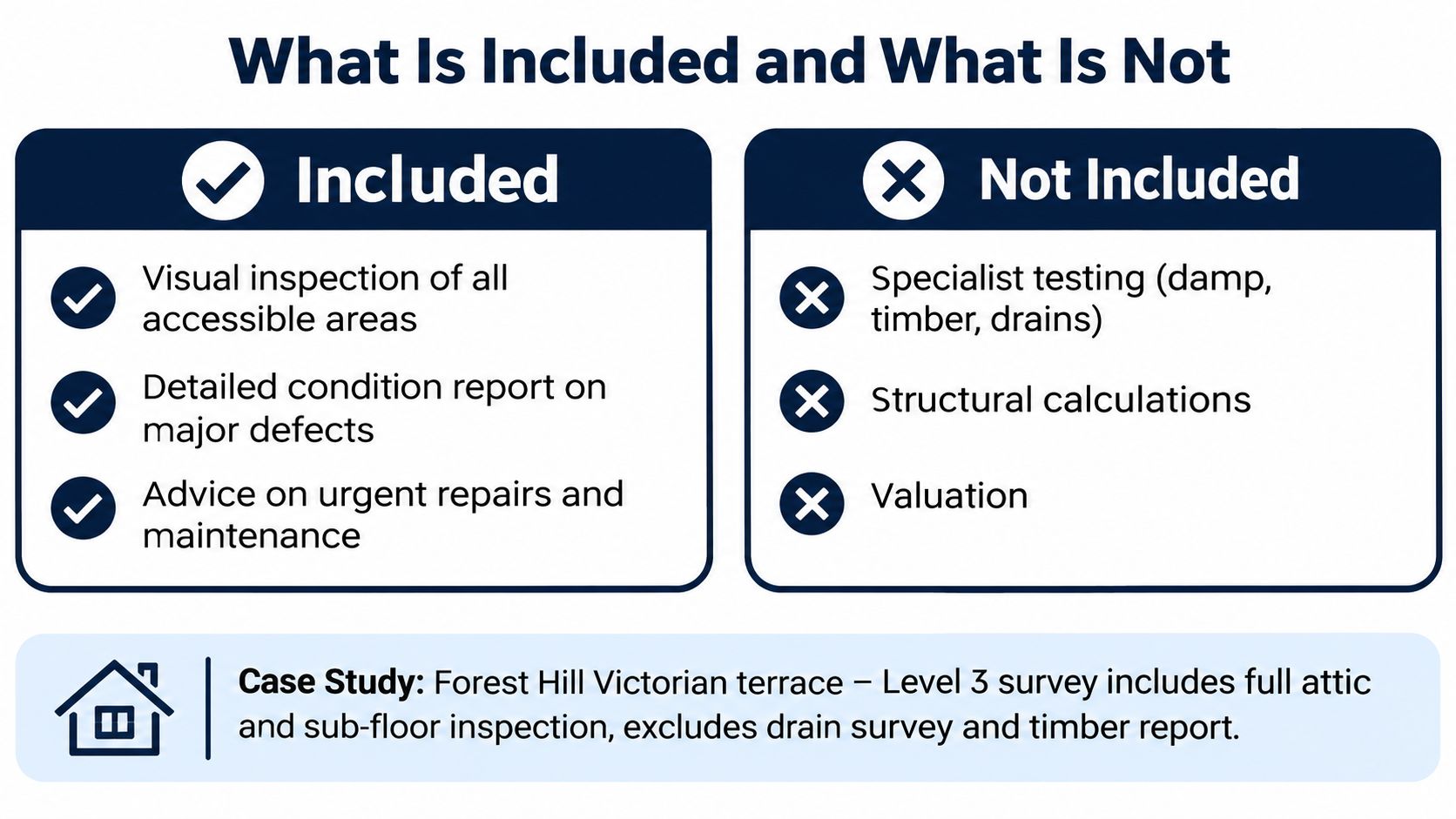
The surveyor inspects, identifies and explains. The surveyor does not open up floors, take wall samples or start repairing defects. A good report stays practical, names the problem in plain English and points you to the next specialist without hiding behind jargon.
Included in the fee
- Visual inspection of accessible areas, including roof spaces, visible walls and sub-floor areas where access allows.
- Condition advice on major defects, such as damp, cracking, roof failure and timber decay.
- Guidance on urgency, so you know what needs action now and what can wait.
Not included unless agreed separately
- Specialist testing, such as damp surveys, timber surveys or drain surveys.
- Structural calculations, which sit with an engineer.
- Valuation work, unless you have instructed a valuation service.
That split matters because the survey fee buys inspection and judgement, not a set of repairs. A post-war flat in Peckham may only need a straightforward condition check, while a Victorian terrace with patchy alterations may need extra specialist input after the survey. The report should tell you where the surveyor has seen enough, and where further investigation is the right call.
A useful comparison with the middle-tier survey is on HomeBuyer Report vs Building Survey. If you are unsure which level you are buying, read that before you instruct anyone. For the cost of cutting corners in another trade, see infrastructure coating cost pitfalls.
When a Higher Survey Fee Pays for Itself
A higher survey fee pays for itself the moment it stops you buying the wrong property. A buyer paying £1,200 for a Level 3 survey on a £750,000 property is paying a small fraction of the purchase price. That is not the number that should worry you. The risk is missing a defect that turns into a large bill after exchange.
In London, the fee makes the most sense on properties with a high risk profile, not just on large or old ones. A Victorian terrace with altered roofs, patched brickwork, damp history or suspect structural movement needs a surveyor who will spend time looking properly. A converted flat with awkward access, shared structures and fire-safety questions can carry more risk than a bigger but simpler house. A newer flat can also justify a stronger survey if the workmanship looks rushed or the service arrangements are unclear.
The return comes in two ways. First, you get an advantage on price or repairs if the report finds roof failure, damp intrusion or movement. Second, you avoid taking on a property that will hurt you later when you come to sell. That is where a proper report earns its fee. It gives you evidence, not guesswork.
New builds deserve scrutiny as well. A snagging survey around £300 to £600 can be enough for some newly completed homes, but it will not catch every problem in a recently finished flat or a property that has been heavily renovated. Hidden drainage faults, fire-safety issues and poor workmanship can sit under a fresh finish, especially in converted stock or quick refurbishments. If you are deciding whether a lighter report is enough, read whether a homebuyer report is enough and judge it against the property in front of you, not the brochure description.
Cheap shortcuts bite in the same way as the warning in infrastructure coating cost pitfalls. Spend less than you should at the front end, and you usually pay more at the back end.
In London, the right survey often pays for itself before completion, because the report changes the deal or saves you from a bad one.
Choosing a Surveyor and Requesting a Quote
Ask who is doing the inspection. Ask when they can get there. Ask what is included, what is excluded and what the report will look like. Those are basic questions, and if the answer is vague, walk away.
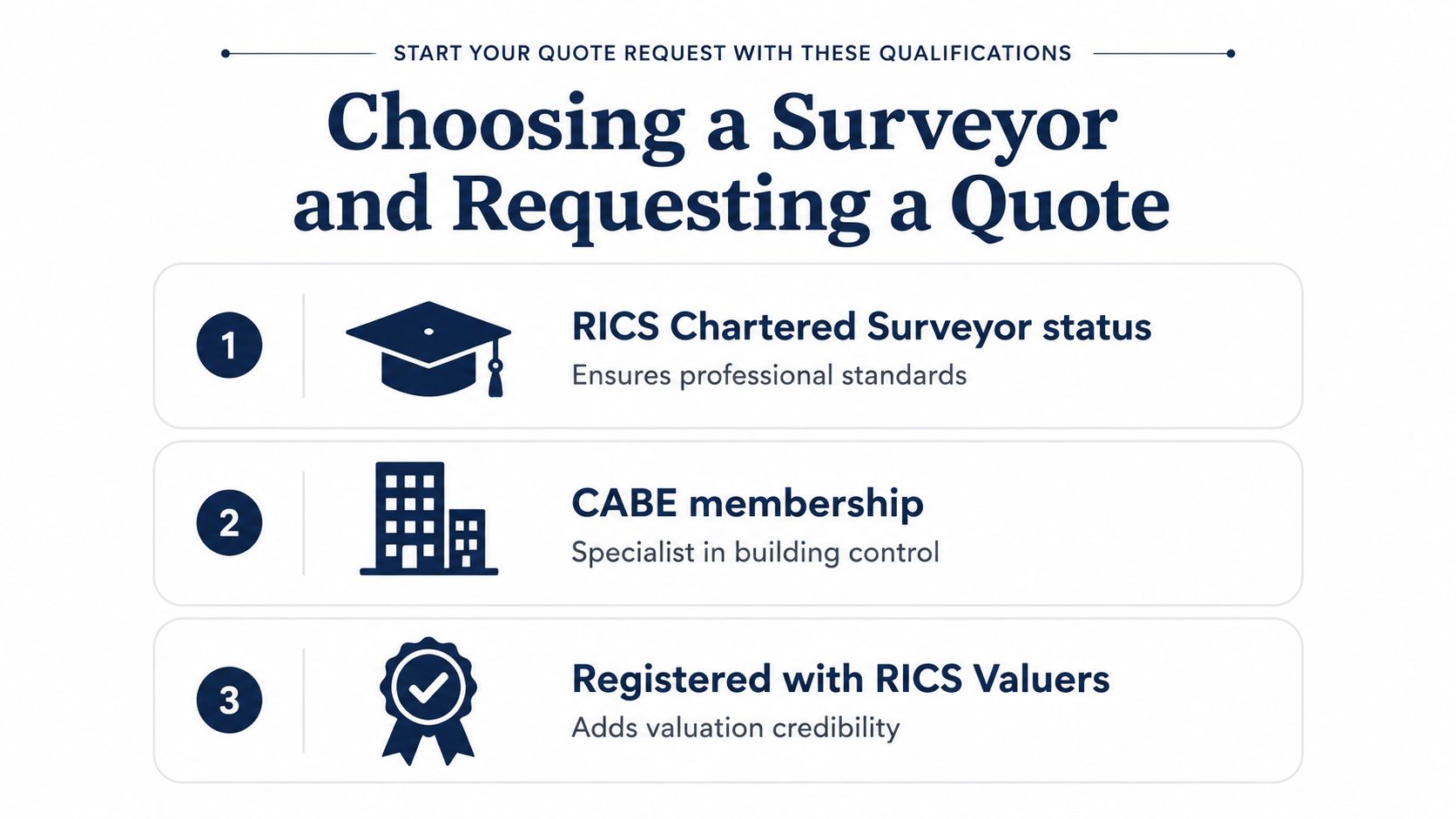
Look for RICS Chartered Surveyor status, CABE membership, registration with the RICS Valuers Registration Scheme and proper professional indemnity cover. Independence matters just as much. A surveyor with no tie to the lender, estate agent or developer is the one giving you an unbiased view.
A lender-appointed panel surveyor is not there for you. That report protects the mortgage company's position. It is not the same thing as an independent buyer's survey.
If you want an example of how to choose sensibly, see surveyors near me. If you need a quote for storage while you move, find storage unit pricing so the moving costs do not blindside you at the same time.
Corinthian Surveyors London LTD is an independent RICS firm run by Clive Thompson, with over 30 years in the built environment and both RICS and CABE qualifications. That is the sort of firm to speak to when you want a per-property quote and a plain answer.
Frequently Asked Questions About Building Survey Prices
A mortgage valuation is for the lender, not for you. A building survey checks the condition of the property itself and gives you the defect list, repair priorities and buying risk. They are not the same product, and the fees reflect that.
A Level 2 HomeBuyer Report is often enough for a leasehold flat if it is modern, conventional and in decent order. If the flat is in a conversion, has alterations or shows signs of damp, movement or poor upkeep, Level 3 is the safer call.
Most surveys are booked and reported within a short turnaround once access is agreed, but the exact timing depends on the property and the surveyor's diary. If time matters, ask that question before you instruct.
Survey fees are sometimes flexible, but only within reason. A proper quote should reflect the property's size, type and complexity rather than be shaved down by guesswork. For a price on a residential property in London, call 0800 00 16 422 or check www.corinthiansurveyors.co.uk.
Corinthian Surveyors London LTD gives straight, independent advice on building survey price, survey level and what a report will tell you before you commit. If you want a proper London quote for a flat, house, conversion or older property, visit Corinthian Surveyors London LTD and speak to a surveyor who knows the stock, the risks and the right level to recommend.