
Building Surveyors RICS: A London Guide to a Trusted Survey
You've probably got a postcode, a price and a nagging feeling that the place needs a proper look. Maybe it's a Victorian terrace in Lewisham, a flat in Bermondsey or a 1930s semi in Bromley. At that point, the question isn't whether to “get a survey”, it's which sort of building surveyors RICS expects you to use, and what you'll get for your money.
The wrong survey leaves you guessing. The right one tells you where the problems are, what needs urgent attention and what can wait. In London, that distinction matters because old brickwork, altered roofs, awkward conversions and patchy repairs are part of the game, not the exception.
Table of Contents
- What RICS Building Surveyors Do
- Choosing the Right Survey Type for Your London Property
- How to Commission a Building Survey Step by Step
- Common London Property Defects and What Surveyors Look For
- What a Building Survey Does Not Do
- How to Choose a Reputable RICS Surveyor in London
- Next Steps and How Corinthian Surveyors Can Help
What RICS Building Surveyors Do
A client rings up and says the same thing in different words. “I just need someone to tell me if the house is sound.” Fair enough. That is the job, but only up to a point. A RICS chartered building surveyor does far more than walk round with a clipboard and note a crack in a wall.
The job is inspection, judgement and reporting
On a typical London instruction, the surveyor inspects the visible parts of the property, then sets out what they have seen in plain English. That means defects, likely causes, maintenance issues and the sort of follow-up that may be needed. RICS sets building surveying within a wider professional role that covers inspection, legal and regulatory compliance, risk management, sustainability, fire safety and specialist surveys such as asbestos and damp, not just defect spotting. That matters because a survey is there to help you make a decision, not just hand you a list of faults. RICS building surveyor pathway guide
RICS accreditation is the point. It means the surveyor has met specific competency standards and is working within a regulated professional framework. For building and defect work in London, that gives you a much better starting point than a general property inspector with no recognised route into the profession. If you want the plain-English version of how the role fits into a survey, read What is a RICS survey?.
Practical rule: if the property is older, altered or the repairs are unclear, use a chartered surveyor who can explain the defect, the risk and the next step.
Specialist experience matters. Heritage work needs the right eye, and the shortage of properly accredited people is real. The IHBC notes the pressure on heritage skills, and that is exactly why listed and period work needs a surveyor who knows how old fabric behaves. IHBC parliamentary briefing on heritage skills
London also throws up patterns that a good surveyor spots fast. A Victorian terrace in south London often brings up patch repairs, tired roof coverings and movement around extensions. A converted flat in west London can hide issues with damp, fire separation or questionable past alterations. The surveyor's job is to separate nuisance from risk, then tell you what needs checking, repairing or pricing into the deal.
If you want an outside view on how surveyors are used in insurance and evidence work, NW Claims Management's guide to surveyors is worth a look. It shows the same point from another angle. Good survey work sits between condition, risk and documentation, not simple property description.
Choosing the Right Survey Type for Your London Property
Don't overcomplicate this. The choice usually comes down to the age, construction and condition of the property. A modern flat in good order does not need the same level of scrutiny as a hacked-about Victorian house in Peckham or a Blackheath period home with conservation constraints.
Level 1, Level 2 and Level 3 serve different buyers
A Level 1 Home Condition Survey suits a fairly standard, modern property in decent condition. A Level 2 HomeBuyer Report is the common middle ground for conventional homes where you want a sensible overview and visible defects picked up. A Level 3 Building Survey is the one you reach for when the property is older, altered, non-standard or throws up more questions than answers.
RICS says a Level 3 Home Survey is a thorough inspection followed by a detailed report, and it must be done by an AssocRICS, MRICS or FRICS member with the right competence. That is the formal RICS route behind a building survey, not a casual inspection. RICS Level 3 Home Survey description
Match the survey to the building, not the hype
A Victorian terrace in Lewisham often needs a Level 3 because you are likely dealing with older fabric, patch repairs and previous alterations. A 1930s semi in Bromley may still be suitable for a Level 2 if it is conventional and well kept, but if you see cracking, roof issues or structural movement, step it up. A converted warehouse flat in Bermondsey can need a Level 3 if the conversion is complex, the layout has been heavily changed or the common parts raise questions.
The mortgage valuation is a separate thing. It is for the lender's protection and it is not a proper survey of the sort a buyer needs. If you want a clearer overview of the survey choice, Corinthian Surveyors has a straightforward guide on what is a RICS survey, which sets out the levels without the usual jargon.
| RICS Survey Types Compared | Best For | Typical London Property | What It Covers |
|---|---|---|---|
| Level 1 | Straightforward, modern homes in visible good order | Newer flats and standard houses | Basic condition overview and obvious issues |
| Level 2 | Conventional homes where the buyer wants a fuller but still practical report | Many post-war houses and flats | Clearer assessment of condition and defects |
| Level 3 | Older, altered, listed or unusual properties | Victorian terraces, conversions, non-standard homes | Detailed inspection, defect analysis and repair advice |
Practical rule: if you're asking, “Will this survey tell me enough to renegotiate or proceed safely?” the answer is often Level 2. If you're asking, “What is actually going on inside this old building?” it's Level 3.
How to Commission a Building Survey Step by Step
Get the instruction wrong and the whole job becomes messy. You end up with the wrong level of survey, the wrong expectations and a report that does not help you make a buying decision. In London, that is how buyers waste time on flats in Brixton, terraces in Forest Hill or a converted building in Bermondsey.
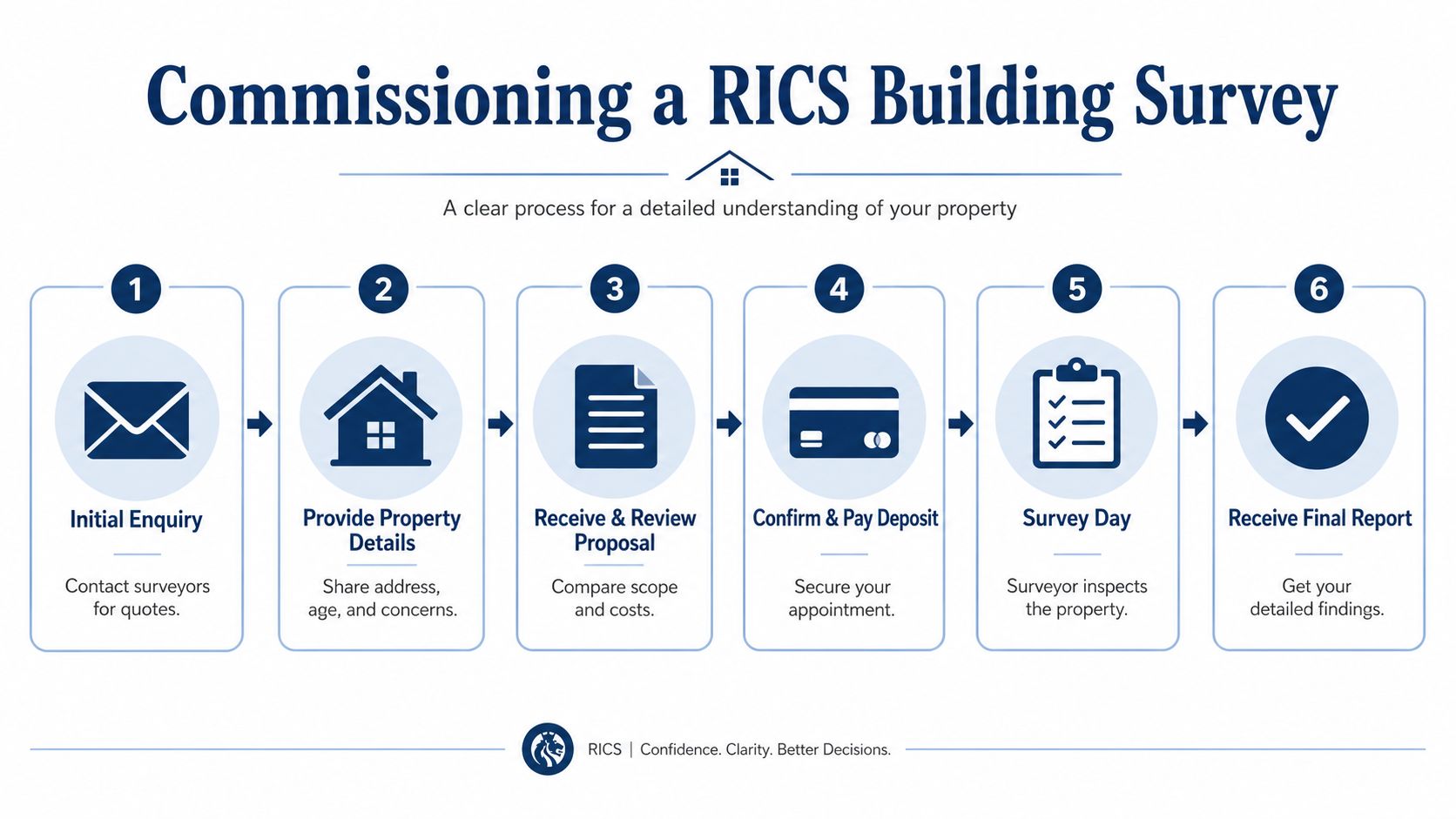
Start with the right information
Give the surveyor the address, the property type, the age if you know it, and the things that are bothering you. Mention cracks, damp patches, roof leaks, alterations, sticking doors or a smell under the stairs. If you have documents, such as planning papers, lease details or old reports, send them too.
A proper surveyor will ask follow-up questions before quoting. That is what you want. It shows they are already thinking about the building rather than just taking the fee.
Read the proposal, not just the price
The quote needs to be specific. Check which survey level is being offered, what the inspection includes, what the report will cover and whether the surveyor has handled similar London property before. A low headline price means nothing if the scope is thin or unclear.
You want plain wording. You want to know what they will inspect, what they will not inspect, and whether access limits are likely to affect the report. If the proposal is vague, move on.
Expect a proper inspection and report
A Level 3 survey often takes two to four hours on site. The report usually follows within five to ten working days. Those timings are useful guides, but they are not fixed rules. RICS' latest skills reporting says 87% of members said skills shortages were affecting their work, with 27% calling the shortage critical and 60% moderate but challenging. RICS Surveying Skills Report overview
That shortage affects clients in real life. Good surveyors are busy, and in London the better ones are often booked ahead because there is steady demand and not enough experienced people to go round. Reports can also take longer when the surveyor is dealing with complex roofs, leasehold issues or older construction that needs careful reading.
The profession is also expected to grow by 1.1% a year, reaching 72,010 surveyors by 2029, and around 1,710 new surveyors are needed each year to replace retirees and meet demand. In plain terms, do not expect an excellent surveyor to be sitting idle. If you want one, plan ahead and book early. RICS Surveying Skills Report overview
A useful comparison point for buyers is compare pest inspection costs for buyers. A building survey is one part of due diligence. In many London purchases, you may also need separate checks for pests, drains or other specialist concerns.
Practical rule: if the surveyor will not explain what they need from you before booking, keep looking.
Know what happens after the inspection
The report should do more than list defects. It should tell you whether the problem is urgent, whether it needs more investigation and whether a specialist should be brought in. That matters in London, where a tired roof, doubtful crack pattern or hidden damp can mean different things depending on the age and construction of the building.
A good survey also helps you separate the serious from the ordinary. If you want a clear example of how to read cracking properly, see Corinthian's guide to structural cracks in walls. It is the sort of issue that gets overcalled by nervous buyers and undercalled by people who do not know what they are looking at.
Corinthian Surveyors handles this kind of instruction routinely across South East London and the Home Counties, and the same basic approach applies wherever you buy.
Common London Property Defects and What Surveyors Look For
London homes are a mixed bag. That is the point. A surveyor working in Forest Hill, Catford or Brixton sees a different pattern of defects from someone only used to recent estates in outer boroughs. Local knowledge matters because the building fabric changes street by street.
Victorian and Edwardian terraces need a sharper eye
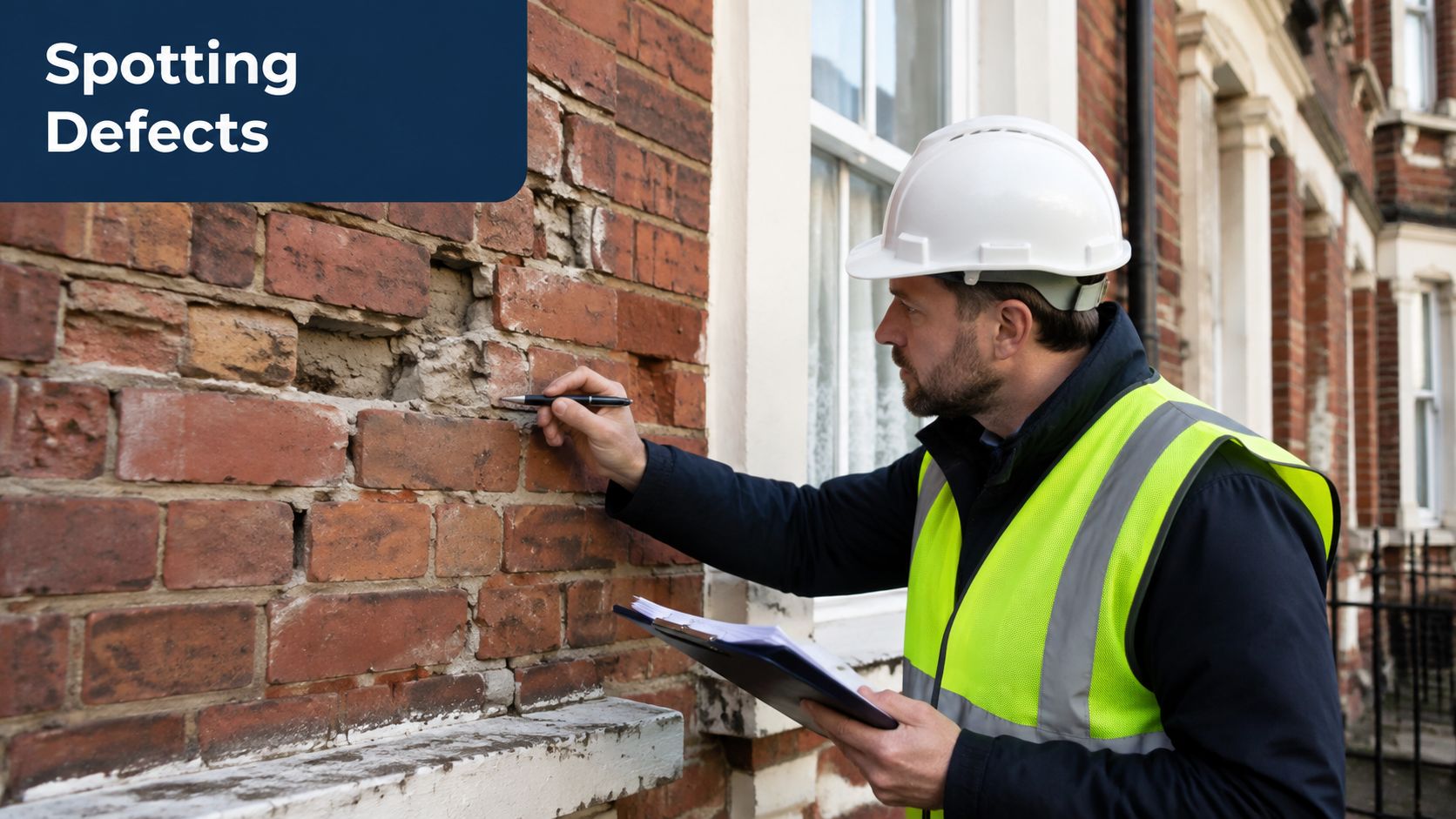
Older terraces often show damp, timber decay, roof wear and signs of movement around openings. Chimney breasts are another regular problem, especially where they have been removed badly or left unsupported. Lime mortar, lath and plaster and old brickwork also need interpretation, not panic. If you want a direct example of what structural cracking can mean in practice, Corinthian's article on structural cracks in walls is a sensible companion read.
The big mistake is treating every crack as the same thing. A stepped crack in an older wall in Greenwich may be stable and long-standing, while a fresh horizontal crack in a property near Brockley could need urgent investigation. The surveyor's job is to separate the ordinary from the worrying.
1930s semis and converted flats have their own issues
A lot of 1930s housing in Bromley, Beckenham and Eltham looks solid at first glance, but that is not the same as problem-free. Roof defects, original lead pipework, past rear extensions and localised movement are all common things to check. A surveyor should also look closely at loft alterations and the quality of patch repairs.
Converted flats are different again. In places like Bermondsey, Deptford and Southwark, the issues often involve sound insulation, fire separation, common parts and leasehold complexity. If the conversion was done badly, the surface finish can hide a mess underneath.
Local history changes the risk profile
Greenwich conservation areas and listed buildings in Blackheath need a more careful reading of materials and repairs than a standard post-war house. The wrong cement pointing on old brickwork or the wrong treatment to a timber window can create fresh problems. In period housing, bad repairs are often more damaging than age itself.
If roof leaks are a concern, the homeowner's guide to roof leak detection gives a useful sense of how water finds its way in and why leaks are often misread. That is exactly the sort of issue a building survey should flag, not overstate.
Practical rule: the best surveyor is the one who knows when a defect is a building problem, when it is a repair problem and when it's a specialist job.
What a Building Survey Does Not Do
A building survey gives you a clear view of condition, risk and likely next steps. It does not give you a final verdict. In London, that matters. A flat in Peckham with patched walls, a Victorian terrace in Islington with damp at ground level, and a converted house in Woolwich with older rear alterations all need judgement, not guesswork.
It does not diagnose everything
If a surveyor finds damp staining, they can explain the pattern and point to the likely source. They can tell you whether it looks like penetrating damp, condensation or a failed repair. They can also tell you when the evidence stops there and a specialist needs to step in.
They are not there to rip walls open, lift every board or run lab tests on every doubtful material. If the signs point towards asbestos, serious timber decay, persistent damp or hidden structural movement, the report should say so plainly and recommend more investigation. That is the limit of the job, and it is the right limit.
Buyers often want a survey to settle everything. It will not do that. The RICS building surveying pathway guide sets out the scope of different survey levels and makes clear that further checks may still be needed after inspection. That is normal practice, not a weak report.
It does not replace legal or valuation work
A surveyor is not your conveyancer. They do not deal with title defects, lease wording, restrictive covenants or any other legal point in the contract pack. If the solicitor needs to raise an issue, that is their job.
A survey also does not automatically include a valuation. If you need one, ask for it separately and make sure it is agreed in advance. Corinthian Surveyors handles residential valuations alongside surveys, but the survey and the valuation are different tasks and should be treated that way. If you are still comparing options, our guide to finding local surveyors near me explains how to choose sensibly.
It should tell you when to bring in someone else
A proper report should separate immediate repairs from further investigation. That matters in Lambeth, Southwark and Croydon, where older housing stock often throws up mixed problems in the same property. One bit may be straightforward. Another may need a damp specialist, a structural engineer or a timber expert.
If the report says more testing is needed, that is not a failure. It is a sign the surveyor has stayed within the evidence and told you the truth. The right question is simple. Did the survey give you enough to make a safe decision? If it did, it did its job.
How to Choose a Reputable RICS Surveyor in London
Pick on credentials first, not on whoever replies fastest. London is full of people who say they can “do a survey”. That's not the same as being the right person for your property.
Check the hard facts
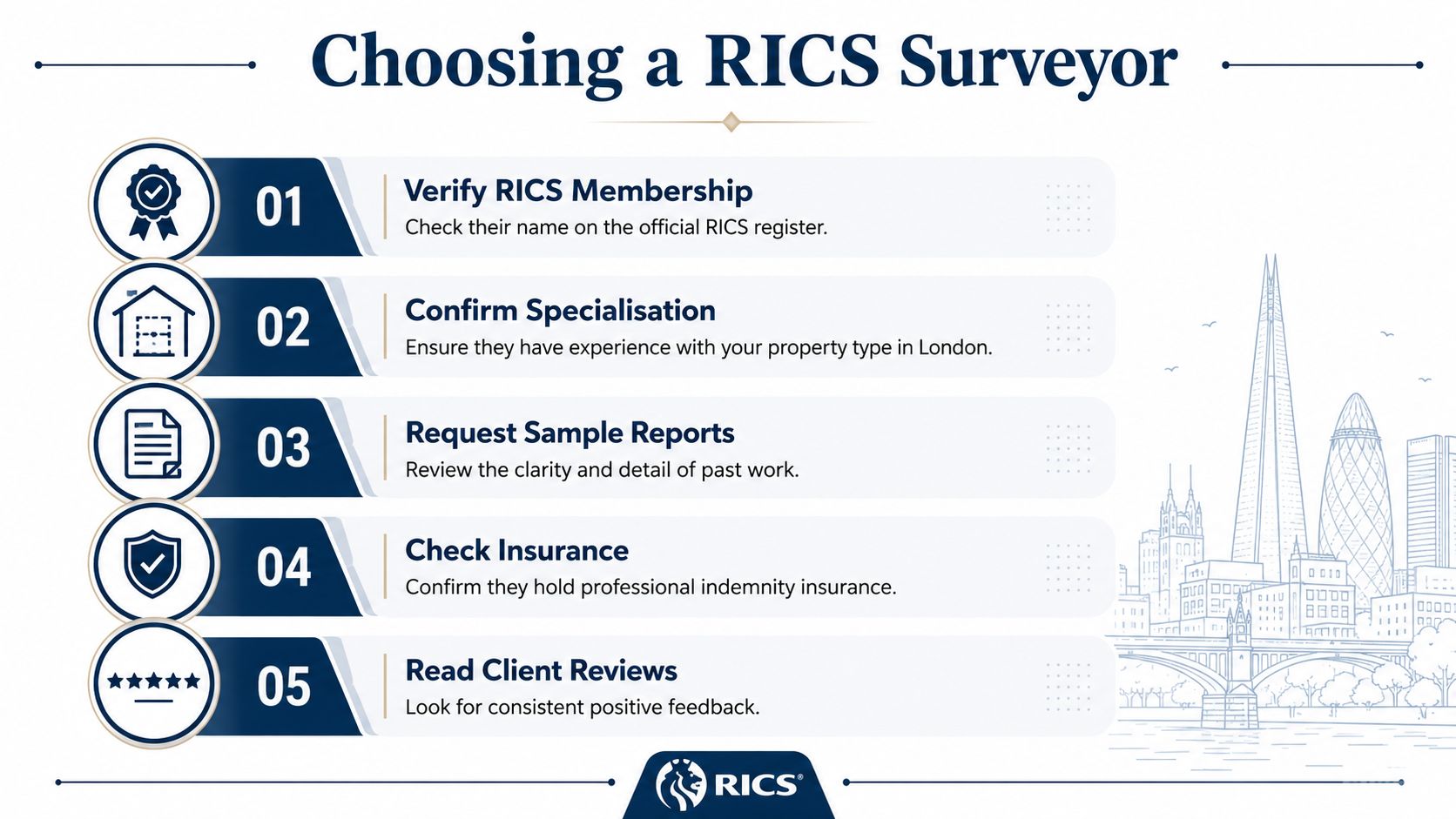
Look for RICS membership first. For some instructions, CABE qualifications also matter, especially where a surveyor is dealing with building fabric and defect analysis. If the firm is part of the RICS Valuers Registration Scheme, that is another sign of proper professional oversight. Independence matters too. You want someone who works for you, not someone linked to a lender, seller or developer.
That is why a firm like Corinthian Surveyors London LTD is worth considering for residential work. It is independent, based in Forest Hill, and focused on residential surveying across London and the Home Counties. No lender tie-ins, no estate agent pressure, no developer angle.
Ask direct questions before you book
- Have you inspected this kind of property before? A Victorian conversion in Peckham is not the same as a 1960s flat in Woolwich.
- What will the report cover? You want scope, not slogans.
- How long will it take? Realistic timing matters if your chain is moving.
- Can you show me a sample report? Clarity on paper usually reflects clarity on site.
- Are you insured? Professional indemnity cover is not optional.
Watch for red flags
A vague quote is a warning sign. So is pressure to book immediately. So are firms that sound more interested in the lender than in your purchase. If you get the sense that the surveyor is just churning through volume, walk away.
For a practical lens on local sourcing, Corinthian also has a useful page on surveyors near me. That is worth reading if you want to understand why local familiarity with places like Dulwich, Crystal Palace and Blackheath matters in real instructions.
Practical rule: if the surveyor can't explain their experience with your exact property type in a few plain sentences, they're probably not the right one.
Next Steps and How Corinthian Surveyors Can Help
The decision is simple when you strip away the noise. Choose the survey that fits the building. Choose a surveyor who knows the area. And choose someone who will tell you the awkward truth in plain English.
RICS skills pressure means good surveyors are busy, and building standards keep moving as regulation tightens around sustainability, fire safety and building performance. That makes experience and independence more important, not less. If you want a residential surveyor who works across South East London, the wider capital and the Home Counties, Corinthian Surveyors London LTD is set up for exactly that sort of instruction. Clive Thompson brings 30 years of experience in the built environment, with RICS and CABE qualifications, and the firm is regulated by RICS.
If you are comparing survey types, want a building survey on an older house or need a clear view on defects before you commit, take the time to ask the right questions. It saves arguments later and gives you a proper basis for negotiation or repair planning.
For a straightforward conversation about the right survey, call 0800 00 16 422 or look at www.corinthiansurveyors.co.uk.
If you're buying in London and need a RICS Building Survey, Corinthian Surveyors London LTD can inspect the property, explain the defects plainly and tell you what needs attention first. Visit Corinthian Surveyors London LTD to arrange a survey or ask about the right report for your property.