
Do I Need a Party Wall Agreement? Expert 2026 Guidance.
You're probably here because the builder has asked a simple question and you need a straight answer fast. You're planning a loft conversion in Lewisham, a side return in Clapham or a rear extension in Bromley, and someone has said, “You may need a party wall agreement.” They may be right. They may also be overcomplicating it.
Here's the practical answer. If your work affects a shared wall, a boundary line or nearby foundations, you may need to serve formal notice under the Party Wall etc. Act 1996. If you're only replastering, drilling for shelves or removing kitchen units fixed to a wall, you usually won't. The problem is that many London projects sit firmly in the first category, especially Victorian terraces and tight side returns where the works are close to next door.
Table of Contents
- Understanding the Party Wall Act in Simple Terms
- When the Party Wall Act Applies to Your Work
- Work That Does Not Require a Party Wall Notice
- The Party Wall Notice and Agreement Process
- Surveyors Awards and Typical Costs in London
- Risks of Ignoring the Party Wall Act
- Frequently Asked Questions
Understanding the Party Wall Act in Simple Terms
A party wall is usually a wall shared by two properties. In London, that often means the wall between two Victorian or Edwardian terraces in places like Forest Hill, Peckham or Brockley. It can also include a wall on the boundary and, in some cases, other shared structures.
The Party Wall etc. Act 1996 is not there to stop you building. It's there to make sure you follow a proper legal process before work starts, so your neighbour's property is protected and your project is less likely to end up in an argument. It applies in England and Wales.
A lot of homeowners ask, do I need a party wall agreement, when what they really mean is, do I need legal consent before I start. Strictly speaking, if there's a dispute or a deemed dispute, the legal document is called a Party Wall Award. That award sets out what work is being done, how it will be carried out and what protections are in place.
Practical rule: If the work is structural, close to the boundary or involves digging near next door, assume you need proper advice before anyone starts on site.
If you want a plain-English primer before getting into the detail, this guide to understanding party wall agreements is a useful starting point. For the notice itself, I'd also suggest reading this explanation of what a party wall notice is.
Three terms matter:
- Party Wall Notice. The formal written notice you serve.
- Adjoining owner. Your neighbour affected by the work.
- Party Wall Award. The binding document prepared by surveyor or surveyors if consent is not given in writing.
That's the basic framework. Once you understand that, the key question becomes what sort of work triggers the Act.
When the Party Wall Act Applies to Your Work
The Act usually catches homeowners out in three situations. It isn't the size of the project that matters. It's the type of work and how close it is to the shared structure or your neighbour's foundations.
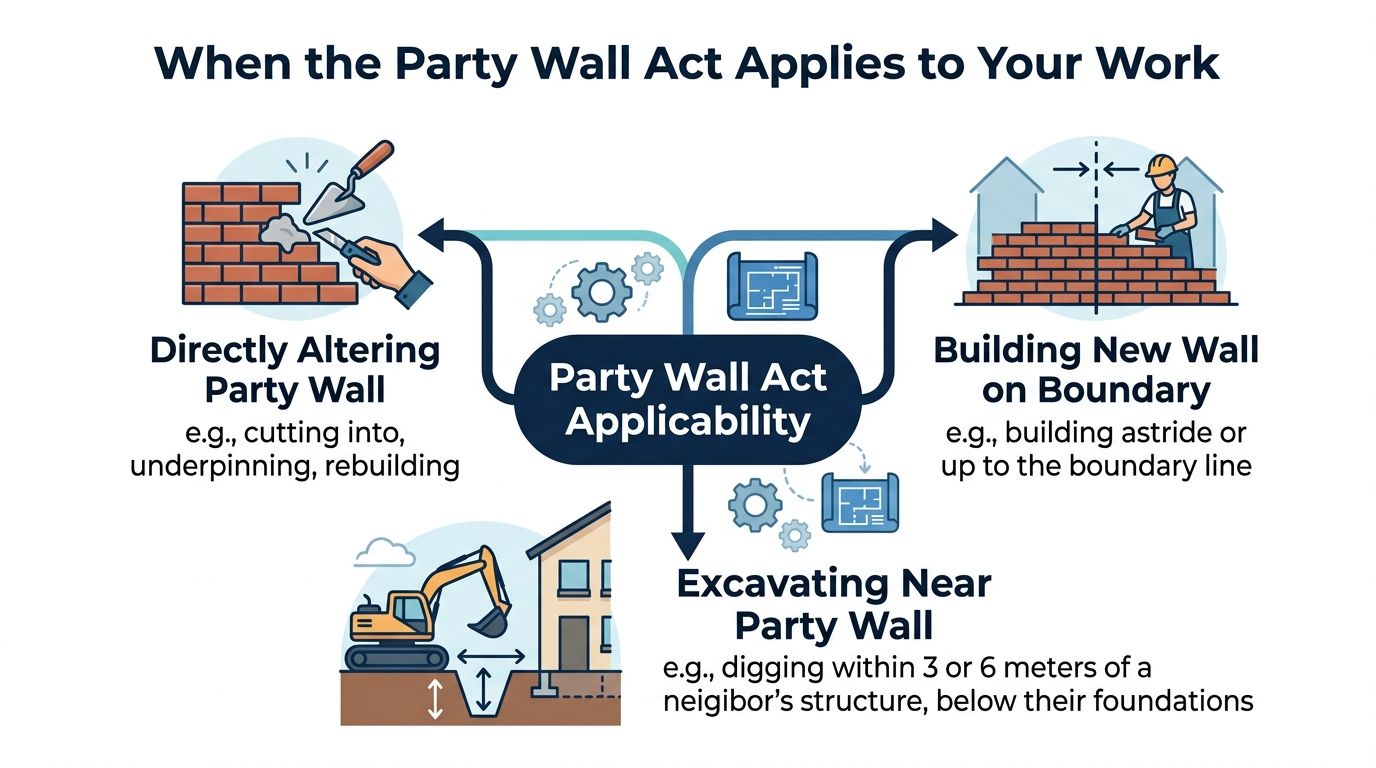
Works to an existing shared wall
If you're cutting into a shared wall to insert steel beams for a loft conversion, that is classic party wall work. The same goes for underpinning, raising the wall or carrying out other structural alterations to it.
In South East London, this is common in terraced houses where the loft design relies on steels bearing into the party walls. Homeowners often assume planning permission is the main hurdle. It isn't. Planning and party wall are separate issues.
Building on the boundary line
If you plan to build a new wall on the boundary, or right up to it, the Act can apply. This often crops up with rear extensions and garden structures where space is tight and every inch matters.
That matters in boroughs with narrow plots such as Southwark, Lambeth and parts of Wandsworth. The design may look straightforward on paper, but once a wall sits on or against the line of junction, the legal process needs checking.
Planning permission and building control do not replace party wall procedure. They deal with different things.
Excavation near your neighbour
Many London owners face an unexpected hurdle with side returns, rear extensions, and basement works, which nearly always involve new foundations. Under the Party Wall etc. Act 1996 in England and Wales, a formal Party Wall Agreement, more accurately a Party Wall Award, becomes legally mandatory if excavation work is planned within 3 to 6 metres of an adjoining owner's structure, with the specific distance threshold determined by the depth of the excavation relative to the neighbour's foundation level, as explained by the Federation of Master Builders guide to party wall agreements.
Here's the simple version:
| Situation | Likely issue |
|---|---|
| Digging close to next door and going below their foundations | Act is likely to apply |
| Deeper excavation | Wider notification zone may apply |
| Basement or substantial extension foundations | Higher chance of surveyor involvement |
In practical London terms:
- Loft conversion with beams into party walls usually triggers the Act.
- Side return extension often triggers it because of excavation near next door.
- Basement dig is one of the clearest examples of notifiable work.
- Minor rear extension can still trigger it if the foundations are close enough.
If you live in a Victorian terrace in Lewisham, Catford or Camberwell, don't judge this by the footprint of the extension. Judge it by the wall you're touching and the ground you're digging.
Work That Does Not Require a Party Wall Notice
Not every job near a shared wall needs paperwork. Bad advice in such instances wastes money.
The Party Wall Act 1996 explicitly excludes minor works like plastering, electrical installations and fitting fixtures that do not damage structural integrity. Homeowners often assume removing kitchen units or drilling for shelves requires a formal agreement when it does not, as set out in this explanation of when you need a party wall agreement.
Minor jobs people worry about unnecessarily
These jobs usually sit outside the Act:
- Replastering walls if you're not affecting the structure.
- Electrical work such as sockets and wiring in ordinary domestic situations.
- Fixing shelves or cabinets to a wall.
- Removing kitchen units attached to a shared wall.
- Decorating work such as wallpapering and similar finishes.
That's the rule homeowners need to hear. Cosmetic work is one thing. Structural work is another.
A useful test is this. Ask whether the job changes the wall's structural role, loading or stability. If the answer is no, you're often outside the Act. If the answer is yes, or even maybe, stop guessing.
If the work doesn't damage structural integrity, it usually doesn't need party wall notice. If it alters the structure, treat it as notifiable until proven otherwise.
London owners are often told to “serve notice just in case” for very small jobs. That can create cost and delay where neither is needed. Good advice should narrow the issue, not make it bigger.
The Party Wall Notice and Agreement Process
Once the Act applies, the procedure matters. It determines whether homeowners either keep control of the project or let it drift.
What notice you serve and when
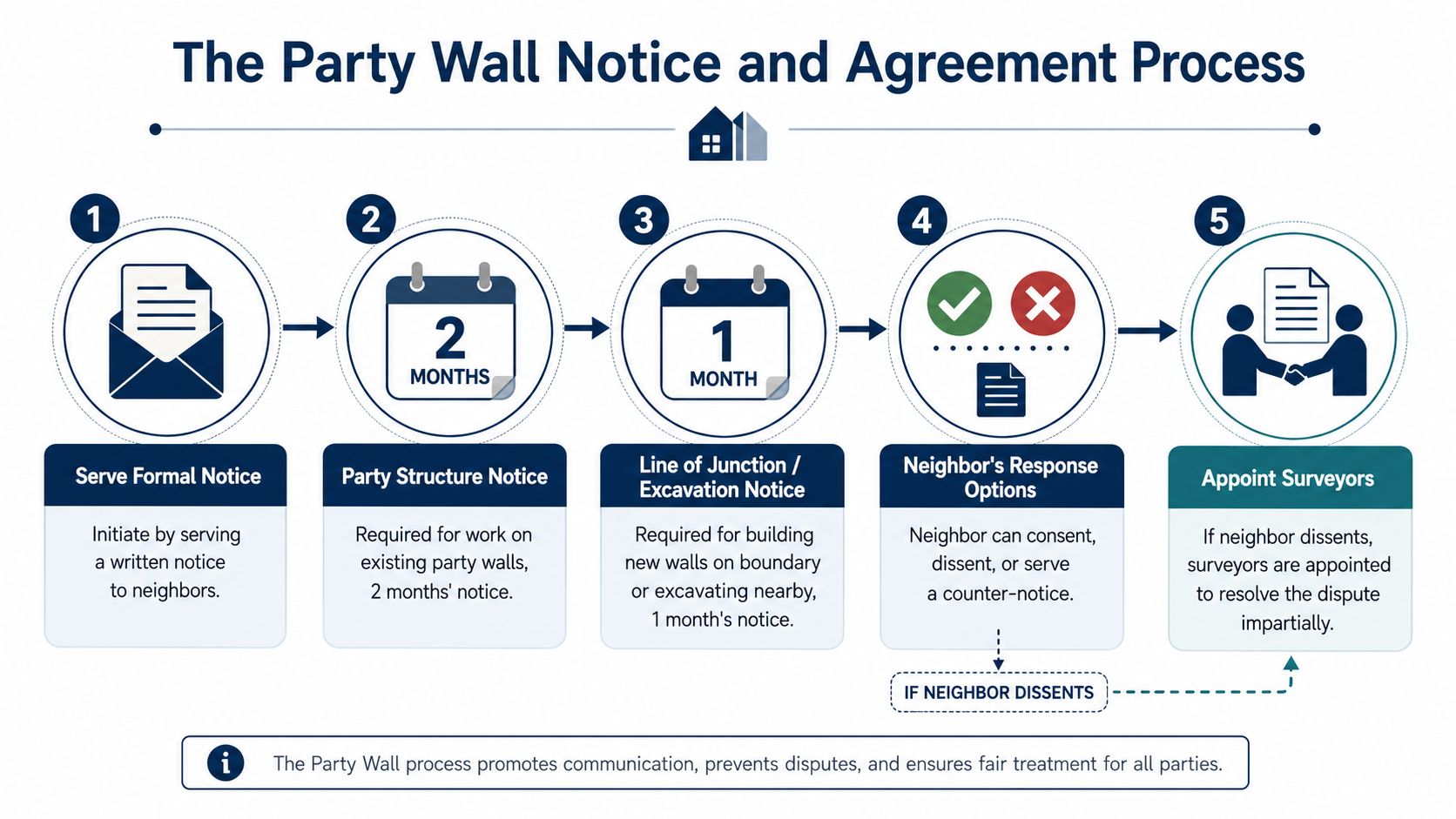
The Party Wall etc. Act 1996 requires homeowners to serve a formal notice at least two months before work on a shared wall or boundary, or one month for excavation. Verbal agreements have no legal standing, consent must be in writing within 14 days of the notice, and if no response is received it becomes an automatic dispute requiring a surveyor, as stated on the government guidance for party walls and building works.
That means a quick chat over the garden fence is not enough. Even if your neighbour says they're fine with it, it still needs to be handled properly if the Act applies.
If you want the surveyor side of that process set out plainly, this article on whether you need a party wall surveyor is worth reading before you instruct your builder.
What your neighbour can do next
Once notice is served, the adjoining owner has three practical options:
- Consent in writing. In that case, the work can usually proceed without a surveyor.
- Dissent. That triggers the appointment of surveyor or surveyors and the preparation of an Award.
- Ignore it. Silence is not neutral. It leads to the same dispute route.
A counter-notice can also be served in some situations. That can alter the scope of what needs dealing with and often slows the timetable.
| Stage | What it means for you |
|---|---|
| Notice served properly | You've started the legal process correctly |
| Consent received in writing | Simplest route |
| Dissent or no reply | Award needed before notifiable work proceeds |
Do the paperwork early. Builders often want a start date before the legal process has caught up. That is how projects get delayed.
In practice, the legal timing catches many owners off guard. They finalise drawings, line up trades and book materials, then only afterwards discover that the neighbour has a statutory period to respond. That is why party wall should be dealt with during pre-construction planning, not the week before demolition starts.
Surveyors Awards and Typical Costs in London
This is the part people really want to know about. What happens if surveyors get involved, and what is it likely to cost.

One surveyor or two
If there is a dissent, you can either appoint a single agreed surveyor or each side can appoint their own surveyor. The surveyor's job is not to fight for one party like a solicitor. The role is to act impartially under the Act and produce the Award.
That distinction matters. Plenty of disputes in London become more expensive than they need to be because the owners treat party wall surveyors as combatants. They are not supposed to be.
An Award usually deals with:
- Scope of works so everyone knows what is proposed
- Access arrangements where required under the Act
- Schedule of condition recording the neighbour's property before work starts
- Protective measures to reduce the risk of damage
- Rights and responsibilities during the works
For residential owners who need support around the process, Corinthian Surveyors London is one independent option. The practice is based in Forest Hill, covers London boroughs and is run by Clive Thompson, who holds RICS and CABE qualifications.
What London owners usually end up paying
In London, party wall agreement costs typically range from £700 to £1,500 per neighbour. The average cost for a Party Wall Award rises to £1,575 for loft conversions and £2,025 for extensions with a single agreed surveyor, but can double if both parties hire separate surveyors, according to the HomeOwners Alliance guide to party wall agreement costs.
That's why a simple loft in a terrace house in Sydenham may be manageable, while a basement scheme in Southwark or Kensington can become much more involved. More drawings, more structural review and more neighbour concern usually mean more surveyor time.
A second cost point is worth knowing. The average cost for a single party wall surveyor to draft a Party Wall Award is approximately £1,000, but for a basement extension it is typically closer to £2,700, as noted in this quick guide to party wall agreement costs.
The building owner starting the work usually pays the reasonable surveyor fees. Budget for that at the design stage, not after the notices go out.
That's the practical lesson. If your architect and builder have priced everything except party wall, the budget is not finished.
Risks of Ignoring the Party Wall Act
Some owners decide to press on and hope next door won't object. That is a mistake.

If you start notifiable work without following the Act, your neighbour can ask the court to stop the job. The government's party wall guidance also makes clear that once notice is served, the adjoining owner must respond in writing within 14 days, and if they dissent or fail to reply, a Party Wall Award must be commissioned by appointing either a single agreed surveyor or separate surveyors for each party.
That matters because once a project is on site, delay is expensive. Labour sits idle. Materials are booked. Access scaffolding may already be up. A legal stoppage at that stage is far worse than handling notice correctly at the start.
Why this goes wrong so often in London terraces
Terraced housing in areas like New Cross, Dulwich and Brixton leaves very little room for error. Foundations are close. Shared walls carry real loads. Old fabric can be fragile, especially where there have been previous alterations such as chimney breast removals or historic movement.
It also isn't just a paperwork issue. Site safety and neighbour risk management matter. If you're planning works, it's sensible to understand the wider issue of spotting construction site hazards as part of good project planning.
A short video can help if you want to see the issue explained visually.
The blunt advice is this. Don't try to save money by skipping the Act. If damage occurs, the legal and financial exposure can be far more serious than the cost of doing the process properly.
Frequently Asked Questions
What happens if my neighbour ignores the party wall notice
If a neighbour fails to reply to a Party Wall Notice within 14 days, they are legally deemed to have dissented. This automatically triggers the requirement for a Party Wall Award and the appointment of an impartial surveyor to resolve the dispute, as explained in this guide on what a party wall is and how the process works.
Silence does not mean consent. Treat no reply as a formal step into the surveyor process.
Can my neighbour stop my extension completely
Usually, no. The Act is designed to regulate how notifiable work is carried out, not to give a neighbour a general veto over lawful building work.
What they can do is force the legal procedure to be followed. If you ignore that procedure, they may seek to stop the works until it is dealt with properly.
How long does the whole process take
Allow more time than you think. The process includes statutory notice periods and, if surveyors are needed, time for reviewing drawings, arranging inspections and agreeing the Award.
For many residential jobs, party wall should be started early in the design and tender stage. If you leave it until the builder is ready to begin, your programme is already under pressure.
Is party wall the same as planning permission
No. They are completely separate.
You can have planning permission and still need to deal with party wall. Equally, some works that don't need planning permission still trigger the Act.
If you're unsure where your project sits, get the answer before the builder starts cutting or digging. Corinthian Surveyors London LTD is an independent firm of RICS Chartered Surveyors and Valuers based in Forest Hill, serving homeowners across London with residential surveying and party wall advice. Clive Thompson holds RICS and CABE qualifications, the firm is regulated by RICS and has no ties to lenders, estate agents or developers. For sensible advice on your proposed works and the right next step, see Corinthian Surveyors London LTD or call 0800 00 16 422.