
How to Become a Chartered Surveyor: A UK Guide for 2026
You're probably in one of two camps. You're either staring at a university prospectus, wondering if surveying is a sensible career, or you're already in property or construction and asking the harder question: how do I get chartered without wasting years on the wrong route.
The short answer is this. If you want people to trust your judgement on a building, a valuation or a defect report, RICS chartership is the standard that matters. It tells employers, clients and other professionals that you can do the work properly and defend your advice when it counts. In residential practice, that means spotting structural movement in a Victorian terrace, explaining damp in plain English, or producing a valuation that will stand up in probate or litigation work. If you want a grounded picture of the day job, look at the range of work a residential surveying practice actually handles.
Table of Contents
- What Does a Chartered Surveyor Actually Do
- Choosing Your Path into Surveying
- The Core Competencies and Experience You Need
- Navigating the APC The Final Hurdle
- Specialisms and Building a Career in London
- Common Pitfalls and Final Advice for Applicants
- FAQs About Becoming a Chartered Surveyor
What Does a Chartered Surveyor Actually Do
The phrase "chartered surveyor" often conjures an image of someone with a clipboard walking around a house. That's only part of it. At its core, the profession demands judgement.
On Monday you might inspect cracking and decide whether it looks like seasonal movement, long-term settlement or something more serious. On Tuesday you might value a house in Bromley for probate. On Wednesday you might explain to a buyer in Peckham why a lender's valuation is not the same thing as a proper condition survey. The job moves between buildings, people and risk.
A good residential surveyor has to be technical without being obscure. You need to recognise roof spread, timber decay, failed pointing, chimney breast alteration and poor-quality flat conversion work. Then you need to explain it so a buyer, solicitor or family executor understands what matters and what doesn't.
A chartered surveyor doesn't just describe defects. He decides what they mean, what should happen next and how much confidence a client can place in the property.
That's why chartership is worth pursuing. The letters matter because the responsibility matters. In practice, surveyors deal with mortgage valuations, homebuyer surveys and building condition inspections as part of the route set out by the National Careers Service building surveyor profile.
If you're serious about learning how to become a chartered surveyor, stop thinking about the title first. Think about the work. If you enjoy buildings, evidence and clear advice, you're in the right trade.
Choosing Your Path into Surveying
At some point you have to choose. Do you want the cleanest route to MRICS, or do you want the route that fits your life and still gets you there without wasting three years?
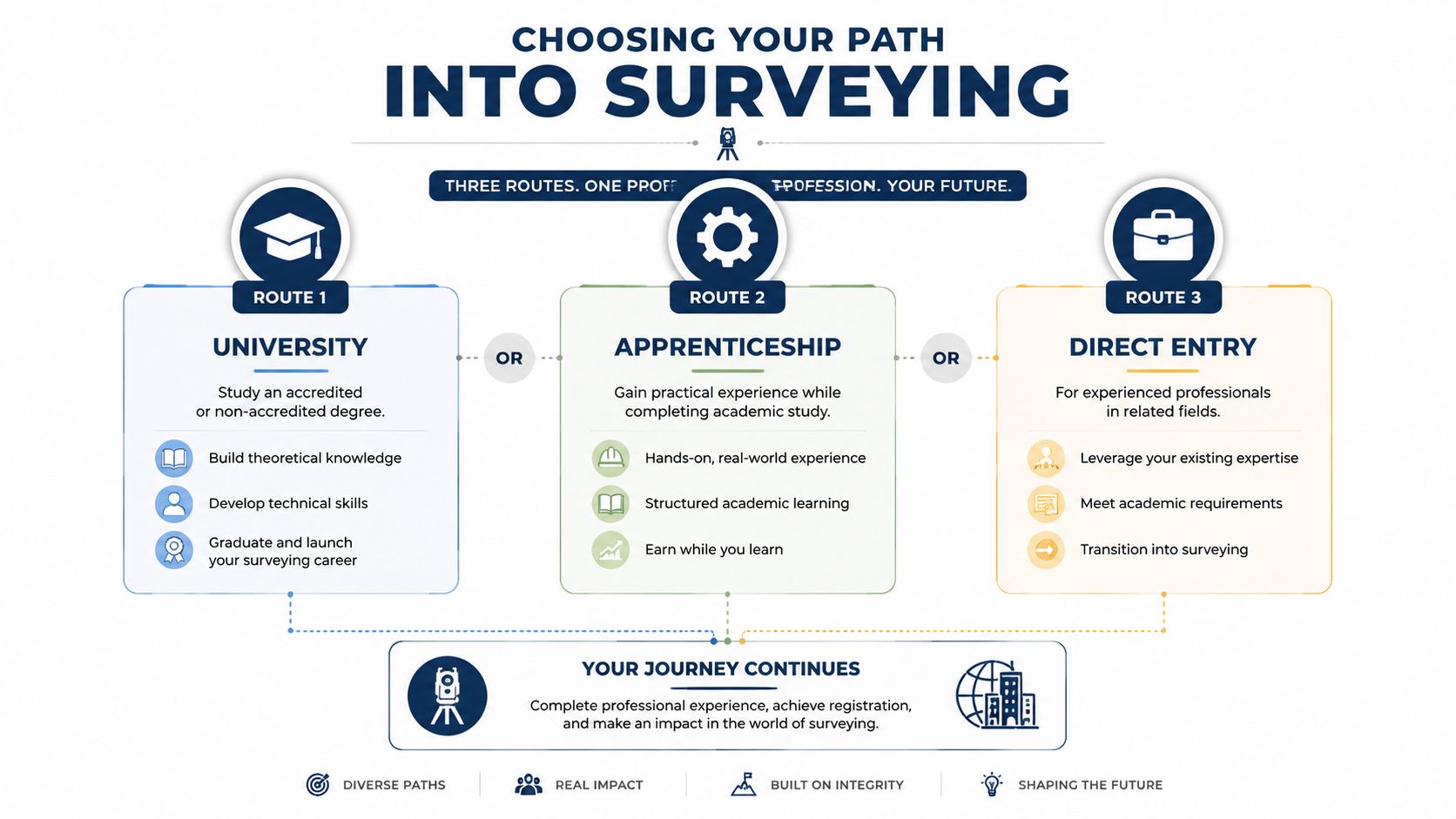
In London, that choice matters more than people admit. Firms are busy, fee pressure is constant, and APC candidates get judged on whether they can produce useful work early. The route that gives you proper exposure to inspections, reports, client conversations and file discipline usually beats the route that merely looks impressive on paper.
The degree route
If you are starting young and you have the option, take a RICS-accredited degree. It is the straightest line. You will still need good experience after university, but you remove a lot of friction from the process and make life easier when it is time to sit the APC.
Do not choose a course on branding alone. Choose one that gives you building knowledge, report writing, measurement, contract basics and some contact with real practice. If you want a clearer picture of the kind of inspection work many trainees end up supporting, read this guide on what a building survey involves. That is the trade you are entering, not an abstract graduate scheme.
If A-levels are the obstacle, sort that problem properly instead of assuming the profession is closed to you. This guide to university admission without A-Levels lays out realistic access routes.
The apprenticeship route
The apprenticeship route suits people who want to earn, learn and build competence at the same time. The official Chartered Surveyor degree apprenticeship standard sets out what employers and apprentices are expected to cover.
My advice is simple. Only take this route if the firm can train you.
A weak apprenticeship can leave you doing admin, booking inspections and carrying a ladder while somebody promises you APC exposure "later". Later often never comes. A good apprenticeship in London can be excellent because you see volume, awkward stock, demanding clients and tight turnaround times early. A bad one leaves you underqualified and overworked.
Ask hard questions before you sign anything:
| Route | Best for | What actually matters |
|---|---|---|
| RICS-accredited degree | School leavers who want the cleanest route | Strong academic base plus a graduate role with real inspection exposure |
| Degree apprenticeship | People who want paid training | Employer commitment to APC supervision, diary discipline and varied casework |
| Experienced practitioner route | Senior people already established in property or construction | Depth of responsibility, evidence of judgement and a background that genuinely fits RICS expectations |
The experienced practitioner route
This route exists for people who already have serious standing in the industry. It is not a shortcut for someone who has spent a few years around property and wants to skip the queue.
RICS explains the main entry routes on its surveyor careers page. Read that page carefully, then be honest about your own position. If you are early in your career, you probably need the standard APC path and proper supervised experience. Accept that and get on with it.
What I would recommend
For most applicants, the best choice is one of two options.
Take a RICS-accredited degree if you can afford university and want the simplest route. Take an apprenticeship if you have found a firm that will train you properly and let you near meaningful work from the start.
The weak option is drifting into surveying through a loosely related degree, joining a generic property job, and hoping it will somehow convert into APC-ready experience later. In London, that mistake costs years. You end up stuck doing agency support, lease admin or basic valuation assistance without enough breadth to build a strong submission.
Choose the route that gets you three things as early as possible. Good supervision. Varied property exposure. Written evidence of your judgement. Those are the ingredients that carry people through the APC and into a career that is financially rewarding.
The Core Competencies and Experience You Need
You won't get chartered because you can recite definitions. You'll get chartered because you can apply knowledge to real property, under pressure, and explain your reasoning clearly.

Technical work comes first
Residential surveying starts with sound technical observation. That means understanding how buildings go together, how they fail and how defects present themselves in different property types.
A surveyor working in South East London sees this every week. A Victorian terrace in Lewisham may show high moisture readings because of bridging and cement render, not because there's some dramatic rising damp diagnosis. A flat conversion in Camberwell may reveal altered chimney breasts, undersized steelwork or fire separation concerns. A 1930s semi in Bromley often tells a different story, roof spread, cavity wall issues or movement around bay windows.
The technical side usually falls into a few practical areas:
- Building pathology: recognising damp, timber decay, roof defects, cracking and structural movement.
- Inspection and reporting: knowing what to record, what to photograph and what further investigation to recommend.
- Valuation judgement: understanding local evidence and knowing the difference between opinion and defensible opinion.
- Construction knowledge: reading a building by age, material and alteration history.
If you want a feel for the level of inspection expected in residential work, this explanation of what a building survey involves is a useful benchmark.
Professional judgement is what gets you trusted
Technical knowledge gets you in the room. Professional conduct keeps you there.
You need to communicate with people who aren't surveyors. Buyers want plain English. Solicitors want clarity. Families dealing with probate want certainty where certainty exists, and honesty where it doesn't. In some types of valuation work, your wording may be read by other professionals and challenged line by line.
The best trainees don't just spot defects. They learn how to rank risk, explain consequences and avoid overstatement.
That means developing habits early:
- Write clearly: if a client can't understand your report, the report has failed.
- Stay evidence-led: say what you saw, what it suggests and what should happen next.
- Keep ethics in view: pressure from agents, sellers or clients never justifies a soft report.
- Learn to defend your view: if you recommend further investigation, you need to explain why.
In smaller residential environments, many trainees improve fastest. You're exposed to actual clients, actual houses and actual consequences. That matters more than polished theory.
Navigating the APC The Final Hurdle
You are six weeks from your APC interview. Your diary is patchy, your case study is dull, and your counsellor has gone quiet because you only send him papers when a deadline is burning. That is how good trainees fail.
The APC is not hard because the rules are hidden. It is hard because candidates leave the serious work too late, choose weak examples, and turn a professional assessment into an admin scramble. In London, that mistake is punished fast. Assessors hear polished trainees every sitting. They can spot thin experience, borrowed language and vague judgement within minutes.
Get your APC set up properly from month one
Treat the APC like a job you are running alongside your day job. Set it up badly and the rest of the process is spent repairing avoidable mistakes.
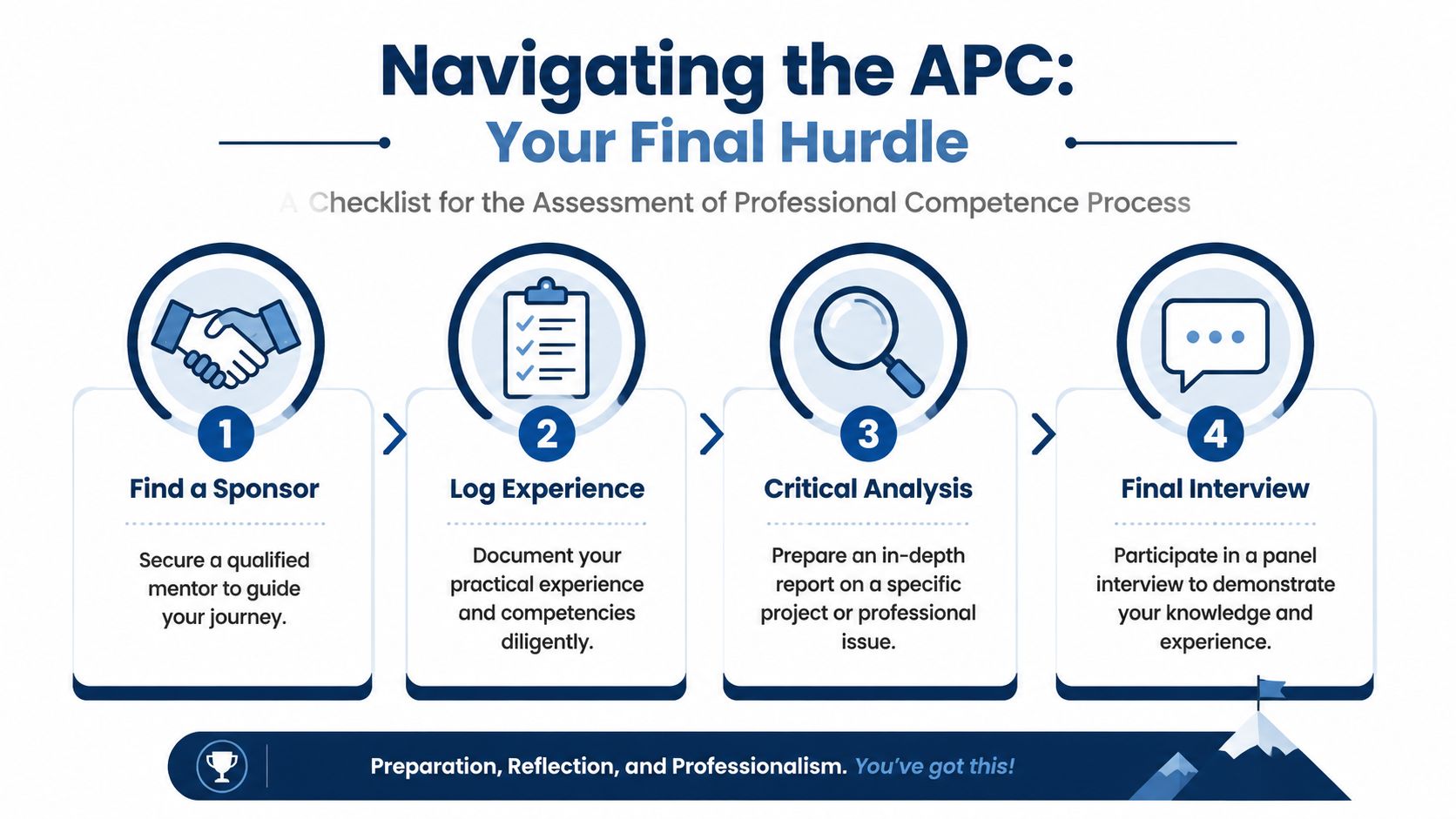
Focus on four things early:
Choose a pathway that matches your real work
Do not pick a pathway because it sounds broader or more impressive. Pick the one your current instructions can support. If your day-to-day work will not give you proper evidence for the competencies, your submission will look forced.Get a serious counsellor, not a nominal one
You need someone who will challenge weak records, question your examples and tell you when your case study has no bite. A famous name is useless if that person is never available.Record experience while it is fresh
Weekly notes beat heroic reconstruction at the end. Write down the job, your role, the decision, the risk, and what happened next. That is the raw material assessors want to hear.Finish the required modules and admin early
Do not create last-minute problems with items you could have completed months before.
If your work includes residential inspection and reporting, keep the standards clear in your head. A practical refresher on what a RICS survey covers helps many trainees sharpen how they describe inspection scope, limitations and advice.
For a visual overview of the final stage, this video gives a straightforward summary before you go back to your own paperwork:
What assessors want
Assessors want evidence that you can be trusted in front of a client.
They are testing judgement under pressure, not your ability to recite guidance notes. They want to hear what you did, why you did it, what risks you considered, and how you would defend that advice if challenged by a client, solicitor, lender or another surveyor.
Your case study matters more than many candidates admit. Pick a job where your own judgement changed the outcome. In London, the strongest examples often come from instructions with real commercial pressure. A valuation where evidence was noisy and the client wanted certainty you could not honestly give. A pre-purchase inspection where defects, alterations and market timing all pulled in different directions. A leasehold or block issue where you had to explain technical risk in plain English to someone about to spend serious money.
Weak case studies usually share the same faults:
- The candidate was present but not responsible.
- The problem was routine and carried no meaningful decision.
- The write-up describes events but avoids analysis.
- The candidate cannot explain the alternatives they rejected.
- The outcome says little about professional judgement.
Pick a case where you made a call, backed it with evidence, and can still defend it under cross-questioning.
London APC candidates need better examples than the guidance suggests
Official guidance tells you the format. It does not tell you what tends to impress in a London interview room.
London work is fast, political and full of partial information. That gives you better APC material if you use it properly. Assessors know the market creates pressure from agents, buyers, landlords, developers and internal fee targets. They want to see that you can stay balanced when everyone around you wants a quick answer.
So choose examples that show one of three things:
| Interview area | What they're testing | What usually goes wrong |
|---|---|---|
| Your case study | Ownership and judgement | Candidate cannot explain why a decision was made |
| Technical competence | Breadth and depth | Candidate knows only a narrow slice of day-to-day work |
| Ethics and conduct | Professional standards | Candidate answers like an employee protecting a deal |
Good London examples often involve uncertainty. Conflicting comparables. Altered period stock with patchy history. Client pressure to soften language. Tight exchange deadlines. Survey findings that affect value, scope of repair, or whether a buyer should proceed at all. That is where your professionalism is tested in real life.
Treat the interview as a professional defence
The interview is a defence of your judgement. Speak like someone who has carried responsibility.
That means short answers first. Then expand if asked. Rambling loses marks because it suggests you do not know which point matters. Memorised scripts fail for the same reason. The assessors will shift the question slightly and see whether you still understand your own advice.
Practice out loud. Not in your head.
Ask your supervisor or a colleague to interrupt you, challenge your assumptions and push on weak areas. If you work in London residential practice, expect probing questions about client care, managing uncertainty, explaining limitations, and dealing with pressure from transaction-driven parties. Those are common failure points because candidates spend too long revising terminology and not enough time defending real decisions.
A good answer usually has four parts: the facts, the risk, your judgement, and the advice you gave. Keep returning to that structure and you will sound like a surveyor, not a student.
Specialisms and Building a Career in London
Chartership isn't the finish line. It's the licence to build a proper career.

Residential surveying is not one job
In London residential practice, the main directions are clear. You can move into building surveying, valuation, party wall work, defect diagnosis, conservation-focused inspection or a mixed general practice role.
That variety is one reason the profession lasts. One week can involve a Level 2 home survey, a probate valuation and a reinstatement cost assessment. Another may lean heavily into defect analysis, project advice or expert witness work. The underlying skill is judgement, but the day-to-day emphasis changes by specialism.
Some specialisms suit certain temperaments better:
- Building surveying suits people who like defects, fabric and detailed inspection.
- Valuation suits people who are methodical, evidence-led and comfortable defending figures.
- Party wall and neighbourly matters suit people who can stay calm when others don't.
- Conservation work suits people who respect older buildings and understand traditional materials.
London rewards local knowledge
This point gets ignored by people writing generic career advice. It shouldn't.
A surveyor who works across Lewisham, Greenwich, Southwark and Bromley needs to read buildings in context. Victorian terraces in Forest Hill and Sydenham often bring chimney breast alteration, suspended timber floors and old moisture management problems. Flats in Bermondsey and Rotherhithe may involve warehouse conversions, service charge complications and concealed structural changes. Edwardian houses in Blackheath and Dulwich can present attractive façades with awkward later alterations hidden inside.
London clients don't pay for theory. They pay for a surveyor who knows what tends to go wrong with that sort of property in that sort of street.
That local knowledge also shapes career progression. Surveyors who become useful are the ones who can connect building age, construction type, borough context and client objective. That's how you become the person solicitors trust, buyers remember and agents can't easily push around.
Common Pitfalls and Final Advice for Applicants
You are ten minutes into the final interview. The panel asks why you made a recommendation in your case study. You start talking in circles, quote guidance you barely used in practice, and realise too late that your diary does not back up half of what you are saying. That is how good candidates fail the APC in London.
The problem is rarely raw ability. It is weak judgement under pressure, poor records, and a case study that looked acceptable on paper but falls apart under questioning. In London, the standard is harsher than many candidates expect because the work is messier, the clients are sharper, and the panel can usually tell who has handled real instructions.
Mistakes that sink good candidates
The first mistake is choosing the wrong case study. Pick one where your role was minor, the decisions were routine, or the link to your pathway is loose, and you hand the assessors an easy reason to doubt your competence. Choose a job where you had to exercise judgement, explain trade-offs, and deal with awkward facts.
The second mistake is treating the diary and competency record like admin. It is evidence. If you write it late, pad it with vague language, or copy the same activity across multiple entries, expect trouble. Assessors spot that quickly.
Other common failure points include:
- A passive case study: you observed the work, but did not drive the advice or decision.
- Thin records: no clear detail on what you did, why it mattered, and what level of supervision applied.
- Weak presentation control: too much scene-setting, not enough analysis, risk, and professional judgement.
- Poor ethics answers: you talk about keeping the client happy before talking about independence, conflicts, or duty to the public.
Ethics is where candidates lose the room fast. In London practice, you will meet clients, agents and brokers who want a convenient answer. The panel wants to hear that you can stay polite, hold your ground, and record your reasoning properly.
Practical advice that actually helps
Use one rule for APC preparation. If you cannot explain a decision clearly, you do not understand it well enough yet.
Rehearse your case study out loud. Then rehearse the awkward questions, not the comfortable ones. Why did you reject one option? What was the risk to the client? What assumption mattered most? What would you do differently now? Those are the questions that separate a competent candidate from someone who has only memorised notes.
If you work in the London market, get specific. A candidate who can discuss licensing risk in a converted flat, service charge disputes in a leasehold block, access constraints on a tight urban site, or the commercial pressure around exchange deadlines sounds credible. A candidate who speaks in generic textbook language sounds untested.
How to make yourself employable
Your CV should read like a work record, not a personality brochure. State the property types, instructions, report work, inspections, valuations, client exposure and software you have handled. Cut empty claims about being dynamic, passionate or people-focused.
At interview, answer like a surveyor. Start with the facts. Move to evidence. Then give your judgement and the practical next step.
Early in your career, varied exposure beats a comfortable niche. You need enough breadth to recognise patterns, enough responsibility to form judgement, and enough repetition to become reliable. That is what gets you through the APC, and it is what builds a reputation once the letters are after your name.
FAQs About Becoming a Chartered Surveyor
How long does it take to become a chartered surveyor in the UK?
Longer than candidates expect. If you come through the graduate route, plan on at least two solid years of structured training before final assessment. If you already have substantial relevant experience, the period can be shorter. The real point is not the calendar. It is whether you have enough live instructions, enough variety, and enough evidence to talk convincingly under pressure.
In London, that usually means exposure to messy leasehold issues, client deadlines, awkward access, and real reporting responsibility. Time served on its own does not get you through.
Can I become chartered without a RICS-accredited degree?
Yes. It is a slower route, and you need to be realistic about it. You will need stronger evidence of competence, better supervision, and cleaner documentation of what you have done.
If that is your route, choose your employer carefully. A weak training environment will waste years. A good counsellor and proper APC support matter more than a glossy job title.
What does the APC involve?
A diary of experience, competency records, CPD, a case study, a presentation, and a final interview. On paper, that sounds tidy. In practice, candidates usually stumble on two things. Their written submission is too vague, and their interview answers drift into theory instead of professional judgement.
Treat the APC like a test of applied thinking. The assessors want to hear what you did, why you did it, what risk you spotted, and how you protected the client.
What is the biggest reason people fail the APC?
Poor judgement under questioning. Not lack of effort.
Candidates fail because they cannot explain their own decisions clearly, they overclaim their involvement, or they present a case study with no real commercial or professional tension. In the London market, bland examples get exposed quickly. Pick work that involved an actual decision, an actual risk, and an actual consequence.
Do I need London experience to build a good career there?
Yes, if you want to be credible quickly.
London property work has its own pressure points. Leasehold disputes, conservation constraints, mixed-use buildings, tight sites, aggressive timetables, and clients who expect plain answers fast. If you want to work in London, get experience in London early. The learning curve is steeper, but your judgement improves faster too.
If you need advice from a firm that deals with real residential property across London, Corinthian Surveyors London LTD is an independent RICS-regulated practice based in Forest Hill, run by Clive Thompson, who holds RICS and CABE qualifications and has over 30 years in the built environment. The firm covers London boroughs, the Home Counties and the South of England, and handles residential work including RICS Homebuyer Surveys, RICS Building Surveys, market valuations and building conservation. It has no ties to lenders, estate agents or developers, which matters if you want independent advice. If you want to speak to someone sensible about the profession or about a residential survey or valuation, call 0800 00 16 422.