
What to Check When Buying a House: A London Buyer’s Guide

You view a flat in Bermondsey or a Victorian terrace in Lewisham. The kitchen is new, the walls are freshly painted, and the agent wants a quick decision. Then six months after completion, cracks open above a bay window, mould appears behind furniture, and a roofer finds long-term water entry in the loft. That is how expensive mistakes start in London.
If you want to know what to check when buying a house, ignore the dressing and assess the building itself. Focus on structure, moisture, roof coverings, timber, drains, windows, services, and any part of the property that has been altered or extended without proper care. In London, that matters even more because the housing stock is so mixed. A Georgian conversion in Blackheath, an interwar semi in Dulwich, and a brick terrace in Bermondsey fail in different ways.
Buyers regularly underestimate how much can be hidden by decoration. Fresh plaster can conceal movement. New paint can cover historic leaks. A smart cellar conversion can hide poor ventilation, bridging damp, or unapproved work. If you are unsure what serious movement looks like, review these common signs of structural cracks in walls before you commit.
A proper survey is required. It gives you a clear view of defects, likely repair costs, and the level of risk before exchange. That matters far more than surface finish, and it is the difference between buying with evidence and buying on hope.
Table of Contents
- 1. Structural Movement and Foundation Integrity
- 2. Damp, Moisture and Rising Damp
- 3. Roof, Loft, Insulation and Ventilation
- 4. Timber Decay, Woodworm and Structural Timber
- 5. Electrical Installation Safety and Age
- 6. Central Heating System and Boiler Condition
- 7. Plumbing, Water Supply and Drainage
- 8. Windows, Doors, Frames and External Joinery
- 9. External Walls, Brickwork, Render and Pointing
- 10. Surveys, Valuations and Professional Assessment Before Exchange
- 10-Point Home Inspection Comparison
- From Checklist to Certainty Securing Your Property Purchase
- FAQ
1. Structural Movement and Foundation Integrity
This is the first thing I look at. Cracks tell a story, but only if you read them properly. Hairline plaster cracking is common. Stepped brick cracks, diagonal movement around openings and distortion to frames need much closer attention.
In Lewisham, Greenwich, Bromley and Croydon, I regularly see movement issues in Victorian and Edwardian stock, and also in interwar houses built on London clay. A 1920s semi in Bromley might show minor settlement above a lintel and need monitoring only. A Victorian flat in Peckham might have old underpinning from decades ago, be perfectly stable today and still raise insurance questions.
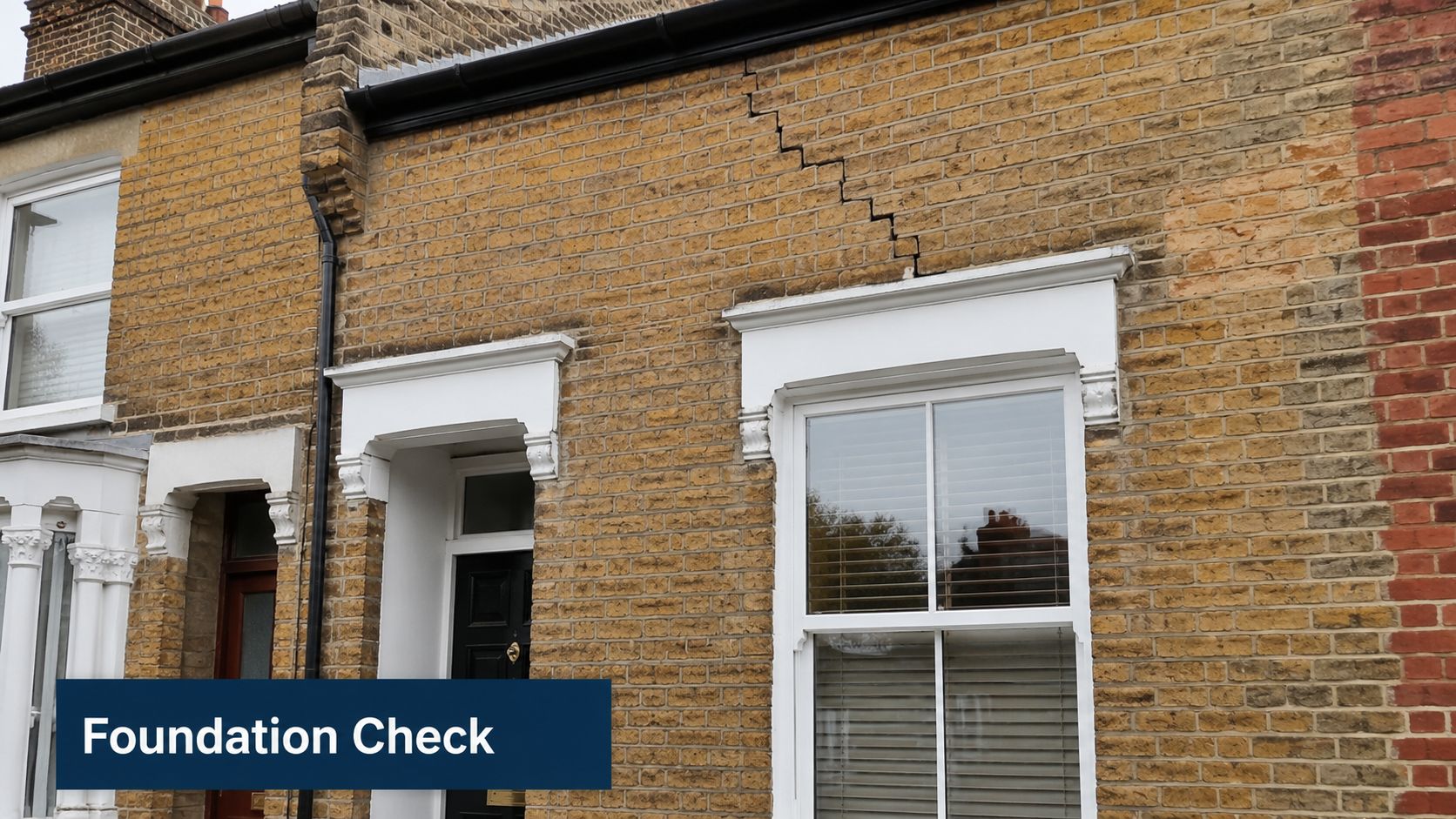
What movement actually looks like
Don't just stare at one crack. Check the pattern.
- Stepped cracking in brickwork: Often suggests structural movement rather than surface failure.
- Doors and windows sticking: This can point to frame distortion, not just poor maintenance.
- Recent filler and fresh paint over cracks: That can hide a live problem rather than solve it.
- External ground and nearby trees: Both can influence moisture levels and foundation behaviour.
Practical rule: Ask why the crack is there, how long it has likely been there and whether anyone repaired the cause or only the finish.
A Dulwich terrace with active heave is a different proposition from a house with old, stable settlement. You need the surveyor to date visible repairs where possible and explain the likely mechanism. If I flag significant cracking, I'll usually tell a buyer to obtain further advice before exchange. You can also read more on structural cracks in walls.
2. Damp, Moisture and Rising Damp
Damp is one of the most common defects in London property and one of the most badly handled. Too many people hear “rising damp” and start pricing injections before anyone has checked gutters, paving, sub-floor ventilation or leaks.
In older terraces around Forest Hill, Catford, New Cross and Southwark, damp can come from several directions at once. I've seen a Lewisham basement flat with high readings at skirting level caused by poor external drainage, not failed damp proofing. I've also seen a Bermondsey warehouse conversion with mould-heavy window reveals caused by condensation and uneven heating.
Here's the sort of defect pattern buyers often miss:
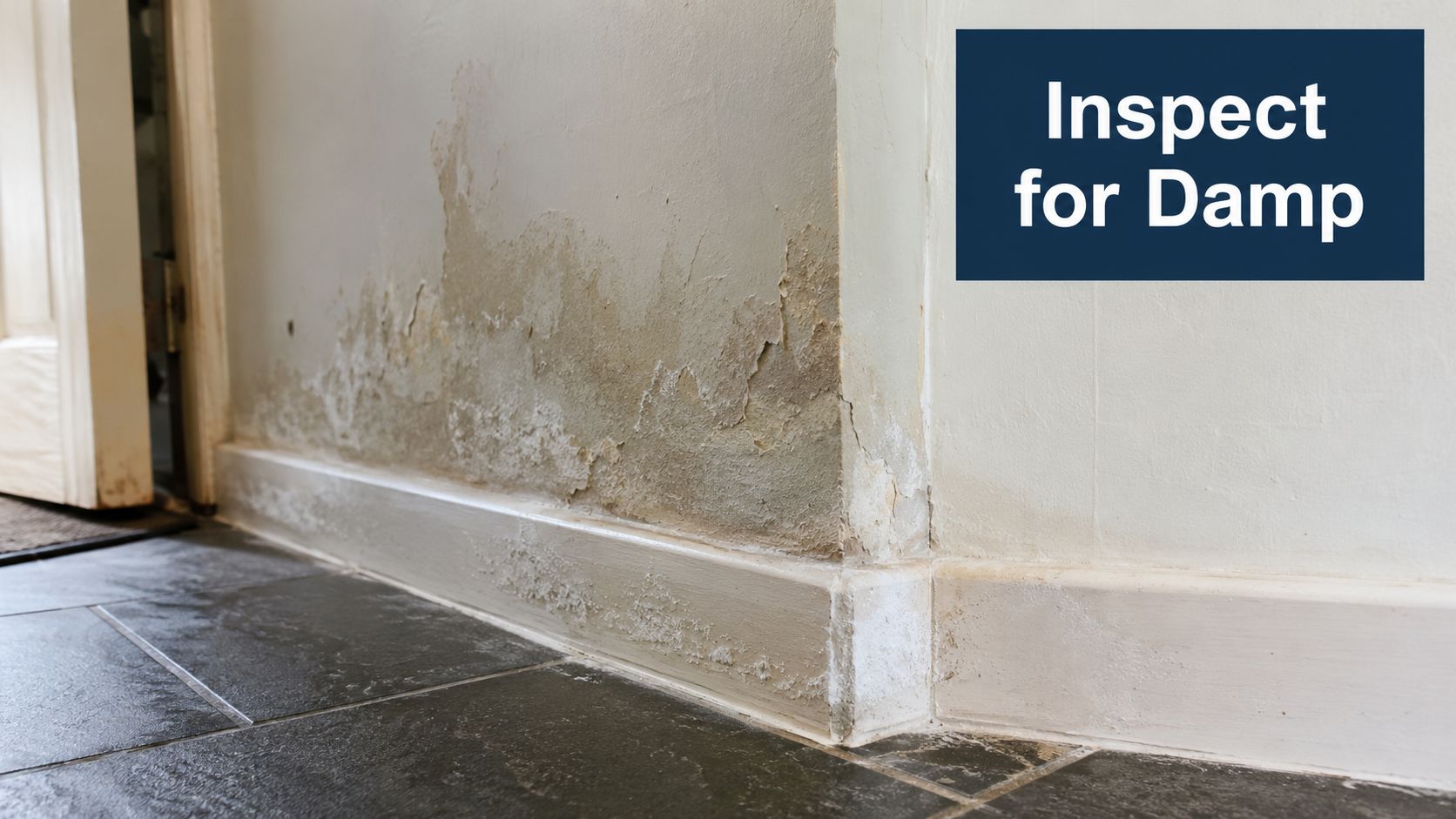
Get the cause, not just the symptom
A proper survey should distinguish between rising damp, penetrating damp and condensation. The remedy depends on the cause. Get that wrong and you waste money while the defect continues.
The financial risk is real. Hidden defects cost buyers money after completion, and 74% of surveyors report that properties with hidden defects leave buyers facing average unexpected repair costs of £5,750, with dampness and roof issues noted as common concealed problems in London, according to the UK House Price Index reference provided here.
Damp treatment without diagnosis is guesswork.
A Blackheath terrace with salt deposits at low level may need proper investigation of moisture source, external levels and wall construction before anyone talks about chemical treatment. In older London housing, especially where floors have been altered and ventilation reduced, the cause is often mixed.
This short video gives a useful visual sense of what buyers should be noticing before they commit:
If a seller has redecorated only the lower metre of a wall, ask why. That's often where the building is trying to tell you something.
3. Roof, Loft, Insulation and Ventilation
You exchange on a London house in dry weather. Six weeks later, after the first proper spell of rain, a brown ring appears on the bedroom ceiling. That defect did not start after completion. You just did not see the evidence in time.
Roof problems are expensive because they rarely stay at roof level. Water gets into insulation, ceiling finishes, chimney breasts and structural timber. In London, the risk varies with the building type. A Victorian terrace in Lewisham may still have decent slate but failing flashings at parapets or chimney stacks. A Bermondsey conversion may have a flat roof with tired coverings, poor falls and awkward maintenance history. A 1950s semi in Bromley often shows patch repairs on ageing concrete tiles that postpone replacement but do not solve the underlying issue.
The loft usually gives the clearest answer. Sellers tidy rooms. They rarely tidy the roof void.
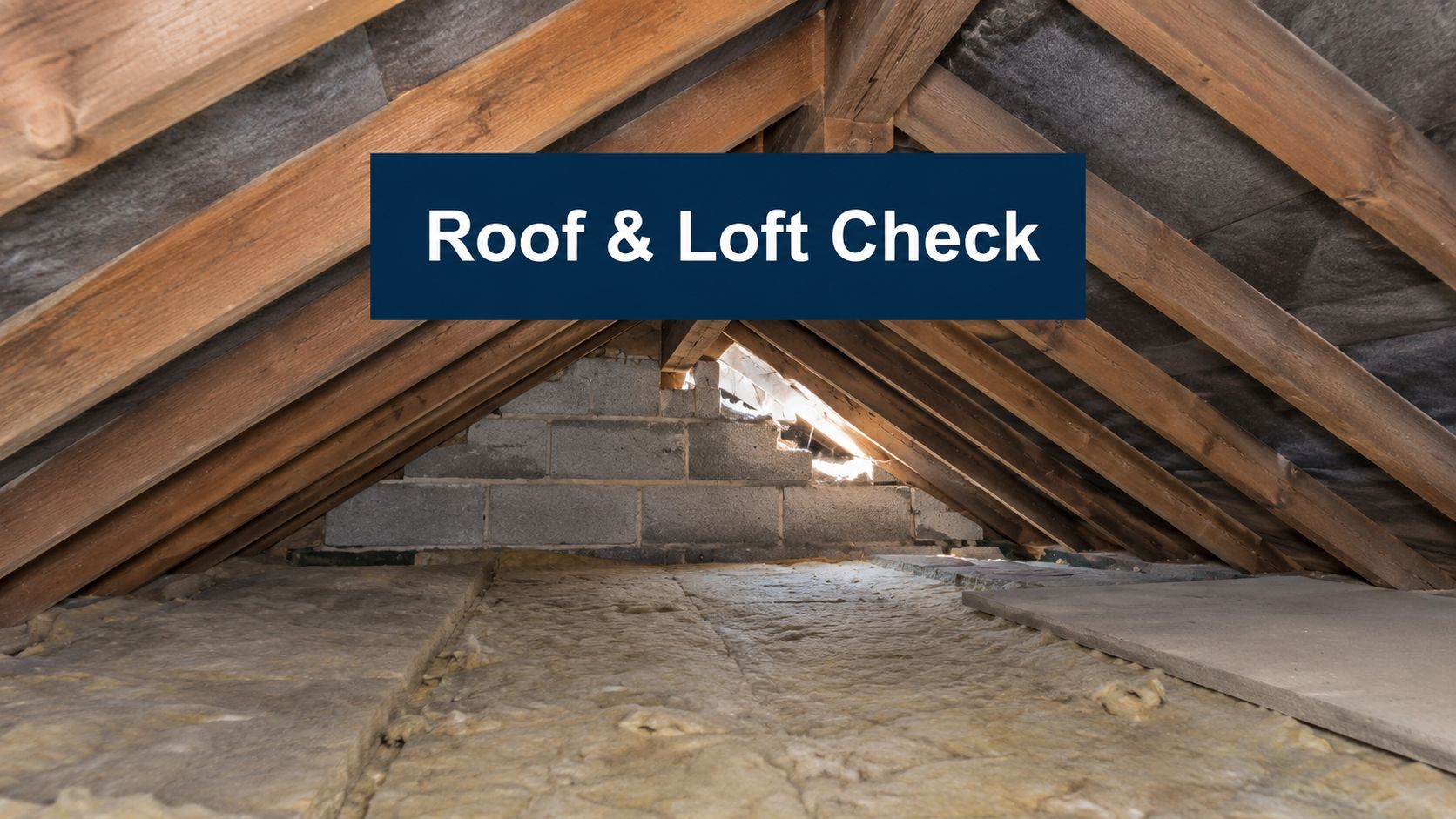
Check for:
- Water staining to rafters, purlins or chimney areas: This points to current leaks or a history of water ingress that needs explaining.
- Daylight through the covering: Small gaps around slates, tiles or abutments often mean wind-driven rain will get in.
- Insulation packed tight into the eaves: That blocks airflow at the roof edge and increases condensation risk.
- Black mould or heavy moisture beads on felt and timbers: This usually indicates poor ventilation rather than a simple roof leak.
- Uneven or compressed insulation: This reduces thermal performance and can suggest repeated access, past leaks or poor installation.
- Old tanks, redundant pipework and makeshift platforms: These are common in older London lofts and often point to neglected maintenance.
Ventilation matters more than many buyers realise. I often inspect lofts where the roof covering is broadly serviceable, but the void is sweating because insulation has been upgraded badly and airflow has been blocked. That is common in older houses that have had piecemeal energy improvements without anyone thinking about how the roof needs to breathe.
Flat roofs need extra caution. Many buyers underestimate them, especially on top-floor flats and rear extensions. Look for ponding, patched coverings, cracked felt, failed edge details and staining at ceiling perimeters. If the seller cannot say when the covering was last replaced, assume you may be dealing with a shorter remaining life than the rest of the building.
Ask direct questions. Has the roof been replaced, overhauled or patched? Were Building Regulations involved for insulation upgrades? Has any leak been traced to a chimney, valley, parapet gutter or flat roof outlet? Vague answers are a warning sign.
A proper survey matters here because many defects are only visible from close inspection of the roof structure, not from the pavement or a quick viewing. In London housing, especially older terraces and conversions, that inspection often makes the difference between buying a manageable property and inheriting a concealed repair bill.
4. Timber Decay, Woodworm and Structural Timber
Timber defects are easy to miss during a viewing because sellers rarely invite you to lift carpets or inspect dark roof corners. Yet decay in joists, lintels and roof members can turn an attractive house into a major repair project.
This is especially relevant in older stock across Southwark, Greenwich and Beckenham. Timber usually fails because moisture got there first. That could be a roof leak, poor sub-floor ventilation, long-term damp at wall bases or leaking plumbing.
Active or historic matters
You need to know if the defect is live. Old woodworm flight holes aren't the same as active infestation. Historic beetle damage in a 1930s semi may need no more than sensible repair and monitoring. Wet rot in ground-floor joists is different. That means the moisture problem is probably still present or was present for long enough to compromise strength.
A Southwark terrace might have decayed joist ends where they bear into damp masonry. A Greenwich house might have insect activity in poorly ventilated roof timbers. A Beckenham semi may show old treatment evidence but poor-quality previous repairs.
If timber has failed, don't stop at the timber. Find the moisture source or the defect will return.
When I inspect older London houses, I also pay close attention to window frames, fascia boards and soffits. These are often the first visible indicators of long-term neglect. If external joinery is soft, internal concealed timber may also be vulnerable.
A better survey level pays for itself. A brief look won't do. You need someone who understands how damp, ventilation and timber condition interact.
5. Electrical Installation Safety and Age
The survey won't test the electrical installation in the way an electrician does, but it should still raise the right alarms. I want to know the approximate age of the system, what type of consumer unit is fitted, whether earthing appears adequate and whether visible wiring suggests an outdated or altered installation.
In London flats and terraces, I still come across ceramic fuse boards, mixed-age additions and amateur alterations. A Peckham flat with cloth-insulated wiring is a straightforward red flag. A Croydon house with aluminium wiring or poorly terminated additions needs proper electrical testing before you exchange.
What a surveyor can and cannot confirm
A surveyor can identify visual warning signs. A qualified electrician must carry out formal testing. Buyers often blur those two things, which is a mistake.
Check for:
- An old fuse board rather than a modern consumer unit: Often a sign the installation hasn't been fully upgraded.
- Mixed socket and switch styles: This can indicate piecemeal work across different periods.
- Loose fittings, damaged cable sheathing or exposed conductors: Immediate safety concern.
- Evidence of DIY work: Spur wiring, untidy trunking and overloaded extensions all deserve scrutiny.
Market behaviour matters here as well. The ONS-linked housing data reference states that 89% of UK homebuyers now use digital valuation tools in their initial screening, but only 32% back that up with a formal RICS valuation, and in London a formal valuation corrects automated figures by an average of ±8.5%. That same gap shows up with condition. Buyers are quick to rely on what they can see, and too slow to verify what they can't.
If I flag concerns, I'll recommend proper follow-up testing. There's more on that in this guide to home electrical testing.
6. Central Heating System and Boiler Condition
A tired boiler can become your problem on day one. It doesn't matter that it worked during the viewing if it's old, corroded and badly maintained. Heating systems often limp on just long enough for the sale.
In Lewisham terraces and Bromley semis, I often see older combi boilers, dated controls and radiators with patchy heat distribution. In some flats, especially where landlords have cut corners, the heating may be undersized or altered without much thought.
Age, upkeep and practical risk
Ask for service history. If there isn't any, assume nothing.
A boiler may look tidy but still be near the end of useful life. Corrosion at pipe connections, staining beneath valves, sludge issues and missing paperwork all point to future cost. A 25-year-old boiler in a Victorian terrace is a budgeting issue now, not later. A house with no functioning fixed heating is also a mortgageability question, not just a comfort issue.
For buyers weighing replacement routes, broad expert advice on home heating options can help you understand what system type may suit the property after purchase. That doesn't replace a survey, but it does help you think practically about what comes next.
If the heating is old and the seller can't show upkeep, price that risk into your offer. Don't leave it to chance.
7. Plumbing, Water Supply and Drainage
Drainage is the bit buyers ignore until a survey or blockage forces the issue. That's a mistake. Old supply pipework and hidden below-ground defects can produce some of the most disruptive repair work after completion.
In Lewisham, Greenwich, Lambeth and Southwark, older properties may still have lead supply pipes or a mix of old and new plumbing. In converted flats, I often find awkward pipe runs, poor boxing-in and limited evidence of proper maintenance. In houses with mature gardens, roots are a recurring problem in underground drains.
Drainage is the hidden cost
You can usually see some of the plumbing. You can't usually see the drainage. That's why buyers miss it.
The risk is often underestimated. The Saga article on property red flags notes that 1 in 5 London homes have unrecorded drainage issues that surveys often miss unless specifically requested, and buyers can be left facing repair bills for shared pipes. That matters in older terraces and conversions where responsibility can be murky and the drains may be Victorian.
Check these points early:
- Lead pipework: Common in older London stock and worth replacing.
- Staining inside sink units or cupboards: Often the first visible sign of leaks.
- Cold water tanks in lofts: Look for rust, poor insulation and neglected lids.
- Shared drainage arrangements: Important in conversions and terraced streets.
A Dulwich terrace with root ingress to the main run may need excavation. A Peckham flat with original supply pipework may need a full upgrade. If a survey raises suspicion, a CCTV drain survey is money well spent.
8. Windows, Doors, Frames and External Joinery
Windows tell you a lot about upkeep. If the frames are neglected, there's a fair chance other maintenance has been deferred as well. In Victorian and Edwardian parts of Forest Hill, Dulwich and Blackheath, original sashes can still be excellent, but only if they've been properly maintained.
This matters for both repair cost and regulation. In conservation areas, replacing original joinery may not be straightforward. A listed or sensitive period building often needs like-for-like thinking, not off-the-shelf plastic replacements.
Survey level matters here
The type of survey affects what gets inspected. For a RICS Level 2 Home Survey, the surveyor must inspect one window on each elevation and one of each type where there are variations, and only inspect sub-floor voids where access is available and panels can be lifted, as outlined in this guide to the RICS Home Survey Standard. That's useful, but it isn't the same as a fuller inspection.
A Level 3 goes further. Survey Merchant's explanation of the newer RICS standard states that Level 3 surveyors are required to check and open all windows during inspection. That matters if you want to identify sticking sashes, failed hinges, rotten meeting rails or failed seals that won't show up in a quick visual look.
In period property, a painted-shut window is never just a window problem. It can also mean trapped moisture, rot and long-term neglect.
A Lewisham terrace with sound original sash boxes may only need localised repair. A Croydon house with widespread failed double glazing units is a larger replacement decision. A Blackheath townhouse may also come with planning restrictions that affect cost and timing.
9. External Walls, Brickwork, Render and Pointing
External walls take the weather first and reveal a lot about the standard of maintenance. On a viewing, buyers often focus on the interior finish and miss open joints, hard cement repairs, failed render and spalled brick faces outside.
That's a common problem in Forest Hill, Greenwich and Bromley. Victorian brickwork often suffers where inappropriate modern pointing has trapped moisture. Rendered houses from the mid-20th century may show hairline cracking, hollow patches or water tracking around openings.
Match the repair to the building
The key isn't just spotting damage. It's understanding whether the repair used is appropriate for the wall type.
A Greenwich Edwardian house with lime mortar should usually be repaired with compatible materials. A Bromley semi with failing render may need local repairs or more extensive renewal depending on adhesion and moisture entry. A Forest Hill terrace with missing pointing can start showing internal damp surprisingly quickly once water gets into exposed joints.
Use this simple check when you view the outside:
- Open or recessed joints: These let water penetrate.
- Crumbling render or hollow-sounding patches: Common signs of failure.
- Spalled brick faces: Can indicate frost damage or trapped moisture.
- Staining under gutters and downpipes: Often linked to prolonged water exposure.
If the external wall finish is wrong for the building, superficial patching won't solve it. Buyers need the defect explained in plain English, with likely next steps.
10. Surveys, Valuations and Professional Assessment Before Exchange
This is the point many buyers try to save money and end up taking the biggest risk. A mortgage valuation is not a survey. It protects the lender's position. It does not give you a proper diagnosis of condition.
The wider market data supports a more cautious approach. UK house prices have risen year-on-year since 2015 apart from a brief dip in late 2023 and early 2024, and Halifax reported the average UK house price at £300,077, while growth slowed to 5.7% over the 2023 to 2026 period after a 19% rise between 2020 and 2023, according to the Statista housing market reference provided. Slower growth means buyers have less room to absorb repair mistakes.
Choose the right survey, not the cheapest one
The survey type must match the building.
A Level 2 is suited to conventional properties in reasonable condition. A Level 3 is the right choice for older or historic buildings, unusual construction, visible defects, significant extensions or where you intend to alter the property, as set out by Rectory Surveyors' explanation of when a RICS Level 3 is required. That covers a lot of London stock.
If you need repair budgeting, Level 3 is the one that gives estimates of costs and likely timescales for identified work, while Level 1 and Level 2 generally record defects without repair costing, according to RICS guidance on the Level 3 survey.
Corinthian Surveyors London LTD is an independent practice in Forest Hill, with no ties to lenders, estate agents or developers. That matters. Independence means the advice is for you, not for the deal. If you're comparing survey types, the pages on RICS HomeBuyer Surveys and RICS Building Surveys are the right place to start. If the report gives you negotiating power, this guide on how to negotiate house price after survey will help you use it properly.
10-Point Home Inspection Comparison
| Item | Implementation complexity | Resource requirements | Expected outcomes | Ideal use cases | Key advantages |
|---|---|---|---|---|---|
| Structural Movement and Foundation Integrity | High – may require structural engineer and monitoring | Surveyor inspection, soil analysis, structural engineer, possible underpinning quotes | Determine stability, mortgageability, and repair cost estimates | Older terraces on clay soils; properties with stepped/diagonal cracks or subsidence history | Detects major safety/value risks; enables negotiation or walkaway decisions |
| Damp, Moisture and Rising Damp | Medium–high – diagnosis can be ambiguous and seasonal | Damp meters, visual inspection, possible damp specialist reports | Identify moisture type and root cause; targeted remedial plan and cost range | Basements, older buildings with failed DPC, properties showing staining or mould | Prevents incorrect treatments; targets cost‑effective remediation |
| Roof, Loft, Insulation and Ventilation | Medium – limited access may require specialist inspection | Ground/loft inspection, binoculars/drone, roofing contractor, thermal imaging if needed | Roof condition, remaining life estimate, insulation/ventilation defects | Properties with old tiles/slates, loft conversions or recurring leaks | Prevents water/timber damage; identifies energy‑saving improvements |
| Timber Decay, Woodworm and Structural Timber | Medium–high – may need invasive checks and specialist treatment | Probing, moisture readings, timber engineer, specialist contractors with guarantees | Active vs historic decay determination; repair/treatment scope and costs | Older homes, poorly ventilated lofts, properties with water ingress history | Prevents structural failure; allows accurate repair budgeting |
| Electrical Installation Safety and Age | Medium – visual flagging by surveyor; testing by electrician required | Visual survey, Periodic Inspection Report (EICR) by qualified electrician | Identify urgent hazards, need for rewiring, compliance issues | Properties with original or cloth/rubber/aluminium wiring | Reduces fire/shock risk; supports insurance and lender requirements |
| Central Heating System and Boiler Condition | Low–medium – visual only; performance needs specialist testing | Visual inspection, Gas Safe engineer for service/EPC if required | Boiler/serviceable life estimate; flag for replacement or repair | Properties with old boilers or inadequate heating | Helps budget for replacement; avoids emergency failures |
| Plumbing, Water Supply and Drainage | Medium – underground issues often need specialist surveys | Visual pipework check, plumber, CCTV drain survey for underground faults | Identify leaks, lead pipe presence, drainage defects and repair costs | Older properties, sites with trees, properties showing drainage signs | Prevents contamination and costly excavations; informs negotiations |
| Windows, Doors, Frames and External Joinery | Low–medium – condition and conservation constraints affect approach | Visual survey, joiner quotations, planning check in conservation areas | Determine repair vs replacement needs; security and energy implications | Period properties with original timber sashes or listed status | Improves thermal performance and security; preserves fabric where appropriate |
| External Walls, Brickwork, Render and Pointing | Low–medium – defects often visible but hidden issues possible | Visual inspection, bricklayer/render specialist quotes, possible sample removal | Assess water ingress risk, repointing/render scope and cost estimate | Older masonry buildings or properties with failing render/pointing | Prevents internal damp; maintains external weatherproofing and appearance |
| Surveys, Valuations and Professional Assessment Before Exchange | Medium – procedural but essential; coordinates specialists as needed | RICS HomeBuyer Report or Building Survey, possible specialist follow‑ups; cost £400–£1,200+ | Comprehensive condition report, traffic‑light severity, negotiation leverage | All property purchases, mandatory for older/non‑standard or high‑risk homes | Reduces purchasing risk, provides independent evidence and negotiation power |
From Checklist to Certainty Securing Your Property Purchase
A good checklist helps you ask better questions. It doesn't replace a proper survey. Buildings are full of clues, but clues still need interpretation. The difference between minor settlement and active movement, or between condensation and rising damp, is where buyers either protect themselves or walk blind into future cost.
That matters even more in London because the stock is so varied. A Victorian terrace in Lewisham, a warehouse conversion in Bermondsey, a 1930s semi in Bromley and a flat in Southwark all fail in different ways. The age, construction, maintenance history and quality of alterations matter just as much as the postcode.
There's also the issue of value. London prices have fallen by £22,400 over the last twelve months, a 3% decline, even while the broader UK trend has been upward, according to Zoopla's June 2026 market update. In plain terms, that gives buyers less reason to shrug off defects and hope future growth covers the mistake. If the building needs work, you need to know before you exchange contracts.
I'd also be careful with energy performance and future compliance. The same Home Buyer Check piece cited earlier on pre-purchase checks warns of emerging 2025 to 2026 risk around EPC non-compliance for lower-rated homes, with potential retrofit costs and mortgageability concerns. That sits alongside the usual structural and maintenance issues, not instead of them.
Corinthian Surveyors London LTD is an independent firm of RICS Chartered Surveyors and Valuers based in Forest Hill, run by Clive Thompson, who holds RICS and CABE qualifications and has over 30 years of experience in the built environment. The firm is regulated by RICS, is a member of the RICS Valuers Registration Scheme and is insured by Royal Sun Alliance. For buyers choosing between a Level 1 Home Condition Survey, a Level 2 or a Level 3, that independence is important because the advice isn't shaped by a lender, estate agent or developer.
If you're serious about what to check when buying a house, instruct the right survey before exchange and read the report properly. If the findings are significant, get the follow-up specialist advice while you still control the decision. That is how you avoid buying someone else's deferred maintenance.
For the financial side of protecting a purchase once you've made it, some buyers also look at mortgage life insurance alongside the survey and legal process. It's part of the wider risk picture, but the building itself still comes first.
If you want straightforward advice on the right survey for the property you're buying, call Corinthian Surveyors on 0800 00 16 422.
FAQ
Do I need a survey if the mortgage lender has done a valuation?
Yes. A lender's valuation is not a condition survey. It is for the lender's lending decision, not for your protection as a buyer.
Is a Level 2 survey enough for a Victorian house in London?
Usually not if the property is older, altered, visibly defective or unusual in construction. In those cases a Level 3 is the sensible choice.
What should I check first when viewing a house?
Start with structure, damp, roof condition, windows and signs of poor maintenance. Cosmetics come last.
Why use an independent surveyor instead of one linked to an agent or lender?
Because independence reduces conflict. You want advice that serves your decision, not the transaction.
If you need a clear view of a property's condition before you commit, Corinthian Surveyors London LTD provides independent residential surveys and valuations across London, with practical reporting that explains defects plainly and helps you decide what to do next.