
How to Negotiate House Price After Survey: Your Expert Guide

You've opened the survey report, skimmed the first few pages and gone straight to the red flags. Damp. Roof defects. Movement. Timber decay. That sinking feeling is normal, but don't make the common mistake of treating the report as bad news. It's useful news.
A survey is there to stop you buying blind. In London, especially in Victorian terraces in Lewisham, flat conversions in Peckham and 1930s semis in Bromley or Croydon, defects are routine. The question isn't whether the property has issues. The question is whether the price still makes sense once those issues are properly costed.
Table of Contents
- Your Survey Found Problems What Happens Now
- Decoding Your RICS Survey Report
- Building a Watertight Case for a Price Reduction
- How to Conduct the Negotiation Itself
- Navigating Seller Responses and Common Pitfalls
- Securing the Reduction and Finalising Your Purchase
- Frequently Asked Questions About Price Negotiation
Your Survey Found Problems What Happens Now
First, slow down. Don't ring the estate agent in a flap and start reading out defects from page 17. You need a clear head and a simple plan.
The right mindset is this. If the survey has found defects before exchange, it's done its job. You've paid for information. That information now gives you a chance to renegotiate, budget properly or walk away from a problem that isn't worth inheriting.

If you're still muddling up a lender's valuation with a proper survey, read this piece on mortgage surveyors valuation. A mortgage valuation is for the lender. It is not there to protect you.
Get organised before you speak to anyone
Start with three piles.
- Urgent defects: Anything serious, costly or safety-related.
- Important but not urgent defects: Repairs that matter, but don't make the place immediately unsafe.
- Age-related wear: The tired bits you'd expect in an older property.
A Victorian terrace in Catford might show long-term damp staining, cracked render and worn flashings. A converted flat in Camberwell might show roof-covering issues, fire separation concerns or signs of poor alterations. None of that is unusual. Some of it justifies a price reduction. Some of it doesn't.
Practical rule: Don't negotiate because you feel disappointed. Negotiate because the report identifies defects that change the property's current value or create immediate repair costs.
Don't confuse defects with disaster
Survey language can sound severe because it has to be careful. “Further investigation recommended” doesn't always mean the house is falling down. It often means the surveyor can see a risk and wants a specialist to confirm the extent.
That matters in London, where older stock hides plenty behind fresh paint. Chimney breast removals in Southwark, suspended timber floors in Brockley and patch repairs in Sydenham often look fine at viewing stage and turn out to need closer scrutiny later.
Your next move isn't panic. It's separating valid negotiation points from the noise.
Decoding Your RICS Survey Report
A lot of buyers struggle here. They've got a report full of technical wording, colour-coded boxes and references to elements they rarely think about. Roof structure. Rainwater goods. Sub-floor ventilation. Wall tie failure. You don't need to become a surveyor overnight, but you do need to read the report properly.
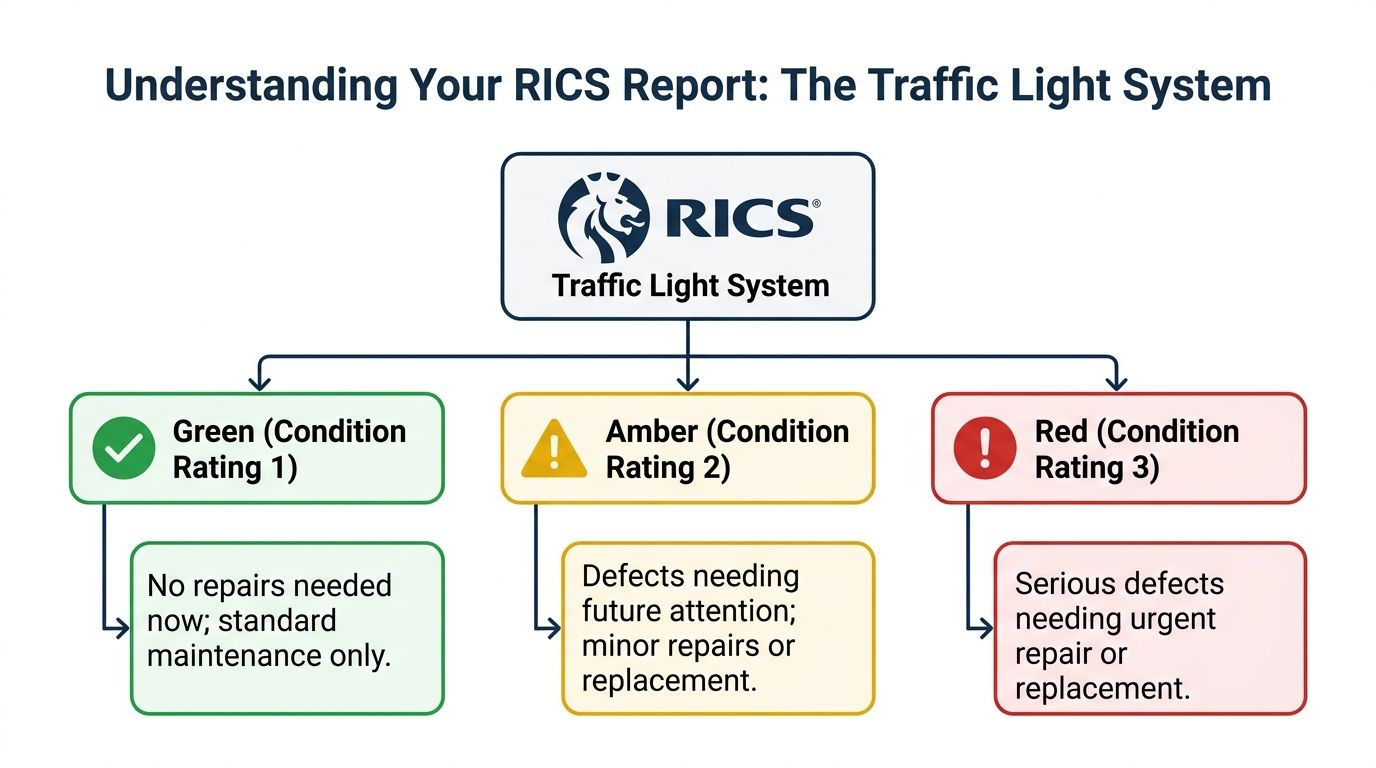
The RICS consumer guide on house surveys states that the RICS Home Survey Standard, updated on 1 March 2021, requires Level 2 reports to use a traffic-light system and include specific advice on repairs. That gives you an objective way to separate a real bargaining point from ordinary upkeep.
If you want a sense of wider UK structural report expenses before commissioning further advice, that guide is a useful starting point.
What the traffic lights actually mean
Consider it this way.
| Rating | Plain English meaning | Negotiation value |
|---|---|---|
| Green, Condition Rating 1 | Fine for now. Routine maintenance only. | Usually none |
| Amber, Condition Rating 2 | Needs repair or replacement, but not urgent | Sometimes relevant |
| Red, Condition Rating 3 | Serious defect needing urgent attention or further investigation | Usually the main negotiation point |
Green doesn't help you.
Amber might help you, depending on scale. Failed mastic around a bath isn't much of a bargaining tool. Widespread window decay in a period property in Blackheath is different.
Red is where buyers should pay attention. That's where you'll often find the defects that affect value and mortgageability.
What matters in London property
A report on a Victorian terrace in Lambeth will read differently from one on a 1930s semi in Bromley. The housing stock is different, so the defects are different too.
In Victorian and Edwardian houses across Forest Hill, New Cross and Dulwich, common serious issues include penetrating damp from defective pointing, movement around chimney breasts, timber decay in sub-floor voids and ageing roof coverings. In Bromley, Sidcup and Bexley, you may be looking more at cavity wall issues, roof spread, old felt coverings and drainage defects.
Don't try to renegotiate over every amber comment in the report. Sellers switch off when buyers treat routine maintenance as a crisis.
This is the true skill. You need to distinguish between deal-breaker defects and age-appropriate issues.
A quick test for what's worth pursuing
Ask yourself these questions:
- Was it visible at viewing stage: If it was obvious, the seller may argue the price already reflected it.
- Does it need urgent work: If yes, it belongs near the top of your list.
- Is it structural, weatherproofing-related or a major system failure: Those are serious points.
- Is it just old: Old isn't a defect on its own.
A Level 2 survey, which typically costs £400 to £950 in the UK according to MV Surveying's guide to the RICS Home Survey Level 2, is visual and non-invasive. It can cover structural integrity, damp, roofing and basic electrics and plumbing, and it may include a market valuation. If that valuation is lower than your agreed price, pay attention. It can support the case that you've overpaid in current condition.
For a fuller breakdown of what a report is telling you, this guide to building survey reports is worth reading.
Building a Watertight Case for a Price Reduction
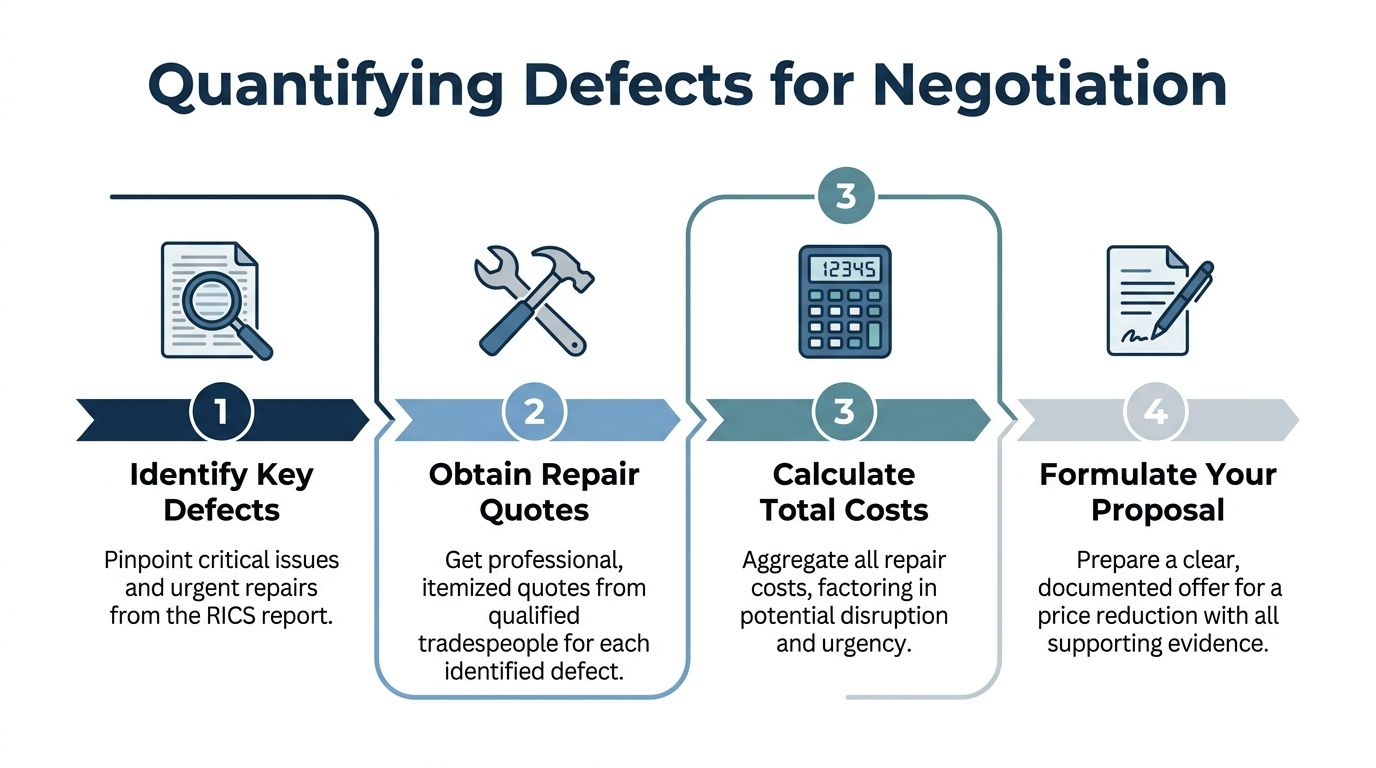
A seller will not cut the price because your survey sounds alarming. They cut the price when you show, in pounds and pence, what it will take to fix the problems properly.
That means evidence, not emotion.
Start with defects that change the value or the risk of the purchase. In London, that usually means roof failure, structural movement, damp with an identified cause, defective drains, rotten windows, unsafe electrics, or a heating system near the end of its life. Leave tired décor, old carpets and hairline shrinkage cracks out of it unless they point to something more serious.
Turn defects into numbers
Get proper quotes. Two is usually enough for each major item.
Use firms who deal with that defect every week. If your survey on a Victorian terrace in Lewisham mentions slipped slates, perished flashings and decay to the rear parapet gutter, get roofers to price that exact work. If a flat in Brixton has damp to the lower ground floor, get an inspection that identifies the cause, not a generic promise to “tank” everything. If there are signs of movement in Croydon or Norwood, follow the survey recommendation and get a structural engineer or subsidence specialist involved before you start arguing about money.
Cheap estimates weaken your case. Itemised written quotes strengthen it.
A useful rule is simple. If a contractor cannot explain the scope, they have not priced the job properly. You want a document that sets out what is wrong, what will be done, what materials are included, and what it costs. That is what an agent can put in front of a seller without the whole discussion turning into theatre.
The Legal & General guide to negotiating house price makes the same point. Buyers who present survey findings alongside repair costs are in a much stronger position than buyers who just say the report was “bad.”
Here's a helpful explainer before you start costing things out:
Your summary should be short and clinical:
- Survey reference: Cite the section or element in the report.
- Defect: Describe it in plain English.
- Recommended action: State the repair or further investigation required.
- Quote source: Name the contractor or specialist.
- Cost: Use the quoted figure, or a sensible midpoint if quotes differ.
If Quote A is £4,800 and Quote B is £5,400 for the same roof repair, asking for £5,100 is sensible. Asking for £8,000 because you want a buffer is how buyers lose credibility.
What to ask for
Ask for the cost of the defect you can evidence. No more.
Keywise on negotiating after survey says reductions often depend on the seriousness of the issue and the quality of the supporting quotes. That matches what happens in practice. A seller may agree the full cost of urgent work. They are less likely to fund your entire future refurbishment plan.
Use this as a practical guide:
| Defect type | Sensible negotiating position |
|---|---|
| Structural failure or urgent major defect | Ask for the full repair cost supported by quotes |
| Serious non-structural issue | Ask for the quoted cost, or close to it |
| Maintenance-grade issue | Ask for a fair contribution only |
| Cosmetic problem | Usually do not include it |
A few London examples make this clearer. An actively leaking roof on a terrace in Rotherhithe is a proper renegotiation point. A 20-year-old boiler in an Islington flat that still works is mostly a budgeting issue unless your surveyor or heating engineer says replacement is now required. Widespread timber decay from long-term damp in a converted flat in Haringey is serious. A dated bathroom in Walthamstow is not.
One more point matters, and buyers often get this wrong. If the seller says, “Don't worry, I'll fix it before exchange,” be careful. I would usually advise against accepting that at face value. Sellers have every reason to do the cheapest possible version of the repair, and once you own the property, you own the consequences. A price reduction gives you control over the contractor, the specification and the standard of work. That is nearly always the better outcome.
Be reasonable. Be firm. Show your workings. That is how you build a case a seller has to take seriously.
How to Conduct the Negotiation Itself
Handle it calmly. This isn't a row. It's a business conversation after new information has come to light.
Always go through the estate agent. Don't call the seller directly and start debating the state of the roof. The agent is there to keep the transaction moving and to absorb some of the emotion on both sides.
A simple way to handle the first call
A straightforward opening works best.
You ring the agent and say the survey has identified several issues that weren't apparent during viewing, you've now obtained specialist quotes and you need to revise your offer to reflect the property's current condition. Then stop talking.
That gives the agent something practical to carry back to the seller. You're not insulting the property. You're presenting evidence.
A simple script:
“The survey identified urgent defects to the roof and damp-related repairs. We've obtained independent quotes and would like to revise our offer to reflect those costs. I'll email over the breakdown today.”
That's enough for the first conversation.
What your follow-up email should say
Keep the email short. Attach the summary sheet and the quotes. Reference the survey sections clearly.
Include:
- The agreed price.
- The defects you're relying on.
- The quote totals or averaged quote figure.
- Your revised offer.
- A clear response deadline.
Keywise notes that buyers often set a 5–7 day deadline when presenting the revised figure in writing through the agent, which helps stop the matter drifting and keeps the chain moving in a controlled way.
A clean email might read like this:
The survey identified urgent defects to the rear roof slope, defective flashings and high damp readings with associated timber risk. We obtained two independent contractor quotes for the urgent works. Based on that information, we are revising our offer to £X. Please confirm the seller's position within the next 5–7 days so we can decide how to proceed.
If you had a Level 3 survey, you may already have a useful starting point. The RICS Home Survey Level 3 description states that the service can include an estimate of repair costs and likely timescales where practicable and agreed with the client. That can make the negotiation much cleaner, especially on older houses in places like Brockley, Nunhead or Crystal Palace where defects are often layered rather than isolated.
Stay factual. Stay brief. Don't write a long emotional essay about your stress levels.
Navigating Seller Responses and Common Pitfalls
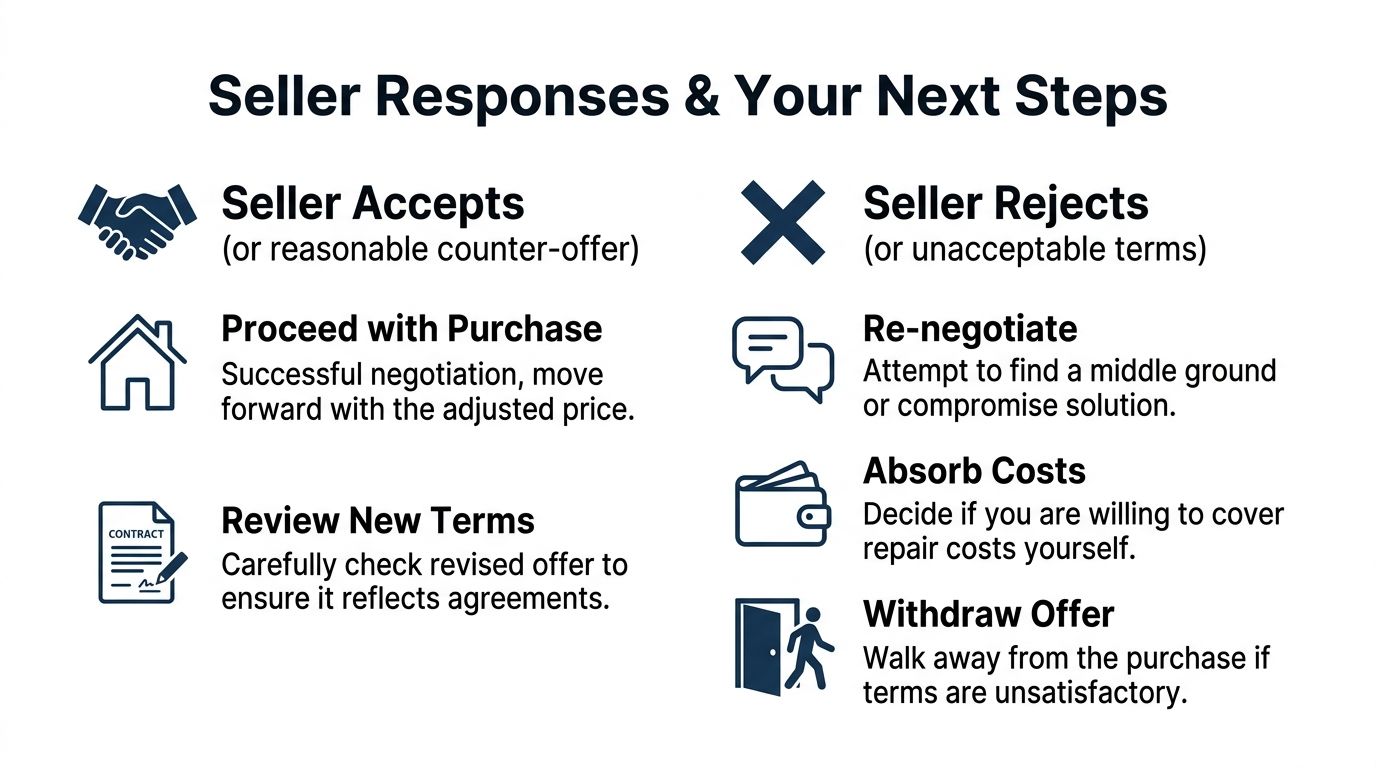
Most negotiations go one of three ways. The seller agrees. The seller counters. The seller refuses and hopes you'll blink first.
What you do next depends on the strength of your evidence and how much you want that specific property.
If the seller says no
A refusal doesn't automatically mean the deal is dead. Some sellers need time to realise the defect is real and the buyer isn't bluffing. Others know perfectly well the issue exists and are waiting to see whether you'll absorb it.
There's a useful caution here from Survey Merchant's discussion of negotiating after a survey. It notes that 68% of surveyors report buyers over-negotiating on minor defects, and that 30% of failed transactions follow sellers rejecting what they see as unreasonable price cuts. The lesson is simple. If you overplay cosmetic or minor points, you weaken your case on the defects that are significant.
Use this test if the seller won't move:
- Can you afford the repairs comfortably: If not, don't fool yourself.
- Are the defects manageable at the agreed price: Sometimes the answer is yes.
- Has the seller made a sensible counter-offer: A compromise may still work.
- Would you buy the same property again knowing this: If the answer is no, walk.
You are still subject to contract. That is your real advantage.
Why seller-done repairs are often a bad idea
Often, buyers are talked into a messy arrangement. The seller says, “Don't worry, I'll sort it before completion.” Sounds convenient. Often isn't.
Recent data cited by Yopa's guide on negotiating a house price after a survey shows that 42% of buyers who accepted seller-performed repairs faced delayed completion or defective work, and 15% then needed costly post-sale rework. It also notes that pre-exchange repair promises are legally weak unless properly documented in the contract by a solicitor.
That's why I generally prefer a clean price reduction. You control the contractor. You control the scope. You control the standard.
If the seller wants to do the works, assume they'll look for the cheapest route unless the contract says otherwise.
If you do go down that road, don't rely on emails, estate agent notes or verbal assurances. Your solicitor must lock down the detail. That means the exact works, the standard required, who inspects them and what happens if the seller fails to do them properly.
The hidden problem with “we'll fix it”
Even where the seller means well, this route causes practical trouble.
A roof patch repair may hide a wider defect. A damp contractor may treat symptoms and ignore the external cause. Completion can get delayed while invoices, guarantees and inspections are chased. Meanwhile, your mortgage offer and chain timetable keep ticking along.
That is why buyers in London often do better with money off the price and control of the work after completion, especially on period properties where old fabric needs thoughtful repair rather than a rushed pre-sale patch job.
Securing the Reduction and Finalising Your Purchase
Once a figure is agreed, don't assume the matter is done. Until it is recorded properly, the original price can still sit in the paperwork.
Get written confirmation from the estate agent that the seller has accepted the revised figure. Then make sure both solicitors receive that confirmation and issue an updated Memorandum of Sale. If that document isn't amended, there is room for confusion later.
Use a simple final check:
- Agent confirms revised price in writing
- Your solicitor receives it
- Seller's solicitor receives it
- The Memorandum of Sale is updated
- Mortgage broker or lender is informed if needed
- You proceed only once the paper trail matches the deal
A lower agreed price can have a knock-on effect on valuation and mortgage administration, so keep everyone aligned. If you want a better sense of how value is judged in the capital, this guide on house valuation in London helps put condition and price into context.
This last stage is dull, but it matters. Deals don't fall apart because the survey found defects. They fall apart because people assume a conversation counts as a completed agreement.
Frequently Asked Questions About Price Negotiation
You have the survey back. The seller says the house is "priced to reflect condition". The agent tells you another buyer is interested. Ignore the noise and deal with the facts in front of you.
FAQ on Post-Survey Negotiation
| Question | Answer |
|---|---|
| How much should I ask off after a survey? | Ask for the cost of defects that affect value, mortgageability or immediate repair liability. Full allowance makes sense for structural movement, roof failure, damp caused by building defects, or unsafe electrics. For older wear and tear, ask for a sensible contribution, not a refund for every tired sash window in a Victorian terrace in Lewisham. The HomeOwners Alliance guide to renegotiating after a survey gives a sound overview, but your figures still need to match the actual defects in your report. |
| Should I negotiate after a Level 2 survey? | Yes, if the report identifies clear defects and you can price them. A Level 2 is often enough to justify renegotiation, especially for damp, roof spread, timber decay, poor drainage, or movement. If the wording is too broad, get one or two contractor quotes before you go back with a number. |
| Can I pull out after the survey? | Yes, right up to exchange. Sometimes walking away is the correct call. If a Croydon house shows signs of subsidence, the insurer history is unclear, and the seller refuses a reduction, stop trying to rescue the deal. |
| Should I ask for repairs instead of money off? | Usually, no. Letting the seller organise repairs is one of the easiest ways to inherit a bad job. They will usually choose the cheapest contractor, do the minimum, and aim to get the sale through. Take the reduction and control the work yourself after completion. |
| What if the seller says the defects are 'already reflected in the price'? | Ask them to show how. If the asking price matched the condition, the survey would not have exposed extra cost you now have to carry. Sellers say this all the time. It only matters if the local evidence supports it. |
| Do I negotiate with the seller or the estate agent? | Put your revised offer through the estate agent and copy your solicitor if needed. Keep it short, factual and written down. Phone calls are fine for pressure. Written confirmation is what counts. |
A point buyers often miss is this. You are not negotiating because the house is old. You are negotiating because the survey has identified defects with a real cost.
That distinction matters in London. A cracked party wall in a tired terrace in Brockley is not the same as general age. Widespread damp from bridged external ground levels, failed flashings and rotten sub-floor vents is not "character". Call defects what they are, then price them properly.
Use simple wording. Try this:
"Following the survey, we are revising our offer to £X. The reduction reflects the cost of dealing with the identified defects, including [issue 1], [issue 2] and [issue 3]. We remain willing to proceed promptly at that figure."
If the seller offers to fix the problems before exchange, be careful. I usually tell clients to refuse unless the work is minor, specific, and easy to verify. Cosmetic patch repairs hide a lot. Fresh filler over movement cracks, a dehumidifier instead of dealing with damp, or a quick roofer patch on a failing rear addition roof will not protect you once you own the place.
First-time buyers also need to keep the rest of the purchase organised while this is going on. A practical checklist like these tips for a smooth first home move helps keep the basics under control while you sort out price, paperwork and timescales.
Keep your head. Keep the evidence. If the revised deal still works, proceed. If it does not, walk away and spend your money on a better house, not somebody else's backlog of repairs.