
Party Wall Surveyors London: Expert Solutions 2026

You're halfway through planning a loft conversion in Balham or a rear extension in Bromley. The builder asks when works can start. Then the neighbour says, “You'll need a party wall surveyor.” That's usually the moment the stress starts.
It needn't. The Party Wall etc. Act 1996 is there to keep work moving and stop neighbour rows turning into expensive nonsense. If you handle it properly from the outset, it protects your project, your neighbour's property and, particularly in London, the relationship over the fence.
Many homeowners struggle. Not because the Act is impossible, but because London projects are tight for space, Victorian and Edwardian housing stock is quirky, and poor paperwork causes delays before a single tool comes out. In boroughs such as Lewisham, Southwark, Greenwich and Wandsworth, I see the same problems again and again: notices served too late, drawings too vague, surveyors chosen for speed rather than judgement and disputes over fees that were avoidable.
Table of Contents
- An Introduction to the Party Wall Act
- When the Party Wall Act Applies to Your London Project
- Navigating the Party Wall Notice Process
- How to Select the Right Party Wall Surveyor
- Typical Party Wall Costs and Timelines in London
- The Party Wall Award and How to Avoid Disputes
- Frequently Asked Questions
An Introduction to the Party Wall Act
The Act is not planning permission. It's not building regulations either. It's a separate legal process that deals with work affecting a shared wall, a shared structure or excavation close to a neighbour's building.
That distinction matters. You can have planning consent and still be in breach of the Party Wall Act. I've seen homeowners in Peckham and Dulwich assume planning approval meant they were clear to start. They weren't.
At its heart, the Act does two jobs. First, it gives a building owner a lawful route to carry out certain works. Second, it gives the adjoining owner protection if those works affect their property.
Practical rule: The Party Wall Act is there to enable building work, not stop it.
In a London terrace, that usually means one of three things. You're cutting into a party wall for steel beams in a loft conversion. You're building near the boundary for an extension. Or you're excavating for foundations or a basement where the neighbouring structure could be affected.
That's why the process matters more in London than many people realise. In places like Southwark, Lambeth and Hackney, homes are tightly packed and works are often more intrusive than they first appear on paper. A job that looks straightforward to a builder can have real implications next door.
If you treat the Act as a formality, you can create delay and mistrust. If you treat it as a framework for setting clear rules before work starts, it usually runs perfectly well.
When the Party Wall Act Applies to Your London Project
A lot of confusion comes from homeowners not knowing which works trigger the Act. The answer is based on what you're doing physically to the structure or the ground.
In London, the common triggers are loft conversions, rear and side extensions, basement digs and some new walls built at the boundary. Victorian terraces in Islington, Hackney and Southwark are classic examples because the party wall is doing real structural work and new beams often need to go into it. In Bromley, Merton and Wandsworth, rear extensions and foundation excavations are the usual flashpoints.
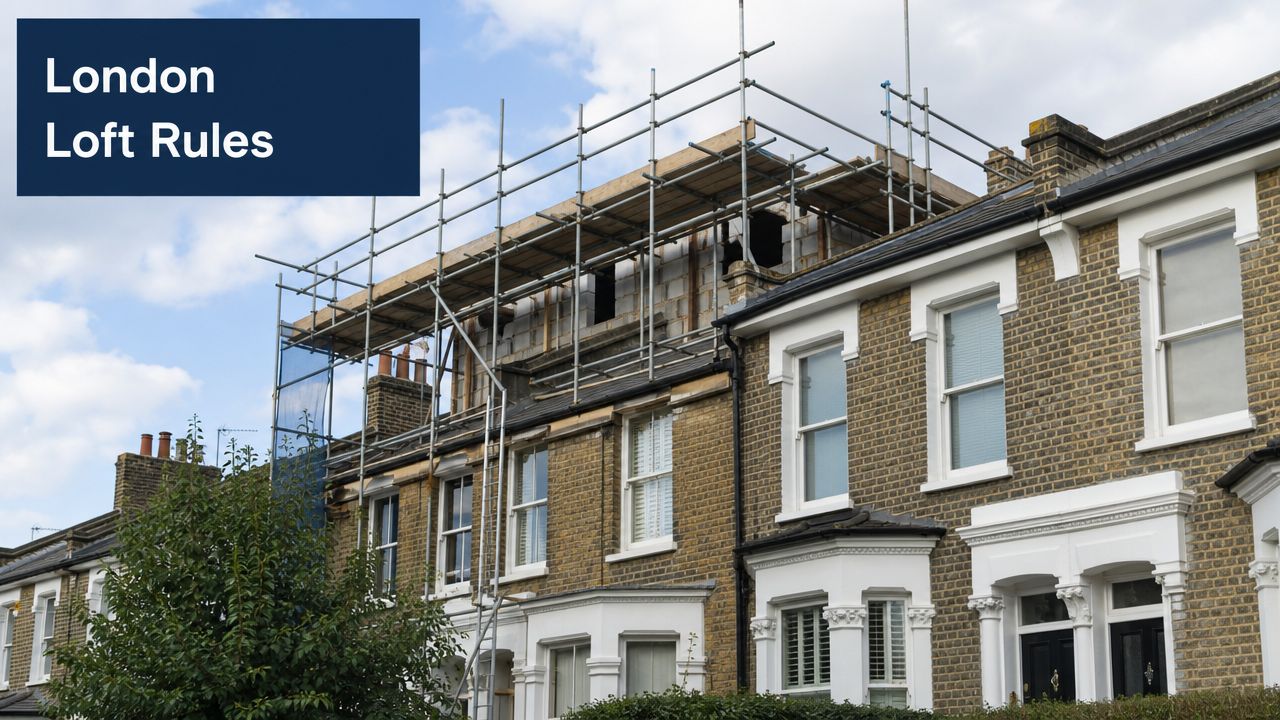
The works that usually trigger it
You're likely to need to deal with the Act if your project involves:
- Cutting into a shared wall: Typical for loft conversions where steel beams bear into the party wall.
- Raising or underpinning a party wall: Less common, but still seen in substantial alterations.
- Excavating near the neighbour's structure: This catches many extension projects where new foundations are close to the boundary.
- Building on the line of junction: Relevant where a new wall is proposed at the boundary.
- Basement excavation: This is the one that causes the most grief in dense parts of London.
Basements deserve special mention. Over 40% of party wall disputes in Inner London involve basement excavations, according to Hourican Associates on local party wall surveyors in London. That doesn't surprise me in the slightest. Basement work is technically demanding, disruptive and far more likely to worry neighbours than a simple loft.
The same source says employing a local party wall surveyor improves neighbour satisfaction and reduces prolonged conflicts. That also rings true on the ground. A surveyor who understands London stock, local construction patterns and borough realities will usually spot the trouble before it starts.
What counts as a party wall
A party wall is usually the wall shared by two buildings, such as the wall between two Victorian terraces in New Cross or Camberwell. A party fence wall is a wall that stands astride the boundary but does not form part of a building. People often mix those up.
A boundary wall entirely on your own land isn't automatically a party wall. Nor is every garden wall caught by the Act. The exact position and function of the wall matter.
Use this quick sense check:
| Project type | Often covered by the Act | Typical London example |
|---|---|---|
| Loft conversion | Yes | Steel beams into a shared wall in a Peckham terrace |
| Rear extension | Often | New foundations near a neighbour in Wimbledon |
| Basement dig | Very often | Excavation under a townhouse in Kensington |
| Internal redecoration | No | Plastering or kitchen refit with no structural work |
If there's any doubt, stop guessing. A quick review at the start is cheaper than untangling a bad decision later.
Navigating the Party Wall Notice Process
London projects most often go wrong with the paperwork, rather than the engineering. A notice served badly, late or without enough detail can stall everything.
A critical pitfall is serving a legally invalid Notice due to missing engineering details or improper drafting, which causes an estimated 40% of project delays before work even commences. Notices must be served 2-3 months prior to the start date with clear drawings attached, as set out in Tate Surveying's guidance on party wall issues.
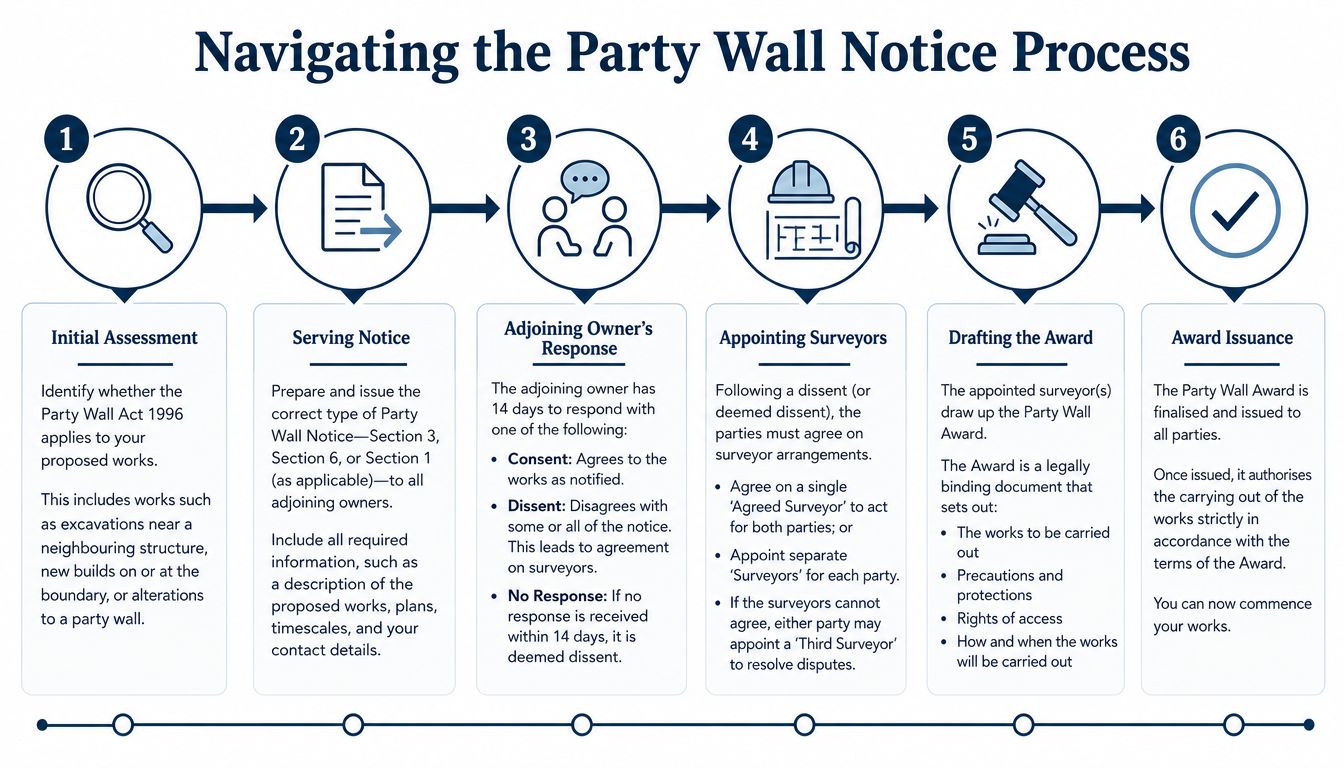
What a valid notice must contain
Under the Act, the building owner must serve a valid party wall notice at least two months before the proposed start date for works affecting a shared wall, party structure or boundary line. The notice must say it is issued under the Act and include the builder's name, address and the project address if different from the property address, as explained by Squarepoint Surveyors on party wall notices.
That's the legal minimum. In practice, I'd go further. Attach clear drawings. Include the engineering information that explains what's planned. If the neighbour can't understand the proposal, dissent is more likely.
For a plain-English breakdown, see this guide on what a party wall notice is.
A vague notice is an invitation to delay. A clear notice gives everyone something solid to work from.
Here's the sequence that keeps matters tidy:
- Check if the Act applies: Don't let the builder make that call casually.
- Prepare the correct notice: Different works require different notices.
- Attach proper information: Plans and engineering details matter.
- Serve it in time: Leave enough room before the intended start date.
- Wait for the response: Don't assume silence means approval to crack on.
What the neighbour can do next
Once served, the adjoining owner has three broad options.
- Consent in writing: Best case. Even then, I'd still consider a schedule of condition for anything more than minor work.
- Dissent and agree on one surveyor: This creates the agreed surveyor route.
- Dissent and appoint their own surveyor: Then each party has a surveyor and, if needed, a third surveyor exists in the background for unresolved points.
No response is not a green light. In practice, it leads to a dispute under the Act and surveyor appointments follow.
The agreed surveyor option sounds simpler, and it often is, but it only works if both sides are comfortable with the same professional acting impartially. Where neighbours already distrust each other, separate surveyors are often the cleaner route.
A basic checklist helps:
- Before serving notice: Finalise the drawings you intend to build from.
- After serving notice: Keep speaking to the neighbour. Don't vanish behind your builder.
- Before paying large deposits: Wait until the Party Wall Award is in place, especially on intrusive work.
That last point is often ignored. It shouldn't be.
How to Select the Right Party Wall Surveyor
Legally, a party wall surveyor doesn't have to be a chartered surveyor. That's the awkward truth. The Act allows a wider pool than many homeowners assume.
My view is simple. On a London residential project, especially in places like Lewisham, Greenwich, Southwark and Clapham, instructing anyone without proper professional standing is asking for trouble. Too much hangs on judgement, drafting and calm handling of people.
Qualifications matter
A competent party wall surveyor should be a member of RICS, CIOB or CABE, because those bodies provide the statutory training and ethical framework needed, as set out in Stokemont's guidance on becoming a party wall surveyor.
RICS matters for another reason. Under RICS guidance, the appointment is personal and independent. The surveyor administers the Act impartially rather than acting as an advocate for either owner, as stated in the RICS Party Wall Legislation and Procedure standard, 7th edition.
That independence is not optional. It's the core of the job.
If you're weighing up whether you need one at all, this article on do I need a party wall surveyor is worth reading before you appoint anyone.
Don't hire a hired gun. Hire someone who understands they are there to apply the Act fairly.
What I'd look for:
- Professional membership: RICS or CABE are strong indicators in residential work.
- London experience: A surveyor who knows period terraces, conversions and tight urban sites will be more useful.
- Actual independence: No cosy relationship with the builder, architect or agent.
- Clear writing: If they can't explain the process plainly before instruction, they won't draft a clean award later.
Questions worth asking before you instruct
Don't ask fluffy questions. Ask the ones that expose competence.
- Who do you act for under the Act: The right answer is that they act impartially within a statutory role.
- What sort of London work do you handle most: Lofts, extensions, basements and heavy structural alterations are not the same.
- How do you deal with schedules of condition and inspections: You want a practical answer, not a canned one.
- How do you approach neighbour communication: A good surveyor lowers the temperature rather than inflaming it.
If the answers sound defensive or vague, move on. A party wall appointment is too important to hand to someone who treats it like form filling.
Typical Party Wall Costs and Timelines in London
You're in Lewisham or Southwark, the builder wants to start in two weeks, and the neighbour has finally replied. First question is always the same. What is this going to cost, and how long is it going to drag on?
Here's the straight answer. In London, party wall fees are usually small compared with the cost of a stalled job, a neighbour complaint, or having to put defective notices right after the builder is booked.
According to Harding Surveyors' London party wall cost guide, the typical hourly rate in London is £150 to £270, with an average of £200 per hour. The same guide states the average total cost for securing a party wall award is approximately £1,000, although the figure varies significantly by project type.
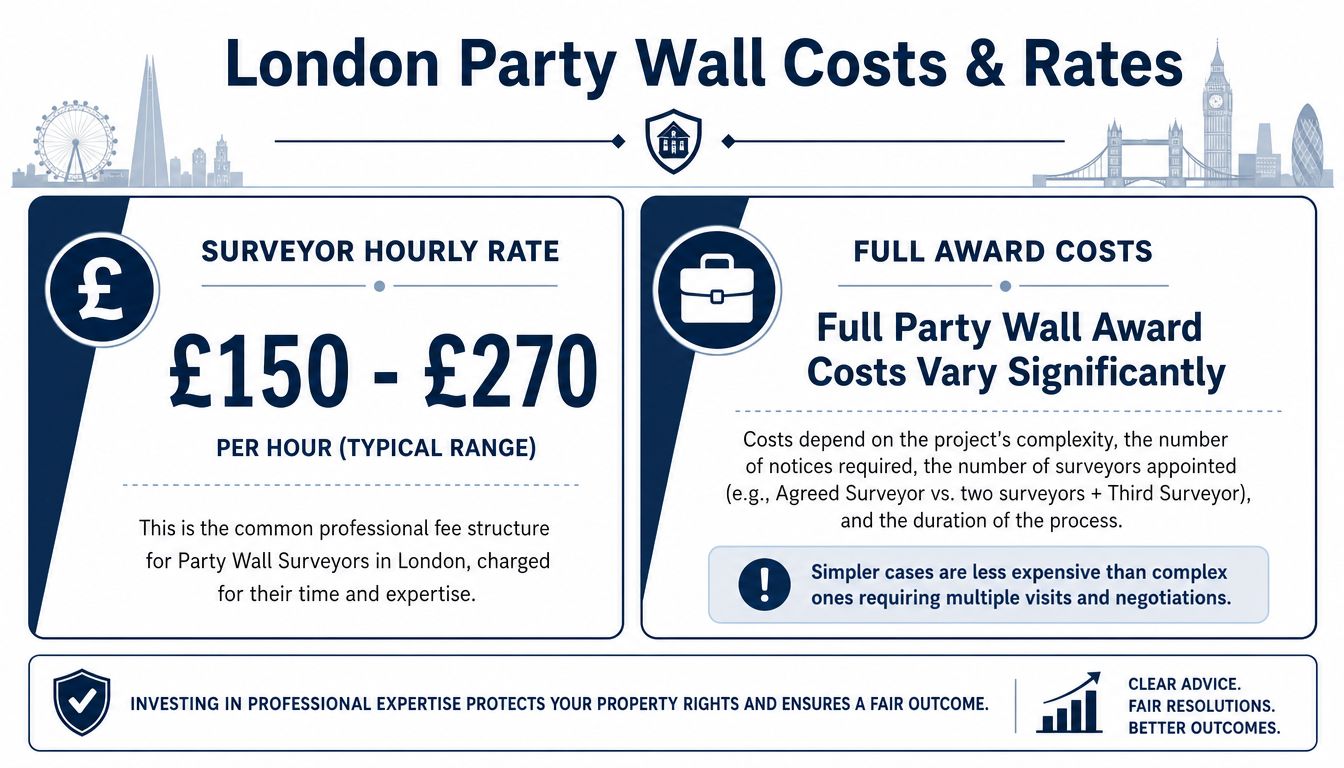
What London homeowners actually pay
For a single agreed surveyor, Harding breaks the costs down like this:
- Loft conversions: £900 to £1,200
- Extensions: £1,200 to £1,500
- New builds: £1,500 to £1,800
- Basement excavations: £1,800 to £2,700
The same source says that where both owners appoint separate surveyors, costs double to £1,800 to £5,400 overall, with basement projects reaching £3,600 to £5,400 in that situation.
A separate RICS-regulated pricing guide from Hourican Associates on RICS party wall surveyor fees in London says a Schedule of Condition Survey typically costs £385 to £585 plus VAT, while a Full Party Wall Award ranges from £1,100 to £1,500 plus VAT for an agreed surveyor. Basement work is priced separately because it needs more technical detail.
That last point matters in real London housing stock. A simple rear extension in a 1930s terrace is one thing. A basement dig under a Southwark townhouse or structural alteration around shared chimney breasts is another. If your plans involve steelwork and partial removal, read this guide to building regulations for chimney breast removal alongside the party wall process, because these jobs often trigger both technical and neighbour issues at the same time.
What affects the bill
The drawings are only part of it. Fees usually rise because the process starts badly, not because the surveyor suddenly becomes expensive.
In practice, the common cost drivers are:
- Invalid or vague notices: Wrong names, poor descriptions of the works, or dates that do not comply with the Act
- Late instruction: The builder is lined up before the paperwork is
- Separate surveyors: Sometimes justified, sometimes a complete waste of money
- Basements and heavy structural work: More inspections, more drafting, more argument
- Poor drawings: If the design team cannot explain the work clearly, the surveyors spend time fixing that
- Neighbour tension: Existing distrust in tightly packed streets can turn a routine matter into weeks of correspondence
That is why cheap quotes often end up costing more. If the notice is defective or the scope is muddled, you pay twice. Once for the original mistake, and again for the delay.
Timelines London owners should plan for
A straightforward matter can move reasonably well if the notice is valid, the neighbour engages, and the surveyor is appointed early. Trouble starts when owners assume the Act can be dealt with after the builder arrives.
As a rule, allow time for three separate stages. Service of notice. Response from the adjoining owner. Preparation of the award and schedule of condition if one is needed. Basements, complex lofts, and schemes with anxious neighbours take longer because they involve more site inspection and more drafting.
On older terraces, records are often poor and hidden alterations are common. In that sort of case, a practical scan-to-BIM conflict framework can help the design team pin down what is there before the argument starts on site.
The point homeowners miss
The cheapest party wall route is usually the one that starts early and stays tidy. Good notices, clear drawings, and a surveyor who knows London terraces will keep the fee sensible.
Leave it late, serve the wrong notice, or turn a minor issue into a turf war over surveyors, and the timetable slips fast. That is what costs money in London.
The Party Wall Award and How to Avoid Disputes
Your builder is due on Monday. On Friday, the neighbour says the notice was wrong, wants a different surveyor, and now everyone is arguing about access, dust, and who pays what. That is how small London jobs in places like Lewisham and Southwark turn into expensive nonsense.
The Party Wall Award is the document that stops that happening. It sets out what work is covered, when access is allowed, what protection is required, and what condition the adjoining property was in before anything starts. If the award is vague, the argument moves from the paperwork to the site.
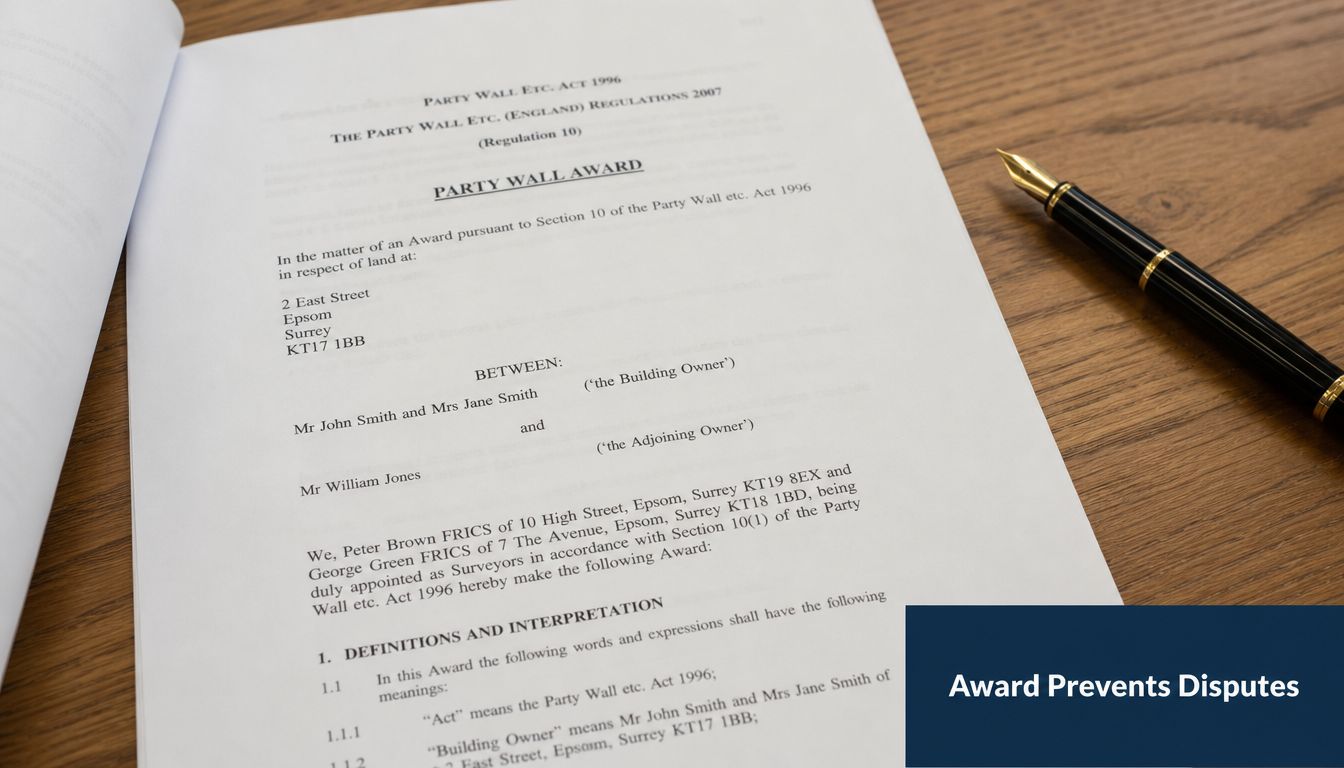
What the award actually does
A proper award gives clear instructions people can follow on a real building job. It should identify the works properly, deal with access and working hours where needed, attach the right drawings, and record the neighbour's property with a schedule of condition. It should also deal with security for expenses if that issue has been raised and justified.
Surveyors writing awards must act impartially. The owner paying the fee does not get a hired gun. That point has been reinforced in court and it matters in practice, especially where one side starts arguing over "reasonable" surveyor fees rather than the actual risk to the building.
Many London disputes falter at this point. Paperwork is treated like a legal formality, but the core issue is practical. Wrong drawings attached. Chimney breast already removed years ago but never shown. Loft steel bearing details missing. Builder asking for access that the award never defined. Then everyone starts blaming everyone else.
If your project involves hidden structure, awkward junctions or poor records, the best way to avoid a row is to pin down the existing fabric early. A practical scan-to-BIM conflict framework can help the design team and surveyor work from what is present, not what someone guessed from an old sketch.
How to stop a dispute before it starts
Disputes usually begin with sloppy detail and bruised trust, not some dramatic legal point.
Do these things properly:
- Get the scope right. The award must match the notice, drawings and intended method of work. If those documents do not line up, expect delay.
- Be precise about access. In Southwark and Lewisham terraces, side return space is tight and access is often the flashpoint. If access is needed, spell out where, when and for what purpose.
- Record condition properly. A rushed or thin schedule of condition is asking for trouble once cracking or vibration is alleged.
- Keep fees sensible and explained. Rows over surveyors' fees start when nobody sets expectations early or the work grows because the original notice and drawings were poor.
- Deal with awkward structural history upfront. Old chimney work, altered flank walls and patched roof structures regularly sit behind party wall arguments. This guide on building regulations for chimney breast removal shows the kind of defect that can spill straight into a neighbour dispute.
One more point. If a surveyor or owner starts treating the process like a contest to be won, the award usually gets slower, longer and less useful. Good awards are calm, specific and written for the site, not for showing off.
A well-run party wall process protects the building and gives neighbours a fair set of rules they can live with. That matters long after the builders have gone.
Frequently Asked Questions
Can my neighbour stop my extension or loft conversion?
Usually, no. The Act is not a veto. If the works are lawful and the process is followed properly, the focus is on regulating how the work is done, not stopping it for the sake of it.
Do I need a schedule of condition if the neighbour consents?
For minor work, not always. For anything structural, I'd strongly advise it. It protects both sides because it records the adjoining property before the first day on site.
What if my neighbour ignores the notice?
Silence does not mean approval to start. It leads to a dispute process under the Act, and surveyor appointments are then made so the matter can move forward properly.
Are local Party Wall Surveyors London owners can meet in person better than remote firms?
In many cases, yes. Local knowledge helps with London housing stock, access issues and neighbour communication. It also makes site visits and practical problem-solving easier when the job gets awkward, which it often does.
If you want steady, independent advice rather than sales talk, Corinthian Surveyors London LTD is a sensible place to start. The firm is based in Forest Hill and covers London boroughs from Lewisham and Southwark to Greenwich, Bromley and beyond. It is run by Clive Thompson, a surveyor with over 30 years in the built environment and qualifications in both RICS and CABE. Corinthian is RICS regulated, independent and has no ties to lenders, estate agents or developers. You can review their wider residential services at our services, including project management and building conservation, if your party wall issue sits within a larger programme of works.