
Valuation for Capital Gains Tax: A Practical Guide
You've sold the place in Peckham, or maybe you're sorting probate on a terrace in Lewisham, and now the tax question lands on your desk. The figure HMRC cares about is not your headline sale price. It's the valuation date and the market value at that point, and if that number is shaky, the whole CGT calculation is shaky with it.
That's why a proper valuation for Capital Gains Tax is not a box-ticking exercise. It's the piece of evidence that stands up when HMRC asks awkward questions, especially where the property was gifted, inherited, transferred between connected people or valued retrospectively. A clean, defensible report saves arguments later.
Table of Contents
- Why Your Valuation Date Matters More Than Your Sale Price
- When HMRC Requires a Professional Valuation
- How RICS Surveyors Value Property for Capital Gains Tax
- Commissioning and Documenting Your Valuation
- Common Valuation Mistakes That Trigger HMRC Challenges
- Real Scenarios for London Homeowners
- Your Next Steps and Frequently Asked Questions
Why Your Valuation Date Matters More Than Your Sale Price
A client in Blackheath can sell a flat for a tidy sum and still be completely wrong on CGT if they use the sale price as the anchor. HMRC doesn't always tax the actual price that changed hands. In many cases, it wants the market value on a specific date in the past.
That matters because CGT is charged on the chargeable gain, not on the mood of the market at the point you finally sold. The value at the correct date is what feeds the calculation, and a bad date gives you a bad answer. That's why property owners in London often need a retrospective view, not just a sales memorandum from an agent.
Practical rule: get the date right first, then worry about the tax arithmetic.
A useful comparison from outside the UK tax system shows the same principle. EndureGo Tax's expert advice on property CGT also stresses that the timing and basis of the valuation drive the outcome, not just the eventual sale figure. The tax logic is similar even if the regime is different.
If you're trying to check where a property sits before you instruct anyone, our own guide on checking property value in the UK is a sensible starting point. But for CGT, a rough online estimate won't do. You need evidence that can survive scrutiny.
The simple point is this. If HMRC says the relevant date was death, gift, rebasing or another deemed disposal point, the later market sale is secondary. The valuation date is the anchor, and everything else hangs off it.
When HMRC Requires a Professional Valuation
HMRC uses market value where the disposal isn't a normal arm's length sale. That includes transfers to a connected person, gifts and inherited assets, plus part-disposals and rebasing situations. The legislation and HMRC guidance are built around the idea that the tax should be based on an open-market figure, not on whatever the parties happened to write into the transfer paperwork. HMRC's market value guidance sets that out plainly.
When market value replaces the real transaction price
The technical definition is straightforward. Market value is the price an asset might reasonably be expected to fetch on a sale in the open market. HMRC also says you don't get to knock the value down just because the whole asset is being valued at once, so there's no room for a made-up “flooding” discount when you're dealing with a larger holding or an awkward disposal route. HMRC's valuation rules are very clear on that point.
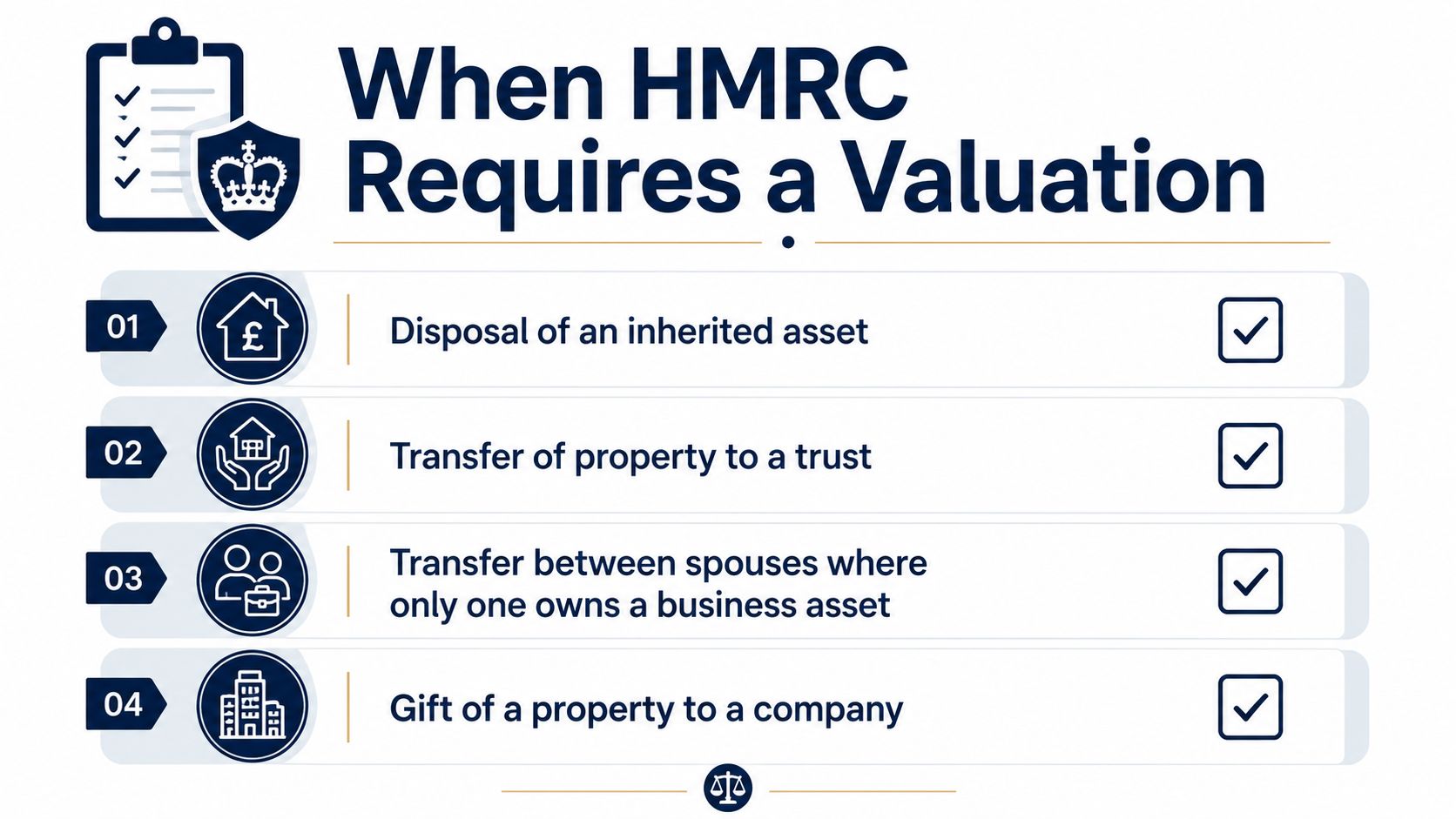
These are the trigger points that commonly force a professional valuation:
- Connected-party transfers: if you transfer a property to a relative, business partner or other connected person, HMRC wants market value.
- Gifts: if you give away a flat in Bermondsey or a house in Croydon, the absence of cash doesn't remove the need for a value.
- Inherited assets: probate values often become the CGT base later, so the valuation needs to be defensible from the start.
- Part-disposals: if only part of an asset is transferred, the retained and transferred interests both need care.
- Rebasing cases: older assets can trigger historic valuation work, including the 31 March 1982 rebasing point mentioned in practitioner guidance.
- Monies worth transactions: if consideration comes in a form that isn't straightforward cash, valuation still matters.
HMRC says it can check valuations and use its own processes where needed, which is exactly why weak evidence causes grief. The official manual on capital gains and other taxes says chargeable gain is broadly the disposal consideration less acquisition, creation or improvement expenditure, and where disposal is deemed at market value, that market value replaces actual proceeds in the formula. HMRC's capital gains manual is the place to look for the mechanics. If you want to see how a tax firm frames this for landlords, landlord capital gains reliefs is a useful read alongside the property-side evidence.
The practical lesson is simple. If the deal isn't a clean open-market sale, don't guess. Get a proper valuation and keep the supporting notes with the tax file.
How RICS Surveyors Value Property for Capital Gains Tax
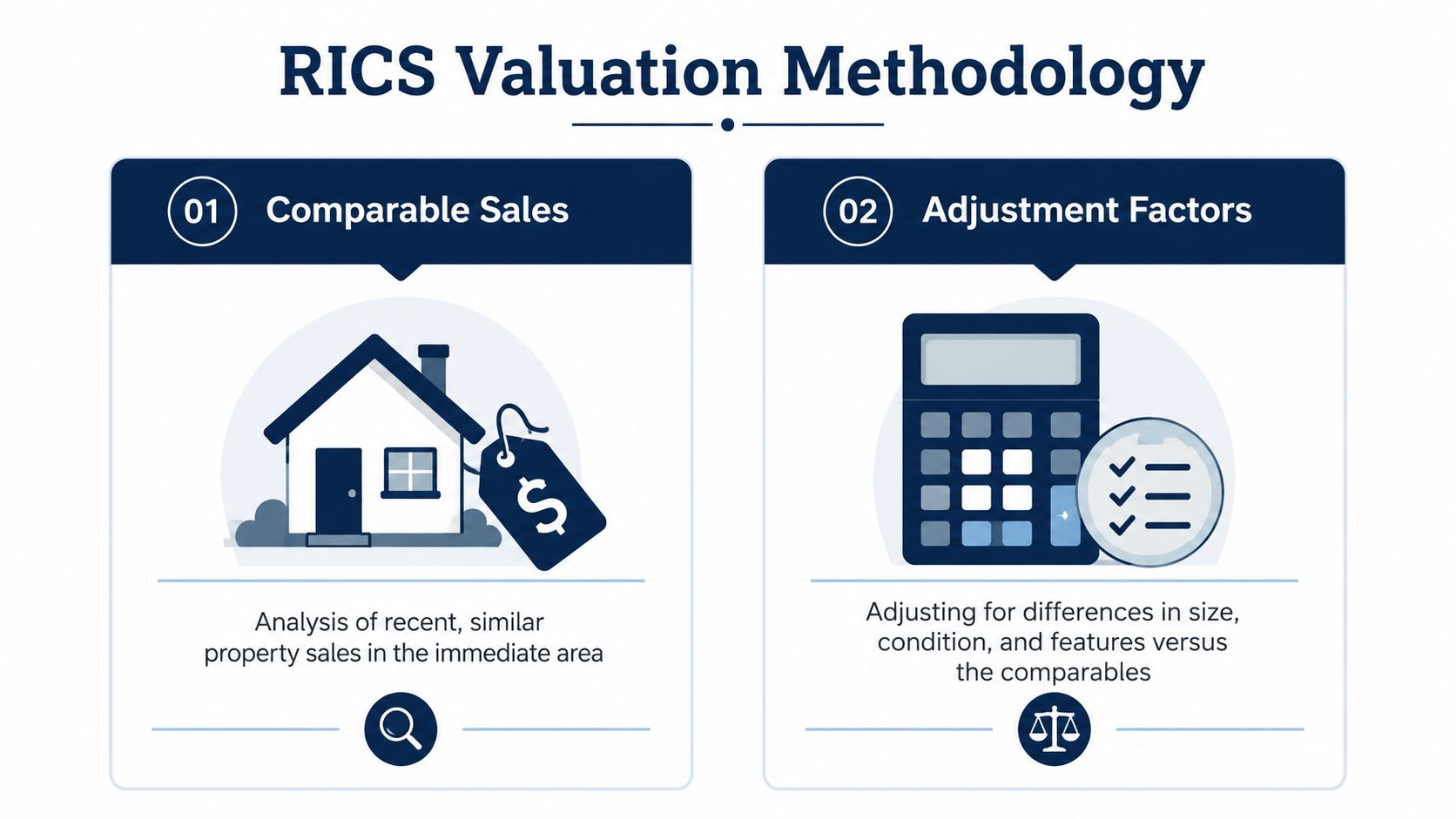
A decent CGT valuation is built from evidence, not optimism. A RICS Chartered Surveyor looks for comparable sales in the same street, nearby streets or the same local pocket, then adjusts for condition, size, layout, tenure and any quirks in the title or property type. That is exactly the sort of work HMRC can understand when it reviews the file. For a deeper look at the format and output, see our page on RICS property valuations.
What good evidence looks like
A proper report is not the same thing as an estate agent's sales pitch, a mortgage valuation or an insurance figure. An estate agent is trying to win instructions. A lender's valuer is trying to protect the lender's security. An insurance reinstatement figure is about rebuilding after a loss, not market value for tax.
A valuation that can't be explained is a valuation HMRC can pick apart.
The better approach is boring, and that's exactly why it works. The surveyor inspects the property, records the condition, notes defects that affect demand and then tests the figure against real transactions. In London that might mean comparing a Victorian terrace in Forest Hill with another in Brockley, or a converted flat in Deptford with a similar unit in Southwark. Local detail matters because a neat postcode match is not enough.
Corinthian Surveyors London LTD does this as an independent practice with no ties to lenders, estate agents or developers. That independence matters more than people think. It keeps the value grounded in the evidence, not in someone else's agenda.
A conservative figure backed by the right comparables is usually more usable than a brave number that looks clever on paper. HMRC cares about defensibility. So do solicitors, probate personal representatives and anyone else who has to rely on the report later.
Commissioning and Documenting Your Valuation
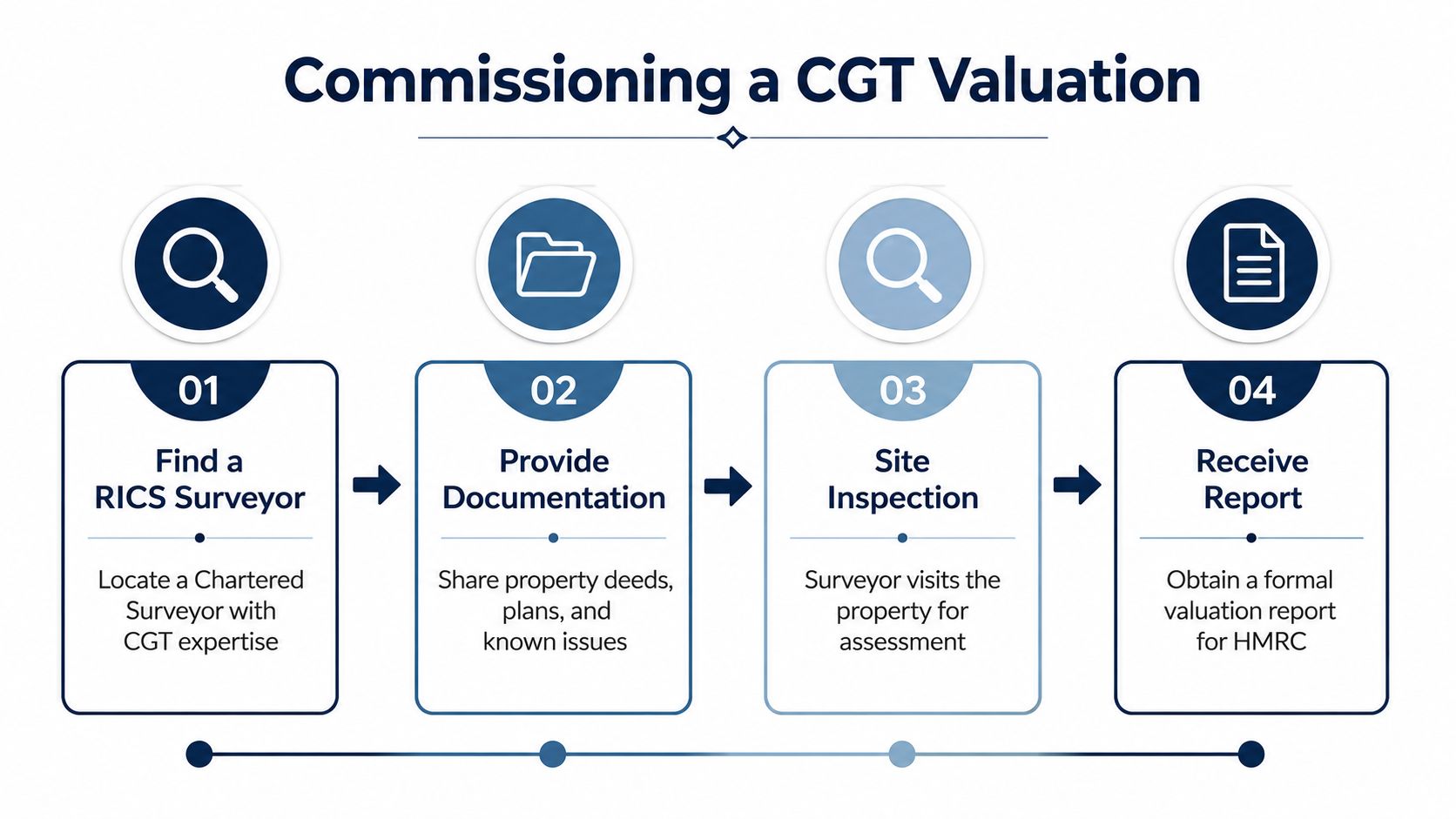
Start with the right brief. Tell the surveyor why you need the valuation, the exact date it needs to relate to and whether the property was gifted, inherited, transferred between connected parties or sold already. If the brief is sloppy, the report will be sloppy.
What to gather before the inspection
Bring the records that help the surveyor separate market value from guesswork:
- Title details and plan: these show what land and rights are being valued.
- Any planning or alteration paperwork: extensions, loft works and internal changes can affect value.
- Evidence of improvements: kitchens, roofs, rewiring and other enhancement work should be recorded properly.
- Known defects: damp, movement, roof leaks or timber issues matter because they affect buyer demand.
- The exact CGT trigger date: that might be the date of death, transfer, gift or another deemed disposal point.
The valuation report should be dated properly, addressed to the right party and tied to the exact scenario. If it is meant to support HMRC reporting, the wording needs to match the tax event, not a general sales estimate. That sort of detail saves needless back-and-forth later.
The sensible part of this process is record keeping. Keep the report, keep the comparables if they're provided and keep the receipts for enhancement expenditure. HMRC enquiries get much uglier when no one can explain why the figure was chosen.
If you want a practical example of the format a report should follow, our page on property valuation reports is worth a look. A clear report is much easier to defend than a casual email with a figure in it.
Common Valuation Mistakes That Trigger HMRC Challenges
The biggest error is using the wrong figure because it's convenient. An estate agent's estimate is not a tax valuation. A mortgage valuation is not a tax valuation either. Neither one is written to survive a challenge on market value.
Another common mistake is mixing up market value with insurance reinstatement cost. They are different numbers for different jobs. If you use the rebuild figure for CGT, you will misstate the gain and possibly misjudge whether disposal timing still makes sense.
The errors I see most often
- Wrong valuation date: the date you like is irrelevant. The relevant tax date controls the calculation.
- Poor comparables: relying on stale sales or the wrong property type weakens the report.
- Ignoring enhancement expenditure: if you've added value through proper improvements, that needs to be captured separately.
- Confusing vacant possession and actual occupation: the valuation hypothesis must match the tax event.
- Using a lender figure: a mortgage valuation is aimed at lending risk, not CGT evidence.
The result cuts both ways. Under-value the property and HMRC may challenge it, which can lead to penalties and delay. Over-value it and you overstate the tax bill, which can distort the decision to sell now, hold back or structure the transaction differently.
If the evidence is thin, HMRC will assume the number is thin too.
That's why a slightly lower but properly supported valuation is usually the safer play. I'd rather stand behind a report with clean comparables from Lewisham, Greenwich or Bromley than a glossy number nobody can justify. That is how you stay out of trouble.
Real Scenarios for London Homeowners

A Victorian terrace in Lewisham that's inherited through probate is a straight example of why the date matters. The CGT value is linked to the date of death, not the later sale price, so the surveyor needs to look at evidence from the right point in time and compare similar stock in the local area. A terrace in Forest Hill is not automatically the same as one in Dulwich, even if they look similar from the kerb.
A gifted flat in Bermondsey is different again. There may be no cash changing hands, but HMRC still wants market value because the transfer isn't an arm's length bargain. That report needs to reflect the flat's condition, lease length, building position and any local premium or discount tied to the block.
A 1930s semi in Bromley bought before 1982 brings another layer. Rebasing can change the starting point, so the valuation has to fit the relevant historic date, not just the current asking price. In Blackheath, conservation area status can also matter because buyers often pay attention to appearance, controls and the cost of altering period features.
For retrospective work after a sale, the job gets more forensic. You're rebuilding the evidence trail after the fact, which means the surveyor has to lean harder on archived comparables, known condition and the exact disposal date.
The video below gives a useful visual overview of the sort of property context that drives valuation work.
That's where local judgement pays off. A valuer who knows Southwark, Lambeth, Greenwich and Bromley won't treat every house as if it's interchangeable. The evidence has to fit the street, the stock and the tax event.
Your Next Steps and Frequently Asked Questions
Start with three decisions. Pin down the valuation date. Gather the paperwork. Instruct a RICS Chartered Surveyor who understands CGT, not just general marketing values. If you're also dealing with probate or a wider tax file, a clear conversation with your accountant helps keep everyone on the same page. For additional tax-side reading, capital gains tax advice gives a broader planning view.
If you're asking whether a retrospective valuation is still usable after a sale, the answer is yes, if the evidence is still sound and the date is right. If you're asking whether a shared ownership staircasing valuation also covers CGT, usually no, because the tax question and the staircasing question are not the same thing. And if your accountant and surveyor disagree, the surveyor should be the one dealing with market value, while the accountant handles the tax treatment.
HMRC can check a valuation after the event, so don't file and forget. Keep the report with your tax records, together with any improvement invoices and notes on the disposal route. That is the cleanest way to reduce the risk of a pointless argument later.
Corinthian Surveyors London LTD handles Capital Gains Tax valuations, probate valuations and market valuations for residential property across London and the Home Counties. If you need a defensible valuation for a home in Forest Hill, Peckham, Greenwich, Bromley or anywhere nearby, call 0800 00 16 422 and ask for a proper RICS valuation based on the actual tax date.
Corinthian Surveyors London LTD carries out residential valuation work, including valuation for Capital Gains Tax, with the same no-nonsense approach used on probate and market valuation instructions. If you need a report that is clear, defensible and tied to the right date, visit Corinthian Surveyors London LTD and take it from there.