
Residential Land Surveyors Guide for London Homeowners

You're halfway through a purchase, the seller's solicitor is moving things along, and then a fence line looks wrong on the title paperwork. That's when people realise a residential land surveyor is not just measuring bricks and mortar, they're sorting out the legal and practical bits that can stall a deal. In England and Wales, HM Land Registry reported 1,406,160 residential property sales in 2023, which is exactly why surveyors stay central to buyer and lender risk management, especially when boundaries, access and condition all need independent eyes on them. HM Land Registry transaction scale and price context
A lot of buyers think a survey is just about damp patches and roof tiles. It's not. In London, the awkward stuff is often about where one title ends and the next begins, and that's where the job gets serious.
Table of Contents
- Introduction to Residential Land Surveying
- Understanding Residential Land Surveying Concepts
- Types of Residential Land Surveys
- When to Commission Each Survey
- Survey Costs and Turnaround in London
- Step by Step Survey Process
- How to Choose and Brief a Surveyor
- Summary and Common Questions
Introduction to Residential Land Surveying
You buy a Victorian terrace in Lewisham, then the neighbour says the side return fence has crept onto their land. That's not a cosmetic problem, it's a boundary problem, and it can hit your purchase, your mortgage and your future building plans all at once. A good residential land surveyor deals with that calmly, using the right evidence instead of guesswork.
In London, that matters more than people think. Dense plots, old title records, converted houses and shared access routes mean the line on a plan often needs proper checking. RICS-regulated advice helps because it keeps the focus on evidence, not assumption. For a practical comparison of how site constraints get assessed before design work starts, the site analysis guide for architects is worth a look too.
The point is simple. Don't wait until a neighbour challenge or party wall issue lands in your lap. Get the survey and boundary position clear early, while you still have room to act.
Understanding Residential Land Surveying Concepts
A lot of confusion comes from people using “survey” as if it means one thing. It doesn't. In residential work, you're usually dealing with boundary evidence, topographic information, measured building data and, in some cases, party wall advice. Each one answers a different question.
RICS standards are clear on the important point. A residential land surveyor must establish legal boundaries from title evidence, physical features and site inspection, not from one measurement source alone. RICS professional standards That's the sensible approach, because a fence, an old deed plan and what is found on site don't always line up.
Boundary evidence is not guesswork
If the title plan is vague, the surveyor looks at the paper trail, the occupation line and the site itself. That might include a fence, wall, hedge, path or historic feature. It does not mean a surveyor can magically turn an indicative plan into a court judgment. If the evidence is weak, a solicitor or specialist boundary expert may need to step in.
Topographic and measured building work serve different jobs
A topographic survey records ground levels, changes in surface and drainage features. That helps when you're planning an extension, redesigning access or dealing with awkward levels at the back of a property. A measured building survey is different again, because it captures the building's layout, elevations and dimensions for drawings and design work.
Practical rule: if the question is “what land do I own”, start with boundary evidence. If the question is “what can I build here”, you're into measured or topographic work.
For address-based property systems, a mapping tool such as Convert addresses to Zillow lot IDs can be useful in other markets. In the UK, though, you should always come back to the title documents and the survey evidence chain first. I'd also point readers to what is a RICS survey if they want the basics without the fluff.
Types of Residential Land Surveys
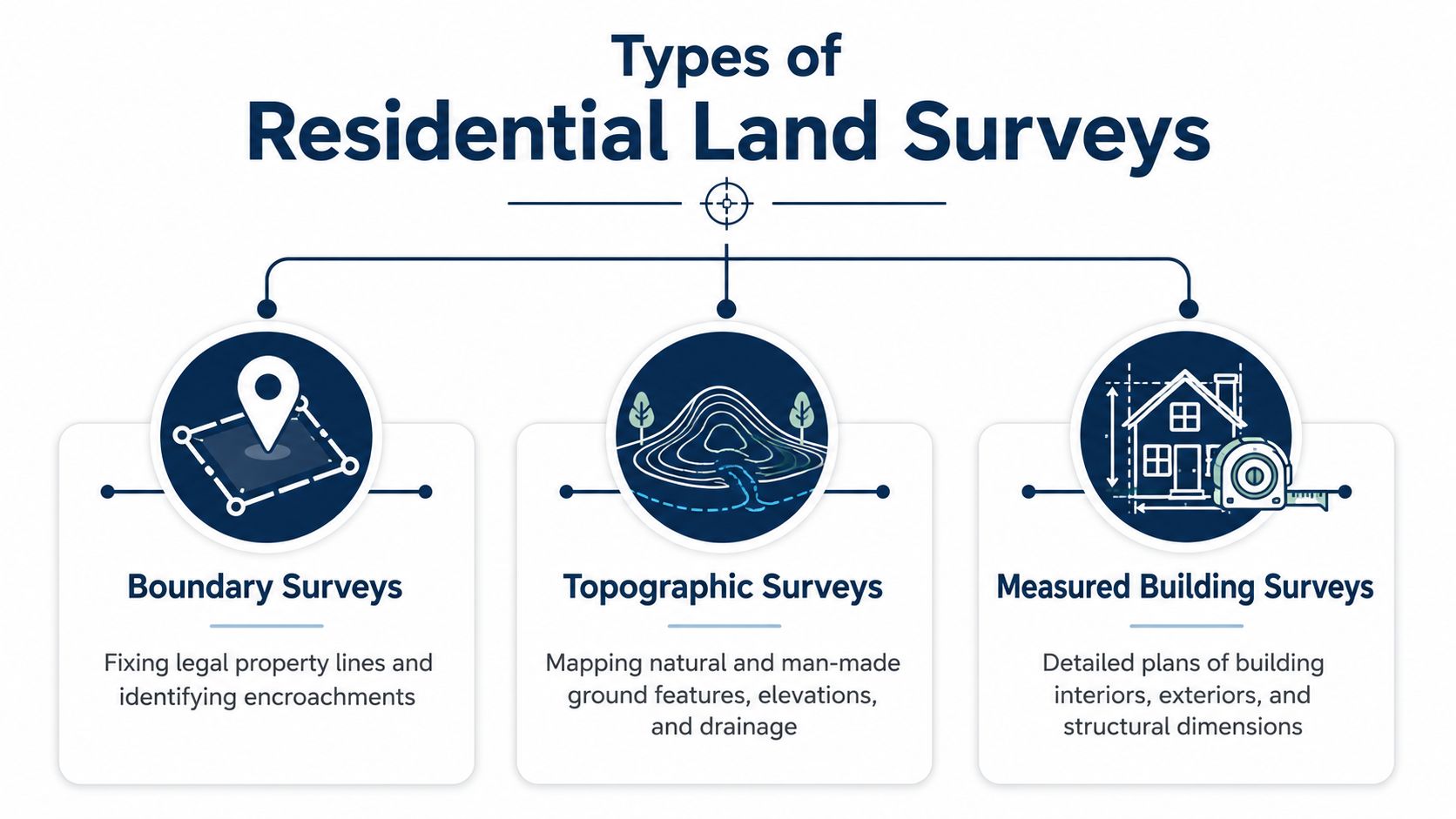
Here's the short version. Different jobs need different surveys. If you order the wrong one, you waste time and still don't answer the actual question.
- Boundary surveys fix or test legal property lines and look for encroachments. Deliverables usually include a plan showing the boundary position, occupation features and any conflict points.
- Topographic surveys map levels, slopes, drainage and physical features on the site. You normally get level data and a site plan that helps with design, access and drainage decisions.
- Measured building surveys produce accurate plans, elevations and internal layouts. They're used when architects, builders or conservation specialists need reliable drawings.
- Party wall advice is not really a “survey” in the same sense. It's the technical and procedural guidance you need where works affect a shared wall, boundary wall or nearby excavation.
The RICS Home Survey Standard also structures residential surveys into three levels, from Level 1 condition checks to Level 3 full building inspection. RICS Home Survey Standard That's the homebuyer side of the world, and it sits alongside boundary and measured work rather than replacing it.
If the title line is the issue, you want boundary work. If the building line is the issue, you want measured plans. Don't mix them up.
When to Commission Each Survey
A first-time buyer in Croydon with an odd title plan should not wait until after exchange to ask for boundary help. If the fence line, side passage or rear wall looks doubtful, commission a boundary survey early and get the evidence clear before the pressure starts. Boundary and access disputes are among the most common residential friction points, and many guides still fail to explain when survey evidence goes beyond what a title plan alone can prove. Boundary and access dispute context
A homeowner in Greenwich planning a rear extension needs a different approach. If there's level change, a tight side return or drainage uncertainty, a topographic survey is the right call because design work depends on accurate ground data. A flat owner in Brixton thinking about loft works should get party wall advice early, because neighbour notice and timing matter long before the builder arrives.
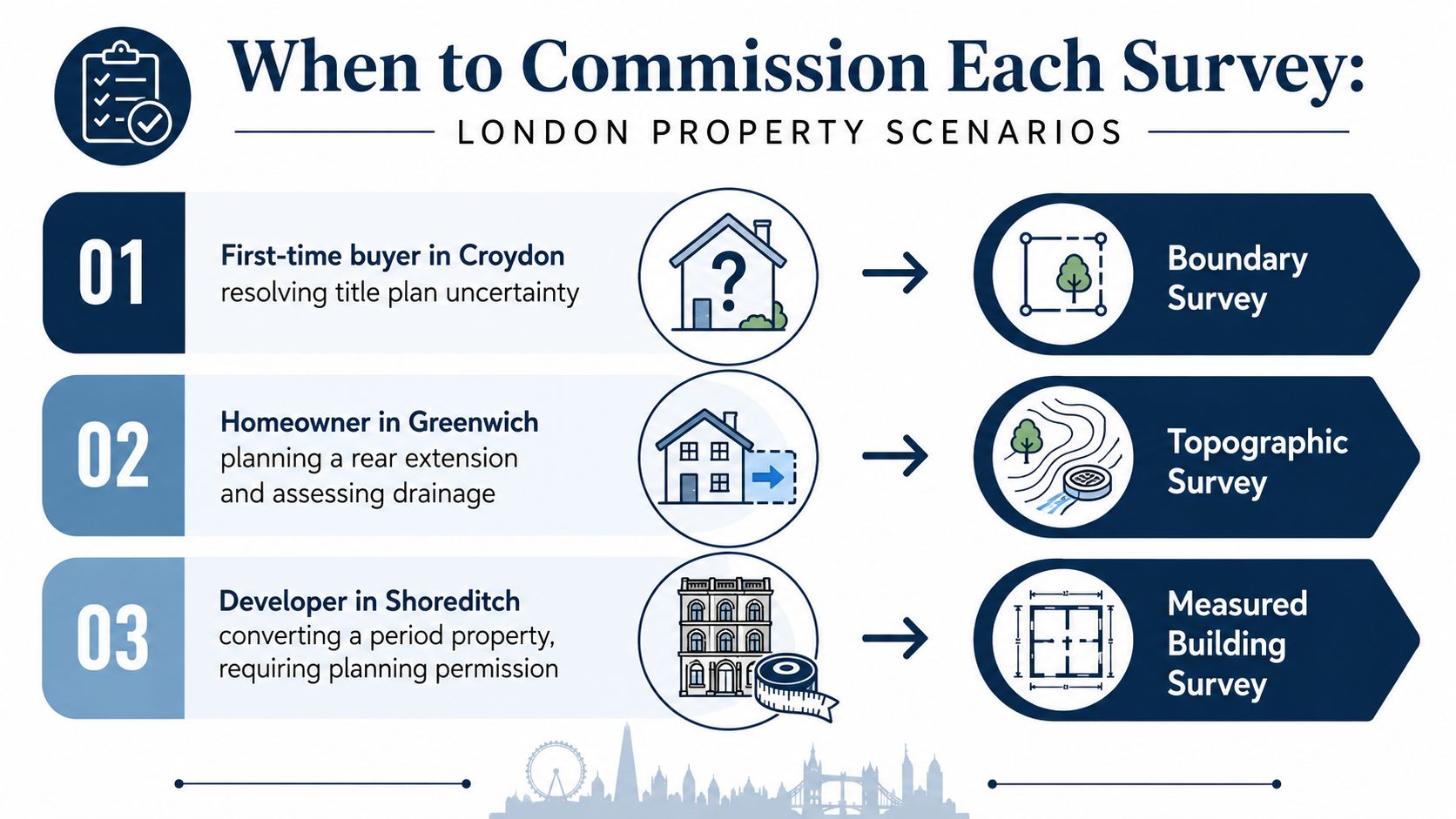
Use the trigger, not the label
- Missing deeds or weak title evidence usually justify boundary-focused work.
- Extensions, rearranged gardens and drainage issues point to topographic surveying.
- Loft conversions, shared walls and excavation near neighbours call for party wall advice.
- Architectural redesign or conservation-sensitive works often need measured building plans first.
If you're dealing with a developer, a builder or a solicitor, be direct about the issue you want solved. A surveyor can only give useful advice when the brief matches the problem. If you want a wider look at residential services, the our services page is a sensible starting point.
Survey Costs and Turnaround in London
People ask about cost first, but timing is usually the primary challenge. In London, industry commentary points to a shortage of experienced surveyors, so realistic turnaround expectations matter when a transaction is time-sensitive. London surveyor availability commentary If your chain is tight, don't leave the survey to the last minute and then act surprised when the report isn't instant.
What changes the schedule? Access, complexity and what kind of evidence is needed. A terrace in Forest Hill with easy access and a straightforward brief is one thing. A split-level house in Camberwell with rear access only, neighbour questions and old plans to review is another.
A good comparison point is how some industries use quote tools to set expectations before work begins. For example, the Ace Aviation Aerospace Academy quote calculator shows the same principle in a different field, you need the right inputs before anyone can price accurately. Survey work is the same. Give the surveyor the right title documents, the right address and the right problem, then let them tell you what timing looks like.
Book early if the deal matters
If you're buying in a chain, order the survey as soon as the paperwork is ready. If you're valuing a flat in Southwark or arranging work in Dulwich, build in a buffer. Corinthian Surveyors London LTD handles residential instructions across London, the Home Counties and the South of England, and that kind of local reach only works if clients are honest about deadlines from the start.
For valuation-related timing questions, see the firm's house valuation cost guide. It helps set expectations without pretending every property is the same.
Step by Step Survey Process
The process should be tidy. If it isn't, trouble starts before the surveyor even gets to site.
1. Initial enquiry
You give the surveyor the address, the reason for instruction and the deadline. If it's a boundary issue in Bromley or a pre-extension check in Peckham, say so plainly. Vague instructions produce vague reports.
2. Briefing the surveyor
Send the title plan, any old survey, the solicitor's paperwork and anything odd you already know about. If access is awkward in Lewisham or Southwark, say that too. A locked side passage, a tenant in occupation or a neighbour-controlled garden gate all affect how the visit runs.
3. On-site inspection
The surveyor visits the property and checks the relevant evidence on site. That could mean boundary markers, visible occupation lines, levels, drainage runs, or the layout needed for drawings. In RICS work, the site visit is not a box-ticking exercise. It's where the evidence is tested against reality.
4. Draft report
A proper draft is read carefully, not skimmed. If anything needs clarifying, this is the moment to ask. You want the wording to be clear enough that your solicitor, architect or builder can act on it without translation.
5. Final report and drawings
The final pack should give you the report, the advice and any necessary drawings in one place. The point is to leave you with something usable, not a pile of notes. A decent surveyor will flag what needs further specialist input and won't pretend to be the wrong expert.
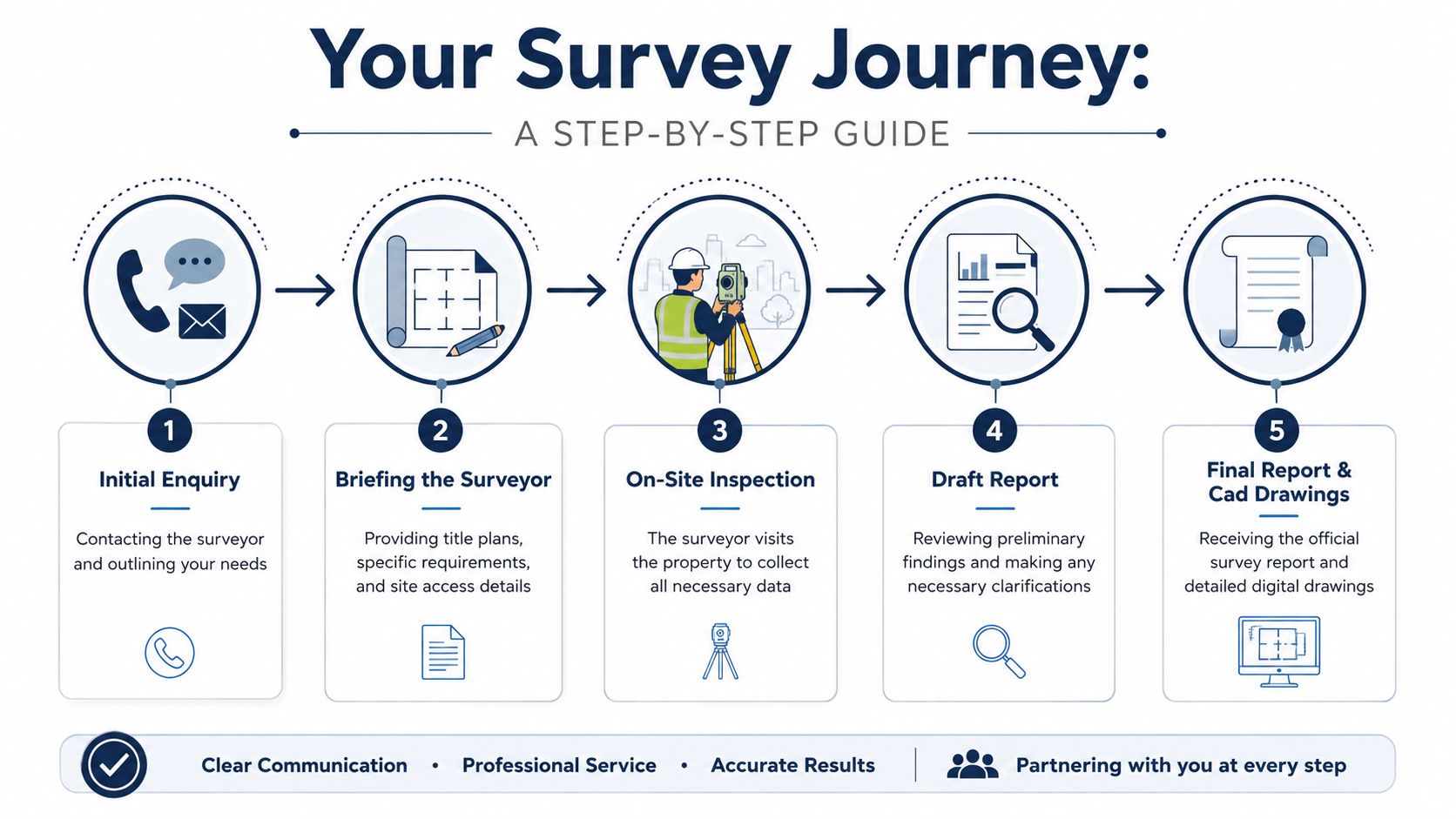
A clean brief saves days later. A messy brief turns a straightforward inspection into a back-and-forth exercise nobody wants.
How to Choose and Brief a Surveyor
Qualifications matter. So does independence. If a surveyor has ties to a lender, estate agent or developer, you need to know that upfront. RICS and CABE qualifications are sensible markers, and independent advice is what buyers should be paying for, not a soft answer designed to keep another party happy.
Local knowledge matters too. A surveyor who knows Forest Hill, Dulwich, Greenwich or Croydon will spot the pattern in the housing stock quicker than someone treating every job like a postcode spreadsheet. Victorian terraces, 1930s semis, mansion blocks and converted flats each bring different boundary and access issues.
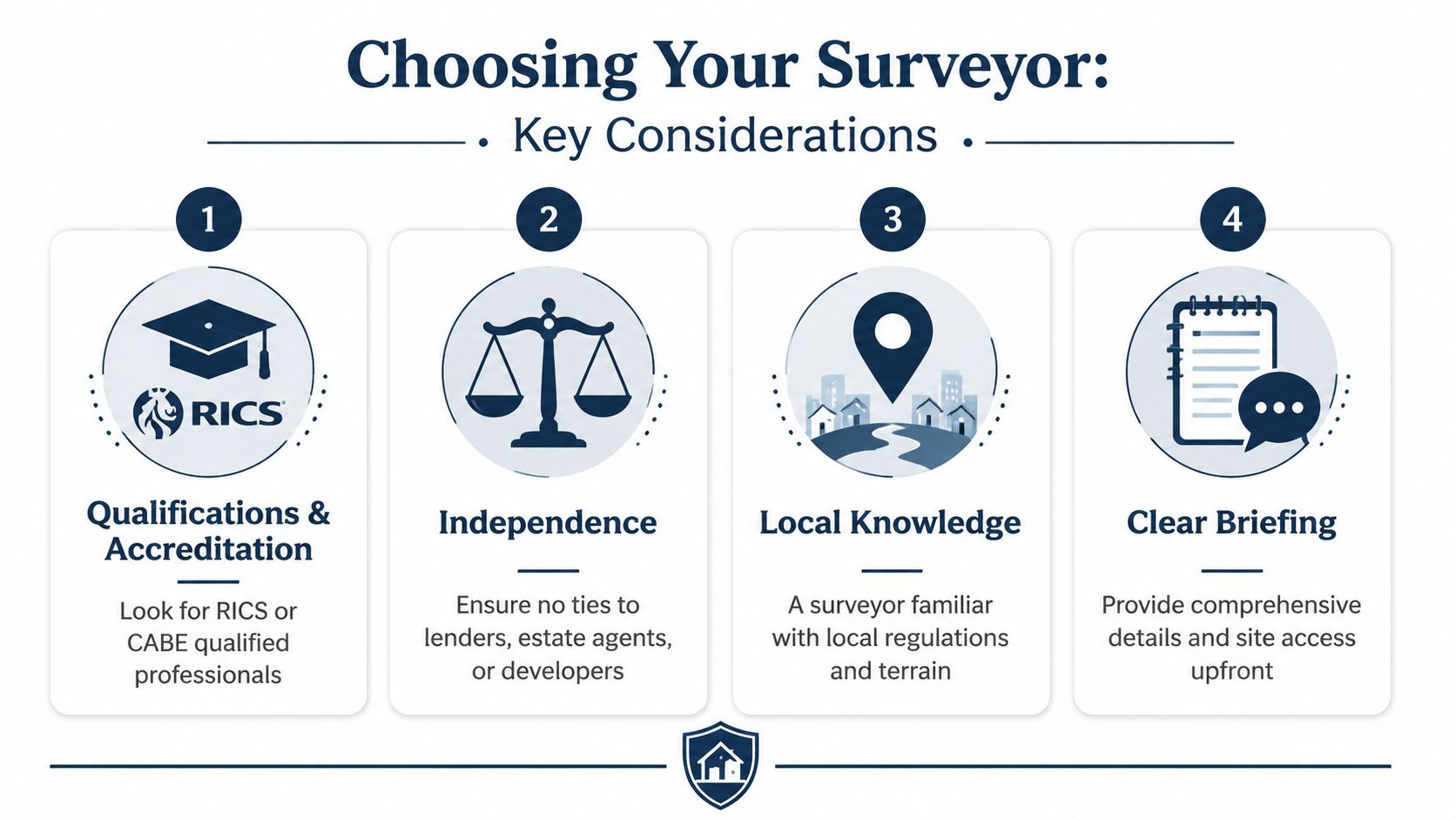
Ask three blunt questions before you instruct anyone.
- What qualifications do you hold? Look for RICS or CABE.
- Are you independent? No lender, agent or developer ties.
- How do you handle similar properties locally? Ask for relevant experience in your part of London.
- What do you need from me now? Good surveyors tell you exactly what documents and access details they need.
If you want a London practice that deals with residential work in that straightforward way, Corinthian Surveyors London LTD is one option. It's an independent RICS Chartered Surveyors and Valuers practice, based in Forest Hill, and it works without lender or estate agent ties.
The contact point is simple if you need to talk through a boundary issue, valuation or survey brief: 0800 00 16 422. If you prefer to read first, the surveyors near me article is a useful place to compare what to ask before you book.
Summary and Common Questions
Residential land surveyors are there to stop avoidable mistakes. They check boundary evidence, inspect the property properly and give you advice you can act on. In London, that means dealing with awkward title plans, tight plots and neighbour issues before they become expensive.
RICS regulation and proper insurance are basic safeguards, not nice extras. If you're buying, building or dealing with a probate valuation, don't skip the survey to save a bit upfront. That's false economy.
When is boundary evidence definitive? Not when a title plan is vague. You need the full evidence chain, and sometimes solicitor input too.
Will changes to the brief affect completion timing? Yes. Late changes usually slow things down, so say what you need at the start.
Should I skip a survey to save money? No. If the issue is boundary, condition or access, you're better off knowing now than arguing later.
Corinthian Surveyors London LTD is an independent RICS practice serving residential clients across London. If you need clear advice on a survey, boundary issue or valuation, call 0800 00 16 422.
A CTA for Corinthian Surveyors London LTD.