
Japanese Knotweed Survey: What to Expect and How It Works

Around 5% of UK properties are affected by Japanese knotweed, directly or through neighbouring land, according to 2023 survey research, so a suspected plant near your home deserves a proper investigation rather than guesswork. A Japanese knotweed survey is a specialist RICS-style inspection that records visible knotweed, maps its location on a site plan and grades its proximity to the building, boundaries and drains so a lender, conveyancer and buyer can make an informed decision.
You may have found the plant in a Forest Hill garden, spotted it beside a boundary in Lewisham or received a worrying note in a survey report for a Victorian terrace in Catford. The sensible response is to slow the transaction down, not abandon it.
I'm Clive Thompson, a senior RICS surveyor in South East London. I've seen buyers lose negotiating power by treating knotweed as a gardening nuisance, and I've seen sellers create unnecessary alarm by relying on an unqualified opinion. The right report separates visible evidence from assumption, then gives your solicitor and lender something they can act on.
Table of Contents
- What a Japanese Knotweed Survey Actually Is
- How Inspectors Carry Out a Knotweed Survey
- Types of Survey and When Each One Applies
- What Surveyors Look for and How Findings Are Reported
- Mortgage, Conveyancing and Insurance Implications
- Costs, Timelines and Remediation Options
- Choosing a RICS-Qualified Surveyor in London
- Next Steps After Discovery and Final Reassurance
What a Japanese Knotweed Survey Actually Is
A Japanese knotweed survey is a targeted inspection for an invasive plant. It isn't a substitute for a RICS HomeBuyer Survey or a RICS Building Survey. Those reports assess the condition of the building and site, while a knotweed survey concentrates on identifying, locating and assessing the plant and its potential effect on the transaction.
The report should record clearly visible growth, show where it sits on a site plan and describe its relationship with structures, boundaries, drains and other relevant features. That location matters. Knotweed on the subject property is a different conveyancing issue from knotweed on adjoining land, especially where a neighbour's growth is close to a garden boundary.
RICS guidance moved away from a blanket seven-metre inspection assumption in 2022. Surveyors are expected to record clearly visible knotweed, document its position and assess its proximity to structures, drains, boundaries and evidence of management or damage. They aren't expected to conduct plant-by-plant checks across inaccessible areas. See the RICS Japanese knotweed guidance for the inspection standard.
That makes the quality of the written evidence important. A lender or conveyancer needs more than “knotweed present” in a paragraph. They need photographs, a plan, a description of access and a reasoned recommendation about further investigation or management.
Practical rule: Don't treat a photograph from a neighbour, estate agent or online plant guide as a diagnosis. Use it to trigger an inspection.
The wider context explains why this issue keeps appearing in residential work. A 2019 UK parliamentary report estimated that more than 2% of development sites and 1.25% of residential properties in Great Britain were affected, amounting to tens of thousands of sites. The report also recognised that knotweed can affect marketability and lender confidence. You can read the government's guidance on how to protect your property from invasives, but a property transaction still needs a site-specific professional assessment.
How Inspectors Carry Out a Knotweed Survey
The inspection should follow a disciplined sequence. The surveyor isn't just walking into the garden, looking for tall stems and leaving a vague note.
Before arriving at the property
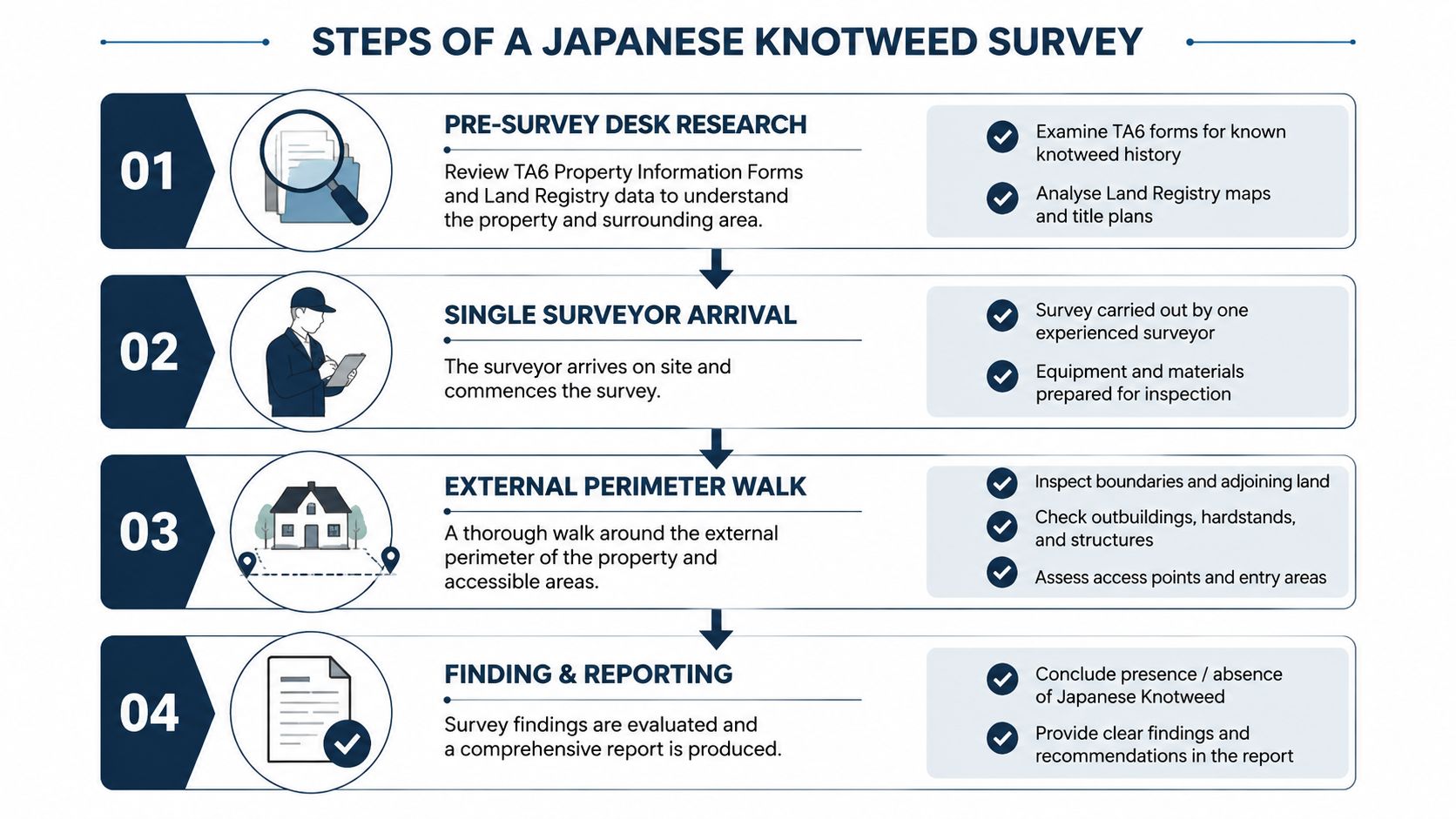
The desk review starts with the information already available. This can include the TA6 Property Information Form, the existing home survey, photographs, site plans and relevant Land Registry information. The surveyor checks for previous treatment, reports of growth on neighbouring land and boundary arrangements that may affect access.
This stage matters because knotweed is often a boundary problem. In tightly packed London streets, a rear garden in Brockley or New Cross may adjoin several properties, garages, railway land, a communal passage or a retaining wall. The inspection needs to account for what can be seen from the subject property and what remains outside the surveyor's access.
At the property
A single surveyor normally begins with an external perimeter walk. They inspect the main garden, side returns, front areas, outbuildings, retaining walls and accessible manholes. They look for live stems, leaf clusters, dead canes, regrowth and signs of previous cutting or treatment.
The surveyor records photographs as evidence. They also note the condition of the ground, possible access restrictions and any relationship with drains, watercourses or adjoining land. Underground drainage is relevant because excavation or plant growth near service routes may require further investigation.
Mapping and reporting
The affected area is plotted on a scaled CAD site plan where the available information allows. The report should explain distances to buildings, boundaries, outbuildings and drainage features rather than leaving the reader to estimate them from a photograph.
After the visit, the surveyor drafts the report and checks the photographs, plan and written conclusion. The final PDF is then issued to the client and, with permission, shared with the conveyancer and lender.
The report must also state what wasn't inspected. Locked outbuildings, dense vegetation, neighbouring land and inaccessible manholes shouldn't disappear into silence. A clear limitation is more useful than false certainty.
Types of Survey and When Each One Applies
Not every concern needs the same level of investigation. The mistake is choosing the cheapest document without checking what the lender, solicitor or transaction requires.
A basic visual check may help before making an offer, particularly if you've seen suspicious growth in a garden or on a development site. It should be treated as an initial opinion, not a mortgage-grade report. A verbal view won't normally map the site, record management history or give a lender enough evidence to approve a treatment arrangement.
A written Phase 1-style survey is the usual next step for a purchase or conveyancing matter. It records visible findings, identifies the location and sets out whether specialist treatment or a fuller investigation is needed. It's also more useful at auction, where the buyer must understand a visible risk before committing.
A full invasive plant survey goes further. It may include recommendations for soil testing, drainage investigation, a management plan and a remediation specification. This is the appropriate route where knotweed is confirmed, where the site is being treated already or where a lender needs a clear plan before releasing funds.
| Survey Type | Deliverable | Typical Cost | Best For |
|---|---|---|---|
| Initial visual check | Preliminary verbal or short written view | Varies by provider | Early pre-offer screening |
| Written Phase 1-style survey | Photographs, site plan, findings and recommendation | Varies by property and scope | Mortgage and conveyancing decisions |
| Full invasive plant survey | Detailed assessment, management plan and remediation recommendations | Varies by scope | Confirmed growth, complex sites and lender conditions |
A standard Level 2 report may identify visible concerns but isn't designed to answer every specialist question about knotweed. Read what a Level 2 survey includes before assuming it will resolve a separate invasive plant issue.
If the plant is mentioned on the TA6 form or identified during a building survey, RICS-linked guidance supports obtaining a specialist survey to establish the risk and recommend remediation. For an older house in Dulwich, a converted flat in Bermondsey or a garden backing onto railway land in Deptford, I'd rather see the specialist report early than have the solicitor discover the issue days before exchange.
What Surveyors Look for and How Findings Are Reported
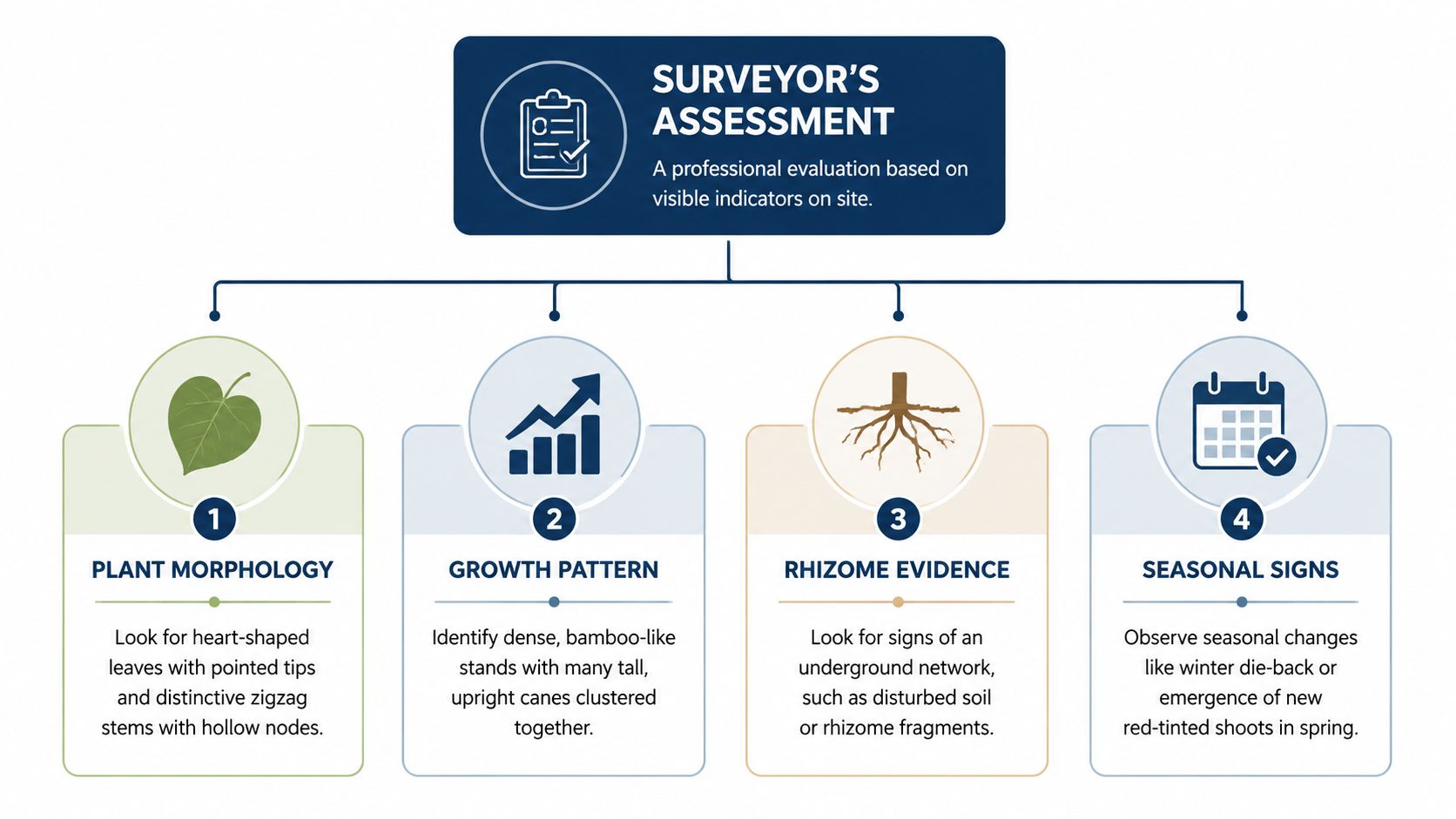
Identification starts with the plant itself. A surveyor looks for heart-shaped or shovel-shaped leaves, hollow bamboo-like canes and, in summer, pink-flecked white flower panicles. The season affects what is visible, so dead canes and fresh shoots matter as much as a large green stand.
A treated area isn't automatically clear. Dead growth may indicate previous management, but it may also sit above living rhizomes. New shoots, disturbed soil and remnants around the edge of a former stand can change the conclusion.
Distance and site context
The surveyor measures or estimates the relationship between the growth and:
- Main building: Particularly habitable rooms and the immediate curtilage.
- Outbuildings: Garages, sheds, extensions and other structures may affect the assessment.
- Boundaries: Growth on adjoining land can still matter, especially in dense London plots.
- Drains and manholes: These can influence the need for further investigation.
- Retaining walls and watercourses: Ground conditions and access may affect remediation.
The findings are then translated into a written management category. Earlier RICS information commonly described Category A as growth within three metres of a habitable space or curtilage, Category B as over three metres but within seven metres, Category C as over seven metres with no construction risk and Category D as treated and managed. Current RICS guidance, however, has moved toward a visibility-and-impact assessment rather than an automatic seven-metre rule, so the report must explain the actual evidence and location.
Research examined by Parliament found that rhizomes rarely extended more than four metres from above-ground plants, typically remaining within about two metres for small stands and 2.5 metres for large stands. The same research found no evidence that knotweed caused more structural damage than other plants, with knotweed and structural damage appearing together in 2% to 6% of surveyed cases. Those findings support a measured assessment rather than treating every sighting as structural failure. The research is available through the published academic study.
The lender and conveyancer read the conclusion, not just the plant description. The report should say whether action is needed, whether neighbour encroachment is suspected and whether the sensible outcome is no further action, a treatment programme or excavation.
Mortgage, Conveyancing and Insurance Implications
A knotweed survey becomes a transaction document.
A seller should disclose known or suspected Japanese knotweed on the TA6 Property Information Form. If the buyer's surveyor identifies it, the buyer's conveyancer will usually raise enquiries and the lender may ask for a specialist report. The lender then decides how the finding fits its own underwriting requirements.
Possible outcomes include a request for more evidence, a retention against the loan, a requirement for funded treatment or a refusal to proceed. Don't assume every sighting kills a mortgage. The decision depends on location, visible impact, management evidence and the lender's policy.
The 2022 RICS framework specifically recognises knotweed on adjoining land within three metres of the boundary as Category D. That is important in London, where a plant may be outside your title but still close enough to affect the risk assessment. Read the RICS residential property position on Japanese knotweed alongside the individual lender's requirements.
| RICS Category | Typical Lender Response | Conveyancing and Insurance Impact |
|---|---|---|
| A | Caution and further evidence likely | Specialist assessment and funded management may be required |
| B | Review of proximity and management | Treatment documentation may be requested |
| C | Often considered lower risk | Report still needs to explain site conditions |
| D | Review of adjoining land and existing management | Evidence of treatment and warranty may be needed |
| No category | Usually no knotweed action | Retain the report in case later enquiries arise |
Parliamentary evidence records that many lenders want proof of a long-term chemical treatment programme effective against Japanese knotweed, or immediate excavation and removal. Some policies also required an insurance-backed treatment plan from an accredited specialist. The House of Commons evidence on mortgage lender requirements explains that lender practice has not been uniform.
A treatment warranty without meaningful insurance backing may not satisfy the lender. Ask the treatment contractor and your broker to confirm the exact wording required before work begins. A five to ten year insurer-backed guarantee is often discussed in the market, but acceptance remains lender-specific, so don't rely on a verbal assurance.
Send the survey to your conveyancer and mortgage broker on the day it arrives. Late disclosure can lead to delayed exchange, a revised offer or a retention held against the purchase price. The 63% of buyers who said they would consider legal action after undisclosed knotweed shows why accurate disclosure is a transactional safeguard, not an optional courtesy. That finding comes from the 2023 UK survey research.
For further context, a mortgage valuation isn't the same as a condition survey. My explanation of what a mortgage surveyor's valuation does will help you separate the lender's valuation from independent advice about the property.
Costs, Timelines and Remediation Options
You'll find many published prices for knotweed work, but the figure depends on access, plot size, report scope and whether the lender needs a particular format. I won't pretend there's one universal price.
A sensible budget discussion starts with the inspection. An initial visual check is often priced from £150 to £300, a full RICS invasive plant survey with management plan may range from £350 to £650 for a domestic garden and a combined site and mortgage-specific report can reach £900. These are indicative 2026 planning figures, not a quotation.
A standard domestic report may take 3 to 5 working days after inspection. Dense summer growth, restricted access or the need to clarify neighbouring land can extend the process. Order before the mortgage deadline, not after your solicitor has asked why the report is missing.
| Survey or Remediation Type | Indicative Cost | Typical Timeline |
|---|---|---|
| Initial visual check | £150 to £300 | Short initial review |
| Full invasive plant survey and management plan | £350 to £650 | Report after inspection |
| Combined site and mortgage-specific report | Up to £900 | Depends on lender scope |
| Herbicide treatment programme | £2,000 to £4,500 | Three to five growing seasons |
| Dig and remove excavation | £4,000 to £15,000+ | Depends on access and soil volumes |
Herbicide treatment is usually a managed programme over three to five growing seasons, with repeated applications and monitoring. It can suit a contained stand where access is reasonable and the lender accepts a funded plan with an insurance-backed guarantee.
Excavation removes contaminated soil and can produce a faster physical result, but it needs careful planning. Severe growth or a Category A finding may make it more appropriate. Costs rise where access is poor, soil volumes are substantial or approved muck-away arrangements are required.
Root barriers, bundled treatment and excavation can form part of a wider specification. Don't choose a contractor from a photograph alone. The survey should establish the extent and relationship to the property first. Then obtain a written method, warranty terms and lender approval.
Keep the timing of treatment separate from exchange and completion. A seller may agree to fund the work, reduce the price or provide evidence of an existing programme. Your solicitor should record the agreement properly. If you need help understanding the timing of a general property inspection, see how long a property survey takes, but knotweed reporting may require a separate specialist timetable.
Choosing a RICS-Qualified Surveyor in London
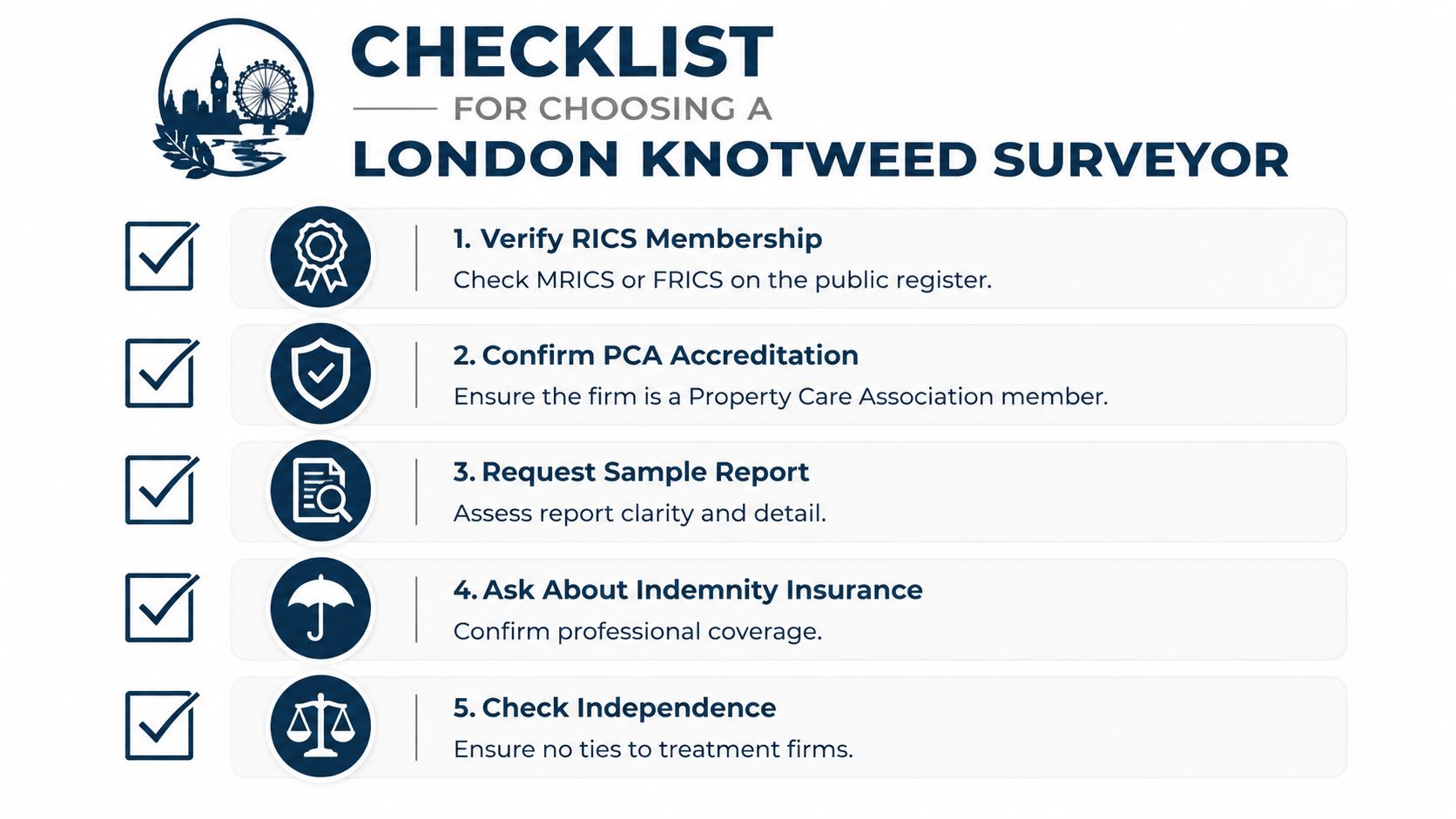
Independence is the most useful filter. Choose a surveyor who has no tie to the lender, estate agent, developer or treatment contractor. That keeps the inspection separate from the decision about who profits from remediation.
Check the RICS public register for MRICS or FRICS membership. Ask whether the firm also has Property Care Association membership, because joint professional credentials can help demonstrate current invasive-weed competence. Confirm who will attend, not just the name on the quotation.
Questions to ask before instruction
- Report content: Will you provide dated photographs, a scaled site plan and a clear written recommendation?
- Site limitations: Which boundaries, outbuildings, drains and neighbouring areas can you inspect?
- Independence: Do you or a connected business carry out treatment?
- Insurance: Can you confirm professional indemnity cover?
- Timing: What is the fixed fee and when will the PDF be issued?
A sample report should show how the surveyor maps the affected area and explains the management category. Don't insist on a decorative document. Insist on evidence that a conveyancer and lender can follow.
Corinthian Surveyors London LTD is an independent Forest Hill practice regulated by the RICS. I hold RICS and CABE qualifications and have more than 30 years' experience in the built environment. The firm is a member of the RICS Valuers Registration Scheme and insured by Royal Sun Alliance. That background supports independent residential survey advice across South East London, the wider capital and the Home Counties.
Avoid anyone who recommends a treatment contractor before inspecting the property, offers to discount a mortgage valuation to secure the work or can't name the qualification of the surveyor attending.
Next Steps After Discovery and Final Reassurance
Treat the report as the start of a decision, not the end of the matter.
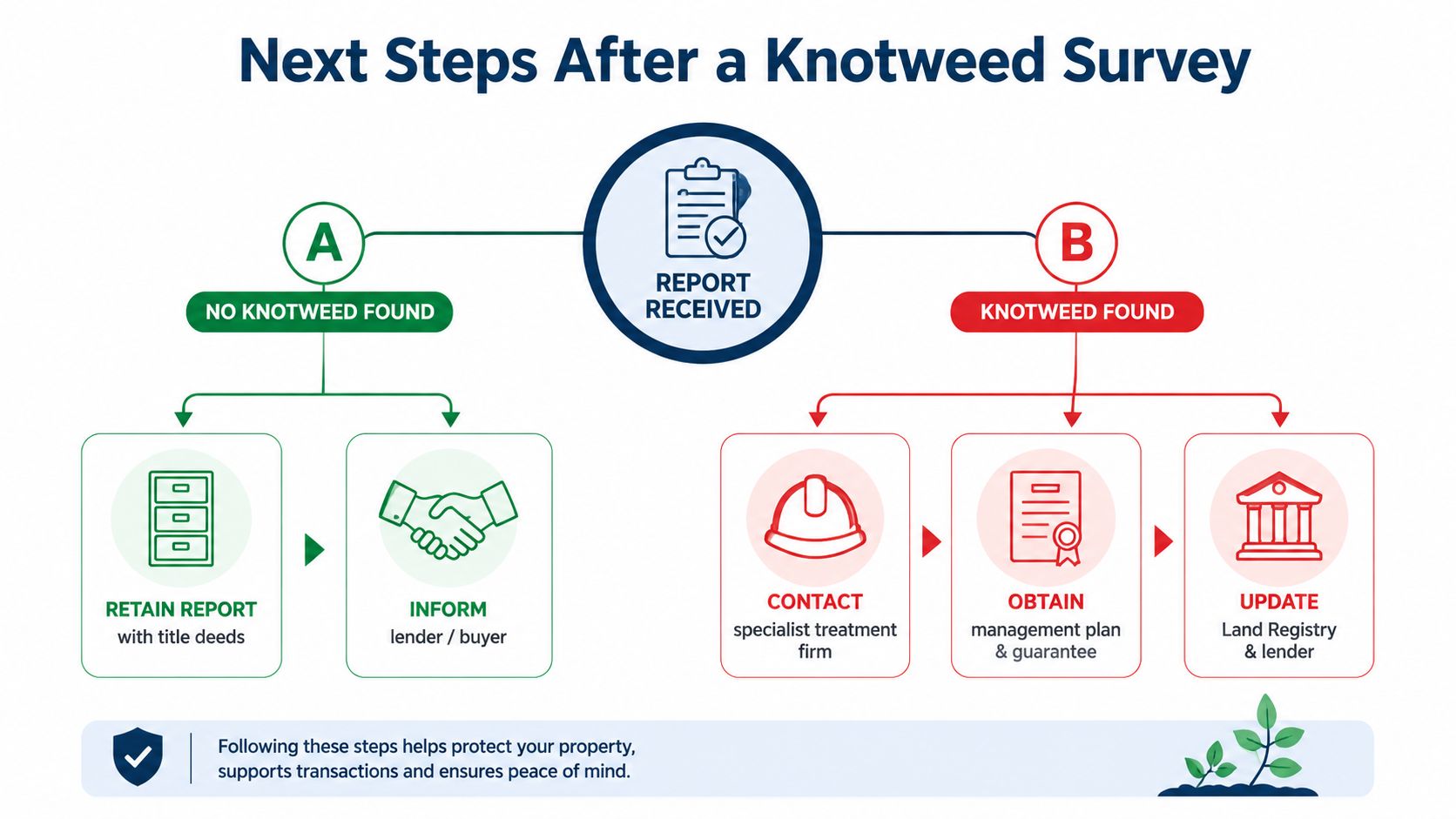
If no knotweed is found, keep the report with the title documents. It can answer a later buyer, solicitor or lender enquiry. If knotweed is confirmed, send the report to your conveyancer and mortgage broker immediately, then ask the lender for written confirmation before exchange.
The practical sequence is straightforward:
- Confirm the finding: Check the photographs, site plan and stated inspection limitations.
- Confirm responsibility: Establish whether growth is on your land, adjoining land or linked to previous treatment.
- Obtain the right plan: Ask for treatment, monitoring or excavation recommendations from an accredited contractor.
- Check the warranty: Confirm the insurance-backed terms meet the lender's requirements.
- Record disclosure: Sellers should disclose known or suspected knotweed on the TA6 form.
A seller shouldn't decide that a minor-looking patch doesn't need disclosure. Non-disclosure creates a far greater legal and commercial problem than a reported, managed issue. The survey gives the parties a basis for negotiation, whether that means treatment before completion, a price adjustment or a documented management plan.
Awareness isn't universal. The 2023 survey found homeowner awareness at 77%, with awareness at 43% among people aged 18 to 24 compared with 92% among those aged 55 and over. That gap is one reason plain-English reporting matters. The plant may be manageable, but the buyer must understand what has been seen and what remains uncertain.
With a properly located finding, a suitable management plan and early communication, knotweed doesn't automatically make a property unmortgageable. It becomes a documented risk that the buyer, seller, lender and conveyancer can assess.
If Japanese knotweed has been reported at your London property, Corinthian Surveyors London LTD can provide independent RICS residential surveying advice and identify when a specialist inspection is needed. Visit Corinthian Surveyors London LTD or call 0800 00 16 422 before exchange so the report can support a clear decision rather than a last-minute renegotiation.