
Internal Wall Cracks: Causes, Severity and When to Worry
The usual advice about internal wall cracks is too simple: measure the gap and decide whether to worry. Width is a clue, not a diagnosis. A narrow crack that's changing can deserve more attention than a wider mark left by movement that stopped years ago. Before you buy filler, establish what's cracked, what else has changed and whether moisture is involved.
Table of Contents
- Why Internal Wall Cracks Deserve a Closer Look
- Hairline, Settlement, Structural and Thermal Cracks Compared
- Judging Severity With the BRE Crack Categories
- Telling Stable Cracks From Active Movement
- When to Monitor and When to Call a Surveyor
- Remedial Options and What Drives the Cost
- Commissioning a Building Survey for Cracked Walls
Why Internal Wall Cracks Deserve a Closer Look
The useful question isn't, “Is this structural?” It's, “Should I repair it, record it or arrange an inspection?” Those are different decisions. Getting the sequence right avoids covering up evidence or paying for repairs that fail.
A crack in paint isn't the same defect as a split extending through masonry. Equally, a mark beside a door needs to be considered alongside the opening, frame and surrounding wall. The plaster is only the surface you can see.
Government technical guidance on wall damage connects cracking with effects such as distorted openings, damaged services and impaired weather-tightness. That's why a surveyor looks beyond the line on the wall.
Look at the room, not just the crack
Describe the circumstances before deciding what the crack means:
- Position: Is it beside a window, below a ceiling or where an extension meets the original house?
- History: Has it appeared recently or reopened through an earlier repair?
- Related changes: Have doors started sticking or gaps appeared beside skirting?
- Moisture clues: Is there staining, mould or damaged decoration nearby?
These details help distinguish an isolated finish defect from a wider building problem. They also help you give a surveyor a useful account instead of saying the wall “looks worse”.
Practical rule: Don't ask a decorator to make an unexplained crack disappear before you've decided whether its history matters.
For a London homeowner, the building's alterations matter as much as its age. An older terrace, a converted flat and a newer extension may contain different materials and junctions. Start with the particular wall and its surroundings, not assumptions about the postcode.
Hairline, Settlement, Structural and Thermal Cracks Compared
Hairline describes appearance. Settlement, structural and thermal describe possible mechanisms. They aren't mutually exclusive boxes. You can describe a crack accurately without yet knowing its cause.
This comparison is a starting point, not a diagnosis.
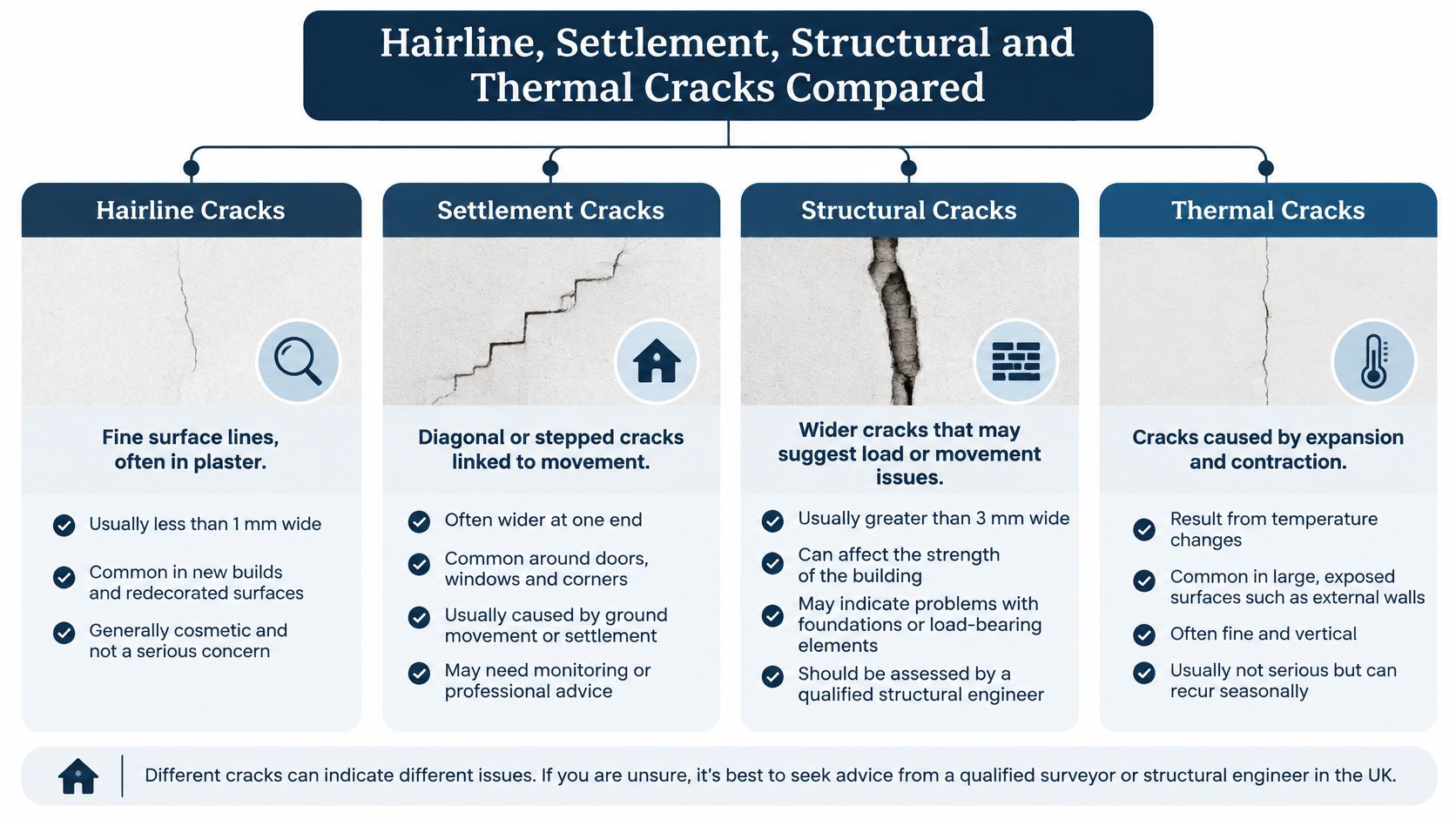
What the descriptions actually mean
| Description | What you may see | What needs establishing |
|---|---|---|
| Hairline | A fine surface line in plaster or decoration | Whether it's confined to the finish |
| Settlement | Cracking associated with movement, sometimes around openings | What has moved and whether movement continues |
| Structural | Cracking affecting masonry or accompanied by displacement | How the building is carrying loads |
| Thermal | A crack that changes with temperature | Whether expansion and contraction explain the pattern |
Drying and shrinkage, moisture changes, settlement of finishes and defective workmanship can all produce internal cracking. Don't treat “settlement” as a reassuring diagnosis unless somebody has established what settled. Don't use “structural” merely because a crack looks untidy.
Thermal cracking relates to expansion and contraction. A recurring line at a material junction may follow that process, but recurrence alone doesn't prove it. Seasonal ground movement can also change a crack's appearance.
Where subsidence fits
At the serious end, the Association of British Insurers reported £153 million paid or committed for subsidence-related household claims during the first six months of 2025. Its account followed an exceptionally warm and sunny spring, conditions that can increase soil moisture loss where shrinkable clay and nearby vegetation are present.
That context explains why progressive cracking deserves attention. It does not establish that your internal wall crack is subsidence.
My recommendation is straightforward: use these descriptions to explain what you've noticed, not to choose a repair. “A diagonal crack beside the rear window that has reopened” is useful information. “The house has subsidence” is a conclusion that needs evidence.
Judging Severity With the BRE Crack Categories
BRE Digest 251 is the principal UK technical framework for classifying visible wall damage in low-rise buildings. It considers appearance and associated symptoms as well as crack width. The categories describe damage severity, not the underlying cause.
BRE crack categories at a glance
The bands and symptoms below follow the BRE Digest 251 classification.
| Category | Typical crack width | Associated symptoms |
|---|---|---|
| 0 | Below approximately 0.1 mm | Negligible hairline cracking, normally requiring no action |
| 1 | Up to 1 mm | Fine cracks generally confined to plaster or finishes, usually addressed through ordinary redecoration |
| 2 | Up to 5 mm | Filling may suffice; recurring cracks may need lining and doors or windows may stick slightly |
| 3 | 5–15 mm, or several cracks around 3 mm | Sticking openings, impaired weather-tightness or fractured service pipes; repointing or limited masonry replacement may be needed |
| 4 | 15–25 mm | Distorted frames, noticeably sloping floors or leaning and bulging walls; sections of masonry may need replacement |
| 5 | Generally above 25 mm | Potentially severe damage, including loss of beam bearing and badly leaning walls; shoring or rebuilding may be necessary |
Read across the table, not just down the width column. A measurement doesn't tell you whether the crack passes through the wall, whether the floor has distorted or whether nearby masonry has displaced.
Nor does a category prove subsidence. A classification records the damage observed. Diagnosis asks why that damage occurred and what action will stop it.
Turn a category into a useful recommendation
A sound assessment should distinguish between the visible defect, the likely cause and the recommended next action. Those aren't interchangeable. A report that records only a width leaves important questions unanswered.
When reading a survey report example, look for that connection between observation and advice. The practical value lies in knowing whether you need decoration, monitoring or further investigation.
A category is a benchmark for damage. It isn't permission to fill a crack without understanding it.
Where access is restricted, the report should explain the limitation. Wallpaper, furniture and fitted cupboards may prevent a complete view. Ask what remains uncertain and whether that uncertainty affects the decision to buy or repair.
Telling Stable Cracks From Active Movement
A memory of what the wall looked like last winter isn't a monitoring record. Use repeatable measurements and dated photographs. That gives a surveyor something concrete to compare.
NHBC's guidance on cracking describes shrinkage cracks as commonly vertical or horizontal, generally constant in width and normally below 2 mm; cracks at or below that width are generally unlikely to affect structural stability. The same guidance identifies cracks wider than 5 mm, continuously wider than 2 mm, wider at one end or diagonal or stepped as reasons for further investigation.
Those are investigation prompts, not an alternative to examining the building.
Make a record somebody else can use
- Identify the wall. Record the room, floor and position relative to doors, windows, corners and ceilings. Give each crack its own label.
- Photograph the context. Take a room view before the close-up. Include a ruler or crack-width card beside the defect.
- Measure consistently. Record the maximum width and identify exactly where you took it. Return to that location for comparisons.
- Date every observation. Keep photographs and readings together. Note heating changes and wetter or drier conditions.
- Record associated defects. Include sticking openings, separated coving or skirting and any matching external damage visible from a safe position.
Don't scrape out the crack just to make it easier to measure. The purpose is to record the existing defect, not alter it.
Seasonal change needs interpretation
An opening that changes with the seasons isn't automatically evidence of progressive failure. Equally, a temporary reduction in width doesn't establish that the cause has gone away. Compare a sequence of observations rather than selecting the most reassuring photograph.
For an overview of the issues involved, this explanation of foundation movement provides useful context for discussing the record with a surveyor.
There isn't a sensible universal monitoring deadline for every property. Ask the inspecting professional to specify the interval and what change should trigger a call. Where necessary, they can recommend a crack monitor or tell-tale rather than relying on photographs alone.
Leave redecoration until the assessment supports it. Filling during monitoring removes a useful reference and can make subsequent comparisons harder.
When to Monitor and When to Call a Surveyor
Monitoring is appropriate only when waiting is a reasonable decision. It isn't a substitute for inspection where the building shows warning signs.
A fine, apparently plaster-only crack without associated movement may be suitable for observation. Progressive cracking or distortion needs a professional assessment, not an open-ended photograph collection.
Use this decision guide alongside the building's condition.
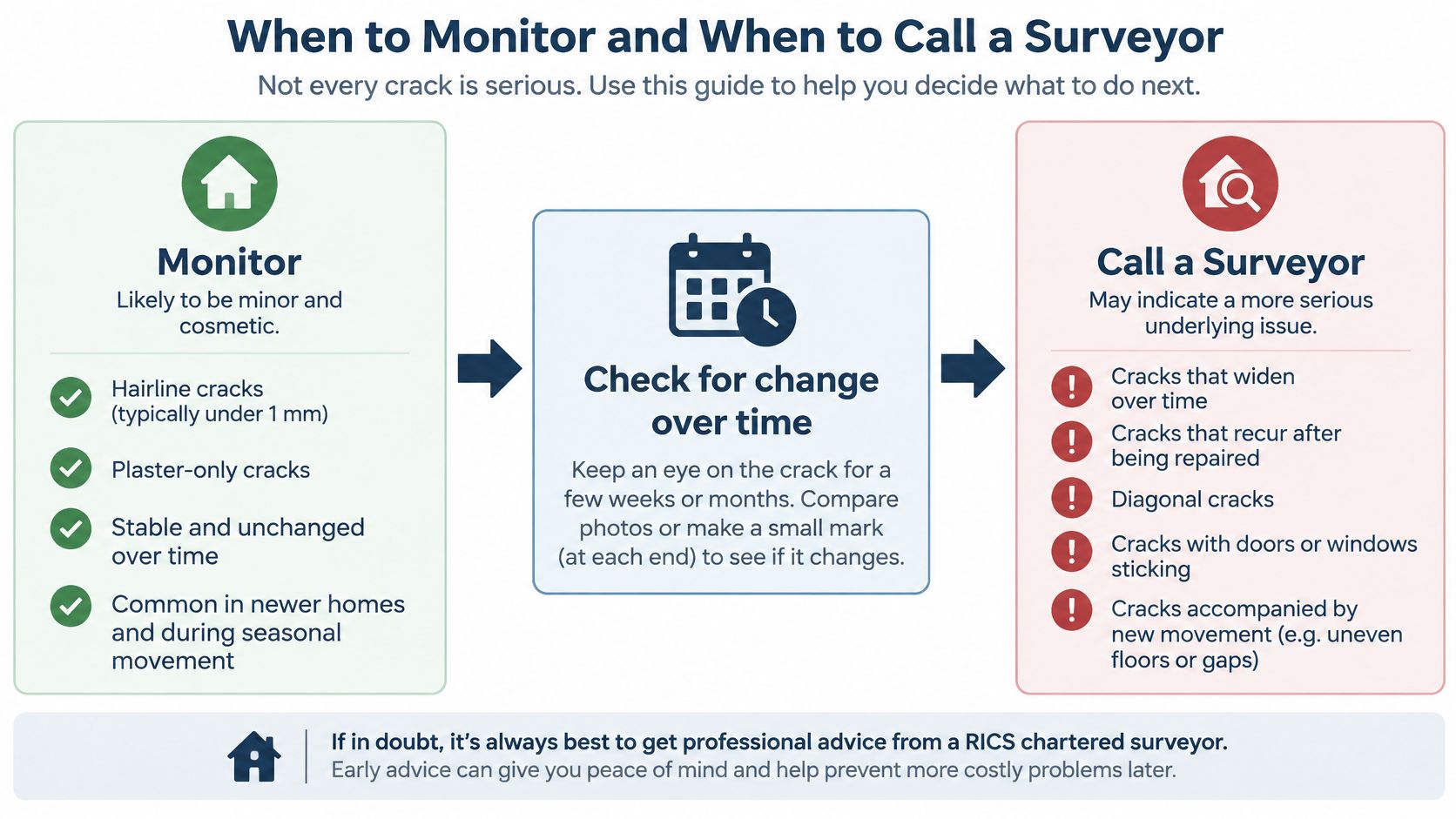
Situations where waiting is the wrong response
- Rapid change: Arrange prompt assessment when damage develops quickly.
- Bulging or leaning: Don't treat displaced walls as a decoration problem.
- Excavation or impact: Report sudden damage following nearby works or an impact.
- Movement around openings: Seek advice where cracking accompanies newly distorted frames or sticking doors.
The distinction between stable historic cracking and active movement is particularly important in older London housing. Guidance on wall cracking and structural deflection supports considering pattern, location and change rather than applying an arbitrary width threshold. Buyers should resolve significant uncertainty before exchange, not assume they can investigate after moving in.
Don't overlook the damp patch
An internal crack can coincide with moisture damage without being structural. Check whether it's near plumbing, a bathroom, a window or a cold corner. Look for staining, salt deposits, mould, soft plaster and repeated decoration failure.
The scale of moisture problems is substantial: the English Housing Survey recorded Category 1 damp-and-mould hazards in 142,000 households in 2024–25, equivalent to 0.6% of homes. Those figures don't diagnose an individual wall. They reinforce why moisture deserves its own investigation.
The investigator needs to distinguish water entering the wall from condensation forming on its surface. Photographs alone won't prove which applies.
For specialist property surveys, explain both the crack and the moisture symptoms when enquiring. Ask who will investigate each issue and what written findings you'll receive. Don't accept responsibility being assigned to an occupier, landlord or previous contractor purely from appearance.
Remedial Options and What Drives the Cost
Repair the cause before repairing the finish. Otherwise, you're paying to conceal a symptom rather than resolve the defect.
Historic England explains that movement in older buildings is common and doesn't automatically mean the structure is unsafe. Where continuing movement is suspected, it advises inspection by a structural engineer familiar with older buildings.
That distinction matters in London's older terraces and conversions. Don't commission a generic structural repair just because a building has historic cracking.
Match the work to the diagnosis
| Established finding | Proportionate route | What to settle before work |
|---|---|---|
| Stable cosmetic cracking | Appropriate filling and redecoration | Whether the background and surrounding finish are sound |
| Recurring finish failure | Investigate the junction or background before choosing the repair | Why the previous repair failed |
| Moisture-related damage | Identify and correct the moisture source, then assess damaged finishes | Whether further moisture investigation is needed |
| Progressive structural movement | Obtain structural advice and a specified repair approach | The cause and whether movement has been controlled |
| Historic movement without progression | Assess maintenance needs and compatible repairs | Whether intervention is necessary at all |
For organising observations before a visit, Northpoint Construction's foundation health checklist for 2026 is an additional preparation resource. Use it to frame questions, not to replace UK building guidance or a property-specific assessment.
Before accepting a quotation: Ask the contractor to identify the defect being repaired and explain how the proposed work addresses its cause.
What changes the price
Access, extent and diagnosis determine the scope. A local finish repair is a different job from investigation across several rooms and external elevations.
- Investigation: Opening up concealed areas or obtaining engineering advice changes the work involved.
- Repair extent: Damaged masonry, services and finishes need different trades and specifications.
- Access: High-level defects and occupied rooms can complicate inspection and repairs.
- Making good: Ask whether preparation, plaster repairs and decoration are included.
Avoid quotations that say only “repair wall cracks”. Ask for a written scope so competing prices cover the same work. Keep investigation fees separate from assumptions about the eventual repair.
Estimates must be property-specific. A photograph can help explain the concern, but it can't establish everything hidden behind the plaster or beneath the floor.
Commissioning a Building Survey for Cracked Walls
Choose the inspection around the question you need answered. For an older or altered property with unexplained cracking, I'd normally recommend discussing a RICS Building Survey (Level 3). If the concern is confined to a known defect in a home you already own, ask whether targeted Defect Analysis would be more appropriate.
The inspection needs to examine the crack in context.

Agree the scope before booking
A RICS Building Survey provides the broader inspection route to discuss for older or significantly altered homes. A RICS Homebuyer Survey (Level 2) may suit a more straightforward property. Don't choose a simpler inspection solely because the crack looks small.
- Check qualifications. Confirm RICS status and ask about CABE qualifications and relevant defect experience.
- Check independence. Ask about ties to lenders, estate agents, developers or repair contractors.
- Ask about recording. Confirm how the surveyor will document width, direction, position and associated symptoms.
- Clarify limits. Ask what the inspection won't establish and when an engineer or moisture specialist may be needed.
- Separate valuation from diagnosis. Check RICS Valuers Registration Scheme membership when valuation work is also required.
Clive Thompson holds RICS and CABE qualifications and has over 30 years' experience in the built environment. His independent residential practice is based in Forest Hill and serves London and the Home Counties. When enquiring about a terrace in Lewisham or a conversion in Southwark, describe its alterations as well as the crack.
Keep the inspection discussion focused on evidence and next steps. The accompanying video is available below.
Frequently asked questions
Can I fill an internal wall crack before selling?
Only after you understand it. Keep the assessment and repair records so a buyer can distinguish documented work from unexplained fresh decoration.
Can a survey prove whether movement is still active?
An inspection can identify evidence and warning signs, but a single visit may not establish progression. Ask the surveyor whether monitoring or further investigation is needed and what decision depends on it.
Gather your dated photographs, readings and previous repair information before booking. Use the contact page to describe the property and agree the appropriate inspection.
Corinthian Surveyors London LTD offers residential Building Surveys and Defect Analysis for unexplained internal wall cracks and associated damp or movement concerns. Call 0800 00 16 422 with your observations, or visit Corinthian Surveyors London LTD to arrange an inspection matched to the property and the decisions you need to make.