
How to Read a Survey Report: A RICS Buyer’s Guide
You've opened the survey report and found red ratings, damp references and a recommendation for further investigation. You still want the house, but you're wondering whether the report is describing normal upkeep or a purchase you'll regret. Start by separating what the surveyor found, what remains uncertain and what you need to do before exchange.
Knowing how to read a survey report isn't about counting defects. It's about giving each finding a proportionate response: proceed, investigate or renegotiate. A worn roof covering and unexplained structural movement shouldn't lead to the same decision.
Table of Contents
- Confirm the Survey Level Before You Trust the Result
- Read the Report in the Right Order
- What Condition Ratings and Urgent Flags Mean
- Questions to Ask Your Surveyor Before You Act
- Turn Each Defect Into a Decision
- Frequently Asked Questions
Confirm the Survey Level Before You Trust the Result
Check the survey level on the first page. Then read the agreed scope, not just the report's title. You need to know what the surveyor was instructed to inspect before deciding how much reassurance a conclusion provides.
The RICS guide to home surveys describes Level 2 as an intermediate visual inspection and Level 3 as a more extensive assessment suited to older, unusual, altered or run-down properties. A visual inspection normally won't include opening concealed construction or testing services.
RICS survey levels and what each covers
| Level | Survey name | Scope of inspection | Best suited to |
|---|---|---|---|
| Level 1 | Home Condition Report | Visual check of the main elements, with a short report on general condition | Newer homes in good repair |
| Level 2 | HomeBuyer Report | Intermediate visual inspection of the building, services and grounds, with no opening up | Conventional homes of typical age in reasonable condition |
| Level 3 | Building Survey | Fuller inspection with detailed descriptions of construction, likely causes of defects and remedial advice, subject to access | Large, older, altered or run-down homes, or where major works are planned |
A Victorian conversion in Brockley with proposed structural alterations needs a different assessment from a modern house in straightforward condition. For the conversion, you'll want the surveyor to consider construction details, previous alterations and the consequences of concealed defects. Even a detailed Building Survey isn't permission to lift every floorboard or remove wall finishes.
Practical rule: A short report doesn't establish that a property is defect-free. Read the inspection limitations before taking comfort from the absence of defects.
Our homebuyer survey comparison helps explain the choice. Corinthian Surveyors carries out both RICS Homebuyer Surveys and RICS Building Surveys.
If the commissioned level looks unsuitable, raise it before relying on the conclusions. Ask what additional inspection would resolve the gaps. Don't assume an upgrade can retrospectively establish the condition of areas that remain inaccessible.
Read the Report in the Right Order
Don't start by searching for the word subsidence. That pulls a warning out of context and can distract you from a more immediate problem elsewhere. Read with the property particulars and a notepad beside you.
A useful reading sequence
- Introduction and scope. Confirm the property address, survey type and inspection limitations. Note inaccessible roof spaces, locked rooms and areas obscured by furniture.
- Condition summary. Flag every red item and any amber item with an urgency note. Use the summary as an index, not as a substitute for the detailed description.
- Overall opinion. Identify recommendations that need attention before exchange. Distinguish those from work the surveyor considers manageable after purchase.
- Detailed inspection. Work through the outside, inside and services. Match roof, chimney and wall observations to internal staining or cracking where the report makes that connection.
- Specialist recommendations. Mark each request for testing or investigation. Record who needs to carry it out and what question they must answer.
- Legal, valuation and risk notes. Send relevant matters to your solicitor. Where a valuation is included, check any qualifications against your lender's requirements.
Finish with separate lists for urgent work, specialist advice and solicitor enquiries. Give each entry a report page reference so nobody has to hunt for the wording.
Keep the full description beside each flagged item. A summary such as roof repairs needed is too vague for a contractor to price or a solicitor to investigate.
What Condition Ratings and Urgent Flags Mean
The colour helps you find an issue quickly. The explanation tells you what to do about it. Keep the relevant page open while discussing a finding with your surveyor.
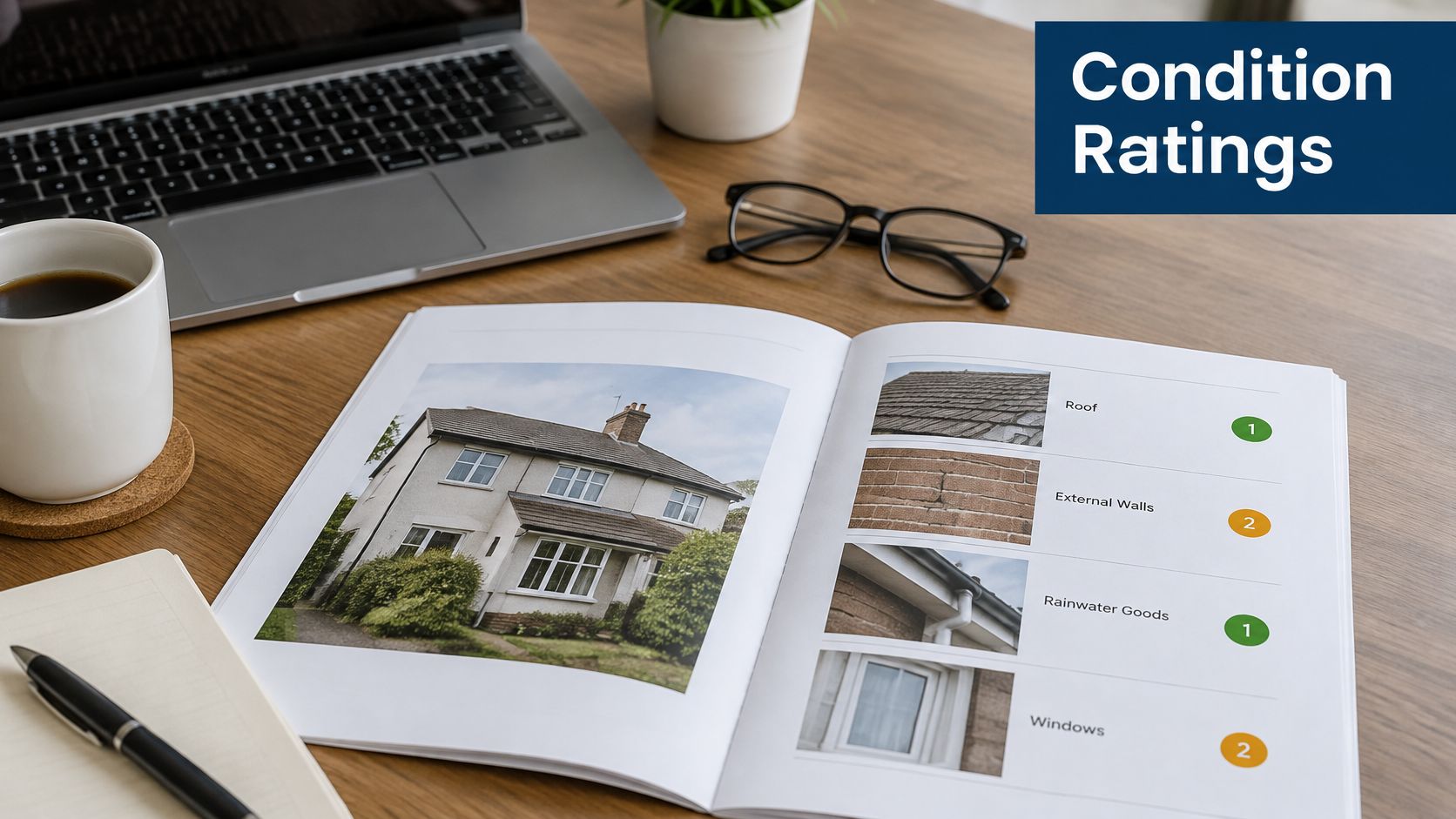
Read the rating alongside the defect
| Condition rating | Plain meaning | Your response |
|---|---|---|
| 1, green | No repair is currently needed to the assessed element | Continue normal maintenance and check the inspection scope |
| 2, amber | Repair or replacement is needed, but the defect isn't considered serious or urgent | Establish the work, timing and budget |
| 3, red | A serious defect or a matter requiring urgent repair, replacement or investigation | Resolve the recommendation before committing to the purchase |
A red rating doesn't necessarily mean expensive structural work. An electrical installation that needs investigation may receive an urgent flag because the surveyor cannot establish its safety through visual inspection. Equally, an amber roof defect can still involve awkward access and scaffolding.
For each amber or red entry, look for probable cause, extent and access limitations. Does the surveyor describe an isolated slipped tile or widespread deterioration? Was the underside of the roof visible? Is the recommendation a repair instruction or a request to establish the condition?
Our survey report example provides context for reading the findings alongside their ratings. Don't transfer a rating from one house to another just because both reports mention the same building element.
Use the video alongside the written report, rather than instead of it.
Notice wording that leaves a question open
Phrases such as could not inspect, further investigation recommended and requires specialist report identify gaps in certainty. They aren't interchangeable with a confirmed defect.
An inaccessible area should be recorded as not inspected. A favourable rating on an accessible part of the building doesn't extend to concealed sections that the surveyor couldn't see. Check the legend because the report may use a separate not-inspected designation.
Create a short record of the flagged elements:
- Location: Name the room, elevation or roof slope.
- Finding: Copy the substance of the observation without shortening away its qualifications.
- Required response: Record the recommended work or investigation and its timing.
Don't average the colours or judge the house by how much green appears. A single unresolved safety concern can matter more than numerous maintenance items.
Questions to Ask Your Surveyor Before You Act
Before you call, separate three things on the page: what was seen, what the surveyor thinks it means, and what remains unproven. A moisture reading is evidence. A claimed cause for that moisture may be opinion until someone tests the likely path of water.
In the RICS review of the Home Survey Standard, 51% of respondents wanted advice about property problems and likely repairs. Use that as the point of the conversation: which findings support proceeding, which need investigation, and which give you grounds to renegotiate.
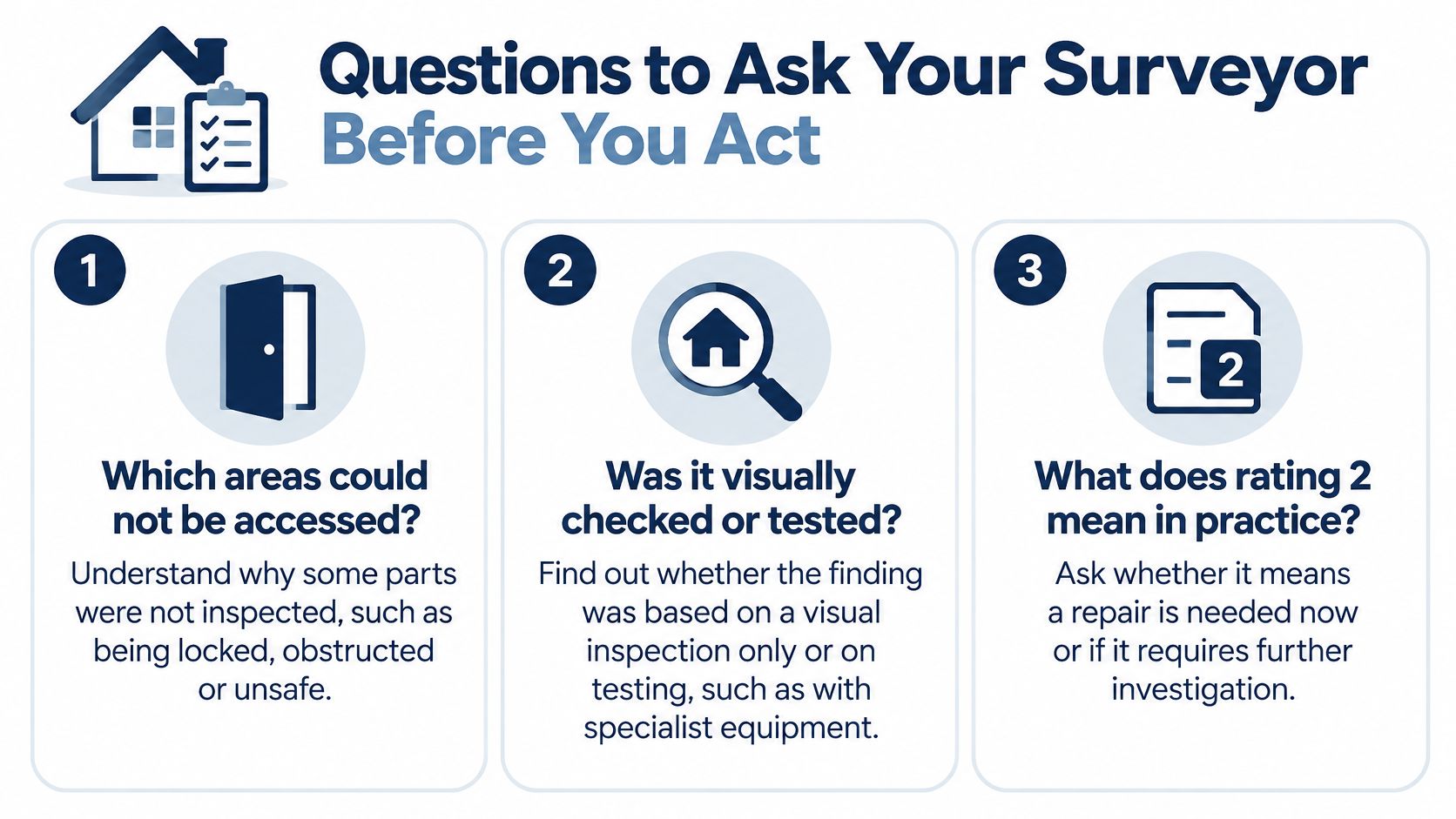
Take this checklist to the call
- Which areas couldn't you access, and why? Establish whether the obstacle was a locked hatch, stored belongings or construction that can't be opened without permission.
- Was this visually checked or tested? Ask what the observation establishes and what it cannot establish.
- What does this amber finding mean in practice? Get a clear distinction between planned maintenance and investigation needed before exchange.
- Who should investigate? Ask whether you need a structural engineer, drainage contractor, independent damp specialist or registered electrical or gas contractor.
- Could there be a connected cause? Find out whether roof leakage, drainage defects or plumbing could explain the visible damage.
- What should a contractor price? Request a defined scope rather than asking a builder to guess from a photograph.
- What goes to my solicitor? Identify shared roofs, boundaries, party walls and leasehold repair obligations.
- Could this affect lending or insurance? Ask what evidence you should put to the lender or insurer.
Push each answer towards a route. If the surveyor can name the defect, likely extent and repair, the finding may sit with proceed or renegotiate. If the cause, extent or consequence is still open, the honest answer is investigation.
Get the important answers in writing
A phone call is useful for clarification. Written confirmation is better for an issue that affects your decision, particularly where further inspection could change the advice.
Corinthian Surveyors London LTD is an independent firm of RICS Chartered Surveyors and Valuers based in London, led by surveyor Clive and working to RICS standards. Independence and credentials matter, and you should still expect a plain answer to each question.
If an answer remains unclear, ask what specific evidence would resolve it: an opening-up inspection, a drain test, a roof void check, or quotes scoped against the report. Reassurance that leaves the original uncertainty untouched does not move the purchase forward.
Turn Each Defect Into a Decision
Pull the amber and red findings into a working schedule. Keep the location, observation, likely cause and recommendation together. Deal with safety concerns, structural questions and continuing water entry before cosmetic work.
For damp, find the source before choosing the treatment. The RICS home survey standards support a whole-building approach to excessive moisture, including possible entry through roofs, walls, floors and windows or leaks from pipework. A stained wall doesn't establish rising damp, and a moisture reading alone doesn't specify the repair.
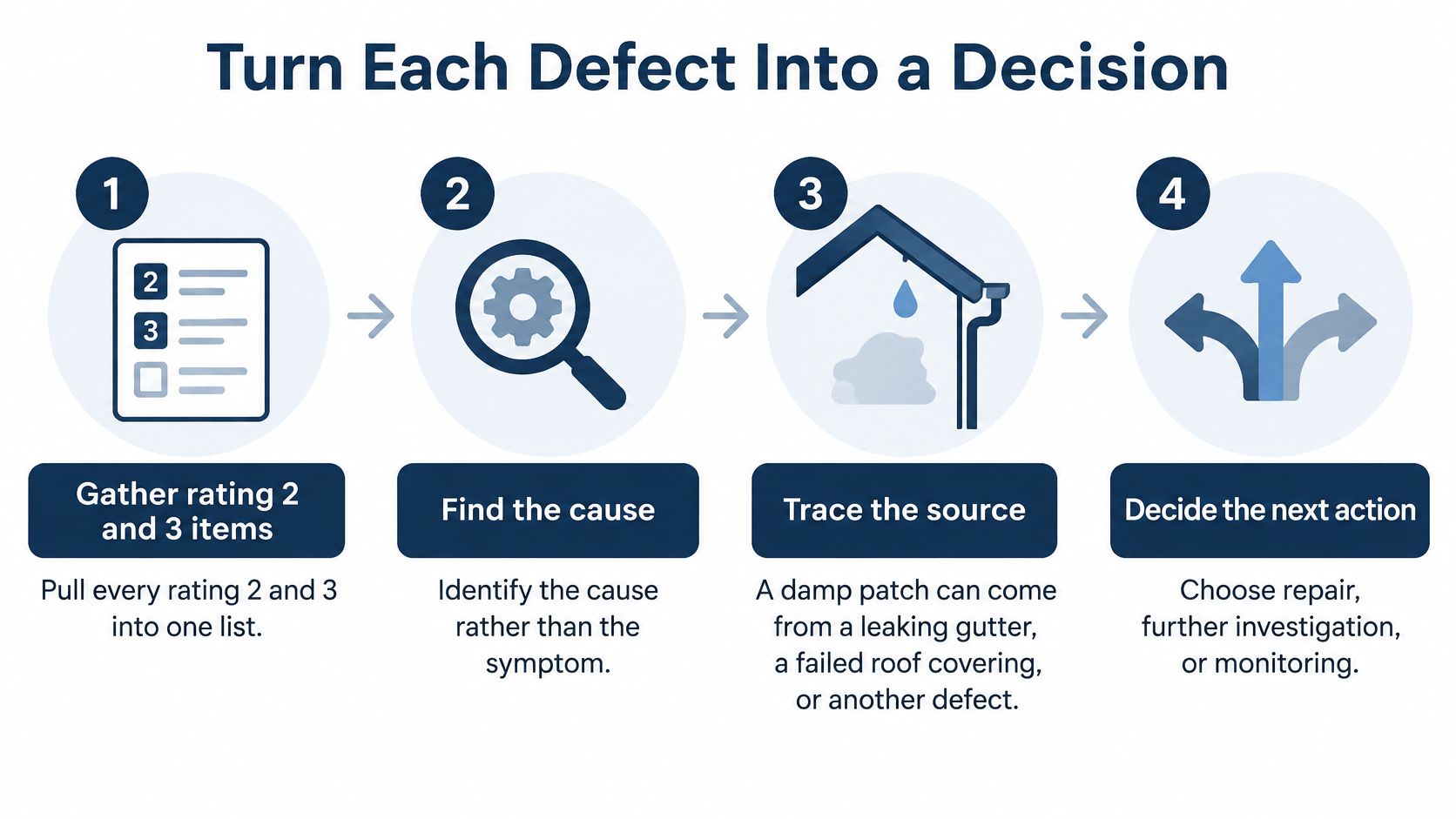
Choose the action that matches the evidence
Proceed when you understand the defect, can afford the work and accept the disruption. Routine gutter clearance or local decoration shouldn't automatically become a demand for a price reduction. Monitoring can be appropriate where the surveyor specifies what to watch and when to seek further advice.
Investigate when the cause, extent or consequence remains unclear. For example, staining below a chimney breast in a Forest Hill terrace could warrant checking the flashing, masonry and ventilation arrangements. Don't commission internal redecoration while leaving the route of water entry unresolved.
Renegotiate when a confirmed defect creates a material cost you hadn't allowed for. Use a written quotation with a clear scope. The seller can decline, so decide what you can afford before presenting a revised offer.
Findings, actions and the evidence to gather
| Finding | Action | Evidence to gather |
|---|---|---|
| Structural movement or active water ingress | Investigate before exchange | Structural engineer or specialist damp report with a written cost range |
| Roof covering needing replacement | Renegotiate or budget for it | Written roofing quotation |
| Routine maintenance items rated 1 or 2 | Proceed and budget | Maintenance plan, with no price cut sought |
| Damp with an unclear source | Investigate before exchange | Specialist damp investigation |
| Electrical or gas concern | Investigate with a qualified contractor | Electrical or gas safety report from a registered contractor |
Tell specialists exactly what they're being asked to establish. A drainage contractor investigating suspected leakage needs a different instruction from someone clearing a blockage. Ask for findings, limitations and recommended remedial work in writing.
A report is not a repair invoice. Obtain quotations for the actual work, including access, making good and any further investigation needed to define it.
Check affordability before negotiating
Allow a contingency for work that may become apparent once finishes are removed. Base that allowance on the unresolved parts of the job and the contractor's advice, not an arbitrary percentage. In a converted flat in Camberwell, also establish whether the lease makes the roof a shared responsibility before treating the quotation as your personal bill.
Our guide to negotiating a house price after a survey explains how to present the findings without turning ordinary wear into a dispute.
Clear communication matters throughout. Vicky described her experience with Corinthian: “I was really impressed with the communication we received from the surveyor Clive”.
Walking away is a decision about risk and affordability, not a punishment for a red rating. Consider withdrawing if a significant uncertainty cannot be resolved, necessary access is refused or the likely work exceeds what you can fund.
Frequently Asked Questions
Does a rating 1 mean the element is in good condition?
It means the surveyor found no current repair need in what could be inspected. It says nothing about concealed construction or how long the element will last. Check the access notes and separate "inspected" from "not inspected" before reading the rating as reassurance.
Maintenance still applies. Rainwater goods need clearing, and sound external joinery still needs protective decoration to stay sound. Treat a rating 1 as a maintenance baseline rather than a clean bill of health.
Can I rely on a Level 2 HomeBuyer Report for an older house?
Age alone doesn't decide it. Construction type, condition, the extent of alterations and your own plans all shape the right scope. Ask the surveyor to explain why that level fits that particular building before you rely on it.
For a heavily altered period property, or a purchase tied to major refurbishment, get advice on scope before exchange. The key question is whether the report tells you enough to proceed, commission further investigation or renegotiate, not whether it carries the right title.
Should I walk away if the report has a rating 3?
Not automatically. A rating 3 marks defects needing urgent or significant attention. Find out what makes the item serious and what evidence would settle it, then decide whether your route is to proceed, investigate further or renegotiate.
You can still withdraw if the remaining risk is unacceptable, if the access needed to resolve the uncertainty is refused, or if lender or insurer requirements leave no workable route. The decision rests on what the report could not establish and whether you can close that gap before you commit.
Corinthian Surveyors London LTD is an independent firm of RICS Chartered Surveyors and Valuers carrying out RICS Homebuyer surveys for buyers and market valuation reports for sellers, with chartered surveyor services offered in Forest Hill, London. To discuss the appropriate survey or arrange a conversation about your report, contact Corinthian Surveyors London LTD at 48 Bell Green Lane, London, SE26 5T3, with the property address and the report's flagged items ready so we can focus on what needs resolving before you commit.