
How Much Are Home Buyers Surveys in 2026

Buyers should budget about £400 to £1,500 for a home survey, with a Level 2 often from around £400 and a Level 3 from around £600. London quotes tend towards the higher end of those published bands, and Corinthian quotes each property individually rather than offering a fixed menu price.
The useful question isn't “how much are home buyers surveys?” It's whether the inspection will give you enough information to judge the repairs you could inherit. Saving on the report makes little sense if you're buying an altered Victorian house and need proper advice about its roof, structural movement and removed chimney breasts.
Table of Contents
- How Much Home Buyer Surveys Usually Cost
- What Each RICS Survey Level Covers
- What Pushes a London Survey Fee Up
- Which Survey Fits London Housing Stock
- When the Cheaper Survey Is a False Economy
- How to Get a Quote That Fits the House
- Questions to Settle Before You Instruct
How Much Home Buyer Surveys Usually Cost
Treat published fees as a budgeting guide, not a quotation. The RICS consumer guide puts the broad UK budget at approximately £400 to £1,500, with a Level 2 typically around £400 and a Level 3 starting at approximately £600.
The wider published bands below reflect the fee ranges discussed in Lloyds Bank's survey fee guidance: roughly £300 to £900 for Level 1, £400 to £1,000 for Level 2 and £630 to £1,500 for Level 3. These are UK bands, not Corinthian prices or a London tariff.
Published UK fee bands by RICS survey level
| Survey | Best suited to | Published UK fee band | How to read it in London |
|---|---|---|---|
| Level 1 Home Condition Survey | Conventional homes in good order where only serious defects matter | About £300 to £900 | Often the lower part of the overall budget unless access is difficult |
| Level 2 Home Survey (HomeBuyer) | Conventional house, flat or bungalow in reasonable condition | Around £400, commonly £400 to £1,000. Older lender figures £500 to £700. Older direct figures about £350 to £550 | May sit higher where values, flats and travel add time |
| Level 3 Building Survey | Older, altered, unusual or clearly defective homes, and buyers planning works | From about £600, commonly £630 to £1,500, and past £1,000 if complex | Often the right choice for Victorian and Edwardian houses with alterations |
| Working budget across levels | Any RICS home survey | About £400 to £1,500 | A starting range only. The quote follows the individual property |
The historical lender and direct-purchase figures aren't current offers. Don't use them to challenge a present-day quote without considering the property, inspection scope and valuation work included.
What the budget actually buys
You're paying for inspection time, professional judgement and advice you can act on. A useful report distinguishes routine maintenance from something that needs investigation before you commit.
For example, slipped roof tiles and a distorted roof structure aren't the same problem. Nor is condensation on a bathroom window the same as damp affecting concealed floor timbers.
London purchases can involve more complicated access and construction than a straightforward modern house. Converted flats in Southwark, extended terraces in Lewisham and older houses in Greenwich can require careful investigation of how different parts of the building meet.
That doesn't mean every London buyer should pay for Level 3. A sound, conventional home with no significant alterations may be properly served by Level 2.
Budgeting rule: Choose the inspection scope first. Compare fees only after you know what each surveyor proposes to inspect and explain.
Keep some money available for follow-up work. The initial report may identify a concern that needs an electrician, structural engineer or drainage contractor rather than another general inspection.
A higher survey fee should have a clear reason. Ask what makes the building more demanding and what additional advice you'll receive.
What Each RICS Survey Level Covers
The fee follows the inspection, not the thickness of the report. Choose the service for the building in front of you, not the report with the most pages.
This comparison shows the basic distinction between the inspection levels.
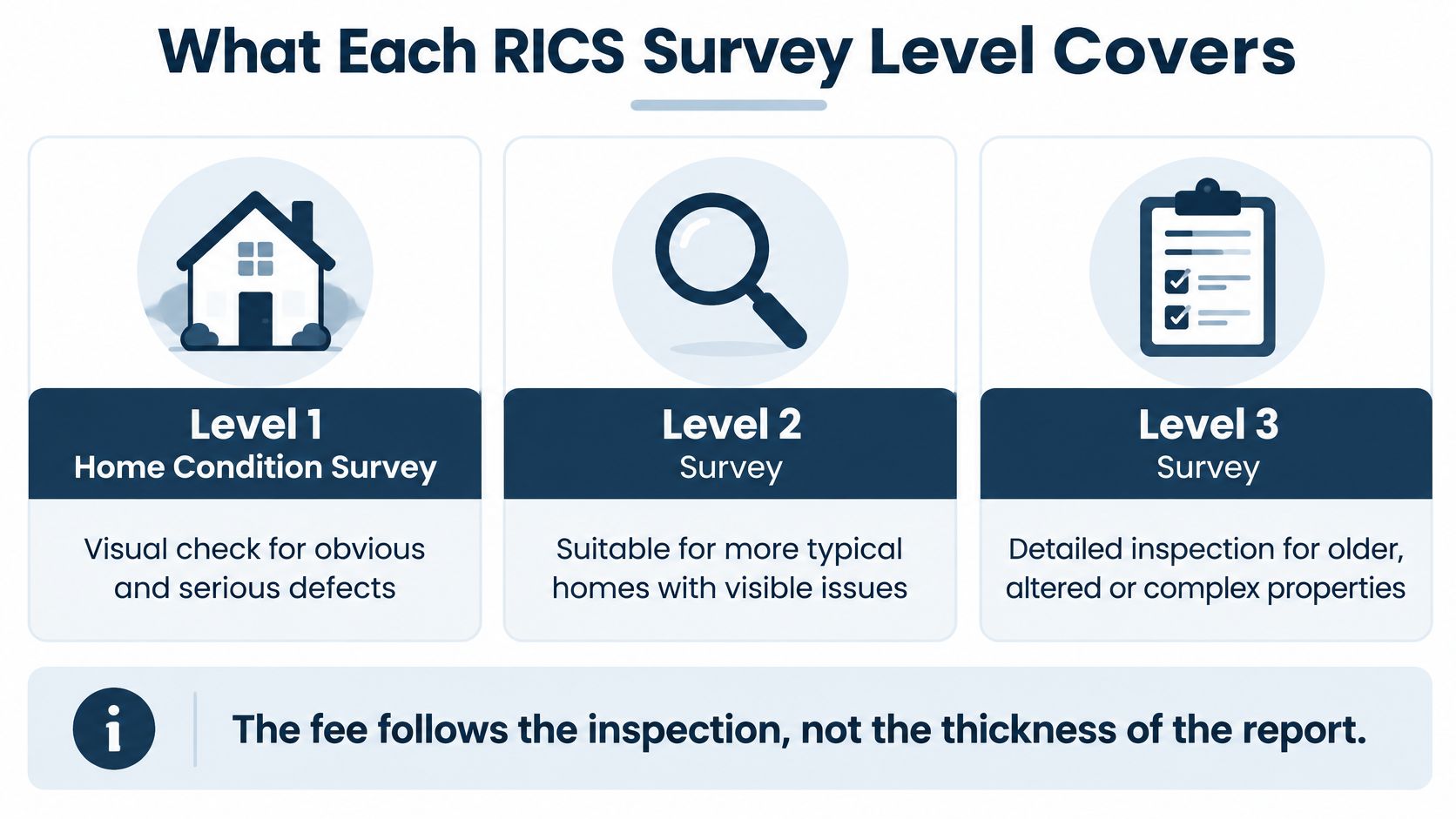
Level 1 and Level 2 for straightforward homes
A Level 1 Home Condition Survey is a visual condition check aimed at identifying obvious and serious defects. It suits a straightforward home that appears in good order when you don't need detailed advice on repairs.
Don't choose it for an ageing conversion just because the interior has been redecorated. Fresh plaster and new flooring tell you little about the roof, concealed timber or structural alterations.
A Level 2 Home Survey covers the building, services and grounds through a wider visual inspection. It suits a conventional house, flat or bungalow in reasonable condition.
MoneyHelper's buying-cost guidance distinguishes this non-invasive inspection from the deeper examination and defect advice associated with Level 3. Services aren't tested, walls aren't opened up and floorboards generally aren't lifted.
Level 3 for older or more demanding buildings
A Level 3 Building Survey examines the structure and fabric in greater depth. The surveyor describes materials, assesses the significance of defects and explains likely causes.
The advice should also outline probable remedial work and the consequences of leaving a defect untreated. That matters when you're deciding whether an uneven floor is an old characteristic or a sign that further investigation is needed.
Think of Level 2 as a careful inspection of a house that appears reasonably sound. Level 3 is the closer examination when the house is old, altered or already showing trouble.
Agree the limits before booking:
- Concealed areas: No survey guarantees that every hidden defect will be found.
- Other professional work: A survey doesn't replace legal searches, an energy assessment or a mortgage valuation.
- Specialist investigations: Drain cameras, electrical testing, opening-up and contractor quotations need separate arrangements when recommended.
- Flats: Ask whether Level 3 is available for the particular property. The government's Right to Buy guide notes that a Building Survey may not be available for some flats.
A surveyor may use a moisture meter during the inspection. That doesn't turn the visit into a specialist damp investigation or establish the cause of every high reading.
What Pushes a London Survey Fee Up
A published band isn't the quote. The surveyor needs to price the time, access and judgement your particular building requires.
A high purchase price alone doesn't describe that work. A smaller converted property can present more inspection difficulties than a larger, straightforward house.
What changes a home survey quote
| Factor | Effect on the quote | London example |
|---|---|---|
| Size and number of floors | More rooms and storeys mean more time on site | A three-storey terrace in Brockley against a compact flat |
| Age and construction | Older fabric takes longer to describe and judge | Victorian or Edwardian houses in Forest Hill, Catford and Sydenham |
| Alterations | Lofts, extensions and removed chimney breasts need closer comment | Conversions and extended terraces in Peckham, Deptford and New Cross |
| Visible condition | Obvious damp, roof trouble or movement points to a deeper survey | A lower-ground flat in Camberwell with staining or a dipping roof |
| Leasehold and access | Common parts, roofs and outside walls may be hard to see | A mansion block in Clapham or a converted warehouse in Bermondsey |
| Where the property is | Travel and time on the road sit inside the fee | Inner London against outer boroughs and the Home Counties |
| Survey only or with valuation | A valuation is separate work even when it shares the visit | Ask which product the figure covers before comparing quotes |
Age matters because the surveyor must understand the construction, not merely record its condition. Lime mortar, lath and plaster and an original roof structure need different judgement from modern materials.
Alterations add another layer. An open-plan ground floor may look attractive, but the surveyor needs to consider support where walls or chimney breasts have been removed.
Access and the instruction matter
In a leasehold building, the selling agent may hold the flat keys but not the keys to communal roof access. Ask for access arrangements early so the surveyor can make the most of the visit.
A locked roof hatch or inaccessible rear elevation can limit the evidence available. Paying for a deeper report won't make a concealed area visible.
Ask what access the surveyor needs before the appointment. Don't discover afterwards that nobody could unlock the common parts.
Historical Department for Communities and Local Government research conducted by Ipsos MORI recorded lender-arranged Level 2 surveys with valuations at £500 to £700 for homes then priced between £200,000 and £250,000, compared with approximately £350 to £550 when bought directly. Those figures explain the older comparison in the table, not what a London buyer should expect to pay now.
The practical lesson is to compare the actual instruction. Confirm whether the quote is survey-only or includes a valuation before deciding that one firm is cheaper.
Which Survey Fits London Housing Stock
Start with the building's construction and alterations. The estate agent's description of its finish isn't enough to choose the inspection.
A conventional semi-detached house can suit Level 2, provided its condition and alteration history support that choice.
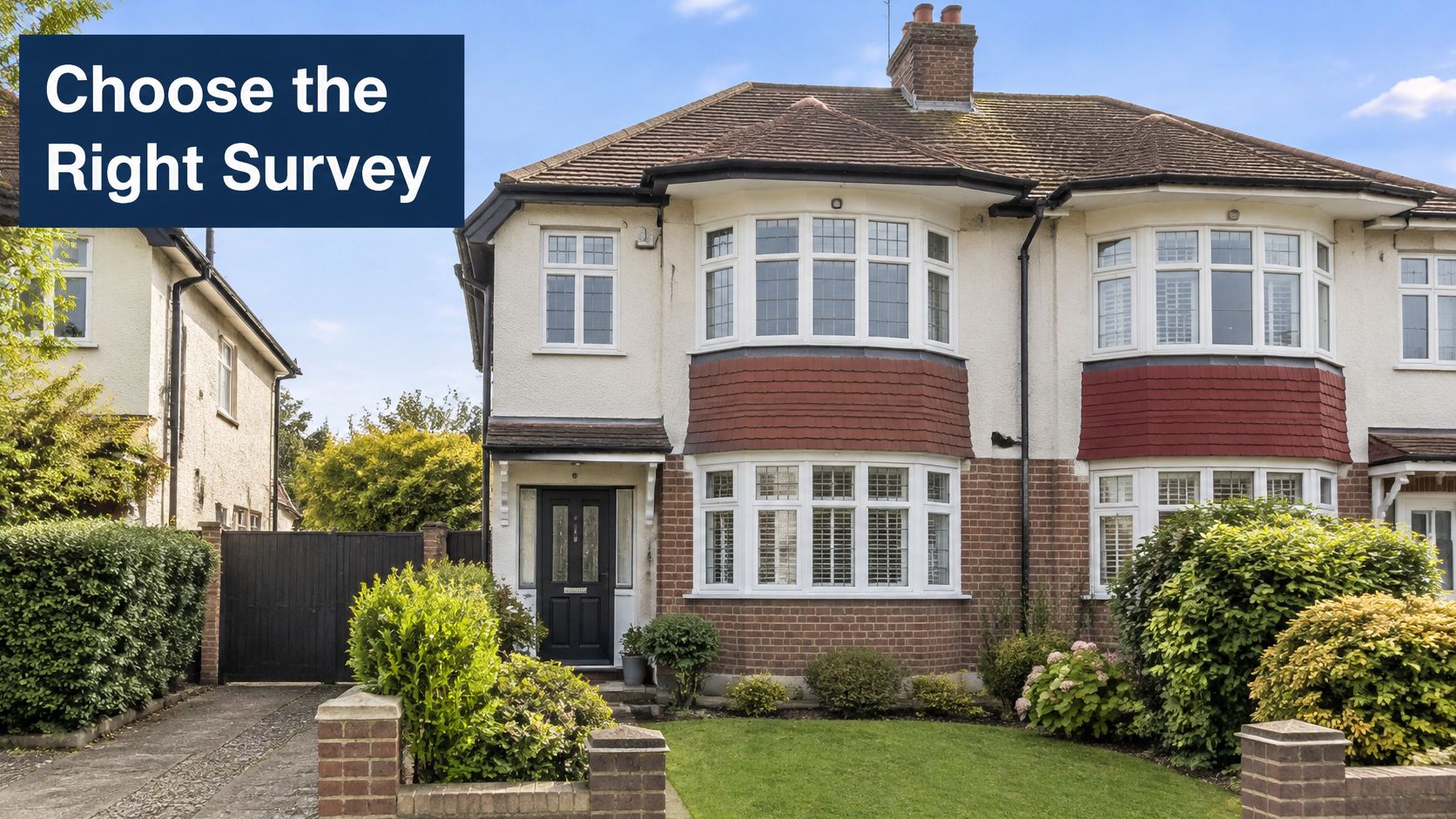
A well-kept semi or an altered terrace
Say you're buying an unextended interwar semi in Bromley, Beckenham or Orpington. If it appears well maintained and has conventional construction, Level 2 is a sensible starting point.
Look beyond the kitchen and bathroom. Roof coverings, chimney masonry and ventilation still deserve attention, as this guide to common problems with 1930s houses explains.
Now take a Victorian terrace in Lewisham or Forest Hill with a rear extension and loft room. Choose Level 3 so you receive fuller advice about the altered structure, roof and junctions between old and new work.
A removed chimney breast changes the conversation further. You need to understand visible support arrangements and whether further investigation or documentary checks are necessary.
This video provides another way to consider the survey decision.
Conversions, traditional buildings and new homes
For a leasehold conversion in Brixton, Clapham or Bermondsey, agree the scope before accepting the quote. The inspection must distinguish your flat from the visible communal structure and identify areas the surveyor cannot reach.
A listed house in Greenwich or a traditional property in a Blackheath or Dulwich conservation area needs someone who understands older materials. Lime mortar and lath and plaster aren't defects just because they're old.
Lead pipework needs different advice because of the material and its use. Don't accept a report that treats every original feature as either harmless character or something to replace.
Use these decisions as a starting point:
- Straightforward and well maintained: Consider Level 2 rather than automatically paying for Level 3.
- Altered, unusual or visibly defective: Choose the deeper inspection and defect analysis of Level 3.
- Listed or traditionally built: Prioritise relevant construction knowledge as well as the survey level.
- New-build under warranty: Arrange an independent condition assessment. Snagging and warranty claims don't replace advice on the property you're buying.
Corinthian's Forest Hill base provides context for advising on this mix of local housing. The right recommendation follows age, construction, condition and planned works, not purchase price alone.
When the Cheaper Survey Is a False Economy
Aviva's consumer study found that 21% of homebuyers in England, Wales and Northern Ireland had not commissioned a survey for their most recent purchase. Among buyers who did obtain one, estimated average savings were £2,600, while new homeowners reported average spending of £3,760 fixing problems after moving in.
These are reported experiences, not a guarantee that a survey will pay for itself. They do show why the lowest fee is not automatically the cheapest decision.
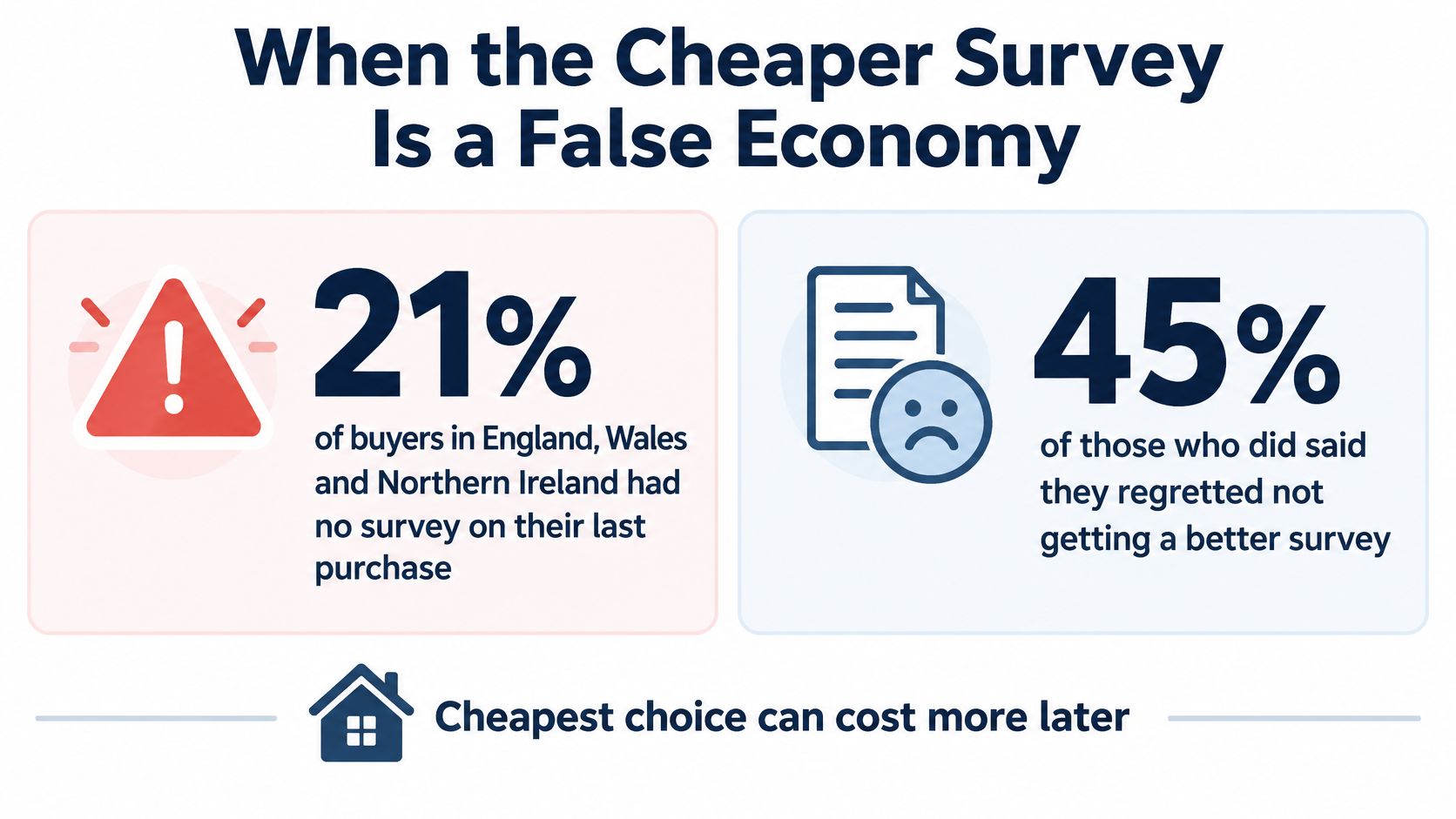
Pay for the risk you actually face
A lower fee makes sense when the property suits a lighter inspection. Paying for extra scope solely because you feel anxious adds little.
It is poor value to choose a lighter service when the house shows reasons for closer examination. Damp staining, a distorted roof or questionable structural alterations need more than reassurance about tidy decoration.
For an extended terrace in Peckham, with plans to remove another internal wall, a deeper inspection can help assess the existing alteration and visible structure. Saving a little on the fee is a weak trade if the report misses evidence that could affect your plans.
The main concern is often what a visible defect may indicate: a leaking roof may have damaged timbers, persistent damp may have a concealed cause, and an alteration may lack adequate support.
A cheap report is good value only if it answers the questions that could change your decision to buy.
Turn findings into a decision
Separate urgent defects from routine upkeep. For significant work, get evidence before using the findings to discuss the price or ask the seller to address a problem.
If the cause remains uncertain, arrange the relevant specialist property surveys. A structural engineer can assess movement; a drainage contractor can investigate a suspected damaged drain.
A survey is evidence for your decision, not insurance against repairs. If wall coverings or sealed voids prevent inspection, the report should explain the limit and identify any justified follow-up.
Resolve material uncertainty before exchange. The sensible economy is a proportionate inspection, booked early enough for you to act on its findings. It is not the smallest figure on the quotation.
How to Get a Quote That Fits the House
A quote should reflect the inspection the property needs. Give the surveyor enough detail to judge the house or flat, not just its postcode and asking price.
What to send and what to ask
Provide the property details. Send the full address, property type, approximate age, number of bedrooms and floors. State whether it is freehold or leasehold, as this helps define the inspection scope.
Describe alterations. Mention loft rooms, extensions, basement accommodation and removed chimney breasts. Include the listing and photographs, especially of anything that concerns you.
Ask for a scope recommendation. Say which level you are considering, then ask whether it suits the building. The surveyor should explain the construction or defect risk behind the recommendation.
Check what the fee includes. Confirm whether it covers a survey alone or a market valuation as well. Ask about VAT and exclusions such as drain testing, electrical testing and opening-up for damp investigations.
Identify the inspector. Ask who will attend and check their RICS qualifications. If you need a valuation, check the firm's RICS Valuers Registration Scheme status.
Check insurance and independence. Ask about professional indemnity cover and any ties to lenders, estate agents or developers. The advice should address your purchase decision.
Compare like for like. Set each quote's scope, access arrangements and exclusions beside its fee. A Level 2 quote is not a cheaper equivalent if the building needs Level 3.
Book after your offer is accepted. Leave time for the report and any recommended investigations before exchange. Give the surveyor your timetable rather than assuming an appointment is available at short notice.
Keep the professional roles clear
Your solicitor investigates the lease, service charges and building-safety documents. Physical defects may prompt questions about planned major works, but a surveyor does not determine your legal liability under the lease.
A lender's valuation serves the lender's decision. It does not replace independent advice on the property's condition or repair priorities.
Corinthian Surveyors London LTD is one option for a property-specific instruction: an independent Forest Hill practice of RICS Chartered Surveyors, led by surveyor Clive, that can advise on the appropriate survey scope from these details.
Questions to Settle Before You Instruct
Who pays for further tests after a house survey?
The buyer usually pays for a structural engineer, damp investigation, electrical inspection or drain survey unless the seller agrees otherwise. Treat these as separate investigations. Ask for a defined scope, because a survey report does not provide a contractor's quotation.
Does a clean survey mean the house is sound?
No. A survey records the condition of accessible areas within the agreed inspection scope. Level 3 gives more analysis for a demanding building, but it cannot establish the condition of every concealed part, such as areas behind covered walls or inside sealed voids.
What should I settle before giving instructions?
Confirm the survey level, access arrangements, whether you need a valuation and what the inspection excludes. Ask who can explain significant findings after you receive the report. These questions to ask before a survey help you assess the proposed service, not just the fee.
The government's How to Buy a Home guide explains that significant survey findings can support a request for repairs, renegotiation or withdrawal of an offer. Decide what evidence you need before choosing a response, especially if the defect's cause or repair cost is unclear.
Before you commit: Get a clear answer about suspected structural support. A reassuring overall impression does not settle that question.
Choose a survey level that fits the building. On a London period house or converted flat, the extra fee for a broader inspection can be justified if it helps you assess defects and renegotiate before exchange. For a simpler property, pay for the scope it needs, not the most extensive option by default.
Corinthian Surveyors London LTD provides residential RICS condition surveys, HomeBuyer surveys, Building Surveys and valuations. To get an individual quote, send the practice the property address, listing and details of any alterations through corinthiansurveyorslondon.co.uk.