
Home Buyers Survey Near Me: A Londoner’s Guide 2026
Your offer's accepted. The estate agent is cheerful, the solicitor starts firing over forms and then someone says, “You'll need to get a survey done.” That's usually the moment the mood changes.
You're excited, but you're also wondering what that means, what sort of survey you need and how to find a home buyers survey near me that isn't just a box-ticking exercise. Fair question. London buyers hear a lot of noise at this stage, much of it from people who aren't carrying the risk if the property turns out to have damp, movement or a roof problem.
I've been surveying homes across London for over 30 years. I'm Clive Thompson, a RICS and CABE qualified surveyor. I'll give this to you plainly. A proper survey is one of the few parts of the buying process that's there to protect you, not the lender, not the agent and not the seller.
Table of Contents
- Your Offer Is Accepted What Happens Next
- What Is a RICS HomeBuyer Report
- Choosing the Right Survey Level 1 2 or 3
- Why a Local Surveyor Is Your Best Bet in London
- How to Find and Instruct a Surveyor You Can Trust
- Reading Your Survey Report and What to Do Next
- Frequently Asked Questions About Home Surveys
Your Offer Is Accepted What Happens Next
Most buyers do the same thing. They spend weeks chasing listings in Forest Hill, Bromley, Greenwich or Peckham, finally get an offer accepted, then freeze when the survey question lands. They ask the agent if the lender's valuation is enough. They wonder if they can save a few hundred pounds by skipping the survey. They tell themselves the place “looked fine”.
That's the mistake.
According to Aviva's 2026 homebuyer findings, 21% of UK homebuyers skip surveys because they trust their own assessment, yet those buyers miss an average £2,600 in potential savings from renegotiating the price based on survey findings. That's not a technicality. That's real money left on the table, before you even get to repair bills.
Practical rule: if you're buying the property, you need advice that's for you alone.
This matters even more in a jumpy market. Reuters reported that in August 2025 the UK housing market saw a marked slowdown, with new buyer enquiries at -17, the house price balance at -19 and agreed sales at -24, all pointing to a much more uncertain buying environment in which surveys help buyers spot defects and negotiate properly, as set out in the Reuters RICS market report.
If you want a useful wider read on deal protection, especially around protecting first-time homebuyers, it helps explain the common-sense reason buyers build protection into a purchase before they're fully committed. Different market, same principle. Don't go into a major purchase blind.
The survey stage isn't red tape. It's the point where you stop guessing and start checking.
What Is a RICS HomeBuyer Report
A RICS Home Survey Level 2, which many people still call a HomeBuyer Report, is the survey most London buyers should start with. It is a serious visual health check on the property. Not a quick glance and not a forensic strip-out.
What it's for
A Level 2 survey is suited to conventional properties built after 1890 using common building materials and in reasonable condition, as explained in this guide to the RICS Home Survey Level 2. That covers a lot of what London buyers look at. Purpose-built flats, many 1930s semis, standard terraces and houses that haven't been heavily altered.
It's there to spot visible defects and risks before you exchange. Things like:
- Damp issues, including signs of rising damp or moisture-related deterioration
- Structural concerns, such as cracking that may point to movement or subsidence
- Roof defects, from slipped coverings to ageing materials visible during inspection
- Timber problems, including decay where it's visible
- General repair issues that could affect your budget or negotiating position
If you want a plain-English overview of the basics, this article on what a RICS survey is is a useful starting point.
A good Level 2 report should answer the buyer's real question: what am I taking on if I buy this place?
What it does not do
Buyers often misunderstand this point. A Level 2 survey is not invasive. The surveyor does not look behind walls or under floorboards. It doesn't involve opening up the building.
RICS inspection standards for Level 2 are visual and practical. The surveyor inspects one window on each elevation, visible parts of services, accessible sub-floor voids by a limited head-and-shoulders inspection and the roof space where it is safe to enter, with external roof and chimney checks often limited to what can be seen from ground level, as set out in the RICS Level 2 standard.
That limitation doesn't make the survey weak. It means you need to understand what it can and can't do. If a defect is hidden inside a sealed void, boxed-in structure or behind fitted finishes, the surveyor can only comment on signs available from a visual inspection.
A Level 2 survey is excellent for the right property. It just isn't magic.
Choosing the Right Survey Level 1 2 or 3
Your offer gets accepted on a flat in Stratford. It looks tidy, the kitchen is new, and the agent says there have been "no issues." A week later you're staring at survey options and wondering whether Level 1 will do, whether Level 2 is enough, or whether Level 3 is money well spent.
My advice is simple. Choose the survey by the building, not by the asking price, the estate agent's confidence, or your hope that nothing serious will turn up.
A modern flat in Stratford carries a different level of risk from an altered Victorian terrace in Lewisham. A 1930s semi in Bromley is a different job again from a converted house in Southwark with patched repairs, old damp staining and structural changes no one has explained properly.
A simple rule that works
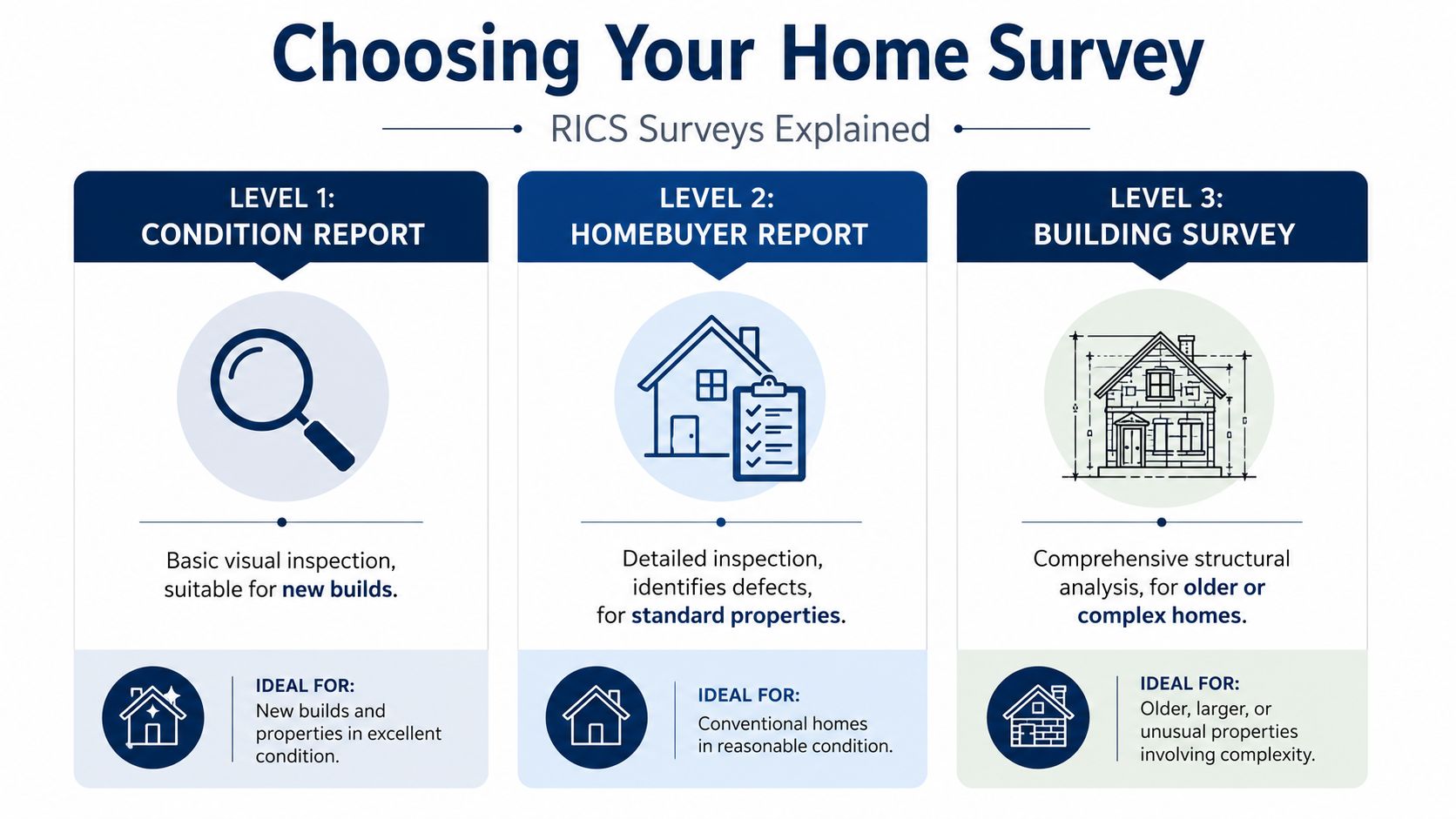
If the property is new, standard and plainly low-risk, Level 1 can be enough.
If it is a conventional home in reasonable condition, Level 2 is usually the right choice.
If it is old, altered, neglected, extended, converted, or built in an unusual way, go straight to Level 3.
That rule will keep you out of trouble far more often than trying to save a few hundred pounds on the survey fee.
Level 1 suits fairly straightforward homes where you want a basic condition snapshot. In London, that may be a newer flat with standard construction and no obvious warning signs.
Level 2 is the sensible choice for many buyers. It fits standard houses and flats where the structure is conventional and the condition appears broadly sound. Typical examples would be a 1930s semi in Bromley, a post-war house in Eltham, or a straightforward flat in Greenwich.
Level 3 is for buildings that need closer scrutiny. If you are buying a Victorian terrace in Peckham with cracking, a period house in Dulwich with extensions, or anything with signs of age, movement, poor alterations or non-standard construction, pay for the detail. If you want to understand that option properly, read this guide to a full structural survey.
Old, altered or tired properties punish buyers who order too little survey.
Cost matters, of course. So does getting the right answer the first time. The Royal Institution of Chartered Surveyors explains in its Home Survey Standard consumer guide that Level 2 and Level 3 surveys are designed for different property types and different levels of risk. The extra fee for Level 3 is usually modest compared with the cost of missing roof spread, hidden dampness, defective alterations or movement in an older London house.
RICS Home Survey Levels at a Glance
| Feature | Level 1 (Condition Report) | Level 2 (HomeBuyer Report) | Level 3 (Building Survey) |
|---|---|---|---|
| Best for | Newer, standard homes with few apparent concerns | Conventional properties in reasonable condition | Older, altered, larger or more complex homes |
| Inspection depth | Basic visual inspection | More detailed visual inspection | Detailed inspection with fuller analysis of defects and risks |
| Main purpose | Condition overview | Identify defects, repairs and issues affecting value or decisions | Understand construction, defects, repair priorities and likely future work |
| Typical London example | Modern flat in Stratford | 1930s semi in Bromley | Victorian terrace in Lewisham with alterations |
| Valuation option | May vary by instruction | Can be instructed with or without valuation under the Home Survey Standard | Usually focused on condition and advice rather than standard valuation format |
| Buyer fit | Lower-risk situations | Mainstream purchases | Homes where a Level 2 would leave too many questions unanswered |
One point buyers often miss. Since 2021, RICS has used the Home Survey Standard across Level 1, 2 and 3 reports, with clear rules on what each level should cover and which surveyors can sign them off. You can see that set out in the RICS Home Survey Standard overview.
If you are torn between Level 2 and Level 3, I'd rather see you spend a bit more and get clarity. In London, older housing stock, conversions and altered properties catch buyers out every day. An independent surveyor should tell you what you need to know, not sell you the cheapest option to keep a referrer happy.
Why a Local Surveyor Is Your Best Bet in London
The “near me” part of your search matters. In London, local knowledge isn't a nice extra. It affects what the surveyor notices, how they interpret it and what they flag as a real risk.
London stock varies street by street
A buyer in Croydon may be dealing with movement patterns linked to clay soils. A buyer in Dulwich or Brockley may be looking at Victorian conversions where the trouble is often hidden in poor alterations, tired roof coverings, ageing windows or shared building responsibilities. In Bermondsey or Rotherhithe, converted flats can throw up a different mix of defects again.
That's why a panel surveyor sent in from a national booking system can be hit and miss. They may be perfectly competent, but competence and local familiarity aren't the same thing. A surveyor who regularly works in Lewisham, Southwark, Greenwich, Bromley and the surrounding boroughs already knows the local housing stock, the common defects and the usual weak points.
Independence matters as much as postcode knowledge
You also want someone independent. Not tied to the lender. Not tied to the estate agent. Not trying to keep a referrer sweet.
Corinthian Surveyors London LTD is an example of the sort of firm buyers should look for. Independent, based in Forest Hill, regulated by RICS, with residential coverage across London, the Home Counties and the South of England. That matters because the advice should be shaped by the building and the evidence, not by anyone else's timetable.
A local independent surveyor is more likely to tell you plainly when a flat conversion has warning signs, when a roof needs closer attention or when a Level 2 isn't enough for the building you're buying. That honesty is what you're paying for.
How to Find and Instruct a Surveyor You Can Trust
Your offer is accepted on a flat in London. The agent says, “We've got a surveyor who can do it quickly.” You're under pressure, the solicitor is asking for papers, and it's tempting to say yes.
Stop there. The surveyor works for you, not for the agent, not for the lender, and not for the pace of the chain.
What to check before you instruct
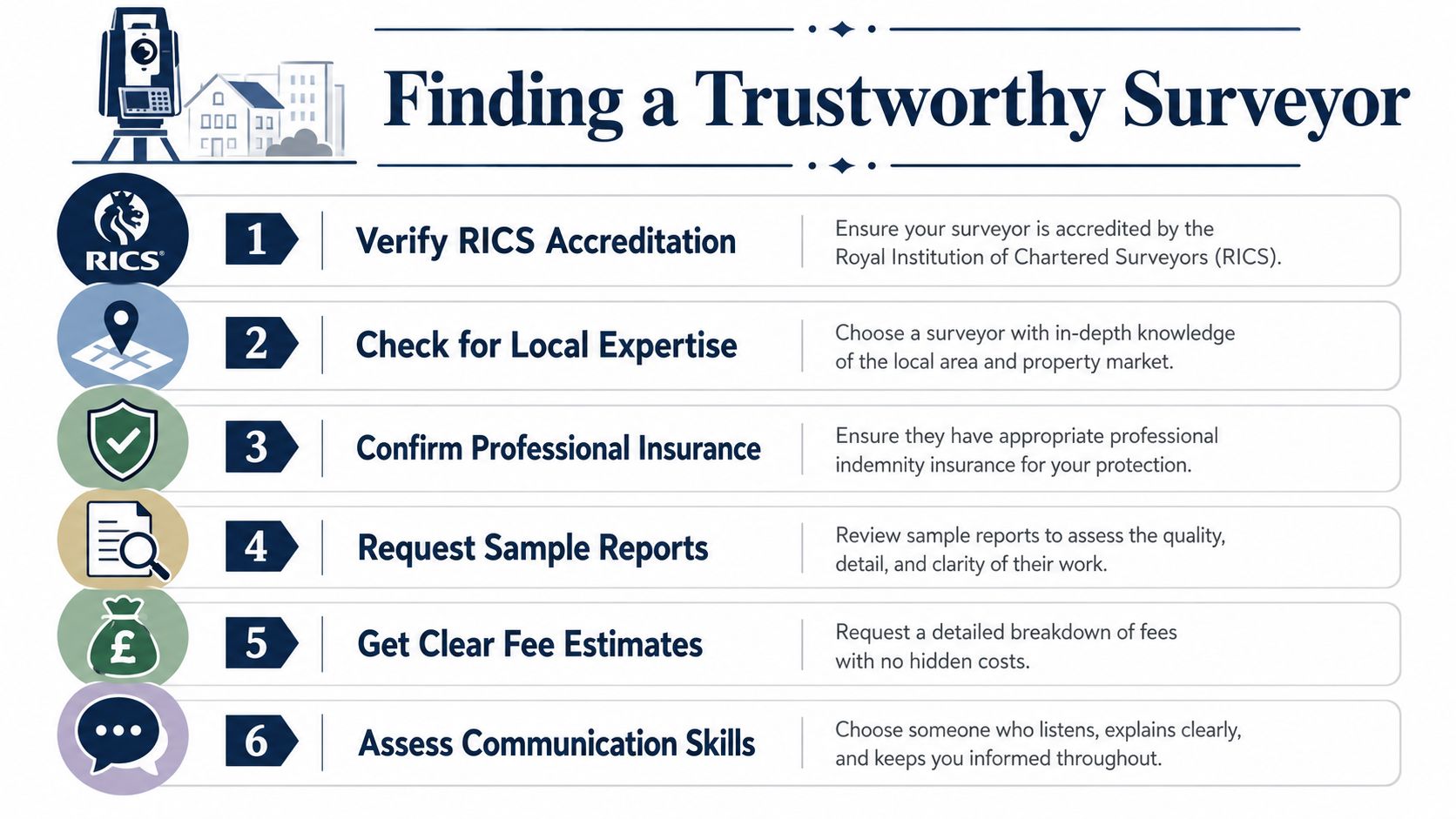
Start with regulation and insurance. The firm should be RICS regulated for residential survey work. If valuation is part of the job, check whether the surveyor is in the RICS Valuer Registration Scheme. The firm should also carry professional indemnity insurance. Corinthian Surveyors London LTD states that it is insured by Royal Sun Alliance. That is the sort of basic protection you should confirm before you book.
Then check independence. This matters more than buyers realise. A surveyor who relies heavily on estate agent referrals is under commercial pressure, whether anyone admits it or not. You want someone who can tell you a roof is near the end of its life, a loft conversion looks questionable, or a flat needs deeper investigation, without worrying who gets upset.
If you want a practical shortlist, this guide on choosing a building surveyor in London without wasting time or money is a sensible place to start.
For buyers trying to get a sense of what the process looks like, this video gives a decent overview:
Price matters, but price on its own tells you very little. As noted earlier, survey fees vary with the property type, size, value and location. A cheap quote can mean a rushed inspection, a thin report, or a surveyor who is spread too wide to give the job proper attention.
Cheap surveys can be expensive purchases.
A property survey is part of due diligence. The same discipline that matters in making informed business decisions matters here too. You need clear evidence, not reassurance dressed up as advice.
Questions worth asking on the phone
Ask a few plain questions and listen carefully to the answers. A good surveyor will answer directly.
- What types of property do you inspect most often in my part of London? You want relevant experience, not a vague claim that they cover the whole capital.
- Which survey level do you recommend for this property, and why? The reason matters as much as the recommendation.
- Will you inspect the roof space and visible services where accessible? That tells you how practical the inspection will be.
- Can I call you after I receive the report? You should be able to talk through the findings in plain English.
- Are you independent of estate agents, lenders and developers? Ask it straight.
- How quickly can you inspect, and when will I get the report? Get a clear timescale.
Ask for a sample report as well. You are not judging the previous property. You are checking whether the report is readable, specific and useful.
If the surveyor sounds evasive, overly slick, or unwilling to say what they will and will not inspect, move on. London buyers waste too much time being polite to the wrong people. Pick the surveyor who speaks plainly, knows the local stock, and answers to you alone.
Reading Your Survey Report and What to Do Next
A survey report shouldn't sit in your inbox like a school exam paper you're afraid to open. It's a working document. Read it with one question in mind. What needs doing, what needs checking further and what does that mean for the purchase?
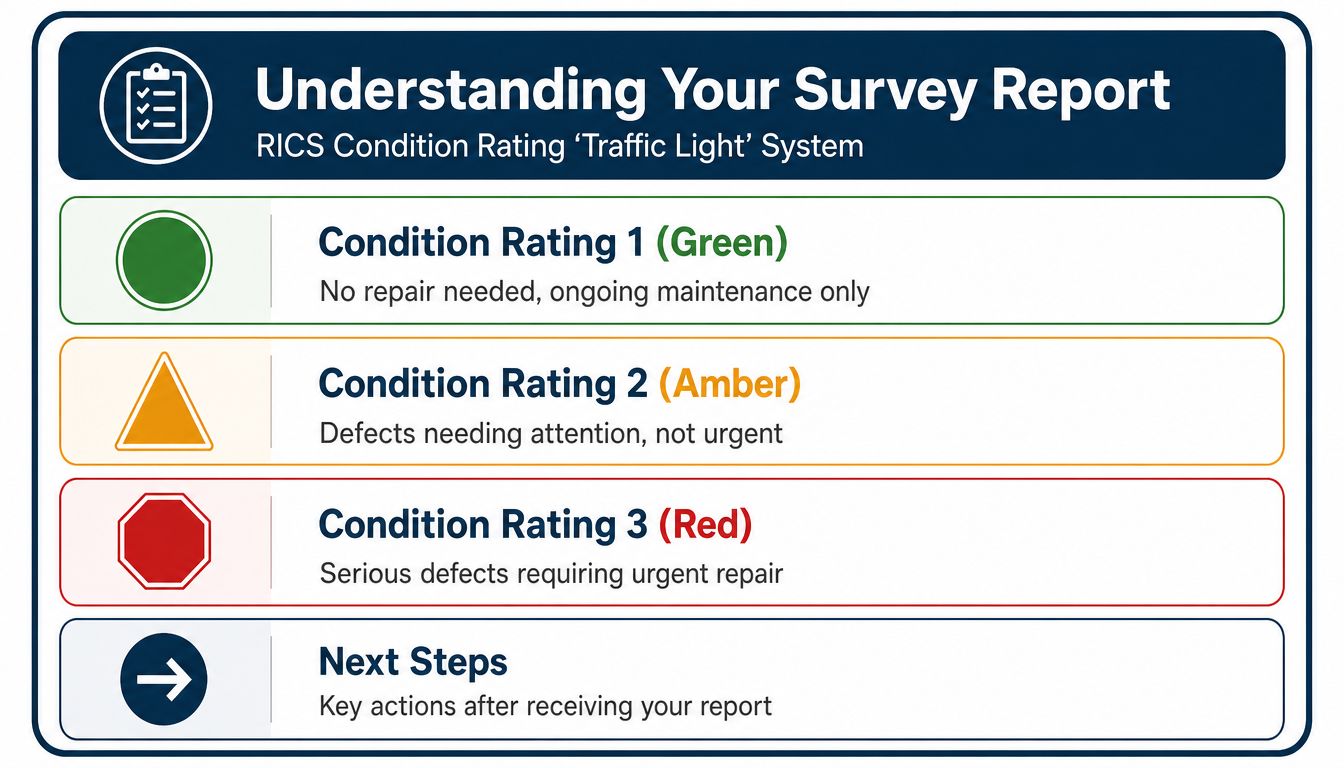
How the ratings work
The RICS Level 2 report uses a traffic light condition rating system, as outlined in this RICS Level 2 explainer video. Condition Rating 1 means no action, 2 means repair or replacement needed over time and 3 means urgent priority.
That system is there to help you sort the important from the routine.
- Rating 1 might apply to an element that appears serviceable and needs only normal maintenance.
- Rating 2 often means the item isn't failing today but does need attention, repair or budgeting for.
- Rating 3 means don't shrug it off. It needs urgent attention or further investigation.
The same explainer notes that the Level 2 format ends at section M, not N, and leaves out section J energy matters, which is only included in Level 3 reports. Buyers sometimes compare reports without realising the formats differ.
What you do with the report
Once you've read it, sort findings into three piles. Issues you can live with, issues that need specialist quotes and issues that may justify renegotiation.
A survey is part of due diligence. If you've ever looked at business due diligence, the logic is similar to making informed business decisions. You gather evidence before committing, not after.
Here's the sensible next move:
- Read the red items first: Anything urgent comes before decorative snags.
- Get specialist advice where the report recommends it: Electricians, roofing contractors, damp specialists or structural engineers, depending on the issue.
- Speak to your solicitor and agent with evidence: Not emotion. Use the report findings.
- Decide whether to proceed, renegotiate or walk away: All three are valid options.
A good surveyor should also talk you through the report by phone. If you need that sort of plain-English explanation from a RICS and CABE qualified surveyor, call 0800 00 16 422 and ask the questions before you commit yourself any further.
Frequently Asked Questions About Home Surveys
Can a survey really save me money
Yes. Sometimes through renegotiation, sometimes by stopping you buying a problem. The saving isn't always immediate cash off the price. It can be avoiding a roof liability, a damp bill or a costly surprise in the first year.
What's the difference between a mortgage valuation and a survey
A mortgage valuation is for the lender. It is not there to protect you in the same way a buyer's survey does. Buyers confuse the two all the time and that confusion costs them.
I'm buying a flat. Do I still need a survey
Yes. Flats still have roofs, windows, walls, services and signs of movement or damp. In London, flat conversions are one of the common places where buyers assume the lease will protect them from defects. It won't.
Why did my Level 2 survey miss a major defect
Because a Level 2 is a visual, non-invasive inspection. It does not open up concealed parts of the building. Direct Line has noted that 42% of surveys uncover issues, while a quarter of buyers without surveys face unexpected bills, in its discussion of survey decisions and hidden problems in home purchases at Direct Line's property survey overview. That doesn't mean a survey should find everything hidden. It means you need the right survey, the right expectations and the right follow-up where the report recommends more investigation.
If you're buying in London and want straight advice on which survey level fits the property, Corinthian Surveyors London LTD handles Level 1, Level 2 and Level 3 residential surveys, along with valuations and related advice across London and the Home Counties. Start with the property address, the estate agent's details and any obvious concerns you've already spotted. That's enough to have a sensible conversation and avoid ordering the wrong report.