
Home Buyers Survey: Essential Guide for London Property

A home buyers survey is a professional inspection of a property's condition, carried out by a trained surveyor, typically a RICS member, before you commit to buying. It identifies visible defects and maintenance problems so you can decide whether to proceed, renegotiate or walk away.
You may be looking at a Victorian terrace in Lewisham, a converted flat in Bermondsey or a 1930s semi in Bromley. The estate agent has made the rooms look their best, your mortgage valuation is being arranged and your solicitor is checking the paperwork. This is exactly when you need an independent view of the building itself.
A survey won't remove every uncertainty. It will show you where the uncertainty lies and tell you when a specialist needs to investigate further.
Table of Contents
- What a Home Buyers Survey Is
- Understanding RICS Survey Levels and When to Choose Each
- Common Defects Found in London Properties
- How Survey Findings Affect Your Purchase Decision
- Survey Costs, Timelines and Choosing the Right Surveyor
- Making the Most of Your Home Buyers Survey
What a Home Buyers Survey Is
You walk around a flat and everything looks fine. The paint is fresh, the windows open, and nothing smells damp. Then the survey lands and says there are high moisture readings to an external wall, cracking above a rear extension, and signs the drains may need checking. That is what a home buyers survey is for. It turns a tidy viewing into a proper risk check, and it tells you when you need a specialist rather than a guess.
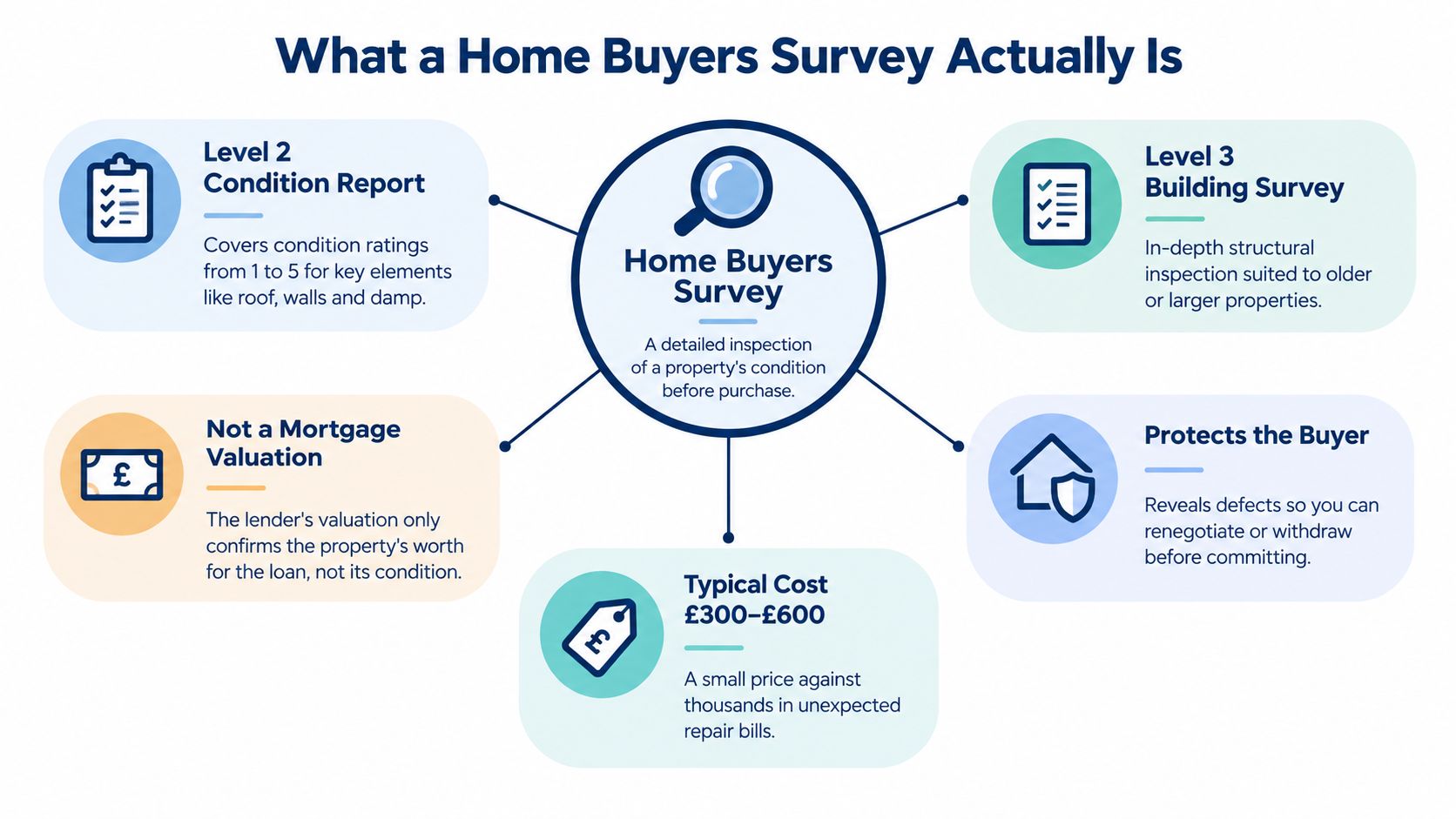
A home buyers survey is a visual inspection of a residential property followed by a written report. The surveyor checks accessible parts of the building, including roofs, walls, floors, windows, drainage, loft spaces and visible services, then records defects, deterioration, repair needs and warning signs that justify follow-up by a damp specialist, structural engineer or drainage contractor. Walls are not opened up. Floors are not lifted. The report gives you evidence, plus a decision point on what to investigate next.
That boundary matters. A surveyor can report tide marks, stained plaster and poor ventilation. A damp specialist is the person to confirm whether you are dealing with condensation, penetrating damp or a failed damp-proof course. A surveyor can record stepped cracking or sloping floors. A structural engineer should take over if the pattern suggests movement, subsidence, lintel failure or altered load paths. A surveyor can note slow drainage, foul smells or inspection chambers in poor condition. A drainage survey with CCTV is the right next step if you need to know whether there are cracked pipes, root ingress or a collapse underground.
A mortgage valuation serves the lender. Your survey serves your purchase decision. RICS says buyers should commission a survey rather than rely on a lender's valuation, and the government describes a survey as a detailed inspection of condition by a trained professional such as an RICS member. See the RICS consumer guide to home surveys for the distinction.
Why presentation isn't evidence
Fresh paint can hide staining. Furniture can hide cracking. A dry day tells you very little about how a roof, gutter or basement behaves after a week of rain.
The point of the survey is to look past appearance and spot the clues that change your next move. The English Housing Survey findings on housing quality report that 3.8 million dwellings, or 15% of England's housing stock, failed the Decent Homes Standard, with common problems including repairs, safety and thermal comfort. A clean viewing does not tell you whether the building meets a decent standard or whether hidden defects are waiting behind cosmetic work.
Practical rule: A valuation protects the lender's security. A survey protects your decision and tells you when to bring in the right specialist.
Before the inspection, sellers can also use a room-by-room inspection checklist for sellers to spot obvious maintenance issues. That can improve access and help the surveyor inspect the property properly, but it does not replace an independent report for the buyer.
Understanding RICS Survey Levels and When to Choose Each
RICS divides residential surveys into three levels. The right choice depends on the property's age, construction, alterations and your plans for it. It doesn't rely on whether you're a first-time buyer.
| Survey Level | Scope | Suitable For | Typical Use Case |
|---|---|---|---|
| Level 1 | Basic visual condition report | Straightforward newer properties in good condition | A simple home where only a broad condition overview is needed |
| Level 2 | Detailed visual inspection with condition ratings and repair advice | Conventional houses, flats and bungalows built with common materials | An ordinary London property in reasonable condition |
| Level 3 | In-depth inspection and analysis of defects, repairs and maintenance options | Large, old, run-down, unusual or heavily altered buildings | A period property, listed building, conversion or purchase involving major works |
A plain explanation of what an RICS survey covers can help before you instruct anyone, but the property should drive the decision.
Level 1
Level 1 is the most limited option. It gives a basic condition overview and isn't the report I'd choose for a Victorian terrace with a converted loft, an old basement or signs of movement. It may suit a straightforward newer property in good condition where the buyer wants a basic record rather than detailed repair advice.
Level 2
A Level 2 Home Survey, often called a HomeBuyer Report, is intended for conventional houses, flats and bungalows with common materials, a simple form and a reasonable general condition. It includes a more extensive inspection of the roof space and drainage chambers than Level 1. It also identifies defects and gives advice on likely repairs and maintenance.
For many ordinary flats in Catford, modern houses in Greenwich or conventional homes in Sydenham, Level 2 is the sensible starting point. You can commission it as a survey-only report or with an additional valuation.
Level 3
Choose Level 3 when the building is old, large, altered, unusual or in poor condition. That includes many Victorian terraces in Lewisham, period houses in Dulwich, listed buildings, properties with basement excavations and flats created from older houses.
RICS says Level 3 is appropriate where major works are planned or where the building needs a deeper assessment. It won't automatically include every specialist test, however. If the surveyor sees evidence of movement, damp or drainage failure, the report may recommend a structural engineer, damp specialist or drainage contractor.
Common Defects Found in London Properties
A Victorian terrace in Lewisham can look sound from the pavement and still need careful inspection. Surveyors look at the pattern of cracking, the condition of the roof coverings, the junctions around extensions and the way rainwater leaves the building.
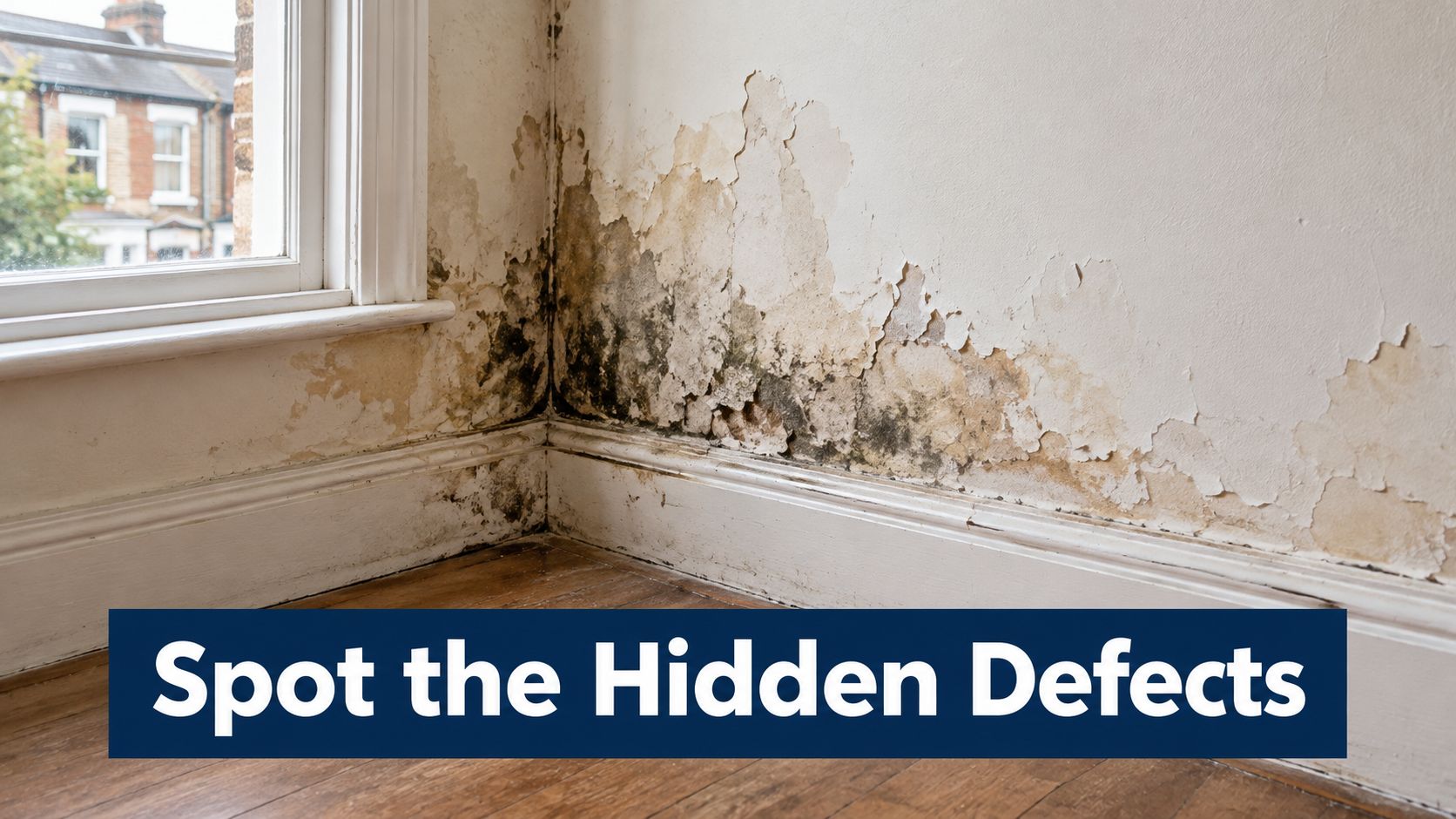
Damp is a common source of confusion. Peeling paint may result from penetrating damp, plumbing leakage, condensation or an unsuitable previous repair. A surveyor can record the visible evidence and likely causes, but a specialist may be needed where the source can't be established without testing. This practical guide to how to spot water damage during an inspection is useful background, although a UK property still needs advice suited to its construction.
What changes from borough to borough
In Bromley and Beckenham, a 1930s semi may present different problems from a narrow Victorian terrace. Look for roof junctions, cavity wall alterations, suspended timber floors and extensions that have been built against the original house.
In Bermondsey, warehouse conversions and other dense urban flats raise different questions. The visible flat may be well finished while the building's roof, external walls, communal drainage or alterations above and below need further attention. A flat survey also needs to be read alongside the lease and management information. The surveyor can't confirm legal rights or service charge liabilities from a visual inspection.
Period properties bring their own details. Original lead pipework, lime mortar, lath and plaster, chimney breast removals and timber decay can all affect repair methods. Cement pointing on an older wall may trap moisture. A removed chimney breast may need documentary evidence and structural confirmation rather than a quick assumption that the work was properly supported.
Cracks need interpretation, not panic. Their position, direction, width, age and relationship to doors or windows matter more than the mere fact that a crack exists.
Subsidence and structural movement need the same measured approach. A stepped crack near an opening, distorted door frame or sloping floor may justify a structural engineer's opinion. That doesn't mean the purchase should automatically stop. It means you need evidence before exchange. Corinthian's guidance on foundation movement and structural concerns explains why the next investigation should match the visible signs.
Roof defects, blocked gutters and poor drainage can create problems far from the original source. The surveyor checks accessible roof spaces, coverings, flashings, rainwater goods and visible drainage features, but concealed pipework and underground runs may need a separate drainage survey.
How Survey Findings Affect Your Purchase Decision
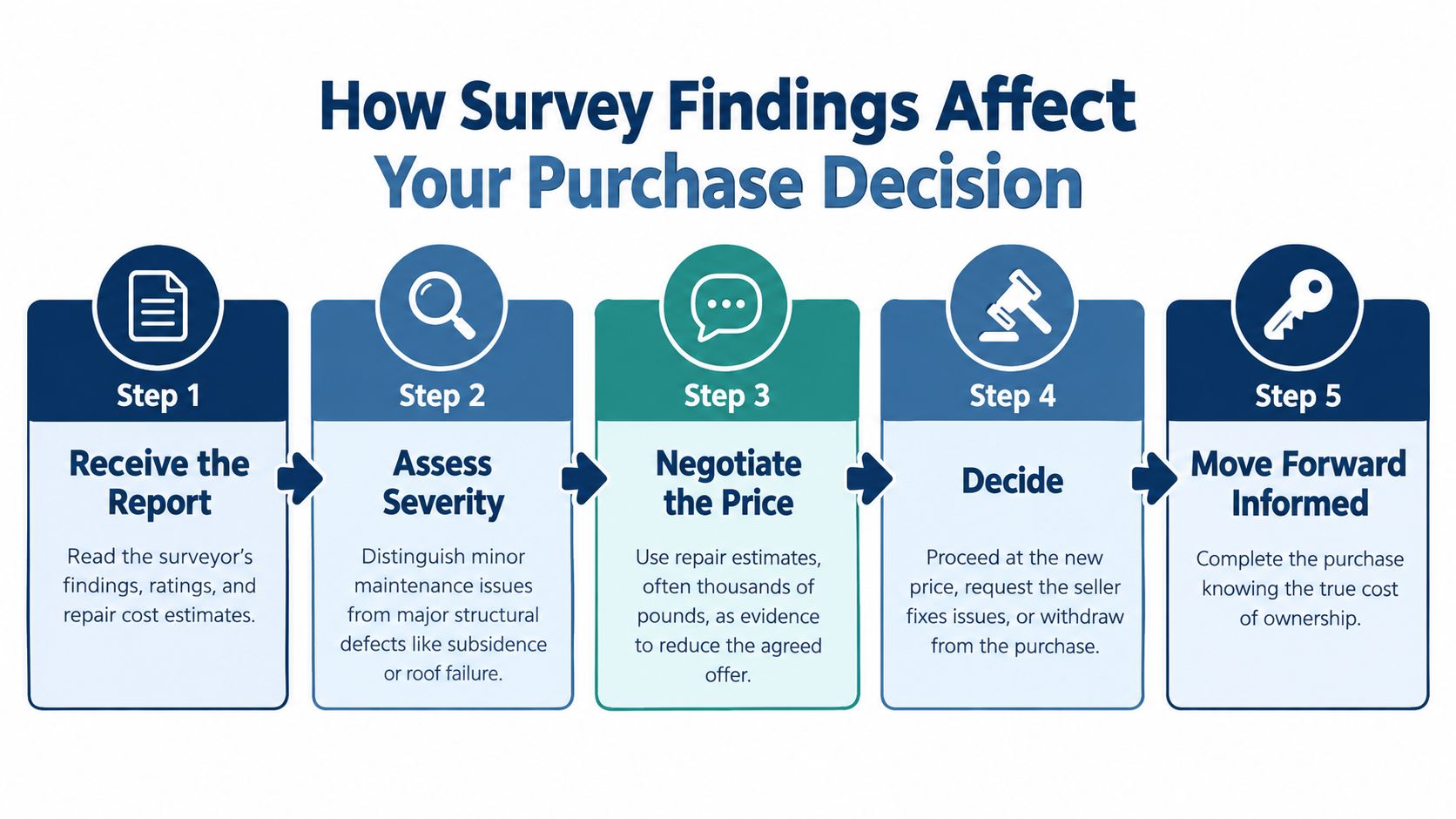
Don't treat the report as a pass or fail certificate. Read each finding with three questions in mind: what is the defect, what could it cost or affect and what evidence do I need before exchanging contracts?
A loose roof tile and a suspected structural movement issue don't belong in the same decision category. Neither does a tired kitchen finish. The surveyor's written commentary matters more than a colour alone because it explains the defect, likely consequence and recommended action.
Use the report as a decision filter
RICS Condition Rating 2 identifies defects that need repairing or replacing but aren't considered serious or urgent. The property should still be maintained in the normal way. The highest-risk category is reserved for defects that are serious or urgent and need immediate attention or specialist advice. A rating doesn't by itself mean a home is uninhabitable.
Use this order:
- Separate maintenance from risk. Cosmetic decoration, worn finishes and routine upkeep may not justify a price change. A leaking roof, active damp or unsafe alteration deserves closer attention.
- Follow the recommended specialist. Ask a damp specialist about unexplained moisture, a structural engineer about movement, an electrician about unsafe visible installations and a drainage surveyor about suspected underground or inaccessible drainage defects.
- Request evidence. Obtain the survey photographs, previous reports, guarantees, building control records, planning documents and specialist quotations where relevant. Don't accept a vague assurance that an issue was dealt with.
- Negotiate from the defect. Ask for a price reduction or a defined repair based on the likely work. A seller repair can be useful, but only if the contractor, specification and completion evidence are acceptable.
- Control the timetable. Delay exchange if a serious question remains unanswered. Withdraw if the risk, cost or uncertainty no longer fits your finances or plans.
When specialist follow-up is essential
A standard survey isn't an energy audit and it can't predict your exact bills. It can, however, identify features that may affect running costs, including poor windows, limited insulation, damp, ventilation problems, roof deterioration and constraints affecting refurbishment. An EPC gives useful information, but it isn't a guarantee of actual energy use.
The same principle applies to asbestos, electrical systems and drainage. If the report says further investigation recommended, don't treat that phrase as background noise. Ask what the surveyor saw, what the specialist should test and whether the result could change your decision.
Survey Costs, Timelines and Choosing the Right Surveyor
Survey fees range from a few hundred pounds for a basic report to more than £1,000 for bespoke work, depending on the property and scope. The cheapest option isn't necessarily the lowest-cost option. A weak report can leave you paying for a second inspection or discovering a defect after completion.
Allow time for the surveyor to inspect the property, prepare the report and answer sensible follow-up questions before exchange. The exact turnaround depends on access, property size, complexity and the survey level. Ask for a clear timetable rather than assuming the lender's valuation and your survey follow the same process.
Check the person, not just the fee
Look for an RICS Chartered Surveyor and check relevant experience with the property type. CABE qualifications can also be relevant to building construction and defects. Ask whether the firm is RICS regulated, carries professional indemnity insurance and can explain the report in plain English.
An independent surveyor should have no ties to the lender, estate agent or developer involved in your purchase. A lender-appointed panel surveyor may be competent, but the lender's valuation instruction still has a different purpose from your own survey.
Ask these questions before instructing:
- Which level fits this property? A good surveyor should explain why Level 2 or Level 3 is appropriate.
- What will you inspect? Clarify roof spaces, drainage chambers, basements, communal areas and access restrictions.
- What happens after the report? Ask whether the surveyor can discuss findings and identify the right specialist.
- How do you report urgency? Confirm how condition ratings and written recommendations are presented.
- What do you know about this housing stock? Local experience matters in Forest Hill, Peckham, Blackheath and surrounding boroughs.
Corinthian Surveyors London LTD is an independent RICS-regulated firm in Forest Hill. Clive Thompson holds RICS and CABE qualifications and has over 30 years of experience in the built environment. The practice covers London, the Home Counties and the South of England, with no ties to lenders, estate agents or developers. Its practical explanation of RICS HomeBuyer Report costs and scope is a useful reference when comparing quotes.
Making the Most of Your Home Buyers Survey
You find the flat, the offer is accepted, and then the survey lands with three words buyers hate: further investigation required. That is the moment to stay calm and get specific. A home buyers survey is a visual inspection. Its real value is not just spotting defects. It helps you decide which points need proper follow-up before you exchange contracts.
Start by treating the report as a decision tool, not a box-ticking exercise. Read it in order of consequence, not page order.
- What has been observed? Staining, cracking, uneven floors, defective pointing, blocked air bricks, roof spread, or signs of past alteration.
- What is the surveyor inferring from that evidence? Possible damp ingress, possible movement, possible concealed decay, possible drainage trouble.
- What needs confirmation by a specialist? This is the key boundary. Surveyors do not open up walls, lift floors or test every service.
- What changes your risk before exchange? Urgent repair liability, insurance concerns, mortgage retention, or work that alters the price you should pay.
That boundary matters most in London, where older housing stock often shows a mixture of age, patch repairs and later alterations. A surveyor may see salt staining and damaged plaster, for example, but that does not prove rising damp. It may justify a damp and timber inspection, or it may point to leaks, bridging, condensation or poor external ground levels. The smart move is to ask what was observed, what the likely causes are, and what inspection would confirm it.
Do the same with cracks. Hairline plaster cracking is common. Progressive cracking, distorted openings, sloping floors or signs of past movement need a sharper response. In that case, ask whether the pattern suggests routine monitoring or whether you should instruct a structural engineer before exchange. The report should help you separate cosmetic defects from defects that need evidence.
Keep your paperwork in one place. Save the survey, photographs, quotations and any specialist reports with your conveyancing documents. If you renegotiate, do it from written findings, not from a seller's reassurance or an estate agent's opinion.
London buyers also have less room for expensive surprises. In the English Housing Survey housing crisis analysis published by GOV.UK, the average age of first-time buyers in London in 2023 to 2024 was 35, compared with 34 elsewhere in England, and 40% of first-time buyers put down deposits worth 10% to 19% of the purchase price. If your deposit has already stretched you, do not carry untested repair risk into exchange.

Frequently asked questions
Can a home buyers survey tell me what my energy bills will be?
No survey can price your future bills because usage, tariffs and heating habits vary too much. What it can do is flag building features that often drive cost in older London homes, such as thin roof insulation, single glazing, solid walls, draughts, poor ventilation or an aging boiler. Your EPC gives a standardised rating, but it will not tell you how a converted Victorian flat feels in January.
Is Level 2 enough for an old London flat?
Only if the flat is fairly conventional, accessible and in reasonable condition. If the conversion is old, the building has been altered several times, there are signs of movement or damp, or the leaseholders may face major works, pay for Level 3. The extra detail is usually cheaper than finding out too late that the warning signs were there all along.
What should I do when a survey recommends further investigation?
Ask the surveyor to pin it down in writing. You want three things: what was seen, why it matters, and what sort of specialist should inspect next. Then get that specialist's written findings before exchange if the issue could affect value, safety or future repair costs. Verbal reassurance from the seller is not evidence.
Corinthian Surveyors London LTD provides independent RICS Level 2 HomeBuyer Surveys, Level 3 Building Surveys and specialist defect advice for residential properties across London. Visit Corinthian Surveyors London LTD to discuss the property, choose the right inspection and arrange clear advice before you exchange contracts.