
Flood Risk Assessment for London Property
You're halfway through a purchase, the survey has landed, and the flood result looks reassuring at first glance. The property may sit outside a river flood zone, yet you're still left wondering about heavy rain, blocked drains, a basement, or whether water could get in through the front step or rear access. That's the point where a proper flood risk assessment earns its keep, because a sensible buyer in London needs more than a map label.
A good assessment helps you decide three things. Is the risk acceptable? Do you need more evidence? What should happen before you exchange or complete? If those questions aren't answered plainly, the report hasn't done its job.
Table of Contents
- What a Flood Risk Assessment Must Help You Decide
- How Flood Risk Is Assembled
- Why London Property Risk Extends Beyond Flood Zones
- Reading Flood Probability, Depth and Climate Evidence
- London Property Scenarios and Their Different Outcomes
- How Surveyors Carry Out a Property Assessment
- Using Results in Purchase, Insurance and Valuation Decisions
- Mitigation, Commissioning Advice and Final Checks
What a Flood Risk Assessment Must Help You Decide
A buyer in Forest Hill can get a tidy-looking flood result and still be stuck with awkward questions. The house may be outside a river flood zone, but the lower ground floor, garden levels, access path or drainage layout can still make the place vulnerable in practice. That is why I treat flood work as a decision tool, not a box-ticking exercise.
A decent assessment should tell you whether the available evidence is enough for a purchase decision. It should also show where the uncertainty sits, because uncertainty is often the issue. If the building has a basement, a sunken front area or a rear slope that feeds water towards the house, a simple zone label is not enough.
Practical rule: if the map looks reassuring but the building form does not, trust the building form enough to ask more questions.
That matters before exchange and completion. Once you own the place, you own the disruption, the repairs and the insurance hassle. If the evidence is mixed, the right answer is not panic, it's proportionate follow-up.
A preliminary residential screen and a property-specific assessment are not the same thing. The first is a quick filter. The second looks at what happens at the site, where water might come from and what it would hit first. For London buyers, that distinction is often the difference between a sensible purchase and a surprise problem.
what to check when buying a house
How Flood Risk Is Assembled
Water only becomes a property problem when three things line up, a route, something vulnerable and something worth damaging. That's the simplest way to understand flood risk. A good assessment looks at the whole chain, not just one part of it.
The four building blocks
Hazard is the source and character of the water. That means where it comes from, how likely it is and how damaging it could be. Exposure is what sits in the way, the rooms, services, contents and structure. Vulnerability is how badly the building would suffer if water got in. Performance is how the existing drains, defences and property-level measures change the outcome.
| The Four Components of Flood Risk | Plain-language question | Property-level example |
|---|---|---|
| Hazard | Where could the water come from? | Intense rainfall, river overflow, groundwater or sewer surcharge |
| Exposure | What would be affected? | Ground-floor rooms, boiler, sockets, basement storage or access routes |
| Vulnerability | How badly would it be hit? | Timber floors, low sockets, below-ground rooms or fitted finishes |
| Performance | What reduces the damage? | Drainage, barriers, raised thresholds or maintained defences |
A doorway, air brick, utility inlet, basement stair or driveway can all act as pathways. The rooms, plant and access points they lead to are the receptors. If there's no pathway, the water may still be nearby, but it won't necessarily damage the building.
For general homeowner thinking, the flood mitigation tips for homeowners resource is useful because it separates practical household measures from broad theory. That said, a London purchase decision still needs site-specific judgement, not a generic checklist.
The key point is simple. A proper assessment asks how water would move, what it would reach and how the building would cope. That is a much better question than “is the postcode in a zone?”
Why London Property Risk Extends Beyond Flood Zones
A flood zone is a screen, not a guarantee. It can tell you where broad hazard exists, but it can't tell you whether a given house in Lewisham, Peckham or Greenwich has a low threshold, a poor drainage route or a basement that will become the first point of failure. Buyers who stop at the zone label often miss the issue.
Surface water, groundwater, sewer behaviour and local ground levels matter at property scale. A low-lying rear garden in Lewisham can shed water towards the house. A basement conversion in Bermondsey can be exposed even when the wider street looks ordinary. A riverside property in Greenwich may face different questions again, because source, defence assumptions and safe access all need checking.
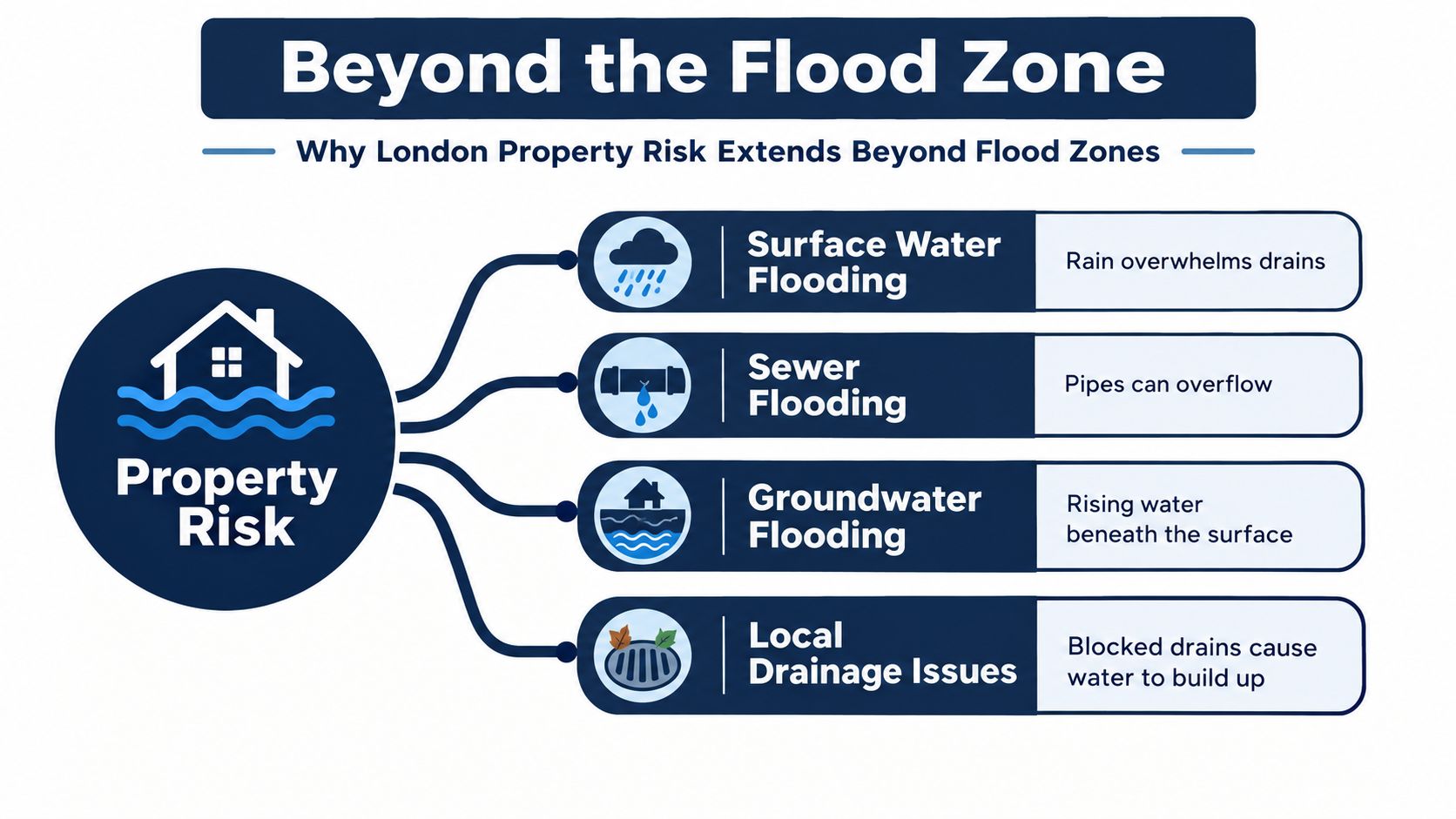
The useful questions are practical ones. Has the seller mentioned past water entry? Do neighbours report recurring drain problems? Does the ground fall towards the property? Are there basement bedrooms, lightwells, sumps or low-level service routes? Is there a believable path for water from pavement, garden or alley into the building?
A map cannot answer those points on its own. It can show a general risk context, but it does not inspect thresholds, doors, covers, chambers or internal layouts. It also does not tell you whether the route into the building is more likely to come from rainwater on the surface, water under the ground or a sewer under pressure.
The question is not whether mapped risk exists. The question is whether there is credible evidence that the property itself can be affected. That is where buyers need to switch from postcode thinking to building thinking.
Reading Flood Probability, Depth and Climate Evidence
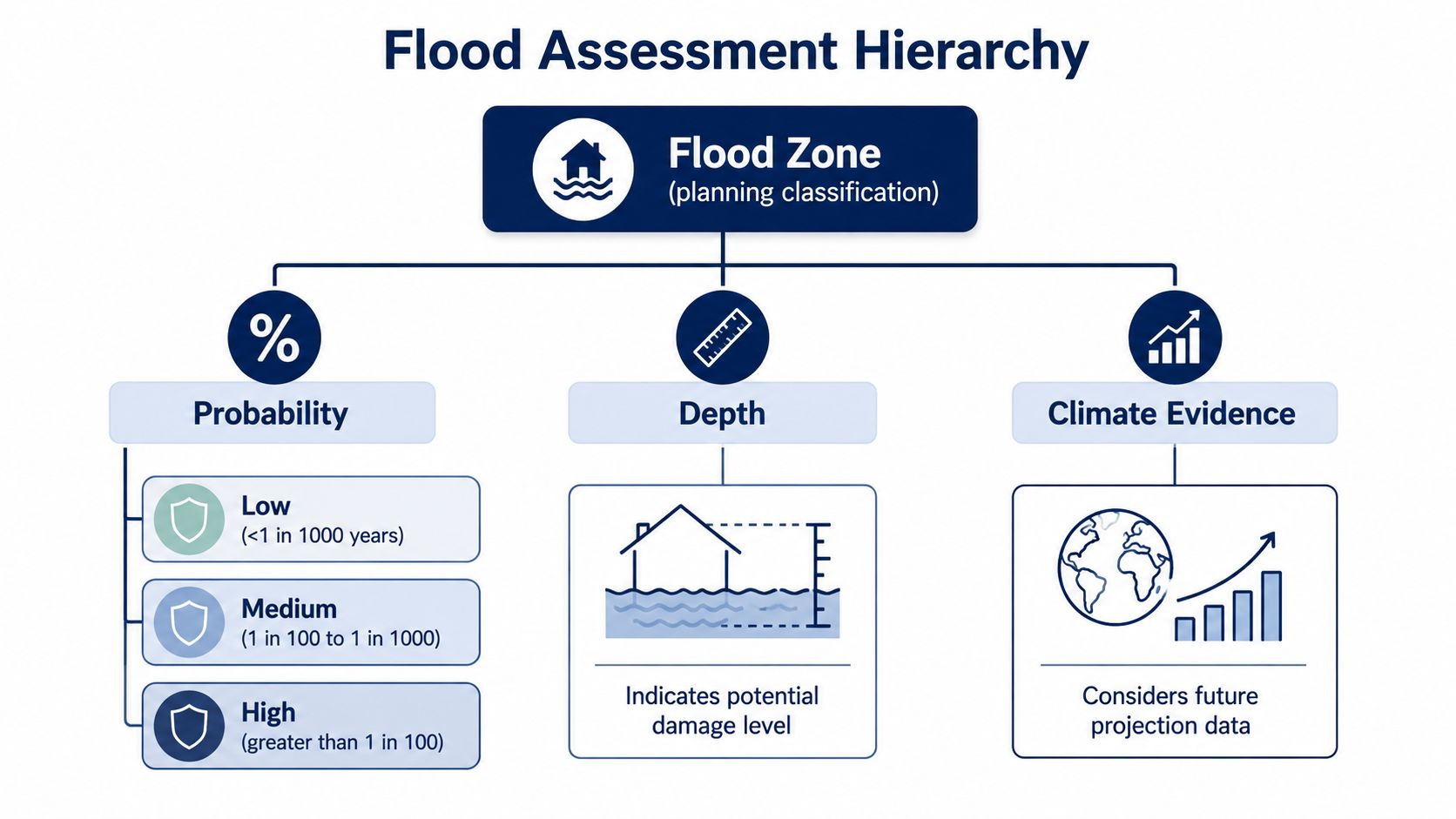
A flood map answers a narrow question. It tells you something about hazard, not the full damage picture. A property assessment has to combine probability, depth, source, route of entry and future climate assumptions before it can support a purchase decision.
A flood zone answers “could water reach this area?” while a property assessment must ask “how would it reach this building and what would happen next?”
That distinction matters because two homes can sit in the same general area and face very different outcomes. One may be raised above the surrounding ground. Another may have a basement, low thresholds and vulnerable ground-floor services. Same broad area, different consequence.
Climate evidence should be treated as a stated assumption, not a prophecy. If the evidence is mixed, I want to know what changes under future conditions and what does not. The buyer doesn't need false certainty, they need a defensible view of the likely risk at the time of purchase and over the life of the property.
The source of flooding also matters. River, sea, surface-water and groundwater risk are not interchangeable. Historic flooding and local drainage behaviour can support or weaken a conclusion, especially where a map looks calm but the site tells another story. For London buyers, that's exactly where judgment beats blind reliance on a label.
For a practical context on protecting external brickwork once a property has a known exposure pattern, the guide to brickwork water repellent is a useful adjunct, but it doesn't replace proper diagnosis. Water management starts with identifying the actual entry routes, then deciding whether the fix belongs in drainage, thresholds, materials or maintenance.
If several independent indicators point the same way, you can usually reach a measured conclusion. If the map looks reassuring but the site evidence doesn't, don't force a neat answer. That's the point to investigate further.
London Property Scenarios and Their Different Outcomes
A Victorian terrace in Forest Hill with a basement is not judged the same way as a flat in a converted building in Bermondsey or a riverside home in Greenwich. The broad flood picture may be similar, but the practical consequences are different. That's why scenario thinking beats generic labels.
Scenario one, Victorian terrace with basement
A terrace in Lewisham or Forest Hill may have a basement room, older thresholds and a rear garden that falls towards the house. If heavy rain has already caused runoff in the area, the main concern is not just whether water reaches the street, but whether it can enter below ground or through a low rear access point. The next step is to check the floor level, drainage route and any history of repeat water ingress.
Scenario two, basement or lower flat conversion
A basement flat in Bermondsey can be exposed even when the wider postcode isn't flagged as a river issue. The point here is not river floodplain, it's localised water entry, access vulnerability and services sitting below external ground level. If the evidence is mixed, I'd want a specialist view before exchange, especially if the flat depends on a lightwell or low-level entry route.
Scenario three, riverside home in Greenwich
A home near the Thames brings source, defence assumptions and future conditions back into the conversation. Even where existing defences reduce everyday risk, the buyer still has to understand residual risk, access and what happens if the unexpected occurs. The decision usually turns on the property's level, the route water would take and whether the building can recover without disproportionate disruption.
The physical likelihood and the practical impact are not the same thing. A house might have a modest chance of water entry but a severe consequence because the boiler, electrics or escape route are badly placed. That's why the surveyor has to look at both.
How Surveyors Carry Out a Property Assessment
A proper survey starts with the address, the property type and the concern raised by the buyer or conveyancer. From there, the surveyor identifies likely sources of flooding, checks the setting and looks for the routes water could use to get in. The order matters because you can't judge the consequence until you know the pathway.
A standard RICS HomeBuyer Survey or RICS Building Survey can flag warning signs, but it is not the same as a specialist flood model. It can pick up low thresholds, evidence of damp from water entry, poor drainage around the building, basement concerns and signs that the property deserves more attention. When the picture is unclear, separate drainage advice, environmental data review or specialist flood input may be the right next step.
The working sequence I'd expect
- Review the instruction and the address. No one should start with a vague postcode-only view.
- Identify the property type and concern. Basement, terrace, flat conversion and riverside house all need different questions.
- Map the likely sources. That includes surface water, river, groundwater and sewer behaviour where relevant.
- Check the site evidence. Ground levels, access, thresholds, drains, services and visible entry points matter.
- Report the findings plainly. A yellow or amber-style warning means understand the consequence and take advice, not assume flooding will happen.
If the evidence is uncertain, the report should say so. A weak assumption is better left exposed than wrapped up as certainty.
Corinthian Surveyors in Forest Hill is an independent practice led by Clive Thompson, who holds both RICS and CABE qualifications and has over 30 years' experience in the built environment. That independence matters because there's no tie to lenders, estate agents or developers. The advice should stand on its own.
For a deeper look at survey scope and what separates a basic report from a fuller inspection, see the notes on what is a Level 3 survey.
Using Results in Purchase, Insurance and Valuation Decisions
A flood finding only matters if you act on it properly. A clear result lets you judge whether the risk is acceptable and whether the price still stacks up. Mixed evidence means you should pause and do more work before you commit serious money.
A mortgage valuation is for the lender's lending decision. It is not a full condition report, and it does not replace a proper survey. Insurance underwriting is a separate exercise again, because insurers may weigh flood history, vulnerability and mitigation in a different way from a valuer.
Use the result to ask the right questions. Is there a credible route for water to enter, through the surface, the drains, the ground, or the building itself? Can the vulnerability be reduced with practical works? Is access safe if the area floods? What happens to contents, electrics, heating and temporary occupancy if water gets in?
The financial impact is concrete. You may face repair costs, replacement costs, loss of use, access problems, or reduced saleability later on. If the property has a flood history or a pattern of exposure that looks credible, those issues should be raised before exchange, not after completion.
Flood risk also sits beside rebuild cost. If the building is underinsured, a claim can become a much bigger problem than the flood itself. That is why our reinstatement cost assessment guide belongs in the same decision folder as flood risk, even though the two questions are different.
My decision framework is straightforward. Proceed if the risk is understood and manageable. Investigate further if the evidence conflicts or the picture is incomplete. Negotiate or mitigate where practical controls can reduce the exposure. Reconsider if the residual risk still feels too high for you, or if your lender and insurer are likely to make the purchase difficult.
Mitigation, Commissioning Advice and Final Checks
Keep flood control practical. Some measures reduce water entry, some reduce damage, and some help you recover faster. A raised threshold, a good drain route, service isolation and resilient materials all sit in different buckets, so don't lump them together.
Don't choose measures from a generic internet checklist. A barrier that suits one house can be wrong for another. The right answer depends on ground levels, access, construction and how the water is getting in.
Before you commission advice, give the surveyor the full address, property type, known flooding issues and any basement concern. Ask what the instruction covers, what information will be reviewed, what will be inspected on site, when the report will arrive and where specialist work falls outside scope. That saves time and avoids false expectations.
Corinthian Surveyors London LTD is independent, regulated by RICS, part of the RICS Valuers Registration Scheme and insured by Royal Sun Alliance. Clive Thompson's RICS and CABE qualifications are the sort of background you want when a report has to be plain, defensible and useful.
For a proper conversation about a London property, call 0800 00 16 422 and use the contact page if that's easier.
Corinthian Surveyors London LTD handles residential surveys and valuations across London with a straight answer on flood risk, not vague reassurance. If you want an independent view before exchange, visit Corinthian Surveyors London LTD and ask for the survey that fits the property, the concern and the level of uncertainty.