
Do I Need a Survey When Buying a House? a UK Guide 2026
Your offer has been accepted. The estate agent wants things moving. The lender is sorting the mortgage. Then the question lands: do I need a survey when buying a house?
Yes, in practical terms, you do.
In England and Wales, a survey isn't a legal requirement for a buyer to purchase a house. But treating that as a reason to skip one is a mistake. You're about to spend a large sum on a property that may have damp, movement, roof defects, poor alterations, boundary problems or party wall issues that won't show up during a viewing.
Around London, I see buyers in Forest Hill, Brockley, Greenwich and Bromley ask the same thing. They're not really asking whether a survey is compulsory. They're asking how much risk they're taking on if they go ahead without one. That's the right question.
Table of Contents
- The Question Every Buyer Asks After an Offer is Accepted
- The Critical Difference Between a Mortgage Valuation and a Survey
- Choosing Your Survey RICS Levels Explained
- Turning a Survey Report into a Negotiation Tool
- Why a London Property Demands a London Surveyor
- Finding Your Surveyor and Final Questions Answered
The Question Every Buyer Asks After an Offer is Accepted
The usual pattern is simple. You've found a house you like, perhaps a Victorian terrace in Lewisham or a flat conversion in Crystal Palace. The viewing went well, the place looked tidy and the seller said there were no major issues. That tells you very little.
A house purchase moves quickly at this stage, and buyers often confuse speed with certainty. They think the mortgage process, the solicitor and the searches will somehow flush out the problems. They won't. A survey is the part that deals with the building itself.
According to RICS guidance on home surveys, in England and Wales, obtaining a property survey is not a legal requirement for a buyer to purchase a house; however, the Royal Institution of Chartered Surveyors strongly advises it as a critical risk-management tool due to potential far-reaching financial implications.
Practical rule: If you can't afford a survey, you can't afford the surprise bill that may follow after completion.
That's why I tell people to stop asking “Do I need one?” and start asking “Which survey fits this property?”
If you're buying a modern flat in Stratford, the answer may be different from a listed building in Dulwich or an Edwardian house in Sydenham with signs of movement. The point is the same though. You need an independent look at condition before you exchange contracts, not after.
A proper survey gives you facts. It can uncover defects, highlight maintenance issues and show where further specialist advice is needed. It also gives you something just as important: negotiating power. If the report raises serious problems, you can renegotiate or walk away before the property becomes your problem.
The Critical Difference Between a Mortgage Valuation and a Survey
The biggest misunderstanding in the whole buying process is this: buyers think the lender's valuation protects them. It doesn't.
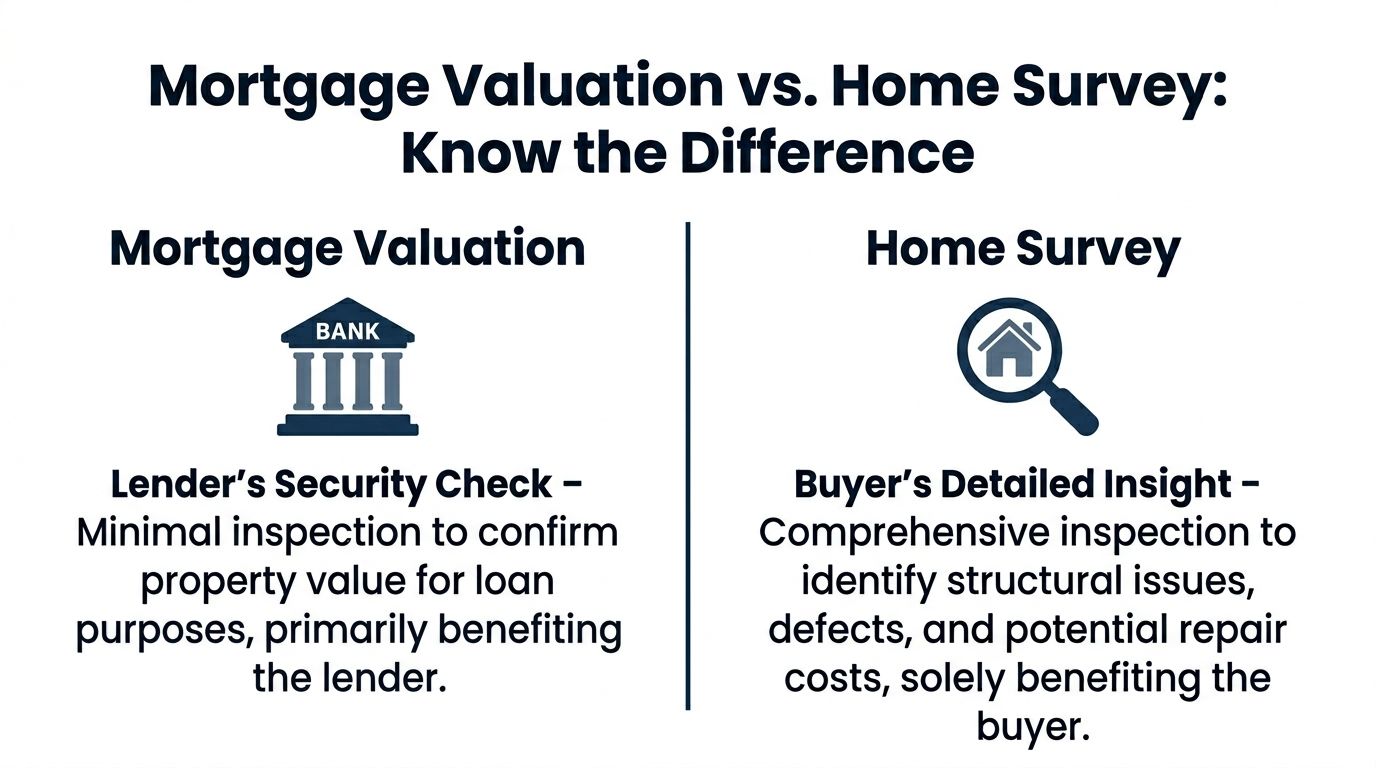
A mortgage valuation is for the lender. Its job is to confirm whether the property broadly supports the loan. It isn't a detailed inspection for your benefit, and it isn't designed to find every defect.
In the UK, over 85% of mortgage applications involve a lender's valuation that often mandates a full survey if the property is over 100 years old or in a higher-risk subsidence area, according to UK Finance. That sounds reassuring until you remember what the valuation is for. It protects the bank's security, not your repair budget.
What a mortgage valuation does
A valuation usually gives the lender a view on market value and suitability for lending. It may involve a limited inspection. In some cases, it may be brief.
It does not amount to a proper diagnosis of the building. It won't give you practical repair advice in the way a RICS survey does.
What a proper survey does
A RICS survey is for the buyer. It looks at condition, visible defects and risk. It helps you understand the building, not just the price.
That means things like:
- Damp and water ingress: Staining, condensation risk, defective guttering and hidden moisture patterns.
- Movement: Cracking, distortion, sloping floors and signs that need monitoring or structural input.
- Roof and timber issues: Missing coverings, ageing felt, decay, beetle attack and poor past repairs.
- Alterations: Chimney breast removals, wall removals and conversions that deserve a closer look.
A valuation can pass and the property can still be a poor buy.
That's the bit many buyers in Southwark, Croydon and Wandsworth only realise too late.
If you want a clearer explanation of how valuations differ from condition reporting, this guide to property valuation reports is useful. Just don't confuse a value opinion with a condition survey. They answer different questions.
The short version
Here's the plain English version.
| Check | Mortgage valuation | RICS survey |
|---|---|---|
| Who it protects | Lender | Buyer |
| Main purpose | Loan security | Condition and risk |
| Looks for defects in detail | No | Yes |
| Helps with repair budgeting | No | Yes |
| Useful for renegotiation | Rarely | Yes |
If you rely on a mortgage valuation alone, you're buying with a blind spot. That's fine for the lender. It's not fine for you.
Choosing Your Survey RICS Levels Explained
Your offer is accepted on a London flat. The estate agent says a basic survey will do. Then you notice a loft conversion over next door, a hairline crack above the bay, and a rear extension sitting hard against the boundary. That is the point where choosing the right survey level matters, because the expensive problems in London are often tied to alterations, shared walls, leasehold responsibilities and boundaries, not just obvious disrepair.
The three RICS survey levels match the risk in the property and the depth of inspection you need. Pick the level by looking at the building, not by trying to save a few hundred pounds on the fee.
Level 1
A RICS Home Condition Survey Level 1 is the lightest option. It suits newer, conventional homes with no obvious signs of alteration or neglect.
It gives you a simple condition snapshot and traffic-light style ratings. It does not give the same level of explanation on cause, consequence or repair approach as the higher levels. In London, that limits its usefulness fast. If a flat has any hint of water ingress, movement, boundary irregularity, party wall alteration or poor work to a roof terrace, Level 1 is too thin.
If you want the basic differences set out plainly, this guide on what a RICS survey is is a useful primer.
Level 2
A RICS HomeBuyer Survey Level 2 is the right choice for many buyers. It suits conventional properties that appear to be in reasonable order, but still need a proper inspection and practical advice.
It is often suitable for:
- Purpose-built flats and maisonettes: Especially where you need a clear view on visible defects, maintenance issues and how problems in common parts may affect you.
- 1930s semis and post-war houses: Common across outer London, where damp, roof spread, dated services and past patch repairs often show up.
- Victorian and Edwardian homes that have not been heavily altered: Fine if the structure looks broadly stable and the layout has not been significantly changed.
Level 2 is often enough for a straightforward purchase. It is also the minimum I would want for many London flats, because issues around window replacement, roof coverings, parapets, shared drainage and leasehold repair liability can become expensive quickly.
Level 3
A RICS Building Survey Level 3 is the right call for anything older, altered, unusual or carrying legal and repair risk that needs closer scrutiny.
Choose Level 3 for properties such as:
- Older period houses
- Listed buildings and homes in conservation areas
- Buildings with loft conversions, rear extensions or removed walls
- Converted flats in former houses
- Properties with signs of movement, damp, uneven floors or poor previous repairs
- Homes where boundaries, retaining walls, vaults, basements or party walls may become an issue
London buyers should be careful. A Level 3 is not just about getting more detail on defects. It is often the better option because London stock has layers of alteration. Chimney breasts removed without clear support, extensions built tight to a boundary, terraces with complicated parapet drainage, garden rooms built over drains, and leasehold flats where the defect sits outside the demise but the cost still comes back to the leaseholders.
Those are the problems that start arguments after completion. They can also turn into expensive legal issues if party wall work was done badly or if boundaries do not match what the buyer thought they were getting.
RICS survey levels compared
| Survey Level | Best For | What It Covers |
|---|---|---|
| Level 1 | Modern, conventional homes with no obvious complications | Basic condition overview and condition ratings |
| Level 2 | Standard houses, flats and maisonettes in reasonable condition | Visible defects, condition ratings and practical advice on repairs and maintenance |
| Level 3 | Older, altered, listed or non-standard properties | More detailed inspection of construction, defects, likely causes and repair implications |
How to choose without overthinking it
Use this rule.
Book Level 2 if the property is conventional, appears well maintained, and has not been materially altered.
Book Level 3 if any of these apply:
- The property is pre-1900, or old enough that hidden defects are more likely
- You can see or suspect alterations, such as a loft conversion, opened-up layout, rear extension or basement work
- The building is a conversion or sits in a terrace with shared structural elements
- There are boundary, party wall or access questions
- The construction is unusual, including timber frame, flat roofs over living space, or anything non-standard
In London, I would rather see a buyer spend a bit more on the right survey than complete on the wrong assumptions. If the property is old, altered or legally messy, book Level 3 and get the fuller advice.
Turning a Survey Report into a Negotiation Tool
Your survey gives you bargaining power on price only if you use it properly.
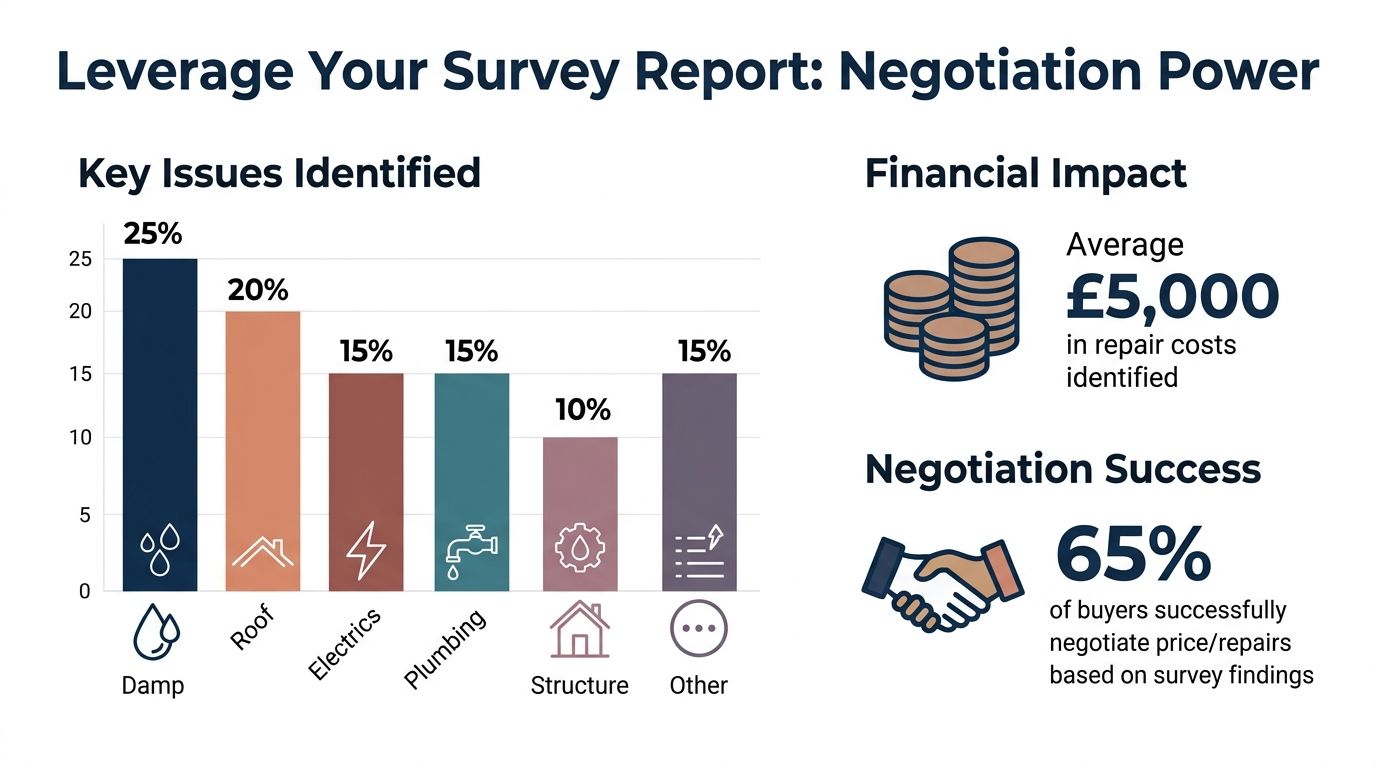
In London, the best negotiating points are often the expensive, awkward issues a seller hoped nobody would press on before exchange. A mortgage valuation will not help you here. A proper survey can give you evidence of roof failure, structural movement, damp linked to defective gutters or bridging, unauthorised alterations, missing fire separation in conversions, and warning signs around boundaries or party wall work. Those points affect cost, risk and resale. That is what you negotiate on.
Focus on the items that change the deal
Do not argue over every defect in the report. Old homes have defects. Flats have limitations. Period buildings move and wear. The question is simpler. Which findings mean you are paying too much for the risk you are taking on?
Usually, the strongest points are:
- Repairs with a clear price tag, such as roof repairs, rotten windows, defective drainage, damp repairs and timber treatment where decay is confirmed
- Issues that affect mortgageability or insurance, such as significant cracking, signs of ongoing movement, fire safety concerns in conversions, or evidence of poor structural alterations
- Legal and neighbour risks, including unclear boundaries, missing party wall paperwork, shared access problems, or signs that an extension or loft conversion may not have been properly documented
- Matters that will hurt you again when you sell, because the next buyer's surveyor is likely to raise the same points
In London, boundary and party wall issues deserve special attention. They are not just technical footnotes. A rear extension built close to the line of junction, a garden fence in the wrong place, or a loft conversion that may have affected a shared wall can turn into legal cost and neighbour conflict very quickly. If the survey raises those concerns, do not wave them through.
How to respond once the report arrives
Keep it calm and specific. Sellers and agents ignore vague panic. They respond to a short list of defects, likely costs and missing paperwork.
Use this approach:
- Pull out the points that affect value or legal risk. Ignore cosmetic items.
- Ask your surveyor which findings are negotiation points and which are just maintenance. There is a difference.
- Get quotes or budget figures for the bigger repairs. That turns a complaint into a number.
- Ask the seller's solicitor for documents. For London homes, that often means party wall awards, building control sign-off, guarantees, planning paperwork, and evidence for any recent structural work.
- Decide what you want. A price reduction, a retention, specific works before exchange, or walking away.
Do not send the full report and ask, “What will the seller do?” Tell your solicitor or agent exactly what you are seeking and why.
A survey fee is small compared with inheriting a boundary dispute, undocumented building work, or a repair bill that should have come off the price.
One more point. If the survey identifies serious movement, major roof failure, missing approvals for structural alterations, or credible boundary or party wall trouble, stop treating it as a routine negotiation. At that stage, you are deciding whether the property is still worth buying at all.
Why a London Property Demands a London Surveyor
London housing stock is varied, patched, altered and often misunderstood. A surveyor who knows the local patterns will spot problems more quickly than someone treating every postcode the same.
That matters in a city where a Victorian terrace in New Cross raises different questions from a 1930s semi in Beckenham or a warehouse conversion in Bermondsey.
The defects change by area and building type
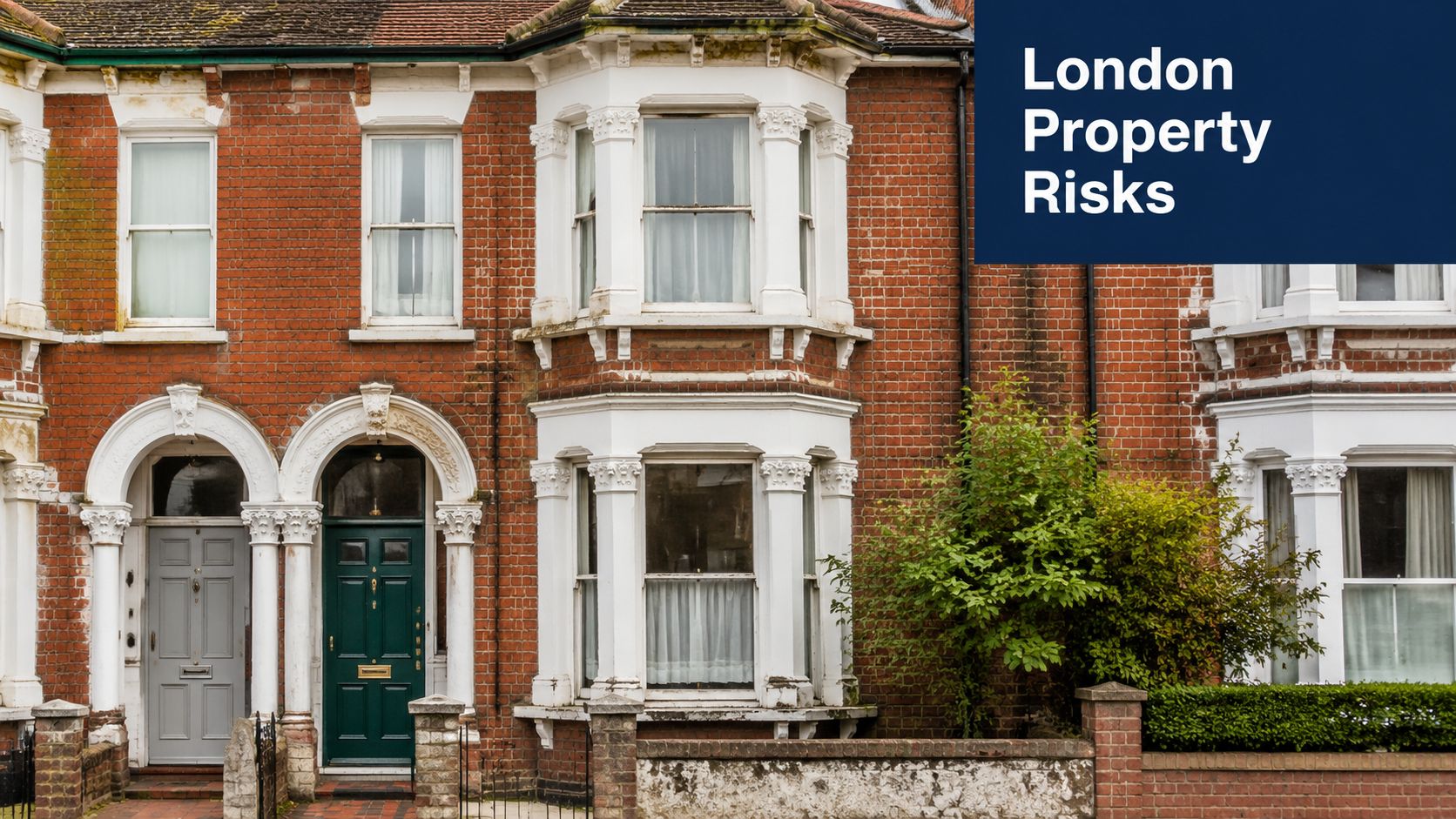
In Lewisham, Peckham and parts of Lambeth, period terraces often come with familiar issues. Solid walls, old slate roofs, suspended timber floors, chimney breast alterations and damp around poorly ventilated basements are common themes.
In Bromley, Bexley and Croydon, 1930s houses often bring different concerns. Think roof spread, ageing bay windows, wall tie concerns in some cases, patchy extensions and drainage issues. Flats in Southwark or Tower Hamlets may look smart internally but still have problems in common parts, roof coverings or fire separation details that deserve scrutiny.
A surveyor with London experience doesn't just look at defects. He reads the building in context.
Boundary and party wall risk is often ignored
This is the bit most generic advice misses.
In London's high-density housing market, boundary disputes account for over 15% of all property-related legal complaints annually, with costs averaging £4,500 per case, according to the verified RICS data provided for this article. A mortgage valuation won't protect you from that.
That risk shows up in practical ways:
- Rear extensions close to boundaries
- Fences and walls assumed to be “about right”
- Shared side access in terraces
- Party wall alterations with poor records
- Loft conversions affecting adjoining owners
If you're buying in Forest Hill, where Corinthian Surveyors London LTD is based, or in neighbouring areas such as Sydenham, Dulwich and Brockley, these issues are not rare. The firm is independent, regulated by RICS and run by Clive Thompson, who holds both RICS and CABE qualifications. That sort of local and technical grounding matters when you're trying to work out if a crack is cosmetic, whether a removed chimney breast was properly dealt with, or whether a boundary arrangement is likely to become a future argument.
Here's a useful overview of the sort of concerns buyers should keep in mind when the building has been altered or sits close to adjoining property.
London knowledge saves wasted decisions
A national call centre can book a survey. That doesn't mean the inspection will reflect local housing reality.
What you need is someone who recognises:
- Victorian quirks: Lath and plaster, lime mortar, old services and historic movement.
- Conversion problems: Sound transfer, unauthorised layout changes and neglected roofs.
- Terraced housing complications: Party walls, shared drainage and hidden structural alterations.
If you're buying in Blackheath, Clapham, Greenwich, Woolwich or Hackney, the same principle applies. Local knowledge is not a nice extra. It changes what gets spotted, how it's interpreted and what advice you receive before you commit.
Finding Your Surveyor and Final Questions Answered
Choosing the surveyor matters almost as much as choosing the survey type.
You want someone properly qualified, independent and used to the sort of property you're buying. That means checking for RICS regulation, and where relevant, broader built environment knowledge such as CABE qualifications. It also means avoiding conflicts of interest. If the surveyor is tied to the lender, estate agent or developer, you should ask how independent the advice really is.
What to ask before you instruct
Ask practical questions, not fluffy ones.
- What survey level do you recommend for this property, and why? If they can't justify the level, move on.
- Do you inspect this type of housing regularly? A flat in a Victorian conversion is not the same as a modern leasehold block.
- Will the report explain defects plainly? You need a document you can act on.
- Can I speak to the surveyor after the inspection? That conversation matters.
If the property is older, altered or showing signs of movement, a fuller inspection is often the safer route. This guide to a full structural survey may help if you're weighing up whether Level 3 is the right call.
Buy the survey before you buy the problem.
FAQ
Do I need a survey on a new build?
Yes. New doesn't mean defect-free. 70% of newly purchased homes in the UK have significant defects or issues that were undetected by the buyer during the initial viewing, according to a 2023 NHBC reference discussed here. A warranty is not the same thing as an independent inspection.
Do I need a survey on a flat?
Yes, in most cases. The survey still matters even though you may not own the whole building. It can highlight issues inside the flat and visible concerns affecting the block, roof, structure or common parts.
Is the seller obliged to fix what the survey finds?
No. But the survey gives you evidence to renegotiate, ask for works or walk away.
When should I book the survey?
As soon as your offer is accepted and the sale looks serious. Leave it too late and you lose time to renegotiate before exchange.
If you want a straight answer on which survey fits the property you're buying, speak to Corinthian Surveyors London LTD. They cover London and the South East, carry out Level 1, Level 2 and Level 3 surveys, and provide independent advice with no ties to lenders, estate agents or developers. If you'd rather talk it through first, call 0800 00 16 422 and explain what you're buying and where.