
Pre Purchase Inspection Cost: What UK Buyers Pay in 2026
A UK home survey typically costs £300 to £1,500, with the survey level chosen deciding where a buyer lands within that range. The cheapest pre purchase inspection cost isn't necessarily the cheapest route to understanding what you're buying.
A low quote can leave you paying separately to investigate defects that the initial report only flags. Start with the building's risks, then compare the fee for inspecting them properly.
Table of Contents
- Typical Pre Purchase Inspection Costs by Survey Level
- How Property Size, Age and Type Shift the Price
- Matching the Survey Level to the Property
- Hidden Costs and How to Check a Quote
- What a Cheap Survey Can Cost You Later
- Confirm the Scope Before You Book
- Questions Buyers Ask About Survey Costs
Typical Pre Purchase Inspection Costs by Survey Level
Published survey fees are guide prices, not a tariff. A surveyor needs the property details before confirming the appropriate inspection and its price.
The typical UK ranges below come from Lloyds Bank's survey fee guide: £300 to £900 for Level 1, £400 to £1,000 for Level 2 and £630 to £1,500 for Level 3.
Typical UK pre purchase inspection fees by survey level
| Survey level | Typical fee range | Best suited to |
|---|---|---|
| Level 1 Home Condition Survey | £300 to £900 | Newer or conventional properties, visible defects only |
| Level 2 Homebuyer Survey | £400 to £1,000 | Standard houses and flats in reasonable condition |
| Level 3 Building Survey | £630 to £1,500 | Older, altered, large or structurally complex homes |
What you're paying for
A Level 1 Home Condition Survey provides a basic assessment of visible condition. It can suit a straightforward property where you need an overview rather than detailed repair advice. It isn't a sensible downgrade just because the purchase has already stretched your budget.
A Level 2 Homebuyer Survey goes further. It suits conventional houses and flats in reasonable condition and includes accessible roof spaces and drainage chambers. The report addresses defects and likely repair or maintenance needs.
A Level 3 Building Survey allows greater depth of inspection and explanation. That matters where an older house has been extended, its layout altered or its structure affected by previous work. You're paying for the surveyor's time and technical judgement, not merely a longer document.
Practical rule: Choose the inspection that suits the building before comparing the price.
The spread between the bottom and top of these published bands is substantial. However, paying at the upper end doesn't automatically make a report suitable, just as a low fee doesn't automatically make it poor.
Treat these figures as the survey budget only. Don't assume they cover the mortgage valuation, searches or legal fees. Write the survey level on every quotation before comparing prices, then check what the quoted service includes.
How Property Size, Age and Type Shift the Price
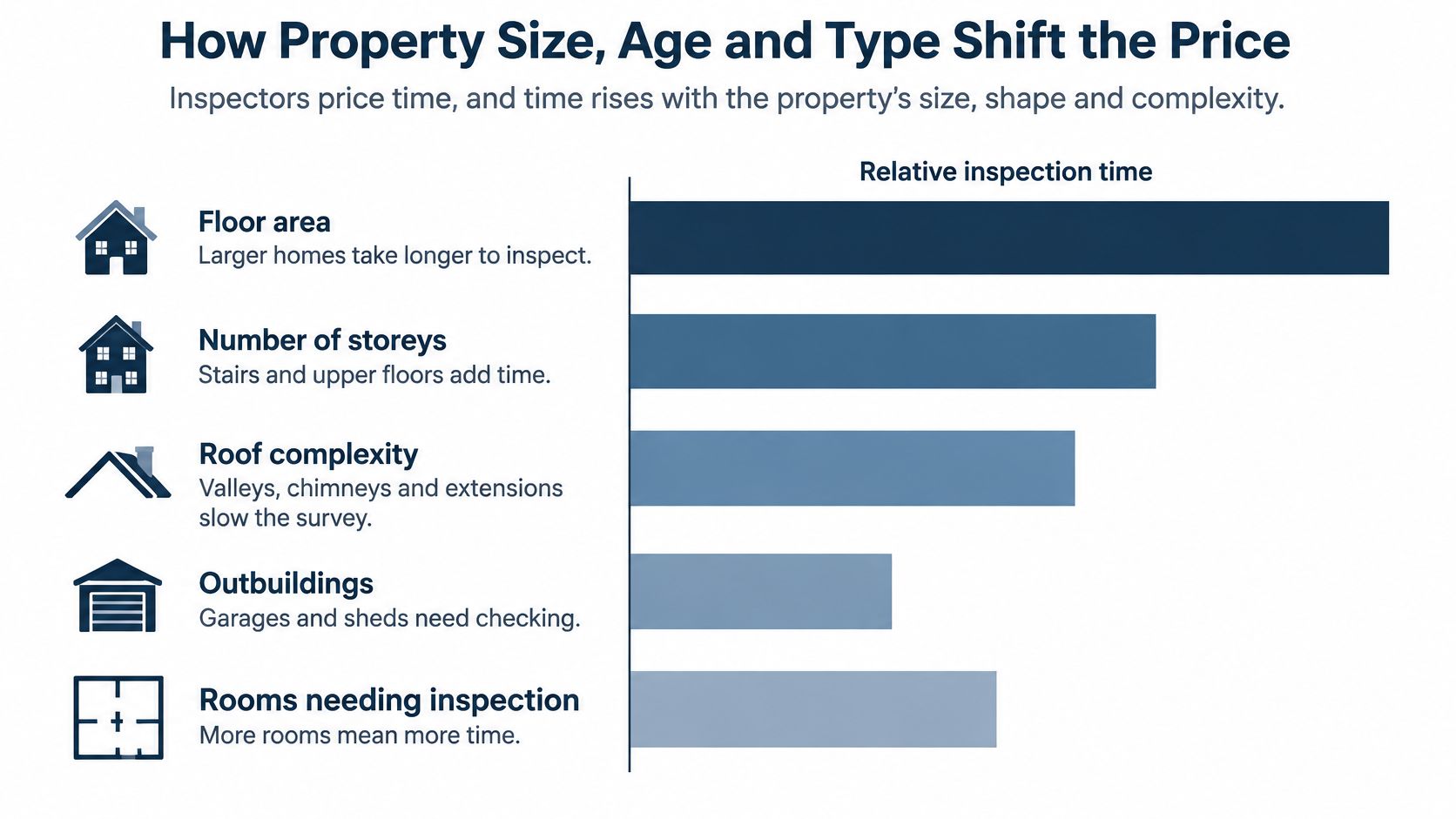
Surveyors price inspection time and reporting work. A large house with several roof slopes, extensions and outbuildings takes longer to assess than a compact house with a simple layout.
Floor area isn't the only consideration. Upper floors, awkward roof access and rooms filled with stored belongings can all affect the inspection. The surveyor also needs time to understand how different parts of an altered building connect.
The illustration below shows the factors that add inspection time. Its bars are relative, not a fee scale.
What transaction figures tell buyers
For transactions across England, Wales and Northern Ireland, Property Reporter's account of the home-moving index records the following quarterly averages, including a £450 Level 2 fee and a £910 Level 3 fee in Q1 2025.
Average survey fees and property values, Q4 2024 to Q1 2025
| Survey level | Quarter | Average property value | Average survey fee |
|---|---|---|---|
| Level 2 | Q4 2024 | £300,000 | £480 |
| Level 2 | Q1 2025 | £295,000 | £450 |
| Level 3 | Q4 2024 | £400,000 | £890 |
| Level 3 | Q1 2025 | £445,000 | £910 |
These are historical transaction benchmarks, not quotations for a London property. They show why treating a survey fee as a fixed percentage of the purchase price is unhelpful. The more detailed service involves different inspection and reporting demands.
Find the row matching the proposed survey level before using the figures as a sense check. Don't compare a basic inspection quote with a building survey average.
How that works across London
Consider a Victorian terrace in Lewisham with original timber floors and lath and plaster ceilings. The surveyor needs to consider ventilation beneath the floors, moisture behaviour and any evidence of removed chimney breasts. Lime mortar and older materials also affect suitable repair advice.
For a 1930s semi in Bromley with later extensions, the junctions between old and new work deserve attention. Roof connections, drainage changes and altered load paths can matter more than the original house's age.
A converted warehouse flat in Bermondsey presents another problem. Important structural elements and shared services may sit outside the flat. Establishing what can be inspected is part of defining the job, not an administrative detail.
Matching the Survey Level to the Property
The cheapest suitable survey is the one that matches the downside risk. Being a first-time buyer doesn't make a basic inspection appropriate, and buying an expensive home doesn't automatically settle the choice either.
Before booking, answer these questions:
- Expensive defects: What would be materially expensive to miss, such as structural movement, roof failure or concealed timber decay?
- Inspection gaps: Which spaces might be inaccessible?
- Shared responsibilities: Who maintains communal roofs, boundary structures and shared drainage?
- Purpose of the report: Do you need visible condition recorded, or detailed advice to support repair planning and renegotiation?
Where Level 2 stops
RICS describes the Level 2 Home Survey as an intermediate inspection for conventional properties in reasonable condition with a simple form and layout. Accessible roof spaces and drainage chambers are included, but it isn't a full structural investigation and doesn't involve testing building services.
That distinction matters when you're buying a flat. A modern interior doesn't establish the condition of the external walls or communal roof. Cladding history, damp concerns and leasehold repair responsibilities can justify additional scrutiny.
Our explanation of what a RICS Homebuyer Report includes helps distinguish the report's purpose from the checks a specialist may need to undertake.
Suggested survey level by property case
| Property case | Suggested level | Main reason |
|---|---|---|
| Newer house, no alterations, good condition | Level 1 | Visible defects are the main concern |
| Modern flat in reasonable condition | Level 2 | Communal roof, external walls and leasehold repairs need consideration |
| Victorian terrace with original features | Level 3 | Lime mortar, lath and plaster and possible chimney breast removals |
| Flat in a converted building | Level 3 | Structure, shared services and restricted access |
| Listed or heavily extended house | Level 3 | Alterations, unusual construction and repair advice |
These are starting recommendations, not automatic rules. A conversion with extensive alterations needs a different conversation from a purpose-built flat with straightforward construction.
At Corinthian Surveyors London LTD, we provide a wide range of residential building and property surveying services. That allows the discussion to start with what needs investigating rather than forcing the property into a predetermined report.
Tell us about visible cracks, staining and previous alterations when requesting your quote. Photographs and the sales particulars help identify questions that need resolving before instruction.
Hidden Costs and How to Check a Quote
The advertised fee isn't always your total inspection budget. Check whether VAT is included, whether the property attracts an additional charge for complexity and whether any valuation forms part of the service.
As a broad sense check, MoneyHelper's buying-cost guidance puts a Level 2 survey at around £400 and a Level 3 survey at £600 or more. These are general survey figures, not a promise about what a particular London home will cost.
Valuations and inaccessible areas
A mortgage valuation serves the lender's lending decision. It isn't a substitute for the condition survey you commission for your own protection. If you also need an independent opinion of value, clarify whether it's included or requires a separate market valuation.
Access exclusions deserve equal attention. A locked loft hatch, an occupied room that cannot be entered or a basement without a key can leave important areas uninspected. The report should identify those limitations in writing.
For a leasehold flat in Peckham or Deptford, ask about communal roofs, external walls and shared drainage. The seller may not control access to them. Arrange permissions through the appropriate person before the visit wherever possible.
Budget for diagnosis, not just detection
A general survey isn't an electrical test, drainage test, asbestos survey, specialist damp investigation or structural engineering assessment. A surveyor may identify warning signs without being able to establish the full cause during a visual inspection.
Say there's a damp patch beneath a window. The survey may identify likely causes and recommend further investigation. A suitably qualified specialist may then need to distinguish condensation from penetrating moisture, a leaking gutter or rising damp before anyone specifies treatment.
Don't buy a remedial product just because a meter gives a high reading. Establish the moisture source and the condition of the surrounding fabric first.
Your working budget should be the survey fee, any separately required valuation and tax, plus necessary follow-up investigations.
Avoid double-counting anything already included. Obtain separate quotations for recommended diagnostic work rather than inventing a general allowance.
Check these points before paying
- Name the level. The quotation should state the RICS survey service.
- Identify the valuation. Confirm whether one is included and who can rely on it.
- Check VAT. Establish the total payable.
- Read access exclusions. Cover roofs, basements, outbuildings and communal areas.
- Allocate follow-up costs. Establish who will commission and pay for specialist checks.
- Confirm turnaround. Agree when you should expect the report.
We carry out RICS Homebuyers surveys on properties customers are buying. When comparing providers, also ask about financial or referral ties to lenders, estate agents and developers.
What a Cheap Survey Can Cost You Later
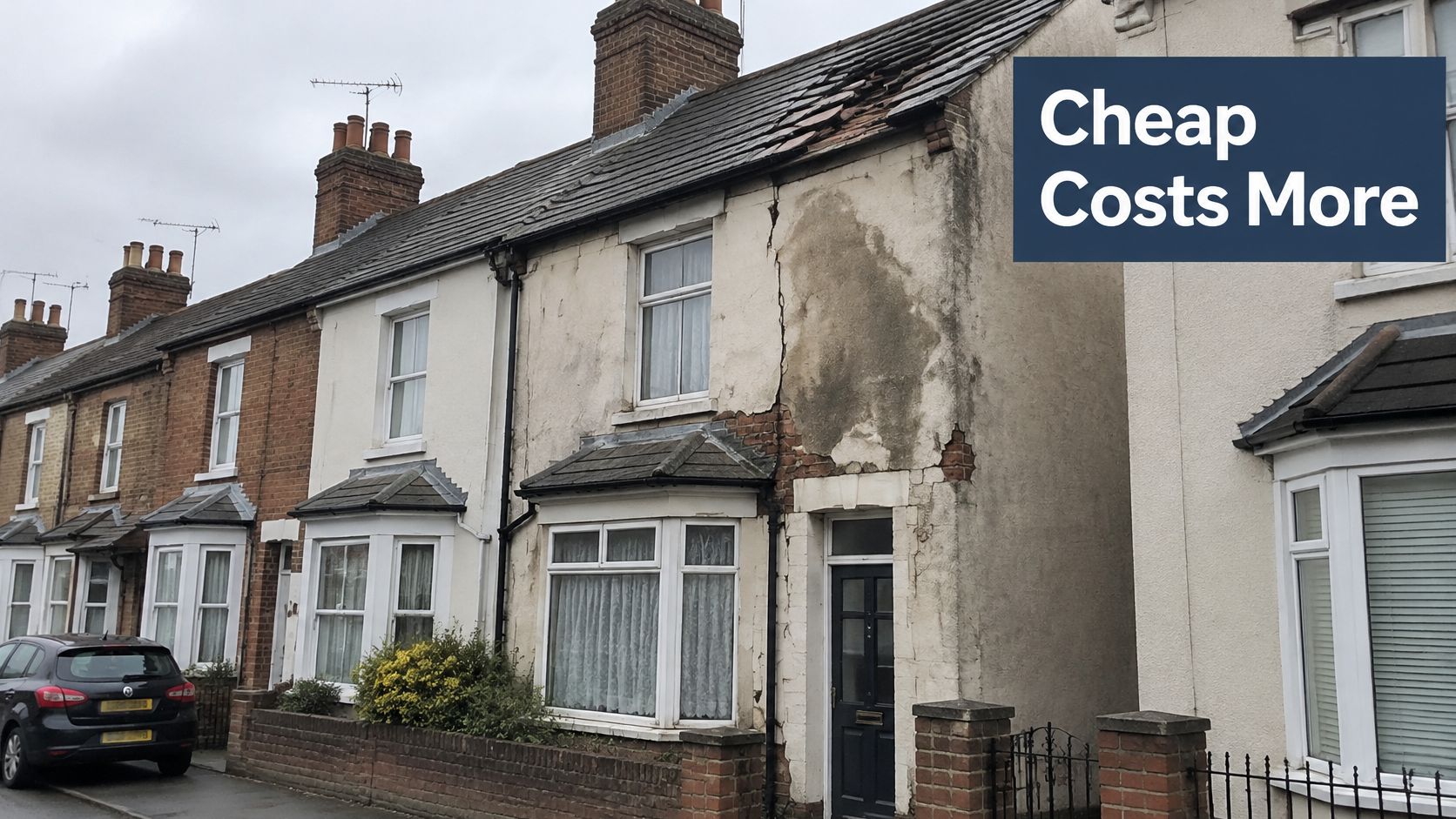
A cheaper inspection saves money only if it still answers the important questions. Downgrading the scope while accepting greater uncertainty isn't the same as obtaining better value.
Visible disrepair is the obvious warning. Less obvious defects can still require substantial investigation and repair.
Put the saving in perspective
The English Housing Survey's housing-quality report recorded 3.8 million non-decent dwellings in England in 2023, equivalent to 15% of the stock, with an average cost of £10,975 and a median of £5,397 to bring a non-decent dwelling up to the Decent Homes Standard.
The median is less affected by unusually expensive cases. These are housing-condition benchmarks, not quotations for repairing the property you're buying.
Separately, The Intermediary reported an average repair cost of approximately £14,000 for homes under offer in England and Wales, based on Allcott Associates' March 2024 survey data.
Neither measure predicts your bill. Both give useful context for weighing an inspection fee against possible repair liabilities.
Test the usefulness of the report
Ask whether the report explains:
- Likely causes: What appears to have produced the defect?
- Urgency: What needs attention before commitment or occupation?
- Maintenance implications: What must be maintained to prevent recurrence?
- Further investigation: What remains uncertain and who should examine it?
Clear evidence can support negotiating the house price after a survey or obtaining a properly defined repair quotation. It doesn't guarantee that the seller will reduce the price.
Use the findings to decide what action is needed before proceeding.
Skipping or downgrading a necessary survey is a false saving. A significant defect discovered after exchange leaves you with fewer practical options than one investigated beforehand.
Confirm the Scope Before You Book
The lowest fee is a risk decision if the scope is vague. Before requesting quotations, prepare the property information that changes the inspection: an address alone will not explain an altered layout, a converted loft, or a history of damp.
- Describe the building. Record its approximate age, construction and known alterations. Say whether you are buying a leasehold flat or a freehold house, and flag access limits such as roof voids, communal areas or occupied rooms.
- Choose the likely level. Use the property cases earlier in this guide to identify a starting point, then discuss anything unusual with the surveyor before the fee is fixed.
- Request written terms. Confirm the inspection level, VAT treatment, valuation inclusion, access exclusions and how any urgent findings will be reported. Compare quotations only after those items match.
Our guide to questions to ask before commissioning a survey helps prepare that conversation. Build the all-in budget around more than the headline fee: the valuation position, VAT, access constraints and specialist follow-up checks can all change what the instruction really costs.
Timing matters: Leave room for follow-up checks before exchange, not just delivery of the initial report.
Cady described our service as having “delivered the report very quickly whilst keeping us in the loop throughout the process”. Agree the timetable for your own instruction rather than assuming every property can follow the same schedule.
Corinthian Surveyors London LTD is an independent firm of RICS Chartered Surveyors and Valuers, led by an experienced RICS Chartered surveyor, with no ties to lenders, estate agents or developers.
Call 0800 00 16 422 with the address, property type and purchase timetable for advice and a property-specific quote. You can also send those details through our online enquiry page.
Questions Buyers Ask About Survey Costs
How much does a pre purchase inspection cost in London?
Treat published UK fee bands as a starting point, not a London price list. A property-specific quote should reflect the inspection level, the size and value of the building, and its complexity, including alterations and any access arrangements the surveyor needs to agree in advance. If a quote comes back well below the band you expected, ask which parts of the scope produced the saving.
Does the survey fee include the mortgage valuation?
Don't assume it does. The lender's valuation and your condition survey serve different purposes: the valuation tells the lender the property secures the loan, while the survey tells you what condition you are buying into. Check the written quotation for any valuation inclusion and establish who can rely on it. Until the quote confirms otherwise, budget for the two as separate items.
Is a cheaper survey ever enough?
Yes, if its scope suits the property. A Level 1 report can suit a newer or conventional home where visible condition is the main concern, while older, substantially altered or structurally complex homes generally call for Level 3.
The deciding question is what you need to understand before committing to the purchase. A lower fee produced by restricted access, excluded areas or a shorter inspection is a risk decision rather than a saving, so I advise buyers to compare what each quote covers instead of the headline figure alone.
Corinthian Surveyors London LTD carries out RICS Homebuyers surveys on properties that customers are buying and provides market valuation reports for homes being sold. Call 0800 00 16 422 with the property address and your purchase timetable for advice and a quote, or send the same details through our online enquiry page.