
What Is a RICS HomeBuyer Report? Scope, Ratings and Limits
An RICS HomeBuyer Report is the RICS Home Survey Level 2 inspection of a conventional house or flat, carried out by a chartered surveyor before exchange of contracts. You get a condition rating of 1, 2 or 3 on each element the surveyor can see, a plain note of what was observed, and a flag on anything that needs looking at twice.
Most buyers ask what's in the report. The more useful question is what each finding lets you do. A document that lists thirty items and leaves you no wiser about your next move before exchange has failed, however neatly it's laid out.
So what is a RICS HomeBuyer Report for? It's a decision tool. It turns what a surveyor can see into actions you can take while your deposit hasn't been released. The rest of this piece is about those actions and the honest limits of what the inspection can prove.
Table of Contents
- What an RICS HomeBuyer Report Actually Is
- Where the Level 2 Report Sits Among RICS Surveys
- How the Condition Ratings Work in Practice
- What the Inspection Covers and What It Misses
- How to Read a Sample Report Entry
- Using the Report to Negotiate or Walk Away
- Confirm the Level, Cost and Timing Before You Book
What an RICS HomeBuyer Report Actually Is
An RICS HomeBuyer Report is the Level 2 survey in the RICS Home Survey framework. The name is the older term. Buyers still search for it and plenty of agents still say it, but the service you instruct is Level 2, so a quote for a HomeBuyer Report and a quote for a Level 2 survey should describe the same piece of work.
The RICS Home Survey Standard consolidated the earlier HomeBuyer Report formats into that condition-based framework. It requires the report to explain its scope, its limitations and the actions open to you. That matters, because a survey is not a guarantee that every defect will be found. Plenty of serious building problems are concealed, inaccessible or outside a visual inspection.
The job it does is independent condition advice. A mortgage valuation protects the lender's loan and tells you almost nothing about the state of the building. The Level 2 report tells you whether the roof covering is near the end of its life, whether there are indicators of movement, whether the drainage looks suspect, and it records those findings with a rating attached so you can price the work or ask the seller a direct question.
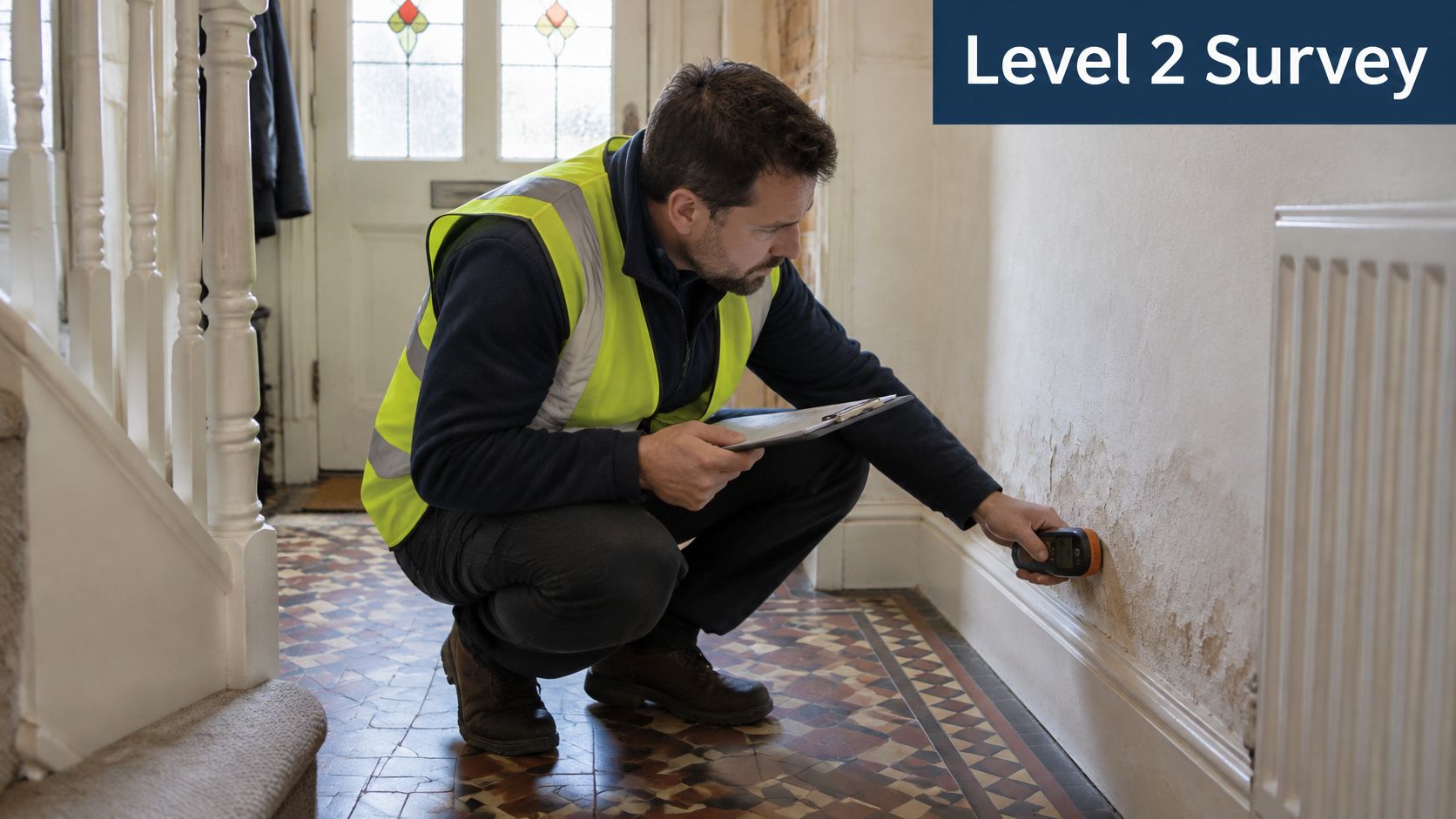
It suits first-time buyers, anyone buying a standard house or flat in reasonable condition, and anyone who wants a condition check before committing money. It is not a repair estimate, a legal search, an intrusive structural investigation or a guarantee. The ratings run 1 for no repair currently needed, 2 for repair or replacement that isn't serious or urgent, and 3 for serious or urgent matters needing further investigation.
Here's the test to apply today. If the property is conventional and in reasonable condition, Level 2 is the usual starting point. If it's old, heavily altered, unusual or visibly neglected, read the next section before you book anything.
Where the Level 2 Report Sits Among RICS Surveys
| Survey level | Best suited to | Inspection depth | Typical use |
|---|---|---|---|
| Level 1 Home Condition Survey | Homes in good order with few concerns | Basic condition overview | Early screening before a purchase |
| Level 2 HomeBuyer Report | Conventional homes in reasonable condition with a simple layout | Physical inspection of inside and outside, accessible roof spaces and visible services | Standard pre-purchase condition check |
| Level 3 Building Survey | Large, older, unusual, altered or substantially run-down properties | Most detailed inspection with fuller commentary on defects | Complex, older or non-standard homes |
The RICS consumer guide to house surveys describes Level 2 as most suitable for conventional properties in reasonable condition and relatively simple in form and layout, such as homes without numerous alterations or extensions. Level 1 gives a basic condition overview. Level 3 is intended for large, older, unusual, altered or substantially run-down properties.
Level 2 is a physical inspection, not a desk exercise. The surveyor examines the inside and outside of the main building and the permanent outbuildings and records the visible construction details and significant defects. That's the difference between a survey and a valuation or a lender's check. You're paying for an independent assessment of condition, risk and the issues that could affect value.
Three questions will tell you which level you need:
- Is the build conventional? Brick, slate or tile, standard foundations, nothing exotic. If yes, Level 2 is in play.
- Has it been heavily extended or altered? A loft conversion, a rear extension, a cellar dig or a removed chimney breast all mean areas where defects tend to concentrate.
- Is there visible neglect, unusual construction or a building older than standard stock? Peeling render, patched roofing, cracked brickwork or a timber frame push you towards Level 3.
Three no answers point to Level 2. Any yes points towards Level 3, and it's cheaper to book the right survey once than to commission a second one after exchange.
There's more detail on RICS HomeBuyer Surveys, on the Level 1 Home Condition Survey and on RICS Building Surveys. Run the property against those three questions before you pick up the phone.
How the Condition Ratings Work in Practice
| Rating | Meaning | Usual next step |
|---|---|---|
| Rating 1 | No repair is currently needed | Routine upkeep only |
| Rating 2 | Defects needing repair or replacement, not serious or urgent | Obtain quotations and factor the cost into your offer |
| Rating 3 | Serious defects or matters needing urgent repair or further investigation | Commission specialist investigation and allow for cost before exchange |
The RICS Level 2 report guidance sets out the ratings that way, and the reason the system exists is comparison. A flat in Peckham and a terrace in Catford produce the same three numbers, so you can weigh findings against each other without translating prose.
Rating 3 is different in kind from the other two. It's reserved for defects that are serious, or that need urgent repair, replacement or further investigation because delay could create serious safety risks or severe long-term damage. That cause and effect is the part buyers skim past. A 3 isn't a bigger version of a 2. It's a signal that something should be investigated properly and allowed for financially before you're legally committed.
Take two illustrative cases. Three slipped tiles on a rear slope would normally sit at Rating 2: book a roofer, get a price, add it to your sums. A stepped crack running up from a bay window is the sort of finding that attracts a 3 until a structural engineer has explained what's happening, because nobody can tell from a visual inspection whether it's old movement that has settled or something still active.
Practical rule: if a finding is rated 3, your next step isn't a builder. It's a specialist who can put a cause and a remedy in writing.
The ratings also don't replace testing. Level 2 assesses visible parts of services only. It doesn't test efficiency or safety, doesn't confirm regulatory compliance and doesn't establish the internal condition of boilers, chimneys, flues, electrical systems, gas installations, plumbing, heating or drainage. Read every limitations entry and ask which restrictions hid something relevant.
The right reading of a 3 is a reason to pause and investigate. It is not automatically a reason to walk away.
What the Inspection Covers and What It Misses
The inspection is more thorough than most buyers expect, and narrower than most assume. On the coverage side, the surveyor:
- Walks the whole building, inside and out, plus permanent outbuildings and the grounds.
- Records construction detail and any significant visible defect, with its relative importance explained.
- Enters accessible roof spaces up to three metres above floor level where it's safe and reasonable, and examines the roof structure visually, as the RICS consumer guide sets out.
- Lifts accessible drainage inspection-chamber covers without causing damage, so the below-ground runs can be seen.
- Uses a heel-drop test on floors where excessive deflection is suspected.
What it doesn't do matters just as much. The RICS Level 2 description of service is clear that coverage is limited to areas physically accessible at the time, that parts which would normally be inspected may not be checkable, and that the report should say so and indicate whether further investigation is needed. The service doesn't generally involve opening up the building, moving heavy furniture, intrusive testing or proving that concealed elements are sound.
Here's the assumption worth correcting. A clean report means no significant visible defect was identified within the agreed scope. It does not mean hidden damp, timber decay, drainage faults, asbestos or structural problems have been ruled out.
Say the loft hatch is blocked by stored boxes on the day. The report should record that the roof space wasn't checked and whether it needs another look. That single line changes what you do next. If it isn't there, ask why.
Ask the surveyor to put each limitation into plain words before you rely on the report. A restriction you don't understand is a blind spot you've paid for.
How to Read a Sample Report Entry
Here's how one entry is built, using an illustrative example rather than a real client report:
Chimney stack. Rating 2. Pointing weathered on the upper section. No movement observed from ground level. Limitation: upper section not viewed from the roof. Recommended action: obtain a repair quotation.
Six parts in four lines: the element, the rating, what was seen, what it means, what wasn't seen, and what to do. Once you recognise that shape, the rest of the document reads quickly.
The RICS Level 2 survey and valuation report guidance confirms what the entry deliberately leaves out. The surveyor doesn't report the cost of putting defects right and doesn't recommend exactly how repairs should be carried out. That's why the recommended action is "obtain a quotation" and not "repoint in lime at £900".
Read your own report in this order:
- Scan for every Rating 3. Highlight them before you read anything else, so the urgent items don't get buried in prose about gutters.
- Read the limitation notes against each rated element. Anything marked as not inspected is a question, not a clean bill of health.
- Note the recommended action for each finding. If it's blank or vague, that's your query.
- Write your questions down before you call. Three specific questions get better answers than an open "is it bad?".
The guide to reading a survey report walks through more entries in the same way. Query anything where the recommended action is unclear, and query it before your solicitor is chasing you for an exchange date.
Using the Report to Negotiate or Walk Away
Timing helps here. In October 2025, UK new buyer enquiries recorded a net balance of -24%, while the national house-price balance stood at -19%, according to RICS market commentary. A softer market gives you more room to ask questions. It doesn't give you licence to demand the earth, and sellers who feel they're being squeezed tend to dig in.
Sort every finding into one of four actions:
- Proceed with routine maintenance. Gutters, a slipped tile, tired sealant. These are the cost of owning a building and rarely worth reopening a price.
- Request specialist investigation. Possible structural movement, damp with no obvious source, electrical or gas risk. You need a cause before you can talk money.
- Obtain contractor quotations and renegotiate. Where a defect has a clear, priced remedy, a written quote is the basis for an adjustment.
- Pause pending legal or building-control evidence. Missing building regulations sign-off, an unclear lease plan or a party wall question belongs with your solicitor before anything else moves.
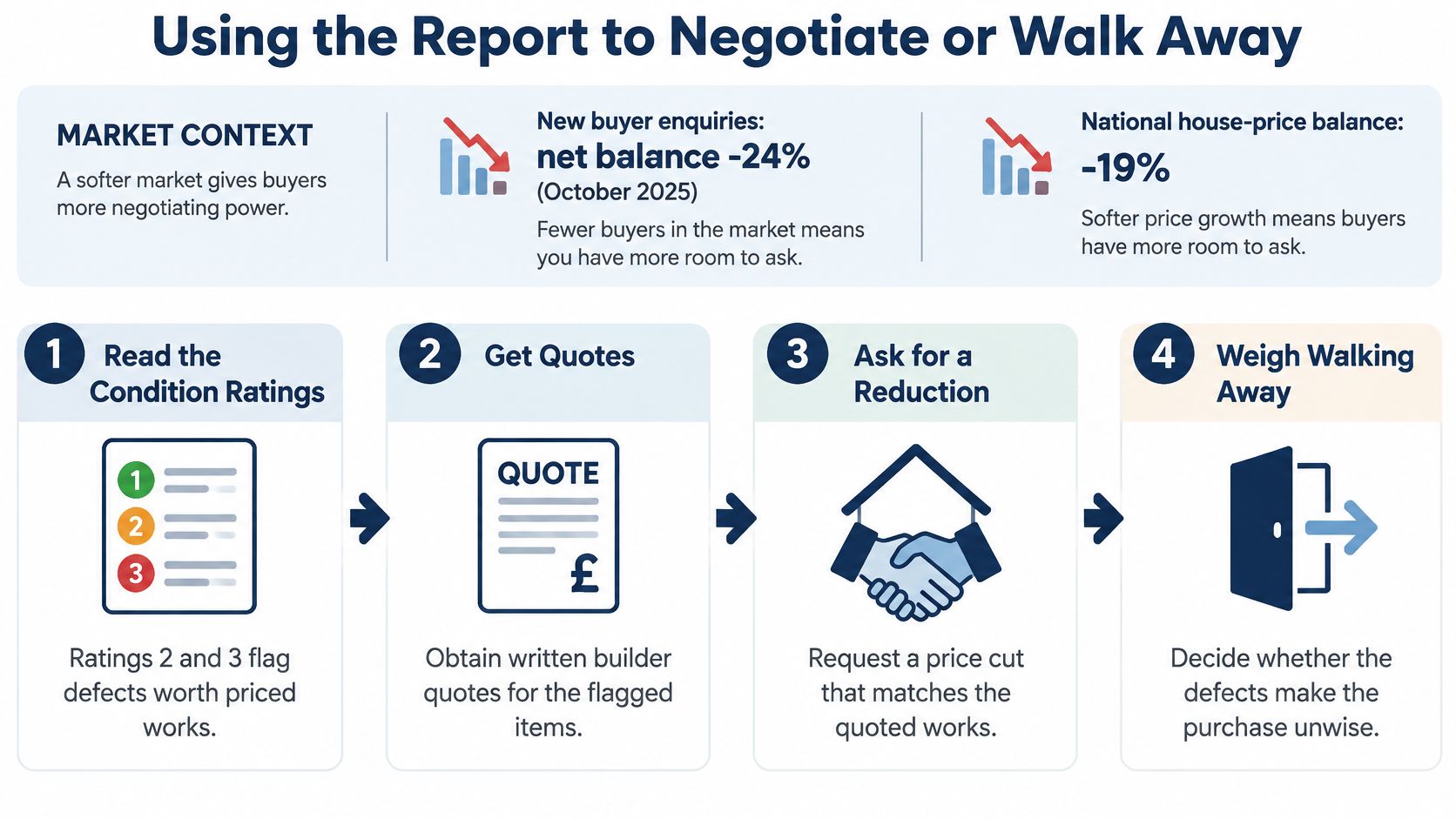
A red or urgent finding is not a pound-for-pound price reduction. You still need the quotation, a view on whether the work is urgent or long-term maintenance, and legal advice on who is responsible. Skipping straight to a discount figure is how negotiations stall.
If you'd like the sequence explained aloud, the walkthrough below covers it.
Leasehold transactions need a separate thought. In a block, a defect in a communal element is often funded through service charges rather than repaired by your seller, so a scary-sounding finding may cost you a share over time rather than a lump sum now. Check the service charge accounts and any Section 20 consultation before you treat it as a negotiating lever.
Where the instruction included a valuation, the market valuation and the insurance reinstatement figure are separate outputs again. Neither is a repair estimate, and neither tells you what the roof will cost to fix.
The report's value is narrower and more useful than a discount. It reduces uncertainty and sharpens your questions for the surveyor, the solicitor and the contractor. Sometimes that ends in a reduction. Sometimes it ends in walking away with your money intact. Negotiating after a survey explains how to put the case together without overplaying your hand.
Confirm the Level, Cost and Timing Before You Book
A booking that only says "a survey" still leaves the level, the fee and the diary date open. Fix those before anyone steps on site.
Six things to nail down before anyone inspects anything:
- The level. Run the three questions from earlier against the property, not against your budget. Choosing a cheaper, narrower survey because the fee looks better will not give you the HomeBuyer scope if the building needs it.
- Survey only, or survey and valuation. The valuation is a separate output with its own figures. Decide whether you need a market figure as well as the condition report, or only the survey.
- Likely restrictions. Ask which areas will probably be inaccessible, such as a blocked loft or a locked outbuilding, and how the report will record them. Those gaps are what the report cannot prove, so plan any further inspection before exchange rather than after.
- A written quote for the specific property. Fees depend on the property, so no fixed rate applies and a verbal figure is not a quote. The guide to what a RICS HomeBuyer Report costs explains why the price follows the building.
- A turnaround date in writing. The report has to land before exchange, and surveyors' diaries vary, so do not rely on an estimate given down the phone.
- Credentials. Check the surveyor is an RICS member and ask about their professional indemnity insurance.
Corinthian Surveyors London LTD is an independent firm of RICS Chartered Surveyors and Valuers based in Forest Hill, London, and a member of the Royal Institution of Chartered Surveyors. The firm carries out RICS HomeBuyer surveys on properties clients are buying, and it can provide a market valuation report where that separate figure is required. Those sit within a wider range of residential building and property surveying services across London.
Contact the firm with the property address and type and ask for a written quote and a turnaround date before you instruct. Get both fixed on paper so you know the report will arrive in time for exchange.