
Probate Valuation Cost in London: Fees and What Sets Them
You're sorting through the paperwork after a death, and someone asks what the house was worth. An estate agent offers an opinion, the solicitor mentions a surveyor and you're left wondering whether another bill is really necessary. The right starting point isn't the cheapest quote. It's whether the estate needs a professional figure and what could happen if that figure is wrong.
Table of Contents
- What a Probate Valuation Costs in London
- What a Probate Valuation Measures on the Date of Death
- Who Can Prepare a Valid Probate Valuation
- When a Paid Valuation Is Worth the Cost
- How the Valuation Runs From Instruction to Report
- Pricing Scenarios Across London Property Types
- Confirm the Scope Before You Instruct a Surveyor
- Probate Valuation Cost Questions Answered
What a Probate Valuation Costs in London
There's no single published London tariff that applies to every probate valuation, so the fee needs to be quoted for the property concerned. The fee is an administration expense paid by the estate, separate from the gross open-market property value reported to HMRC.
A useful quote describes the work, not just the amount payable. It should identify the property interest being valued, the inspection arrangements and the written report you'll receive. Ask whether VAT, additional visits and subsequent correspondence are included.
The main cost is professional time. A straightforward house with clear ownership documents and good comparable sales needs less investigation than a flat with unclear lease terms or land with development potential.
Probate valuation fee drivers
| Fee driver | Why it changes the work | Direction of fee |
|---|---|---|
| Floor area | More rooms, roof space and services to inspect | Higher as area grows |
| Freehold house | One title, usually the simplest tenure to value | Lower |
| Leasehold flat | Lease, service charge and ground rent to read and explain | Higher |
| Share of freehold | Two sets of title and management terms | Higher |
| Visible defects or unusual construction | More notes on condition and likely cause | Higher |
| Title restrictions or easements | Effect on value must be read and explained | Higher |
| Development or hope value | Planning and local sales research needed | Higher |
| Access problems | Extra visits or a limited inspection | Higher |
| Several titles or adjoining land | Valued together where combined worth differs | Higher |
| Thin local sales evidence | Wider search for comparable sales | Higher |
These directions are comparisons, not automatic surcharges. A large conventional house may be simpler to value than a small flat with a defective lease.
HMRC's property valuation guidance explains that assets may need to be valued together where their combined worth exceeds their separate values. That's why an adjoining garden plot or related title needs attention before the fee is agreed.
Gather the documents before requesting a quote
- Title register: Include the title plan and details of any additional land.
- Flat documents: Send the lease, service charge accounts and ground rent information.
- Planning history: Include permissions, refusals and applications affecting the property.
- Existing surveys: Provide any building survey or defect report already on file.
- Valuation date: Confirm the date of death.
- Nearby sales: Supply details of relevant transactions you know about.
A complete pack lets the surveyor price the actual work rather than allow for unresolved questions. It also helps you compare quotes on equal terms.
What a Probate Valuation Measures on the Date of Death
A probate valuation is an independent estimate of the property's open-market value at the date of death.
The test is what a willing buyer would reasonably have paid a willing seller on that date. The property's condition and legal restrictions must be assessed as they stood then, not after repairs, clearance or improvements.
HMRC's inheritance tax valuation guidance requires the open-market approach, including appropriate development or hope value, without deductions for selling expenses or the cost of selling assets together. An estate agent's asking price isn't that calculation. Nor is the eventual sale price automatically the right answer.
How the property figure affects the estate
Asset values are added to establish the gross estate. Debts such as a mortgage are then considered before applicable reliefs and exemptions determine the taxable position.
HMRC's estate calculation guidance identifies a £325,000 basic threshold, with available allowances potentially affected by an unused spouse or civil partner's threshold, gifts within seven years and the residence nil-rate band.
For a hypothetical example, take a house valued at £400,000 with a £250,000 mortgage. It contributes £400,000 to the gross estate, while deducting the mortgage leaves £150,000 of net property value before reliefs and thresholds are considered. Those are illustrative figures, not a London price estimate.
Keep the figures separate: The mortgage changes the estate calculation. It doesn't change what the house itself was worth.
Where an IHT400 is required, the property valuation supports the asset entry and the resulting estate totals. Our guide to probate valuations in London explains the property-specific work.
Tell the valuer about defects, tenancies, restrictions and planning potential. Supply relevant comparable sales too. Missing information can leave an apparently precise figure resting on the wrong assumptions.
Who Can Prepare a Valid Probate Valuation
The right person depends on the property and the evidence the estate needs. An executor's estimate may suit a straightforward case, while a written professional valuation gives a reasoned basis for a more complex or financially significant property.
| Option | Qualification and evidence | Independence | Best used for |
|---|---|---|---|
| RICS Chartered Surveyor or Valuer | Written open-market valuation with reasons and stated assumptions | Check for any connection to lenders, agents or developers | Property near thresholds, or unusual or complex homes |
| Estate agent appraisal | Often a marketing opinion rather than a written probate valuation | May be connected to winning the sale instruction | An early guide before marketing |
| Executor's own estimate | Based on the executor's evidence and reasoning | The executor's own view | Modest estates well below the applicable threshold |
These options are not interchangeable. The evidence should match the purpose: a suggested asking price is not automatically a date-of-death valuation, and an unsupported estimate may be difficult to justify.
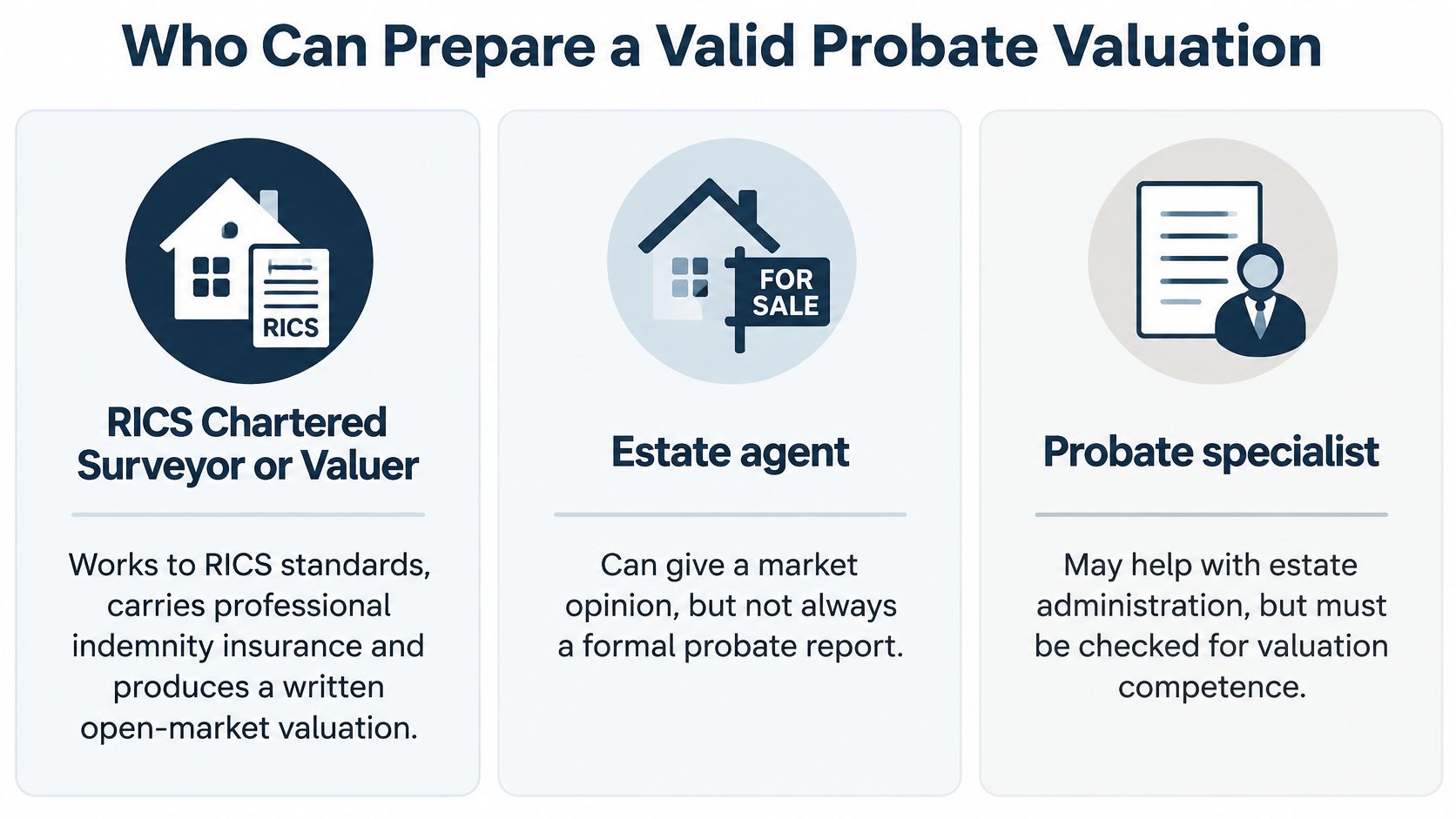
A surveyor's report should identify the valuation basis, relevant assumptions and reasons for the conclusion. Ask about relevant residential valuation experience and professional indemnity insurance. RICS membership alone does not show whether someone has experience with the property type in question.
The main professional routes are illustrated below. A probate specialist's administrative role does not, by itself, establish property valuation competence.
Qualifications and independence both matter
An estate agent may know the local sales market, but a suggested marketing price may allow for negotiation or be intended to attract buyers. Ask whether the agent will provide a written open-market valuation for the date of death, with reasons, rather than an asking-price recommendation.
Where an own estimate is appropriate, the executor should keep the property particulars, condition information and reasoning behind the figure. A round number without supporting evidence is harder to explain.
HMRC's guidance on valuing an estate recognises that a professional valuation is not required in every case. Personal representatives remain responsible for making reasonable enquiries.
Corinthian Surveyors London LTD is an independent firm of RICS Chartered Surveyors and Valuers based in Forest Hill, London. Its guide to what a valuation surveyor does explains the role of valuation work. For any appointment, disclose relationships with beneficiaries and ask the valuer to confirm there is no conflict.
When a Paid Valuation Is Worth the Cost
An executor assessing a conventional property in an estate clearly below the inheritance tax threshold may be able to use a realistic, evidence-based estimate. HMRC's guidance on reasonable enquiries and estimates sets out the need for personal representatives to make reasonable enquiries. The decision should turn on the evidence and the risk of getting the figure wrong, not on an assumed threshold.
A low estimate still needs a sound basis. Consider the whole estate, the property's condition and the available evidence before deciding whether to instruct a valuer.
When to pay for a professional valuation
| Estate situation | Suggested approach | Main reason |
|---|---|---|
| Conventional property, estate clearly below the inheritance tax threshold | Consider a realistic, evidence-based estimate | Clear documents and comparable sales may support the figure |
| Estate close to the inheritance tax threshold | Commission a professional valuation | A well-supported figure can help address the risk of under-reporting |
| Unusual, defective or leasehold property | Commission a professional valuation | Defects and restrictions can materially affect value |
| Several titles, adjoining land or development potential | Commission a professional valuation, with the assets considered together where appropriate | Combined worth can differ from separate sale values |
| Property sold soon after death | Use the sale as evidence and consider market movement | The sale price is evidence, not automatically the date-of-death value |
A conventional house with clear documents and closely comparable sales may be straightforward to assess. A short lease, unresolved movement or possible development value calls for more judgement than property listings can provide.
A desktop assessment may reduce inspection work, but it cannot establish unseen condition. If the estimate assumes the property is in reasonable repair despite known roof failure, the saving may be outweighed by the risk of an unsupported figure.
Pay for uncertainty that could change the estate's tax position or create a dispute between beneficiaries. Extra work is harder to justify when the property and evidence are straightforward.
A later arm's-length sale can help support the assessment. The figure still needs to reflect the property's condition, market circumstances and the terms of the sale at the relevant date.
The fee is small beside the potential cost of a wrong figure. An unsupported valuation can lead to additional tax exposure, an amended return or disagreement among beneficiaries. A written report does not guarantee that the figure will never be challenged, but it provides a reasoned basis for the executor's position.
How the Valuation Runs From Instruction to Report
Agree the process before arranging access. The surveyor needs to know why the report is required and which property interest belongs to the estate.
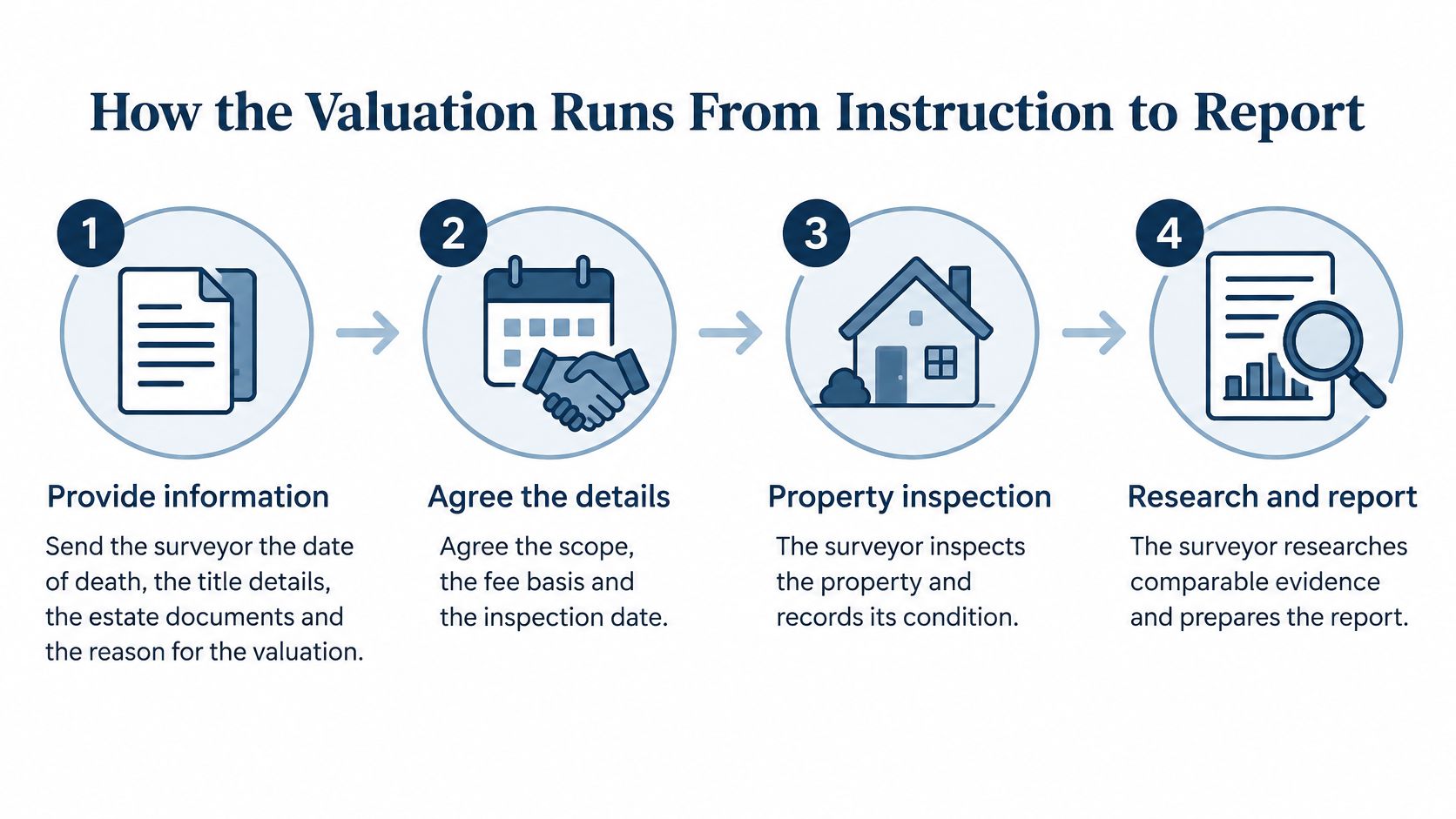
The main stages are shown below, followed by the practical details that prevent avoidable delays.
The instruction and inspection sequence
Send the initial information. Provide the date of death, title details, available estate documents and purpose of the valuation. Missing ownership information can stop the surveyor identifying what must be valued.
Agree scope and fees. Confirm the fee basis, inspection arrangements and any exclusions in writing. Unresolved instructions about additional land or separate interests can delay acceptance.
Check the property documents. The surveyor reviews the title, lease where applicable, planning history and initial sales evidence. Missing lease pages or unanswered planning questions may require further enquiries.
Arrange complete access. Coordinate keys and attendance with executors, tenants or other occupiers. Locked rooms, inaccessible outbuildings and unavailable keys can mean a restricted report or another visit.
Inspect the property. The surveyor records condition and visible defects that would affect a buyer's judgement, including damp, roof deterioration and timber damage. Stored belongings or unsafe areas can limit what can be assessed.
Analyse comparable sales. Relevant transactions are assessed against the property as it stood at the valuation date. Waiting for confirmation of a transaction or finding sufficiently similar evidence can extend the research.
Check factual details. If a draft review is included, the executor checks matters such as accommodation, ownership and tenancy information. Late corrections can require further investigation, but the valuation conclusion remains the surveyor's professional judgement.
Issue the final report. The signed valuation records the conclusion and its supporting basis. Outstanding material questions must be resolved or clearly addressed through stated assumptions.
What the finished report should explain
A useful report identifies the property, the interest valued and the relevant date. It should explain the inspection limitations, material assumptions and comparable evidence, rather than just announce a number.
Our valuation report example guide explains how to read that information. A probate valuation inspection isn't a substitute for a separate building survey or specialist testing.
Confirm the delivery timescale at instruction, including what happens if documents or access arrive late. Tell the surveyor about any estate reporting deadline rather than assuming the report will fit it.
Keep the signed report, instructions, factual corrections and supporting documents together. Retain the evidence available to you and the correspondence explaining material assumptions.
Pricing Scenarios Across London Property Types
A Victorian terrace in Lewisham can demand more investigation than its floor area suggests. If chimney breasts have been removed and ceilings show cracking, the valuer needs to distinguish age-related features from defects that would influence a buyer's offer.
The housing type is a starting point, not a diagnosis. The inspection must establish what is present.
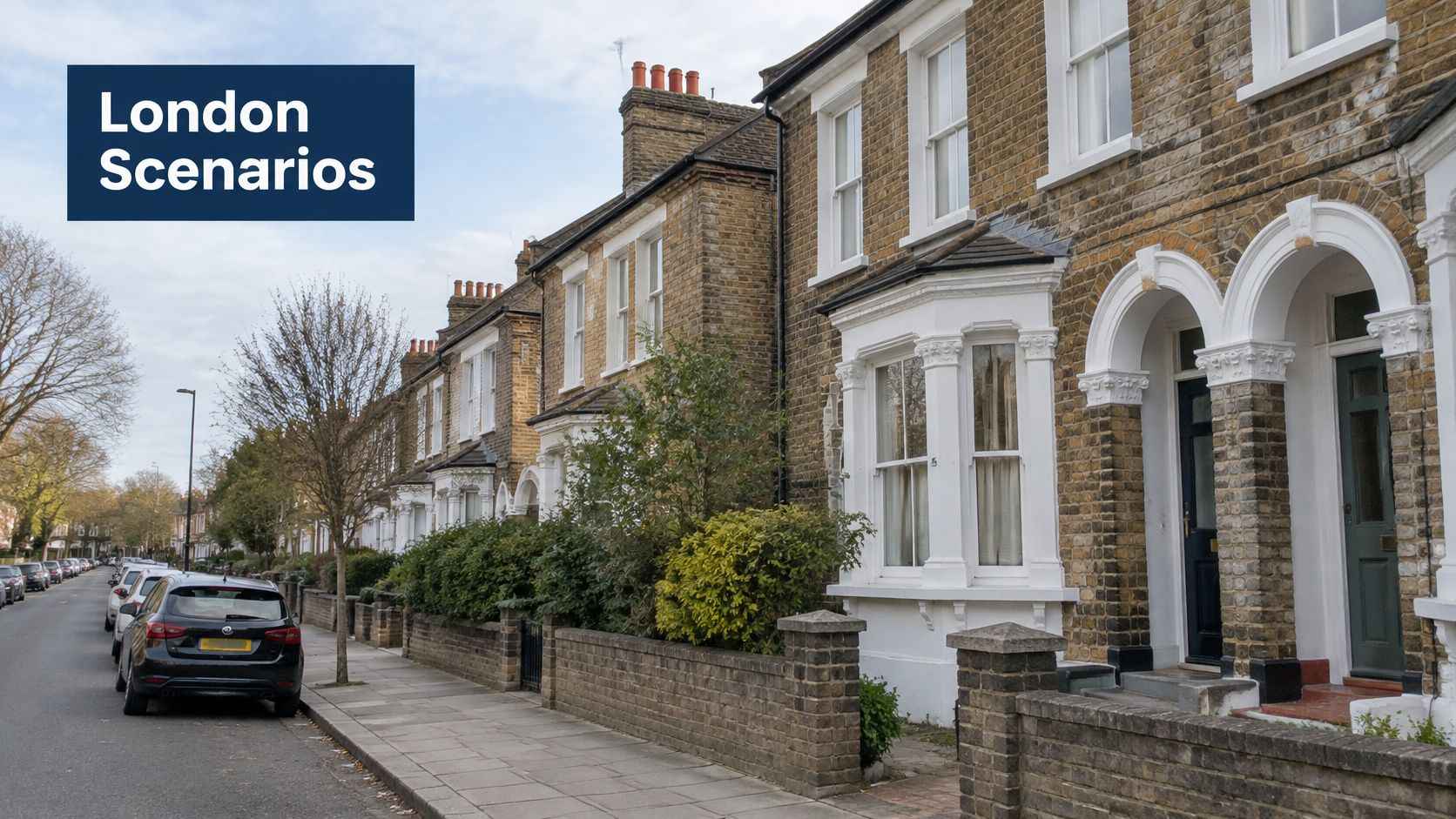
Probate valuation scenarios by property type
| Scenario | Main fee drivers | Ask the surveyor |
|---|---|---|
| Victorian terrace house, Lewisham | Lead pipework, lime mortar, lath and plaster, chimney breast removals | How will condition be recorded and priced? |
| 1930s semi, Bromley | Floor area, garden, extensions or loft conversion | Will any extension be valued separately? |
| Converted warehouse flat, Bermondsey | Conversion history, shared spaces, leasehold terms | Which lease terms will you read and report on? |
| Leasehold flat with arrears or short lease | Lease length, service charge accounts, ground rent | How will the lease affect the value in the report? |
For the Lewisham terrace, original materials aren't automatically defects. Lime mortar and lath and plaster require informed assessment rather than blanket deductions. Lead pipework and altered chimney supports raise different questions about condition and evidence.
For the Bromley semi, an extension or loft conversion changes the accommodation being compared with neighbouring sales. The house is normally valued as a whole, not by adding a separate price for each improvement. The surveyor should explain how alterations affect its market position and what documentation is missing.
For the Bermondsey warehouse conversion, shared access, conversion quality and lease obligations may be as significant as the internal space. Comparing it with a conventional purpose-built flat without adjustments can produce a poor conclusion.
The video below offers additional context for discussing the valuation instruction.
Lease paperwork can outweigh inspection time
For a flat with a short unexpired lease or service charge arrears, send the actual documents. Don't rely on a sales description saying the lease is long or the charges are reasonable.
Distinguish the market effect of the lease terms from any debt owed by the estate. Otherwise, the same liability could be reflected inconsistently in the valuation and estate accounts.
These scenarios explain differences in probate valuation cost, not fixed prices. Even nearby streets can offer very different comparable evidence because of property size, tenure or condition. The valuer may need to widen the search while explaining why the selected sales remain relevant.
Confirm the Scope Before You Instruct a Surveyor
A quote is useful only if it covers the work the estate needs. Before accepting it, check the surveyor's relevant valuation experience, independence, inspection arrangements, written report, fee exclusions and expected delivery time.
Make the quote answer the actual question
Ask the surveyor to confirm in writing that the instruction is for a probate valuation and identifies the ownership interest being valued. A whole freehold house and the deceased's share in a jointly owned property are different valuation instructions.
Clarify how follow-up work is charged. A factual query from the executor, a beneficiary's disagreement and detailed HMRC correspondence may require different amounts of time. Ask which are covered by the quoted fee.
Before accepting: Compare the scope line by line. The lowest fee may exclude an inspection, document review or follow-up you need.
Corinthian Surveyors London LTD is an independent firm of RICS Chartered Surveyors and Valuers based in London. It provides market valuation reports for homes being sold and a wide range of residential surveying services.
Send enough information for a property-specific quote
Send the property address, date of death and title documents with your enquiry. Include the lease if relevant, and explain any known defect, occupancy issue or proposed sale. If a solicitor is coordinating the estate, say who will approve the instruction and receive the report.
Agree the scope and fee in writing before booking an inspection. That gives the surveyor a clear basis for the work and helps ensure the report answers the questions the estate needs addressed.
Probate Valuation Cost Questions Answered
Is a probate valuation always required?
A value is needed to calculate the estate, but a paid professional report is not automatically necessary. For a straightforward estate with a clear, supportable figure, an executor may be able to use an evidence-based estimate. Uncertainty about the property's value or its proximity to a reporting threshold makes professional advice more useful.
Can an estate agent's appraisal be used for probate?
An agent's appraisal can contribute evidence, but check what it covers. An asking-price suggestion without a valuation date, assumptions or supporting reasons may not answer the questions raised about the estate's figure. Ask for a written open-market assessment suited to the intended purpose.
What happens if the property sells for a different amount?
A later sale price does not, by itself, show that the original valuation was wrong. The difference may reflect a change in market conditions, the property's condition or the circumstances of the sale. If the reported value was incorrect, an amended return may be needed.
Keep the report and related correspondence. They help explain how the executor reached the figure if HMRC or a beneficiary asks.
Corinthian Surveyors London LTD is an independent firm of RICS Chartered Surveyors and Valuers in Forest Hill, London, offering residential surveys and market valuations. To discuss a property, visit Corinthian Surveyors London LTD with the address and title documents and request a quote.