
Cost of House Valuation for Probate: London Guide 2026
Why do executors budget for a probate valuation by floor area, then face an HM Revenue & Customs evidence query months later? The cost of house valuation for probate is a tax-risk decision. A lower fee can turn expensive if the report cannot support the figure submitted.
GOV.UK sets a £526 court fee for estates valued above £5,000; that charge pays for the grant application, while the valuation fee is set by the property and the scope of work. For the actual figure, get a written quote for that address.
I would budget for three separate charges: the court fee, the valuation fee, and later work if HMRC queries the value, the house sells months after death, or a capital gains calculation needs the date-of-death evidence.
Table of Contents
- What a Probate Valuation Costs in London
- What the Valuer Is Pricing at the Date of Death
- What Moves the Fee Up or Down
- What the Valuation Fee Covers and What It Leaves Out
- When an Estimate Is Not Enough
- How to Choose a RICS Valuer for Probate
- Get a Written Quote Before You Instruct
What a Probate Valuation Costs in London
Ask three London firms to value the same house for probate and the quotes will not match. Nothing in the probate process fixes the price; the fee follows the work that particular property needs.
The court charge is a different bill, and it runs on a published tariff rather than a quote. GOV.UK states that estates valued above £5,000 incur a probate application fee of £526, while estates valued at £5,000 or less pay no application fee. Extra copies of the grant cost £2 each when ordered with the application and £16 each when ordered later; a second application costs £22. That money pays for the grant. It does not pay for inspecting a house, pulling comparables or writing a report, and the same charge falls on a modest flat in Catford as on a high-value house in Blackheath.
The valuation itself is commissioned separately. GetAgent's 2025 guide puts a UK estate agent or surveyor valuation used in probate at an estimated £150 to £500 or more, a market estimate rather than an official tariff. The spread is wide because the jobs differ: a short agent's appraisal sits at the lighter end, while a formal RICS report priced for a specific address carries an inspection and a stated basis of value. A retrospective date-of-death valuation is priced on its own quote, because the valuer has to rebuild an earlier market.
| Charge | Typical cost | What it covers |
|---|---|---|
| Probate court fee, estate over £5,000 | £526 | Grant application only, excludes the valuation |
| Probate court fee, estate £5,000 or less | No fee | No application fee |
| Estate agent or surveyor estimate | £150 to £500 or more | GetAgent 2025 market estimate, not an official tariff |
| Formal RICS valuation for probate | Quoted per property | Written quote stating valuation date and scope |
| Retrospective date-of-death valuation | Quoted per property | Extra work where the property is sold months later |
Practical rule: Ask for a written quotation that names the valuation date, the address, the inspection, the reporting basis, the fee, and whether VAT or later HMRC queries are included.
The assignment drives the fee more than the postcode. A Lewisham flat and a Bromley house can cost much the same, or very differently, depending on lease length, condition and how far back the market has to be reconstructed. Two quotes that look far apart are often pricing different scopes. Compare what each fee buys before comparing the totals.
What the Valuer Is Pricing at the Date of Death
Think of the valuation as a photograph of the market on the day of death, not a video of everything that happened afterwards.
The relevant date is normally immediately before the death. It is not the day you instruct a surveyor, apply for probate or sell the house. HMRC guidance explains that the valuation should reflect the property and locality at the date of death and disregard later changes, including subsequent improvements, deterioration or changes in the surrounding area.
The figure you need is the price the property might reasonably have achieved in an open-market sale at that time. It is not the insurance rebuild cost. It is not the cheque left after the agent and the solicitor have been paid. A sale months later can be useful evidence. It does not automatically replace the date-of-death figure, and the report should say it is retrospective and name the statutory date.
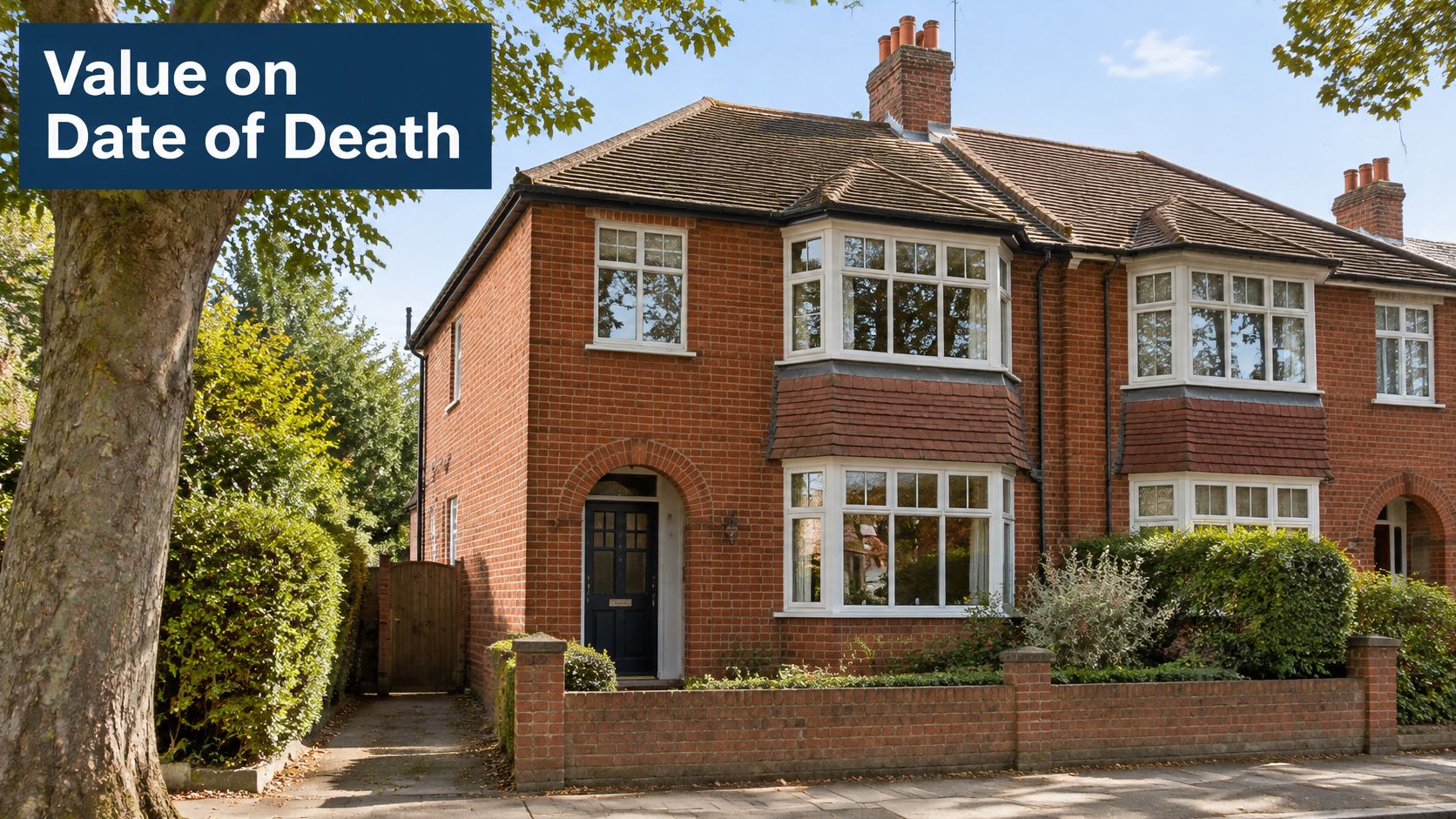
A later extension does not travel backwards
Say a Victorian terrace in Lewisham is sold nine months after death, and the family built a rear extension in that gap. The valuer prices the house as it stood on the date of death: the old kitchen, the original rear wall, the comparables from that period. The extension is ignored for the probate figure, even if it lifted the eventual sale price. Market movement in Brockley or Forest Hill over those months is separated from changes to the building itself.
That split is where the fee comes from. Current sales are easy to pull. Historic sales, adjusted for condition known at the time, take longer. If you want the wider method behind a market figure, how to value a house sets out the steps a valuer uses in practice.
I would not accept a quote that fails to state the valuation date. Without that date, you cannot tell whether you are buying a probate figure or a price for a sale next month.
What Moves the Fee Up or Down
The court fee does not rise because the house is worth more. Variation sits entirely in the valuation work. Three things move a quote, and they do not all pull the same way.
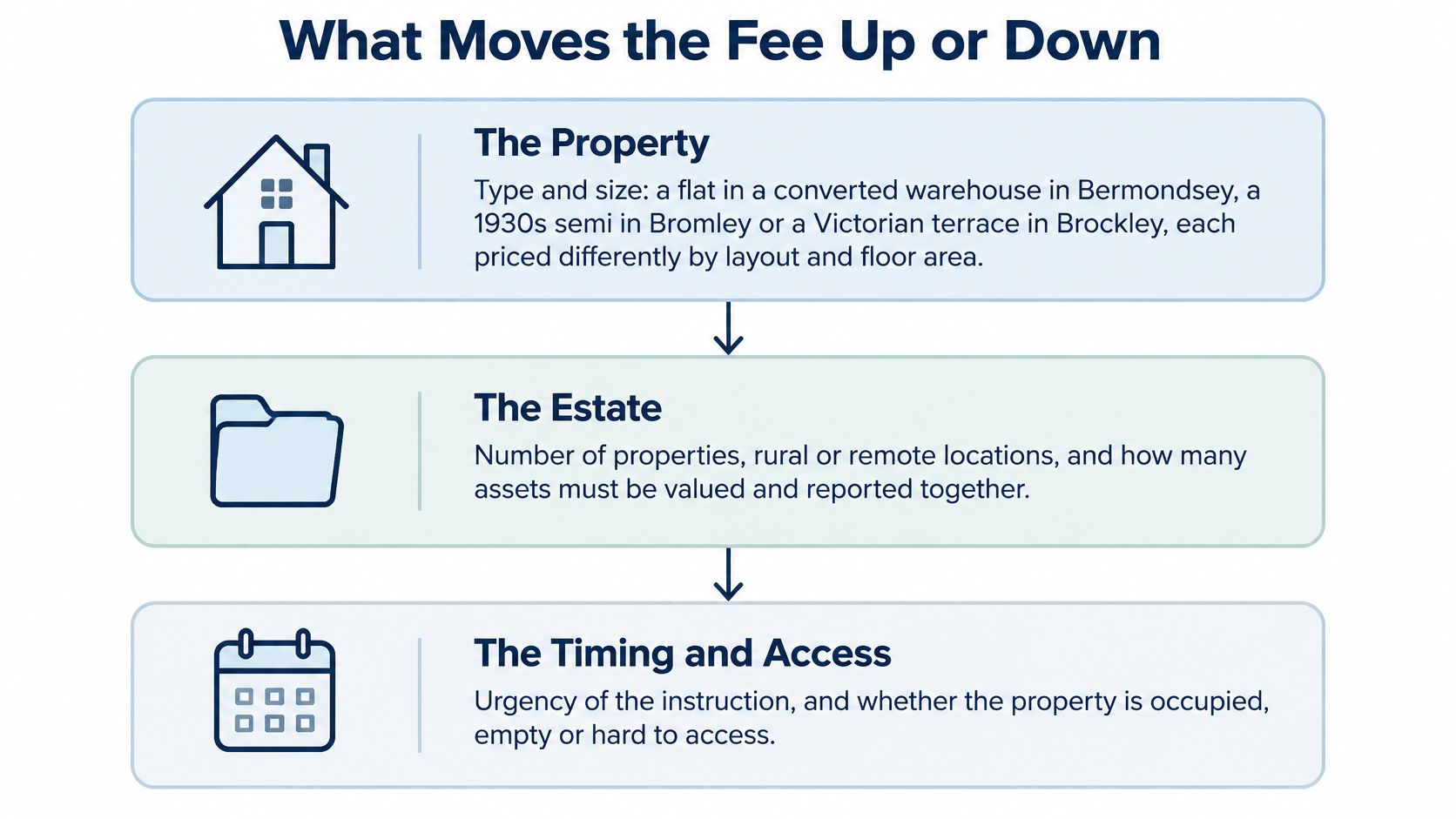
The property
Type and layout set the inspection and the comparables. A flat in a converted warehouse in Bermondsey needs different evidence from a 1930s semi in Bromley or a Victorian terrace in Brockley. Floor area matters, but so does what is awkward to measure: split levels, a roof terrace, a basement that may not have consent.
Tenure is often the quiet cost. A short lease, a missing share of freehold, or a service-charge dispute in a block in Lambeth changes both the value and the time. Listed status or a conservation area in Southwark, and any unlawful alteration, add research before anyone puts a number on the page.
Complexity of the estate
One straightforward house is a different job from three properties reported together, or from a plot with planning potential. Unusual construction, a house split into flats without a clean paper trail, or beneficiaries who already disagree about the figure all lengthen the report. The valuer is pricing the argument they may have to support, not just the visit.
Timing and access
A probate deadline, an empty house with no keys, or a sale many months after death each change the programme. Retrospective work means rebuilding historic conditions and separating market movement from later works. A standard house seen this week, with the owner's papers ready, is the lower end of effort. A locked flat and a date of death two years ago is not.
The more work needed to inspect the building or reconstruct the market, the higher the fee. Ask which of those three is actually driving the number on the quote.
What the Valuation Fee Covers and What It Leaves Out
A written scope is what protects the executor. Headline fees that leave out VAT, travel or a second property are how estates under-budget.
For inheritance tax, the statutory basis is open market value: the price the property might reasonably be expected to fetch if sold on the open market at the relevant time. HMRC's Inheritance Tax Manual states that the value must not be reduced merely because the whole estate, or a large quantity of property, is placed on the market at once. Sale costs, such as estate-agent fees and conveyancing expenses, are not deducted. The report should state the valuation date, condition and comparable evidence, rather than the net proceeds you hope to bank.
| Scope item | Usually included | Confirm before you instruct |
|---|---|---|
| Written report with valuation date and open-market basis | Yes | Exact date of death and reporting basis |
| Inspection of the property | Usually | Internal or external inspection and access arrangements |
| Comparable sales evidence | Usually | Which sales and what time period |
| Sale costs such as agent and conveyancing fees | Not deducted | Confirm the figure is an open-market value |
| VAT | Often added on top | Whether the quote is inclusive or plus VAT |
| Travel outside the surveyor's area | Often a separate charge | Mileage or a fixed charge |
| Several properties on one estate | Priced per property | The price for each address |
| Retrospective date-of-death analysis | A separate line of work | Extra fee if the property is sold months later |
| Follow-up questions from HMRC | Only if the quote says so | Whether responses are covered |
Where quotes quietly differ
VAT is the usual surprise. A fee that looks lower can be higher once tax is added. Travel outside the surveyor's usual patch, and a second or third property, should be priced before you instruct, not after the visit. Follow-up with HMRC is the item most often left off. If the Valuation Office Agency writes in six months, you want to know whether a reply is in the fee or a new invoice.
A valuation report example shows the kind of date, basis, assumptions and inspection limits a usable report contains. Compare quotes line by line against that list. Do not compare them by the largest number on the first page.
When an Estimate Is Not Enough
A modest house can carry more probate risk than a larger one when the estate sits near a tax point or the beneficiaries are already arguing. I treat the instruction decision as tax risk: what must be reported, who may challenge the figure, and what a wrong value costs later. Budget the pieces separately. The probate application is administration, the valuation is evidence, and later HMRC questions or amended tax are exposure; each has a different reason to exist.
HMRC guidance allows personal representatives, in some lower-value estates and for some individual assets, to use their own realistic estimate. The estimate still has to be an honest attempt at open-market value; a nominal figure chosen to keep the return quiet is still wrong. Where inheritance tax is due, the value goes on form IHT400 and probate cannot be applied for until that reporting is done, so the number needs enquiries behind it.
Where a realistic estimate can carry the file
An estimate is easier to defend when the estate sits comfortably away from a threshold, the home is a standard flat or house, the tenure is simple, and the beneficiaries agree. A dated agent letter can be a starting point in that narrow case. Keep it realistic and file it with the estate papers; a marketing price is not the probate figure.
Where the fee is the cheaper option
Pay for a RICS report when the property is the main asset, the estate sits near a threshold, or HMRC may question the return. Development land, a short lease, unusual construction, beneficiaries who will not agree a number, or a later sale far from the declared figure all weaken a rough estimate. A low value can cut tax at first and then bring amended tax, interest and penalties. A high value can inflate the tax or leave a beneficiary short.
One yes on this test is enough to instruct; the comparison is the fee against the cost of an incorrect figure, and zero is not the alternative:
- Threshold: Is the estate close to a point where tax starts or a relief changes?
- The building: Is there development potential, a short lease, or construction a local agent rarely values?
- The people: Will beneficiaries, or HMRC, challenge the number?
- The timeline: Will you sell many months later and need the death-date figure kept separate from the sale price?
How to Choose a RICS Valuer for Probate
Choose the valuer whose number still stands when HMRC, a beneficiary or a later buyer tests it. The fee is buying a defensible death-date figure, not a nicer PDF.
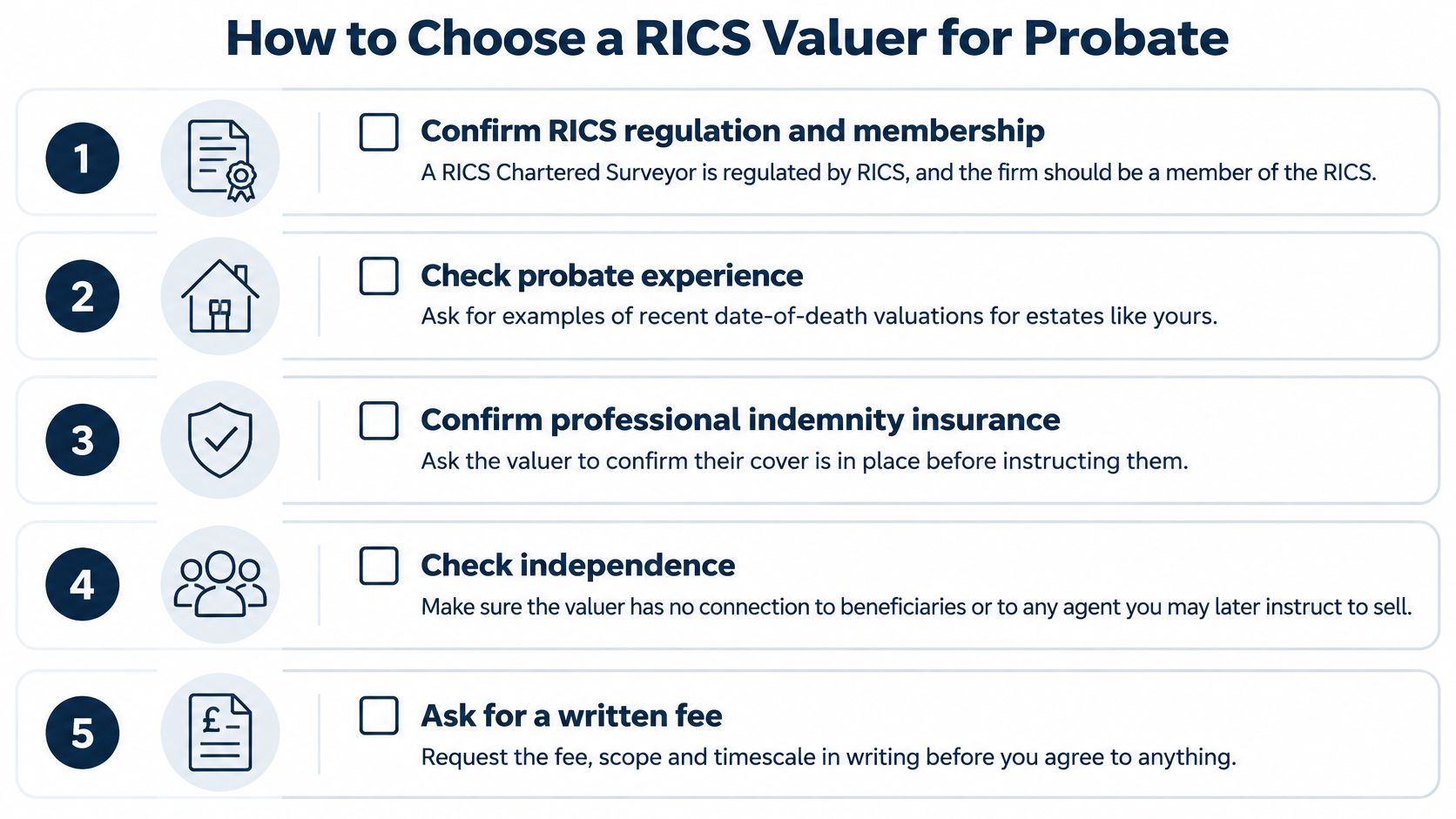
- Confirm regulation. A RICS Chartered Surveyor is regulated by RICS, and the firm should be on the RICS Valuers Registration Scheme for valuation work. That ties the opinion to a professional standard rather than a sales pitch.
- Get the named sign-off. The report should name the signing valuer and show their current RICS qualifications and registration, so you can check them before you pay. Ask what professional indemnity insurance stands behind the figure if it is challenged.
- Test independence. The valuer should have no tie to a lender, an estate agent or a developer, and should not be acting for the agent who will sell the house or for a beneficiary who wants a particular number. Independence is the point of commissioning your own report.
- Ask for local evidence. Recent sales in the right borough matter. A valuer who knows conservation areas and housing stock in Croydon, Greenwich or Wandsworth will adjust for micro-location instead of using a borough-wide average. Read what a valuation surveyor does before you compare firms.
- Screen the quote. It should put the basis, valuation date, address, inspection and exclusions in writing. If those lines are missing, you do not yet have a quote.
Red flags are simple: a fixed price with no scope, a valuation bundled with an instruction to sell, pressure to use the marketing agent's valuer, or no clear complaints route. Walk away from those.
For probate, ask one extra question: how would you defend this figure if HMRC queries it after the house is sold? A careful answer usually sounds narrower than a confident one.
Get a Written Quote Before You Instruct
A written quote should make clear what the fee covers and which later costs could fall to the estate. Confirm the scope before booking an inspection.
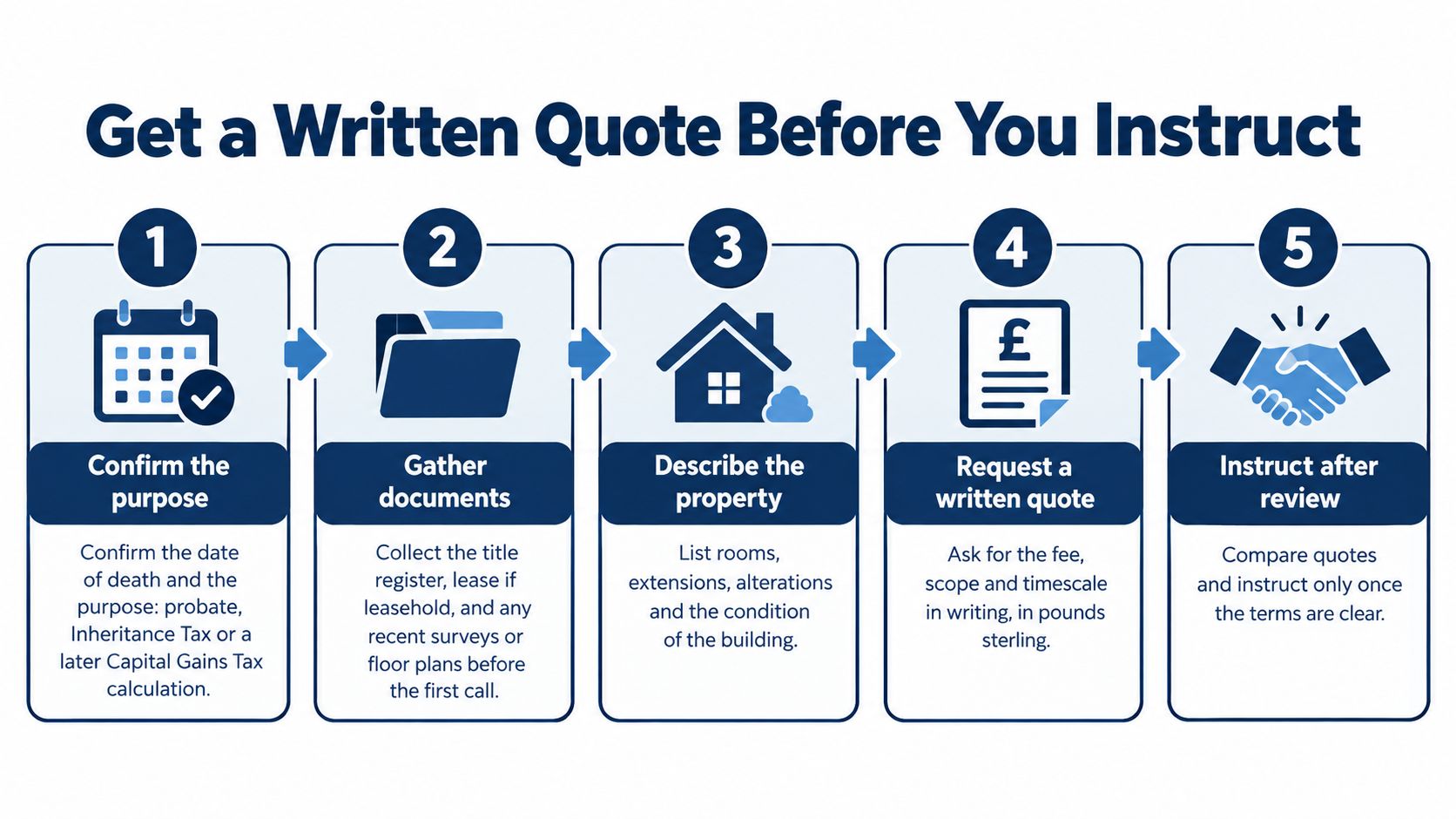
- State the purpose and valuation date. Give the date of death and explain that you need a probate valuation. If you may also use the figure for a later capital gains calculation, raise that before instruction so the valuer can confirm whether one report will cover both purposes.
- Gather relevant property records. Have the title register ready, along with the lease and service-charge details for a leasehold property. Include planning and building-control records for alterations, and a short list of work completed since the date of death.
- Compare the scope, not just the fee. Ask whether the quote includes an inspection, comparable evidence, VAT, travel, additional properties, retrospective work and replies to HMRC. Get any exclusions in writing.
- Arrange access before the visit. Confirm who will provide keys or alarm codes and ensure the valuer can access every room. If access is incomplete, a return visit may add to the cost.
- Keep the report with the estate records. Retain the valuation, comparables, inspection notes and assumptions. They may help explain the figure if HMRC or a beneficiary asks how it was reached.
Questions worth asking on the call
Who will sign the report, and are they RICS registered for valuations? Ask for the surveyor's name and qualifications to be confirmed in writing.
Is VAT included, and are replies to HMRC included? These can affect the amount the estate ultimately pays, so check whether follow-up work would be charged separately.
Will the report state the open-market value at the date of death? Confirm that the valuation is for probate and that any sale costs are treated separately, rather than deducted from the property value.
Corinthian Surveyors quotes each London property on its own facts and will set the valuation date and scope in writing before you instruct. Contact the firm through its website with the date of death and property address ready so the quote can be scoped.
Corinthian Surveyors London LTD prepares independent residential probate valuations for executors who need an open-market figure at the date of death, including retrospective work where the house is sold later. The firm is regulated by RICS, and each job is quoted in writing for that property rather than from a flat tariff. Visit Corinthian Surveyors London LTD to see how a probate instruction is scoped before you commit the estate to a fee.