
How Much Is a Building Survey in the UK in 2026
A full RICS Level 3 building survey in the UK typically costs roughly £630 to £1,500 or more, with the final fee moving according to size, age, construction, location and scope. London properties sit at the top of that range, so a quote well above the bottom end isn't automatically expensive.
You've had an offer accepted. The estate agent's pushing for progress and you're staring at three survey quotes that barely resemble each other. That spread usually means the firms aren't pricing the same job.
Table of Contents
- What a Building Survey Actually Costs in 2026
- Which Type of Survey Is a Building Survey
- Property Factors That Push the Fee Up or Down
- Why London Quotes Sit at the Top of the Range
- Example Price Bands for Common London Properties
- Why a Cheaper Survey Can Be False Economy
- What the Quote Does Not Cover
- Getting Accurate Quotes You Can Compare
What a Building Survey Actually Costs in 2026
When buyers ask how much is a building survey, they usually mean a Level 3 survey. That's the detailed inspection used for older, altered or unusual homes.
Independent UK consumer guidance on survey types and prices places a full building survey at approximately £630 to £1,500 or more, depending on size, location, complexity and value. There's no fixed national price because the work is priced on inspection and reporting time.
A small straightforward house can sit near the bottom of the band. A large Victorian terrace in Lewisham with extensions, a converted loft and a history of movement will not.
RICS Home Survey Levels at a Glance
| Level | Common Name | Best For | Typical UK Price Band |
|---|---|---|---|
| Level 1 | Condition Report | Newer conventional homes in good condition | Lowest of the three |
| Level 2 | HomeBuyer Report | Conventional homes in reasonable condition | Mid range |
| Level 3 | Building Survey | Older, altered, listed or defective homes | £630 to £1,500 or more |
Four things drive the number you're quoted. The property itself, where it is, what's included in the report and who's carrying out the inspection.
Practical rule: Compare written scopes on the same property, not headline fees from a price menu.
An independent RICS surveyor should quote for the address in front of them. If a firm gives you a firm fee without asking about age, size and construction, ask what they've allowed for.
Budget using the band, then get a property specific quote. That's the only figure worth relying on.
Which Type of Survey Is a Building Survey
The RICS structure has three levels and the names cause most of the confusion. Which guidance on the three RICS Home Survey levels confirms Level 1 is least detailed, Level 2 is the former HomeBuyer Report and can include a valuation and Level 3 is the former Building Survey.
Level 1 gives a basic overview of condition. It's suited to a modern flat or a conventional house with no obvious problems.
Level 2 looks at significant issues that affect value and habitability. It's the sensible choice for a conventional property in reasonable condition, for example a 1930s semi in Bromley that's been maintained and hasn't been heavily altered.
The diagram below shows how the three levels build on each other.
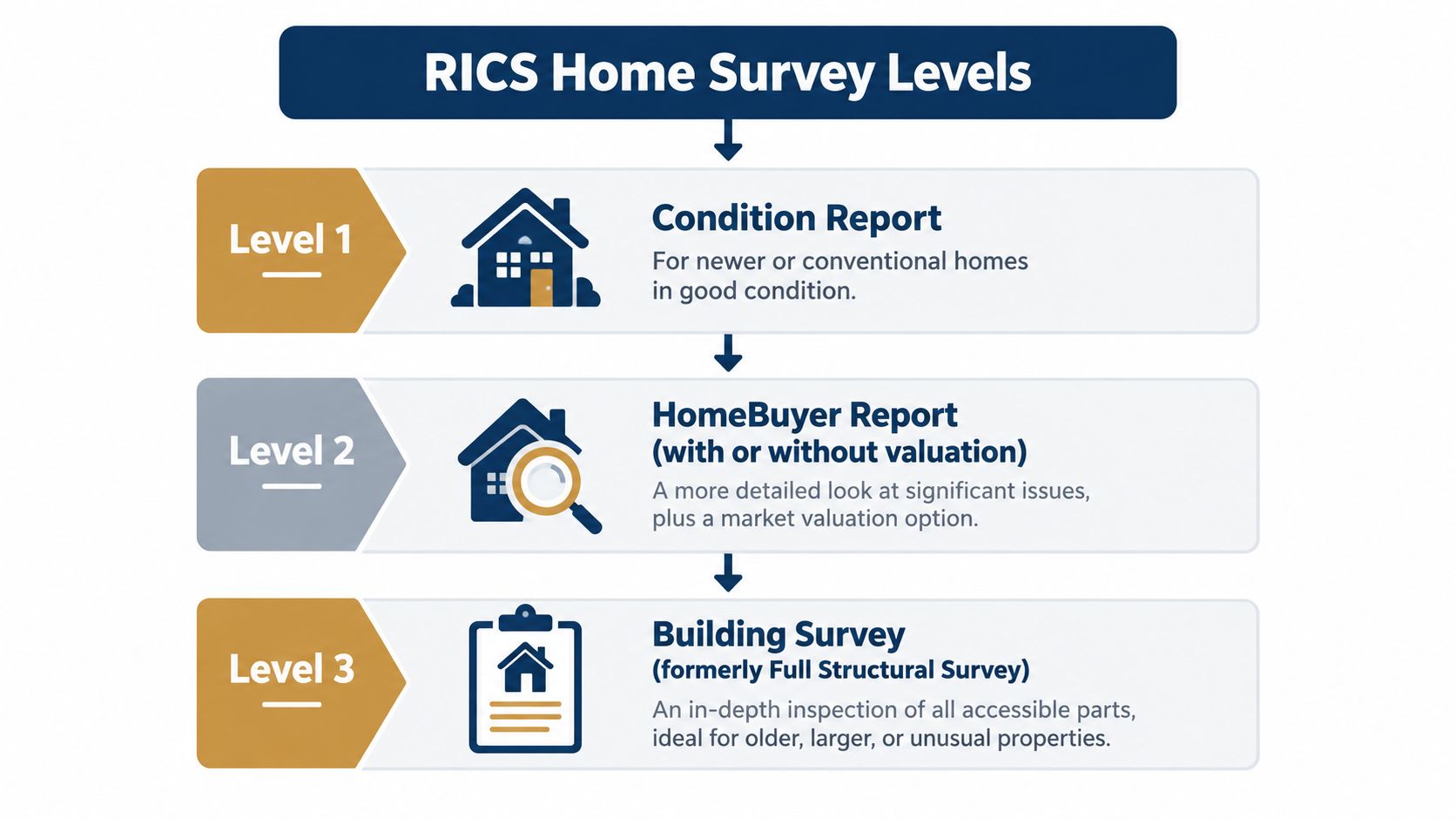
Level 3 is the building survey this article is pricing. It examines accessible parts in depth and explains defects, likely causes, remedial options and future maintenance.
Use Level 3 for a listed building, a non-standard construction, a visibly defective house or a property you plan to renovate substantially. Converted warehouse flats in Bermondsey and period conversions in Peckham often fall into this category because the alteration work matters as much as the original building.
Not the Same as a Mortgage Valuation
A lender's valuation checks whether the property is adequate security for the loan. It isn't a condition report for you.
Buyers who rely on it often discover damp, roof defects and timber decay only after completion. If you want a side by side view before you decide, read this homebuyer survey comparison and match the level to the property, not to the cheapest fee.
Property Factors That Push the Fee Up or Down
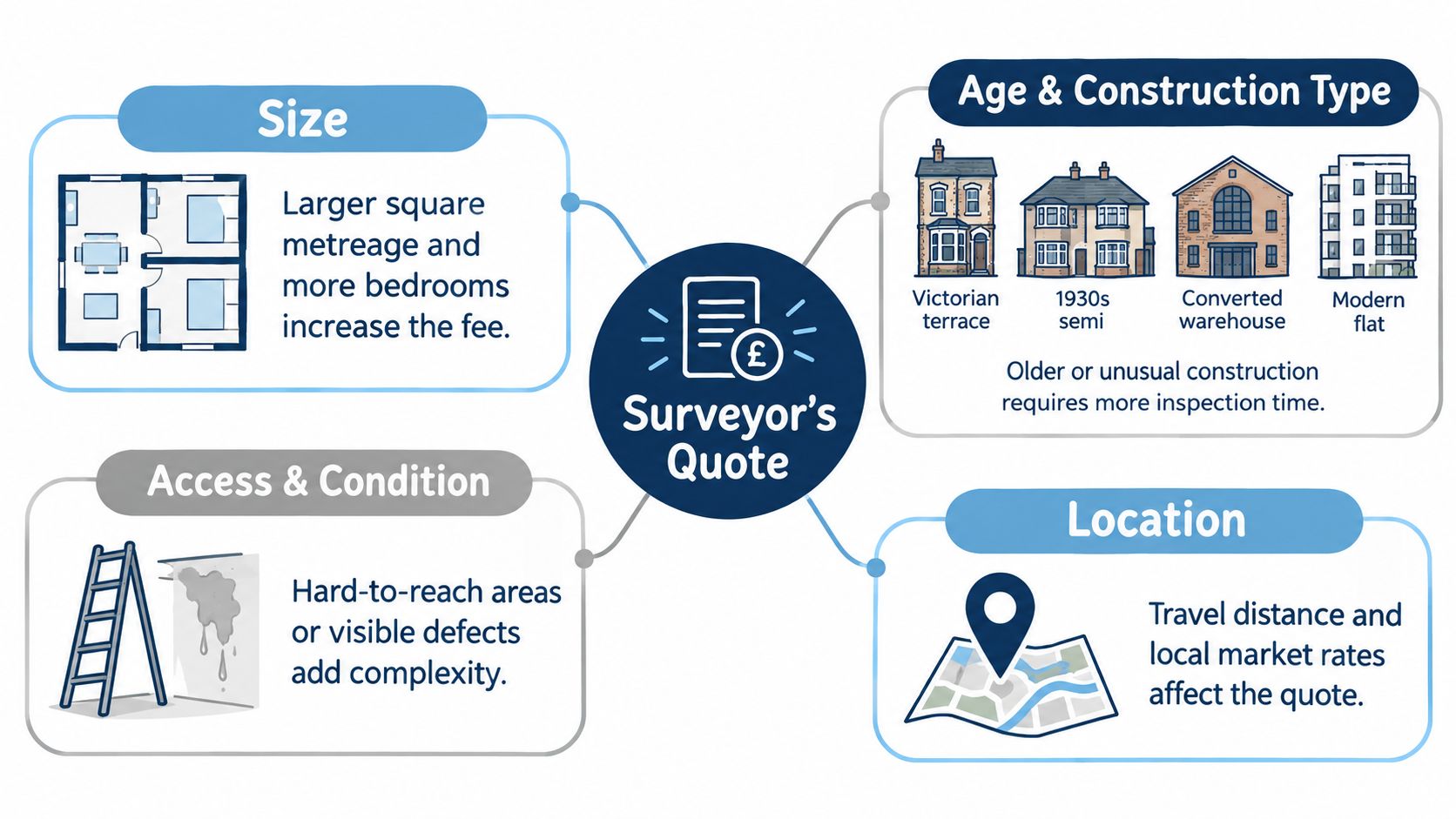
Surveyors price time and risk. RICS consumer guidance on what drives survey fees is clear that larger houses, older buildings, unusual construction, extensive alterations, poor accessibility and properties needing detailed investigation normally attract higher fees.
Size is the starting point. More bedrooms, more reception rooms and more roof space mean more to inspect and more to write up.
Age and construction come next. A Victorian terrace brings lime mortar, lath and plaster, original chimney breasts and a long history of piecemeal repair. A modern flat on a Barking development brings a shorter and simpler inspection.
The factors below are the ones a surveyor works through when pricing your job.
Alterations push fees up because they raise questions. A removed chimney breast, a steel beam from a kitchen extension and a loft conversion all need checking for support and workmanship.
- Access difficulties: A cluttered or boarded loft and a locked outbuilding slow the inspection down.
- Visible condition: Cracking, damp staining and sagging floors need analysis, not just a photograph.
- Ancillary structures: Garages, outbuildings and large gardens add scope if you want them covered.
Property value also plays a part, partly because professional liability rises with value. Two houses of similar size in Forest Hill and Sydenham can still attract different fees if one's been extended twice and the other hasn't.
Before you ring for quotes, write down the age, the number of bedrooms, the construction type and any alterations you know about. You'll get a more accurate figure first time.
Why London Quotes Sit at the Top of the Range
London isn't a single market and it isn't cheap to work across. Higher property values alone pull fees towards the upper part of the UK band.
The housing stock does the rest. South East London is full of Victorian and Edwardian terraces in Lewisham, Catford and Brockley that have been extended, converted and repaired many times over.
Listed buildings and conservation areas in Greenwich, Blackheath and Dulwich add another layer. The surveyor has to consider original fabric, past repairs in the wrong materials and restrictions on how defects can be remedied.
Access and Travel Are Real Costs
Flats create practical problems that houses don't. Getting into a shared loft, viewing a flat roof or inspecting a rear elevation over a neighbour's garden can take time and permissions.
Travel across boroughs also feeds into the fee. A surveyor based in South East London inspecting in Richmond or Walthamstow is allowing for a long round trip as well as the inspection.
A higher fee for a period house in Greenwich and a lower fee for a simpler house in Bromley can both be correct. They are different jobs.
Independent surveyors with no ties to lenders or estate agents quote per property rather than from a fixed menu. That's a strength, not a lack of transparency.
Judge a London quote against other quotes for the same address and the same scope. Comparing it with a national entry level price tells you nothing useful.
Example Price Bands for Common London Properties
These examples show relative position within the national band set out earlier. They're budgeting benchmarks, not quotes, and London work typically falls towards the higher end.
A one-bed new-build flat in a recent development is the simplest Level 3 instruction in this list. There's no loft of your own, the construction is conventional and the flat is small. Expect it towards the lower part of the London range if access is straightforward.
A two-bed Victorian conversion flat in Camberwell or Brixton costs more to survey. The surveyor is looking at the flat, the conversion work, sound and fire separation and the condition of shared elements that affect you.
Houses Where the Fee Climb Is Steeper
A three-bed 1930s semi in Bromley or Beckenham sits in the middle ground. Cavity walls and a conventional layout keep it manageable, but an old roof covering, an extension and outbuildings add time.
A large four or five-bed Victorian terrace in Dulwich or Clapham is a different proposition. Multiple floors, a cellar, chimney stacks and decades of alteration push it firmly to the top of the band, and a heavily altered example can go beyond it.
- Lower end in London: Small, modern and unaltered homes with good access.
- Mid range: Conventional interwar houses with one extension and no major visible defects.
- Upper end and above: Large period houses, listed buildings and properties with complex alterations.
Check the VAT Position Before You Compare
Some firms quote including VAT and others quote net. HMRC guidance identifying 20% as the standard VAT rate means a taxable net fee of £800 becomes £960 once VAT is added.
That's a common reason two quotes look far apart when they're almost identical. Ask every firm the same direct question: is that figure inclusive of VAT.
Why a Cheaper Survey Can Be False Economy
A Level 2 report on the wrong property isn't a saving. It's a cheaper answer to a question the property isn't asking.
The risk isn't theoretical. English Housing Survey findings on housing quality in 2024 found 15% of English dwellings, around 4.0 million homes, failed the Decent Homes Standard, while 9%, or 2.3 million dwellings, contained a Category 1 hazard.
The comparison between the two levels is worth seeing before you decide on price alone.
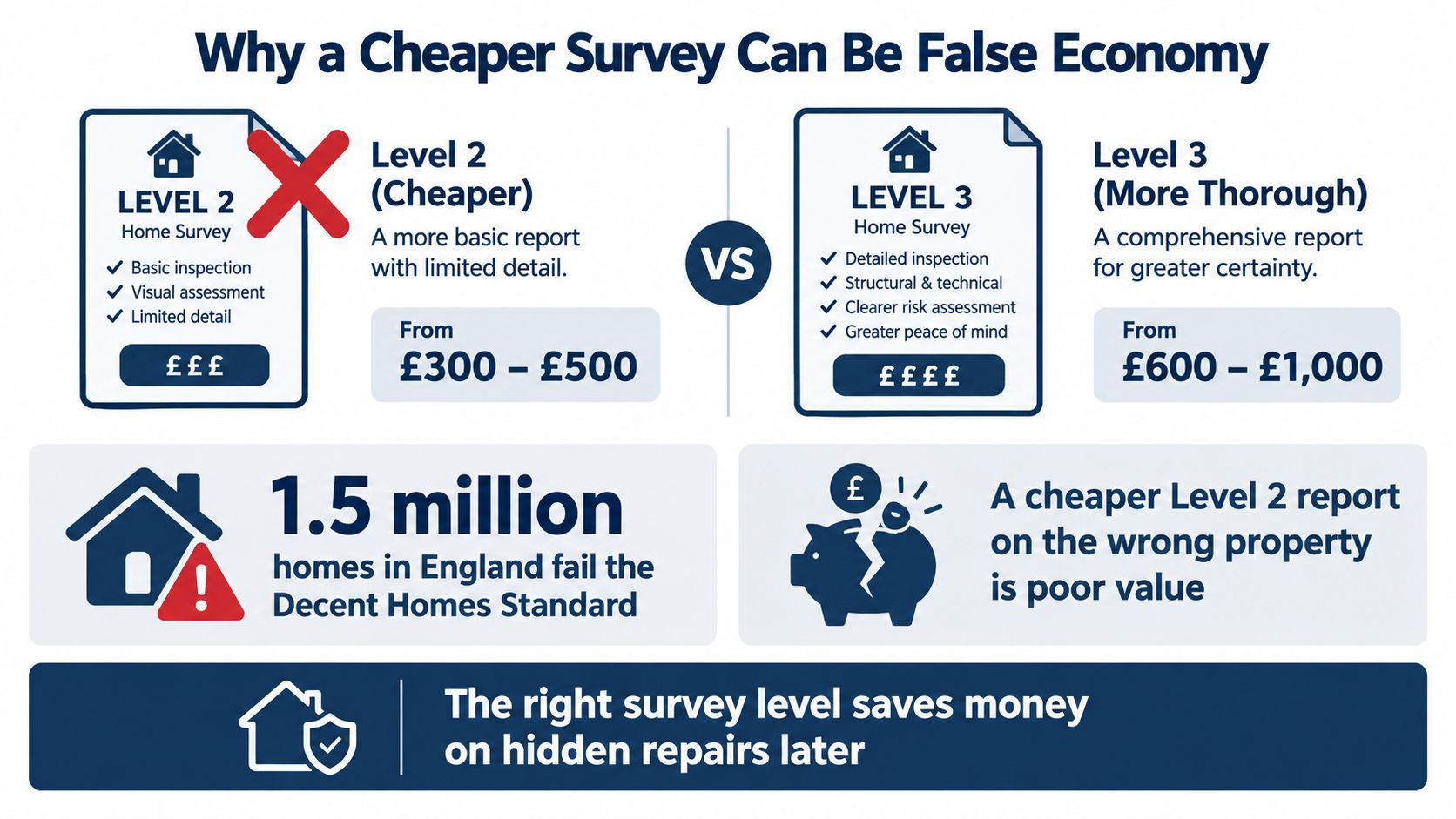
Level 3 is built to get into the mechanism of a defect. That's structural movement, penetrating damp, defective flashing, timber decay and poor alteration work, plus roof and chimney defects that a shorter inspection may only flag in passing.
Understanding the cause changes the decision. A crack from a failed lintel is a repair, while progressive movement is a specialist investigation and possibly a reason to walk away.
Good findings give you options. You can renegotiate with evidence, commission a targeted specialist report or withdraw before you've committed further costs.
The short video below covers how survey findings affect a purchase decision in practice.
So don't compare the survey fee with no fee at all. Compare it with the probability and consequences of concealed defects in the actual house you're buying.
For a sound modern home, Level 2 is often enough. For an older or altered property, paying for Level 3 is the cheaper decision over the life of the purchase.
What the Quote Does Not Cover
A building survey is a visual inspection of accessible parts. It isn't a test of every system in the property and it isn't a guarantee.
Surveyors don't automatically test for asbestos, lift floors to hunt for hidden timber decay or run cameras through underground drains. Electrical installations, invasive damp investigation and planning compliance sit with specialists or with your solicitor.
The checklist below sets out the exclusions buyers most often assume are included.
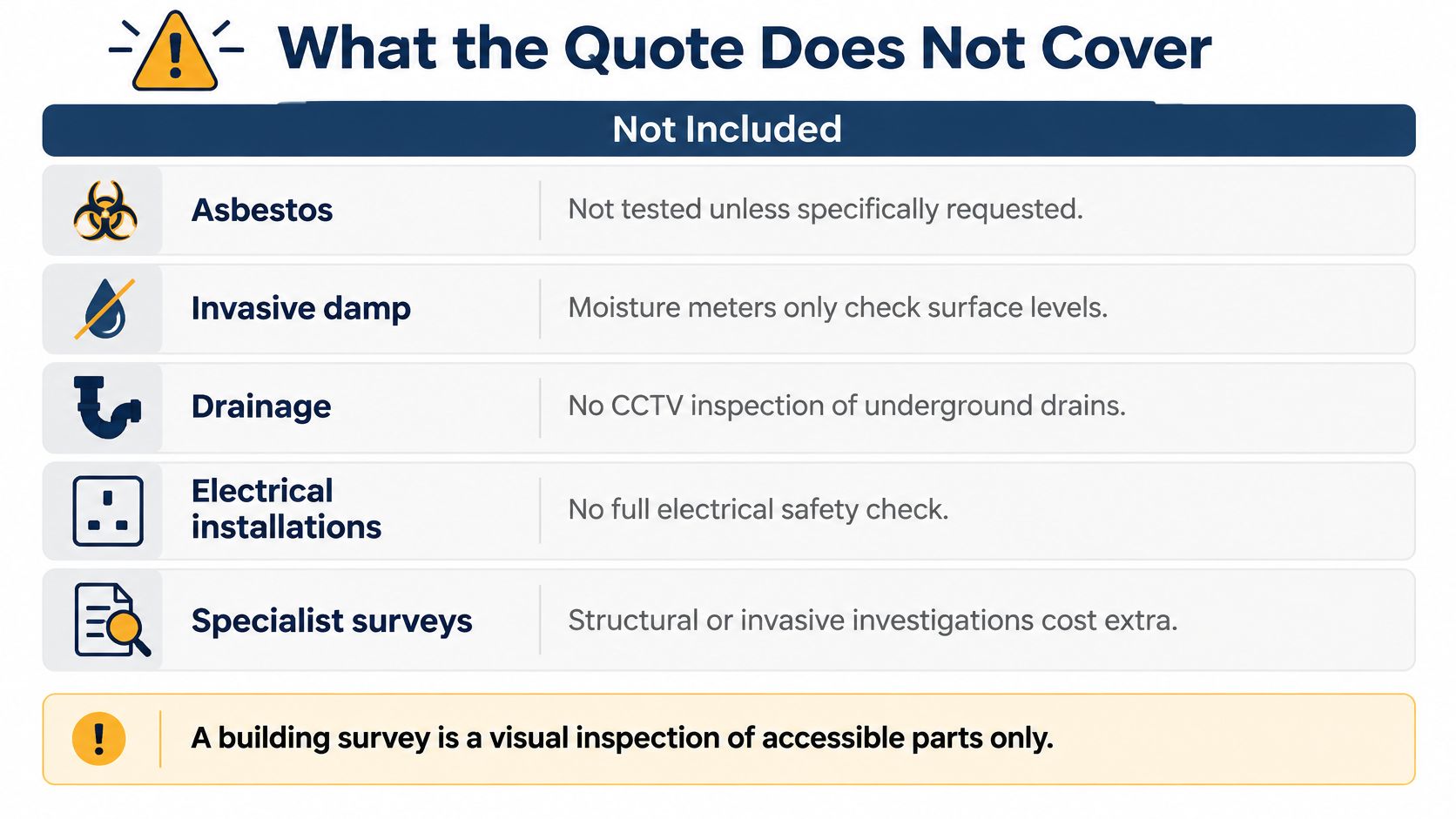
A good Level 3 report tells you where those limits bite. It records what couldn't be seen and recommends further investigation where the evidence points that way. Budget for those follow ups separately, particularly where the report identifies suspected asbestos or drainage defects. This overview of specialist property surveys explains which specialists cover which risks.
Extra Due Diligence for Flats
Leasehold purchases carry a second layer of cost and work. Government housing quality data recording buildings with unsafe cladding recorded 5,190 residential buildings at least 11 metres high with unsafe cladding by the end of June 2025.
Ask whether the inspection covers accessible communal areas, roof spaces, balconies and external elevations. Then budget separately for the lease, service charge history, reserve fund, major works notices and fire safety documentation.
The useful question isn't only what the survey costs. It's what you'll still need to investigate after you've paid for it.
Getting Accurate Quotes You Can Compare
Get written quotes from three independent RICS surveyors and give each one identical information. That means the address, property type, approximate age, number of bedrooms and any specific concerns you want covered.
Then check the same line items on each quote.
- VAT: Confirm whether the fee is inclusive or net.
- Valuation: Ask whether a market valuation is included or charged separately.
- Reinstatement cost: Confirm whether a building reinstatement cost assessment for insurance is part of the fee.
- Turnaround and follow up: Ask when the report will arrive and whether questions afterwards are included.
Keep other transaction costs separate in your budget. HM Land Registry guidance on registration fees and VAT confirms its statutory fees aren't subject to VAT, while local authority searches vary by council, with the London Borough of Barking and Dagenham listing a full residential LLC1 and CON29 search at £245.50 including VAT. Those are conveyancing costs, not survey costs.
When you're researching firms, read what past clients say about report quality and turnaround, and you can browse P page reviews as one starting point for that background check. This guide on how to choose a building surveyor sets out the questions worth asking before you instruct anyone.
Don't expect a surveyor to match a much cheaper quote. The difference is usually scope or reporting time, and cutting either weakens the report you're relying on.
Look for RICS regulation, CABE qualification where relevant and professional indemnity insurance. Corinthian Surveyors London LTD is one independent London example of that model, quoting per property with no ties to lenders, estate agents or developers.
Is a Building Survey Worth It on a New Build
Usually Level 1 or Level 2 is enough for a new build in good order. Choose Level 3 if you're planning major works or you've seen defects that need explaining rather than listing.
Does the Fee Include a Valuation
Not automatically. Level 2 can be bought with or without a valuation and Level 3 quotes vary, so confirm it in writing before you instruct.
How Long Should the Report Take
It depends on size and complexity and on access arrangements. Agree a date at instruction stage rather than assuming a standard turnaround.
Can You Negotiate a Survey Quote
You can ask, but a considered fee reflects inspection time and liability. Reducing the scope to reduce the price is a poor trade on a property that needs detail.
If you'd like a property specific figure rather than a budgeting band, have the address and property details ready and call 0800 00 16 422.
For a written quote based on your property's age, size and construction rather than a generic price list, Corinthian Surveyors London LTD provides RICS Level 3 Building Surveys across London, the Home Counties and the South of England. Send the address and a brief property description and you'll get a clear fee, a defined scope and plain advice on whether Level 3 is the right survey for that home.