
Foundation Movement in London Homes

You're viewing a Victorian terrace in Lewisham and notice a diagonal crack above the front doorway. The vendor calls it historic settlement. Your instinct says otherwise. In Forest Hill, Catford, Peckham and across South East London, that moment needs evidence, not guesswork.
Foundation movement can result from clay shrinkage, tree roots, defective drainage, shallow footings or an old repair. It can also be harmless thermal cracking, loose plaster or historic settlement. The practical question isn't, “How wide is the crack?” It's whether the building is moving now, why it's moving and what evidence supports the conclusion. Cracks in walls of a house need to be read in context.
The right decision pathway is straightforward. Identify the defect, assess the ground and building, record changes over time, investigate the cause and only then discuss repairs. That approach protects a buyer negotiating a purchase, an owner dealing with an insurer and a seller trying to explain a property's history.
Table of Contents
- When a Crack Makes You Stop and Look Twice
- What Foundation Movement Actually Means
- The Main Causes and Risk Factors in London
- How to Read the Signs Around Your Home
- What a Surveyor Actually Checks and Records
- When to Commission a Surveyor or a Specialist
- Repair Options, Costs, and What to Expect
- Prevention, Maintenance, and When to Get Advice
When a Crack Makes You Stop and Look Twice
A crack that appears suddenly feels serious because it changes the way you see the whole house. An owner in Sydenham may notice that a crack is wider after a dry spring. A buyer in Dulwich may see stepped cracking in the brickwork and wonder whether to walk away.
Don't make either decision from one visual symptom. Foundation movement is a diagnosis, not a description. The same crack can result from seasonal clay movement, a leaking drain, thermal expansion, historic settlement or a defect around a window opening.
Practical rule: Record the evidence before you choose the remedy.
Start with photographs taken from the same position. Note the crack's location, direction and width. Check both sides of the wall where possible. Then look outside for nearby trees, changes in ground level, damaged rainwater goods and separation around extensions.
The wider context matters in London. The British Geological Survey identifies shrink–swell as a major British geohazard capable of damaging foundations, pipes and utility services, with an estimated cost to the UK economy of about £3 billion over the past decade. The BGS shrink–swell dataset explains why clay, weather, drainage and vegetation all belong in the assessment.
This article takes you through the decisions in the order I'd discuss them with a client. You'll see what foundation movement means, which signs justify investigation, what a surveyor records and when a structural engineer or geotechnical specialist is appropriate. You'll also see why underpinning shouldn't be the automatic answer.
What Foundation Movement Actually Means
A building sits on ground that can change. Some soils compress under load. Others change volume as their moisture content changes. The most important mechanism for many low-rise properties in the UK is shrink–swell behaviour in clay.
Clay absorbs water and expands during wet conditions. During prolonged dry weather, it loses water and contracts. If the soil beneath one part of a building contracts more than the soil beneath another part, the structure experiences differential movement. That bending can produce cracking.
Uniform movement is often less damaging because the building moves together. Differential movement is the concern because one section may drop, rise or rotate relative to another. A rear extension, bay window, chimney breast or side addition can respond differently from the main house.
Much of London and the wider South East is associated with clay-rich formations. The British Geological Survey's explanation of clay shrink–swell describes how swelling can cause heave, while shrinkage can cause settlement or subsidence. The effect depends on the clay type, its water content and how strongly it changes volume.
The terms are related but not identical:
- Settlement is downward movement of the ground or building. It may be historic, uniform or caused by local conditions.
- Subsidence usually describes downward movement linked to a loss of support beneath foundations. In clay, shrinkage is one possible cause.
- Heave is upward movement, often when clay rewets and expands or when tree removal changes the moisture balance.
- Foundation movement is the wider description. It covers movement affecting the ground and the building's foundations, regardless of the final diagnosis.
That distinction matters when reading a survey. A report identifying movement isn't necessarily saying the house needs underpinning. It should lead to a cause-based investigation.
The Main Causes and Risk Factors in London
Five factors repeatedly deserve attention in London homes: clay-rich soil, vegetation, drainage, foundations and previous movement. None proves a defect alone. Together, they can create a credible explanation for cracking.
Clay, trees and changing moisture
Clay contracts during dry conditions and expands when rewetted. Mature trees and shrubs can intensify the process because their roots draw water from the soil. Tree species matter, but so do height, distance, root influence and whether a tree has recently been removed.
Oak, poplar and willow are examples of trees that can place substantial demand on surrounding moisture. A surveyor should record the species where identifiable, its height, distance from the building and relationship to the affected elevation. The practical guidance on tree root risks for homeowners provides useful background, but a property decision still needs a site-specific assessment.
Removing a large tree isn't automatically safe. The ground can rewet and clay can expand after the water demand disappears. That's why the timing of tree work belongs in the property history.
Drains and foundation depth
A leaking drain can soften local ground or wash fine particles from beneath a footing. The result may be localised loss of support rather than broad clay shrinkage. Look for displaced drain runs, damp ground, staining, repeated blockages and cracking close to inspection chambers.
Foundation depth and consistency also matter. Victorian terraces in Lewisham, Catford and Peckham often have shallower footings than 1930s semis in Bromley or Beckenham. That isn't a defect by itself. It does mean a surveyor should consider how the building responds to nearby trees, later extensions and changes in ground moisture.
Historic movement can leave cracks that no longer progress. Old repairs, repointing, distorted openings and a long-standing uneven floor may reflect a settled condition rather than active subsidence. The task is to separate the building's history from what's happening now.
A property with clay soil, a large nearby tree and defective drainage has three interacting risk factors. That combination justifies more investigation than a single isolated hairline crack.
How to Read the Signs Around Your Home
Start with the crack's pattern, not just its width. A crack following a plaster joint can be cosmetic. A stepped crack through masonry, especially one that changes direction around openings, deserves closer attention.
Hairline cracks under 2 mm in plaster are usually cosmetic, but the figure isn't a diagnosis. Cracks over 5 mm, diagonal cracks through brickwork and cracks that widen over a season should be checked by a suitably qualified professional. These thresholds are useful prompts, not proof of foundation movement.
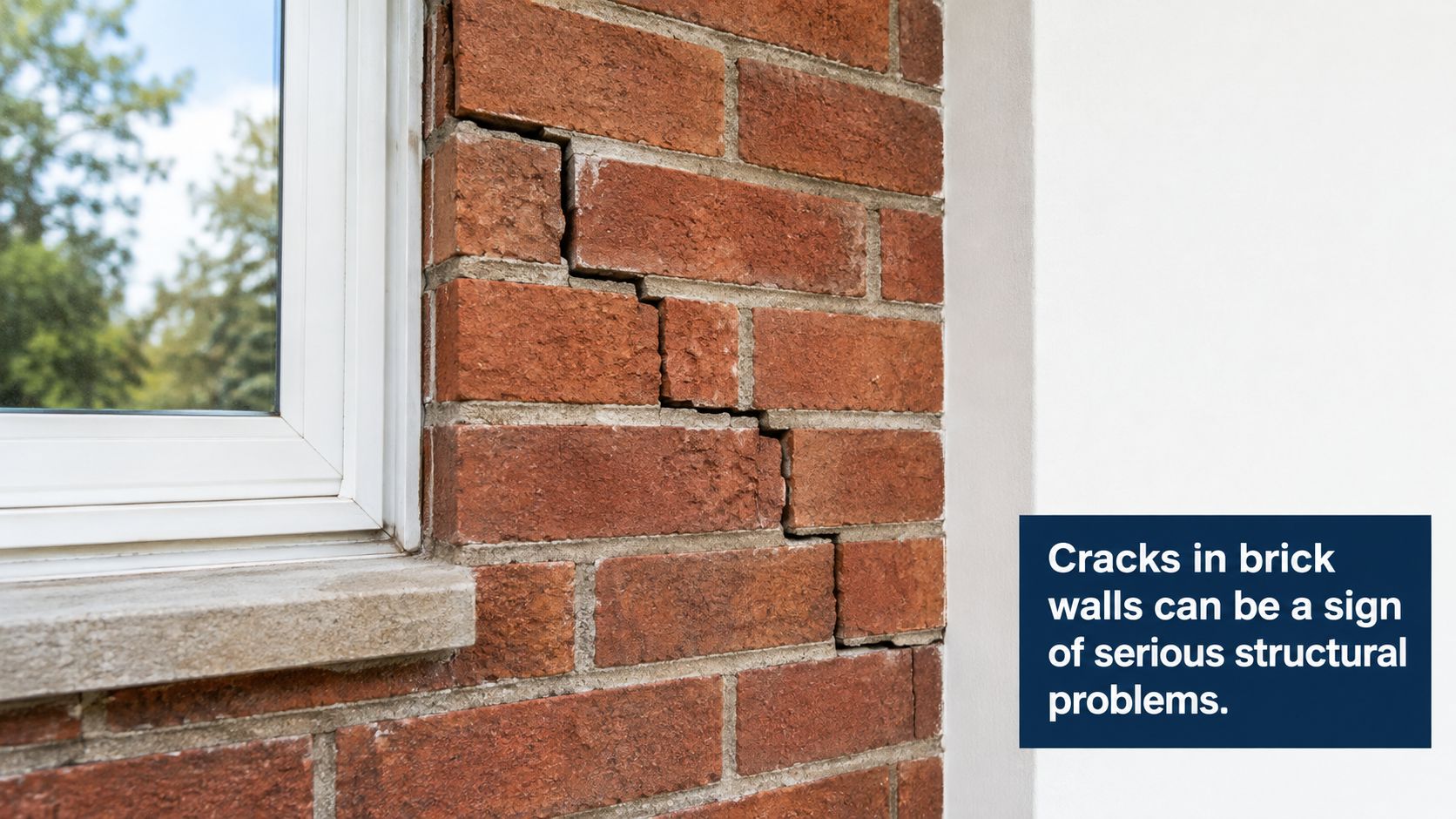
Look at what accompanies the crack. Doors and windows that have started sticking, sloping floors, gaps between skirting and floor coverings, rippling wallpaper at corners and out-of-square openings can show distortion. Outside, check for a leaning chimney stack, separation where an extension meets the original house or a crack that continues through brickwork rather than stopping at the render.
A crack wider at one end can indicate rotation or differential movement, but it still needs context. Thermal movement can open cracks as materials heat and cool. Lath and plaster can move independently from the structure. Historic settlement can leave an obvious pattern that remains stable.
Use photographs and a simple record. Note the date, location, approximate width and whether the crack appears on the internal or external face. If the crack changes, record the change rather than filling it immediately. You can find further practical context in this guide to signs of subsidence inside a house.
The following video may help you recognise common visual patterns, but it can't replace an inspection of the building and its surroundings.
Signs alone don't establish active foundation movement. They tell you whether the next step should be observation, a surveyor's opinion or specialist investigation.
What a Surveyor Actually Checks and Records
A proper inspection begins outside. I want to know how the building sits in relation to trees, drains, neighbouring structures, paving and ground levels. I'll look for water discharge against the wall, blocked gutters, damaged downpipes, changes around extensions and evidence that the ground falls towards the property.
Inside, the surveyor maps the visible evidence. That means recording the crack's position, direction and approximate width, then comparing it with doors, windows, floors, ceilings and the corresponding external elevation. A single diagonal crack means more when it aligns with distortion around an opening or a change in floor level.
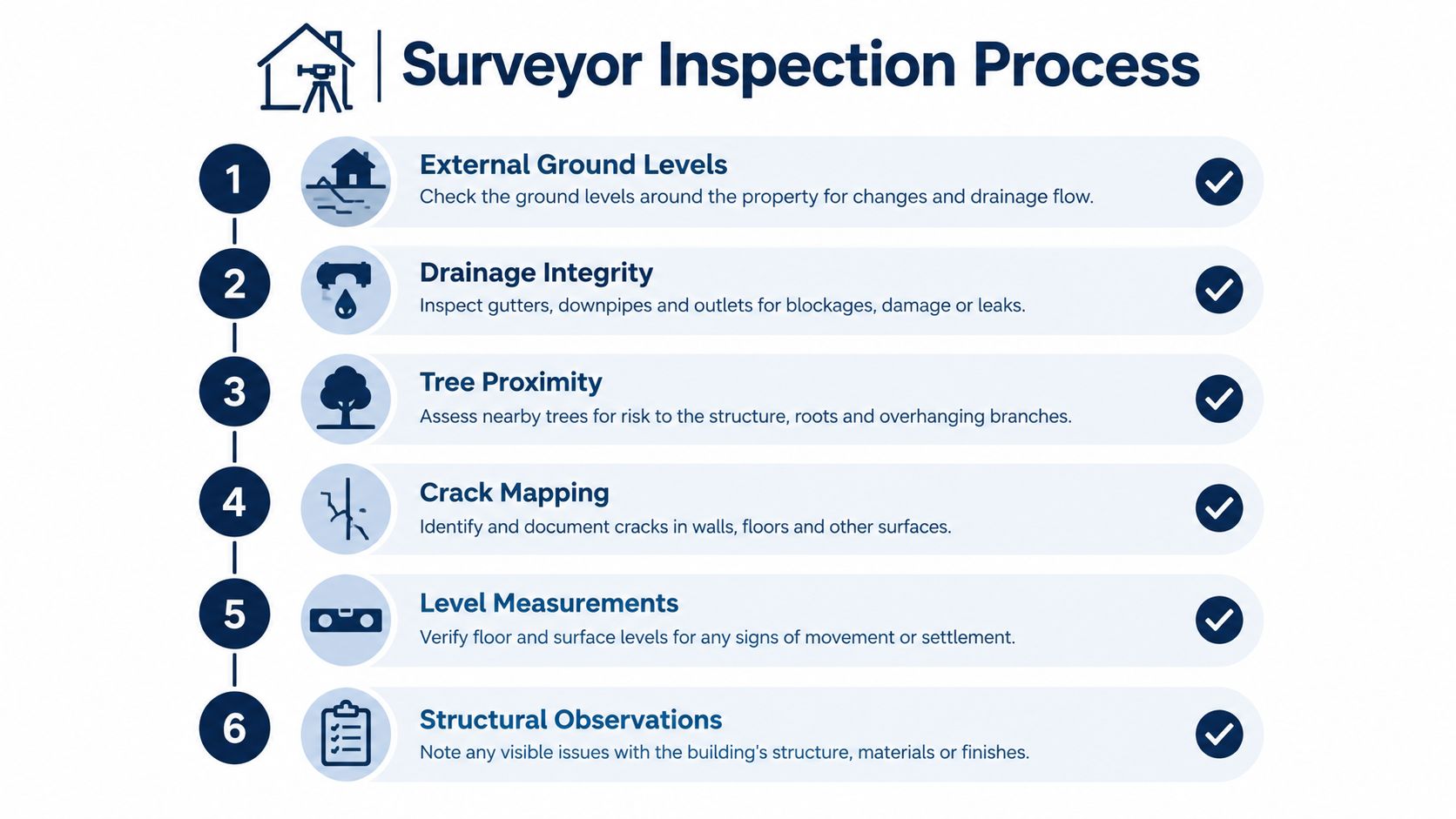
Monitoring is evidence, not delay
One inspection is a snapshot. Clay movement can be seasonal, so a surveyor may recommend crack monitoring where the pattern and site conditions don't establish whether movement is active. RICS-related guidance notes that monitoring may need to continue for 12 months or longer in some cases, particularly where seasonal ground conditions are relevant. Guidance on subsidence investigation describes investigations such as trial holes, drain checks, boreholes and crack monitoring.
Monitoring should be organised. Use fixed reference points and consistent photographs. A crack gauge or tell-tale can provide a clearer record than relying on memory. If measurements show progression, the recommendation changes. If they remain stable, unnecessary structural work may be avoided.
Choosing the entry-point survey
A RICS HomeBuyer Survey at Level 2 can suit a conventional London property where the suspected issue is limited and accessible. A Level 3 RICS Building Survey is more appropriate for older, altered or unusual buildings, including many Victorian terraces, period houses and properties with extensions.
A Level 1 Home Condition Survey is a basic condition check. It rarely provides enough detail to advise on suspected foundation movement. An independent surveyor with no tie to a lender or estate agent can record the evidence for your decision, rather than treating a mortgage valuation as a structural investigation.
When to Commission a Surveyor or a Specialist
Choose the survey level according to the property and the evidence already available. Don't order the cheapest report by habit if the building has visible distortion, a history of underpinning or a tree close to the affected wall.
| Property situation | Recommended starting point | When to add a specialist |
|---|---|---|
| Relatively modern, straightforward home with no visible movement | Level 1 Home Condition Survey may be suitable | Add a surveyor or engineer if defects emerge |
| Standard London purchase with limited concerns | Level 2 RICS HomeBuyer Survey | Add drainage or structural advice where the report identifies risk |
| Older, larger or altered property, including Victorian terraces and period homes | Level 3 RICS Building Survey | Add a structural engineer or geotechnical specialist where cause or extent is uncertain |
| Progressive cracks, distortion or previous underpinning | Level 3 survey and prompt specialist review | Structural engineer, drainage contractor or geotechnical specialist as appropriate |
| Proposed basement, extension or neighbouring excavation | Survey and separate party wall assessment | Structural and party wall advice before works begin |
A structural engineer should become involved where the evidence points to load-bearing distortion, underpinning, piling or a design for remedial works. A geotechnical specialist is more relevant where soil behaviour, bearing capacity or the extent of ground movement remains uncertain.
Escalate promptly if cracks are progressively widening, the property has a recent underpinning history, a significant tree has been removed close to the building or the structure is visibly distorted. Don't let a contractor proposing underpinning become the person who diagnoses the cause and sells the remedy.
Party wall matters can arise where basement works, foundations or excavation on a neighbouring property could affect your building. Corinthian's Party Wall Advice can sit alongside the condition assessment when proposed works involve shared walls or adjoining foundations.
Repair Options, Costs, and What to Expect
Underpinning is not the default response to a crack. If a drain is leaking, repairing the drain may address the cause. If a tree is drawing water from shrinkable clay, sensible arboricultural management may be more appropriate than immediately rebuilding the foundation.
The repair route depends on the evidence. Localised underpinning may support a limited affected area. Mass concrete underpinning can involve sequential excavation beneath the foundation. Piled solutions transfer load deeper into the ground, while resin injection may be considered in specific ground conditions and requires careful assessment.
Each option carries different disruption, design and insurance implications. The cheapest-looking intervention isn't necessarily the safest one. A structural engineer should design significant remedial work, and the insurer should be involved before works begin if a claim may exist.
Domestic subsidence payouts averaged £17,264 per claim in the first half of 2025, according to data reported by the Forum of Insurance Lawyers from Association of British Insurers figures. The FOIL update on subsidence claims also records that nearly 9,000 households received support during that period. That figure is a useful benchmark for the scale of some claims, not a quote for your property.
Keep the process controlled:
- Notify the insurer early: Follow the policy procedure before instructing major remedial work.
- Preserve evidence: Photograph cracks, retain reports and keep records of drainage, tree work and repairs.
- Obtain the diagnosis first: Confirm whether movement is active and identify the mechanism.
- Use the right designer: Structural work needs suitable technical design and building control consideration.
- Check future disclosure: Keep completion documents and guarantees for a future sale.
For general background on concrete foundations and construction methods, Atlanta Concrete Solutions foundations is a useful resource. Its information doesn't replace a UK property-specific diagnosis or advice on a London clay site.
Prevention, Maintenance, and When to Get Advice
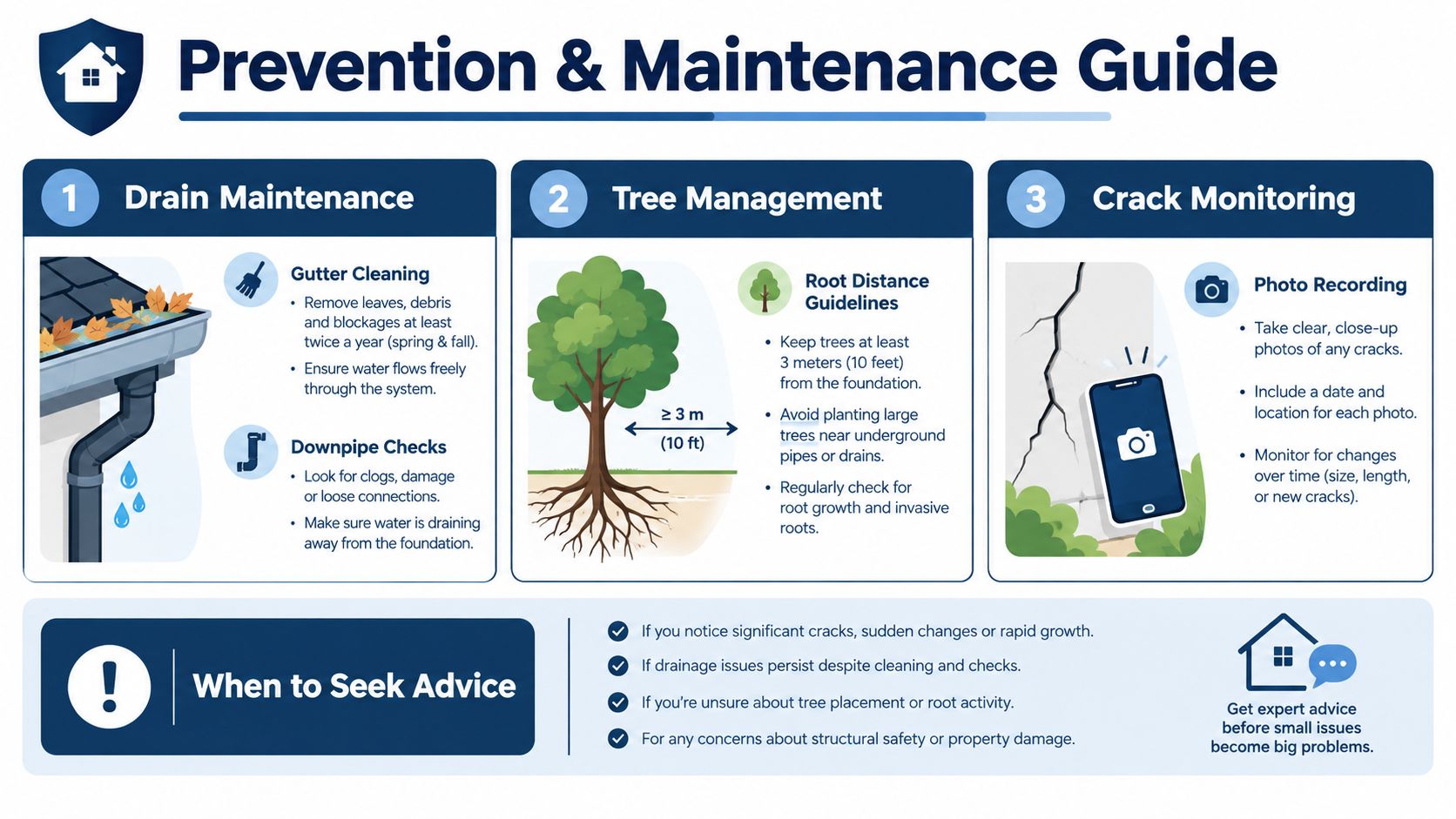
Maintenance won't eliminate foundation movement, but it can remove avoidable triggers. Keep gutters and downpipes clear. Check that rainwater discharges away from the building. Arrange investigation of repeated drain blockages, damp ground or a damaged inspection chamber instead of allowing a leak to continue beneath a footing.
Manage trees sensibly. Don't fell or heavily reduce a mature tree beside a building without understanding the possible soil response. Record significant tree work, because a future surveyor or insurer will need to know what changed and when.
Use a simple monitoring routine:
- Photograph consistently: Take images from the same position with a ruler or scale beside the crack.
- Record dates and conditions: Note dry weather, heavy rain, nearby tree work and repairs.
- Mark the location: Use a sketch or room reference so separate cracks don't become confused.
- Avoid cosmetic repairs too soon: Filling a crack removes useful evidence before the cause is understood.
- Keep the property file: Store surveys, drainage reports, structural calculations, guarantees and insurance correspondence together.
The climate evidence makes proportionate monitoring more important. The British Geological Survey reports that 2025 brought the UK's warmest spring on record and its driest spring for more than 50 years, with domestic subsidence-related insurance claims totalling £307 million in the same year. The BGS report on climate-related subsidence risk supports closer attention to evidence, not panic about every crack.
Questions London homeowners ask
Will insurance cover foundation movement?
Policies vary. Insurers commonly want the cause investigated before agreeing repairs, so notify them promptly if active movement is suspected. Don't commission underpinning or remove a tree first without checking the policy process.
How long should foundation movement be monitored?
The period depends on the evidence and ground conditions. RICS-related guidance notes that monitoring can continue for 12 months or longer where seasonal movement needs to be distinguished from progressive damage. A surveyor should set out what is being measured and what result would change the recommendation.
Can I buy a property with a history of movement?
Yes, but only after establishing whether the movement is historic, repaired and stable. Ask for previous surveys, structural designs, guarantees, insurance details, drainage records and monitoring results. A Level 3 Building Survey is usually the sensible starting point for an older London property with that history.
Corinthian Surveyors London LTD is an independent residential practice based in Forest Hill. Clive Thompson holds RICS and CABE qualifications and has over 30 years' experience in the built environment. The firm has no ties to lenders, estate agents or developers, so its assessment can focus on the property and the evidence. For a suspected defect in Lewisham, Greenwich, Bromley, Southwark or another London borough, call 0800 00 16 422 to discuss the appropriate survey or valuation.
Corinthian Surveyors London LTD can inspect suspected foundation movement through an appropriate RICS HomeBuyer Survey or Level 3 Building Survey, record the evidence clearly and recommend specialist investigation where needed. Visit Corinthian Surveyors London LTD before you commit to a purchase, repair or negotiation.