
How Long Does Survey Take: UK House Timelines 2026
The on-site inspection commonly runs from about 90 minutes for a small flat to a full day for a large or complex house. The written report usually follows in 3 to 10 working days, depending on the survey level.
You may be looking at a Victorian terrace in Catford, a converted flat in Bermondsey or a 1930s semi in Bromley with an offer accepted and a solicitor already asking for dates. The question sounds simple, how long does survey take, but the answer isn't one appointment and one number.
A survey has three stages: booking, the site visit and the report. Access, property size, construction, specialist investigations and the surveyor's reporting workload all affect the clock. For most London buyers, allowing roughly one to three weeks from instruction to usable advice is more realistic than planning around the inspection alone.
Table of Contents
- The Short Answer for UK Buyers
- Survey Types and Their Typical Durations
- A Realistic Timeline From Booking to Report
- What Actually Affects Survey Timing
- When One Survey Becomes Several Reports
- Practical Ways to Speed Things Up
- Planning Your Survey Around the Wider Transaction
The Short Answer for UK Buyers
The first delay is often finding a suitable appointment. In London, the surveyor needs the correct property details, the seller or agent must confirm access and the inspection must fit around the surveyor's existing diary. A survey that could be completed quickly on site may still be several working days away if access isn't ready.
The second stage is the inspection. A straightforward Level 1 survey may take about an hour, while an RICS Level 2 inspection commonly occupies several hours. A Level 3 Building Survey can take most of a day, particularly where the house has extensions, a loft conversion, basements, outbuildings or difficult roof access. HomeOwners Alliance explains the practical differences in inspection times between RICS survey levels.
The final stage is the written report. HomeOwners Alliance says Level 1 and Level 2 reports typically return in 3 to 5 days, while a full structural survey can take up to 10 working days. Some surveyors may take longer, which is why the useful planning figure is measured in working days rather than hours. UK guidance on building survey turnaround also highlights the difference between finishing the inspection and receiving the advice you need to act.
Practical rule: Don't book the survey for the day before an exchange deadline. Leave time to read the report, ask questions and investigate defects.
For a conventional property with good access and no specialist follow-up, the process may move briskly. Older London housing needs more care. The next section sets out what each RICS level involves and how its scope affects the timetable.
Survey Types and Their Typical Durations
The right survey depends on the property, not just the buyer's budget. A short inspection isn't automatically efficient if it fails to examine the defects most likely to affect an older London home.
The broad comparison is:
| Survey type | Typical on-site time | Report turnaround |
|---|---|---|
| RICS Level 1 Home Condition Survey | About 1 to 2 hours | About 3 to 5 working days |
| RICS Level 2 HomeBuyer Survey | About 2 to 4 hours | About 5 to 7 working days |
| RICS Level 3 Building Survey | About 4 to 8 hours, sometimes a full day | About 7 to 10 working days |
| Mortgage valuation | About 30 to 60 minutes | Often about 2 to 5 working days |
A Level 1 Home Condition Survey is intended for a newer or straightforward property. It gives a basic condition overview. It isn't the right tool for a heavily altered Victorian house where you need detailed analysis of movement, roof construction or previous building work. See the RICS Home Condition Survey service for the type of property this level is designed to suit.
A Level 2 HomeBuyer Survey is commonly used for conventional flats and houses in reasonable condition. It covers visible defects such as damp, roof problems, timber decay and signs of structural movement. It won't open up walls or provide a detailed diagnosis of every concealed defect.
A Level 3 Building Survey takes longer because the inspection and report go further. It's generally more suitable for older, larger or altered properties, including period houses in Forest Hill, Sydenham and Dulwich, listed buildings and non-standard construction. A plain-English guide to RICS surveys can help you distinguish the levels before instructing anyone.
A mortgage valuation is separate. The lender wants an opinion on value and basic security. It isn't a proper condition survey and shouldn't be treated as a substitute for one.
A Realistic Timeline From Booking to Report
Take a standard two-bedroom Victorian terrace in South East London. It has no unusual chain complication, but it still needs an organised sequence from instruction to report.
Stage one is booking. You instruct the surveyor, confirm the scope and level, provide the address and arrange access through the estate agent. In London, an appointment may be 3 to 7 working days away, sometimes longer during busy weeks. That is often the first point where a transaction loses time.
Stage two is the site visit. A Level 2 inspection may take roughly 2 to 4 hours. A Level 3 inspection may occupy 4 to 8 hours, depending on the building. The surveyor checks accessible roof areas, loft spaces, walls, floors, damp indicators, services, extensions, boundaries and visible evidence of alterations.
Stage three is reporting. The surveyor reviews photographs and notes, checks relevant information and writes the findings in a form you can use. Allow 5 to 10 working days for the written report where the property or scope requires a detailed assessment.
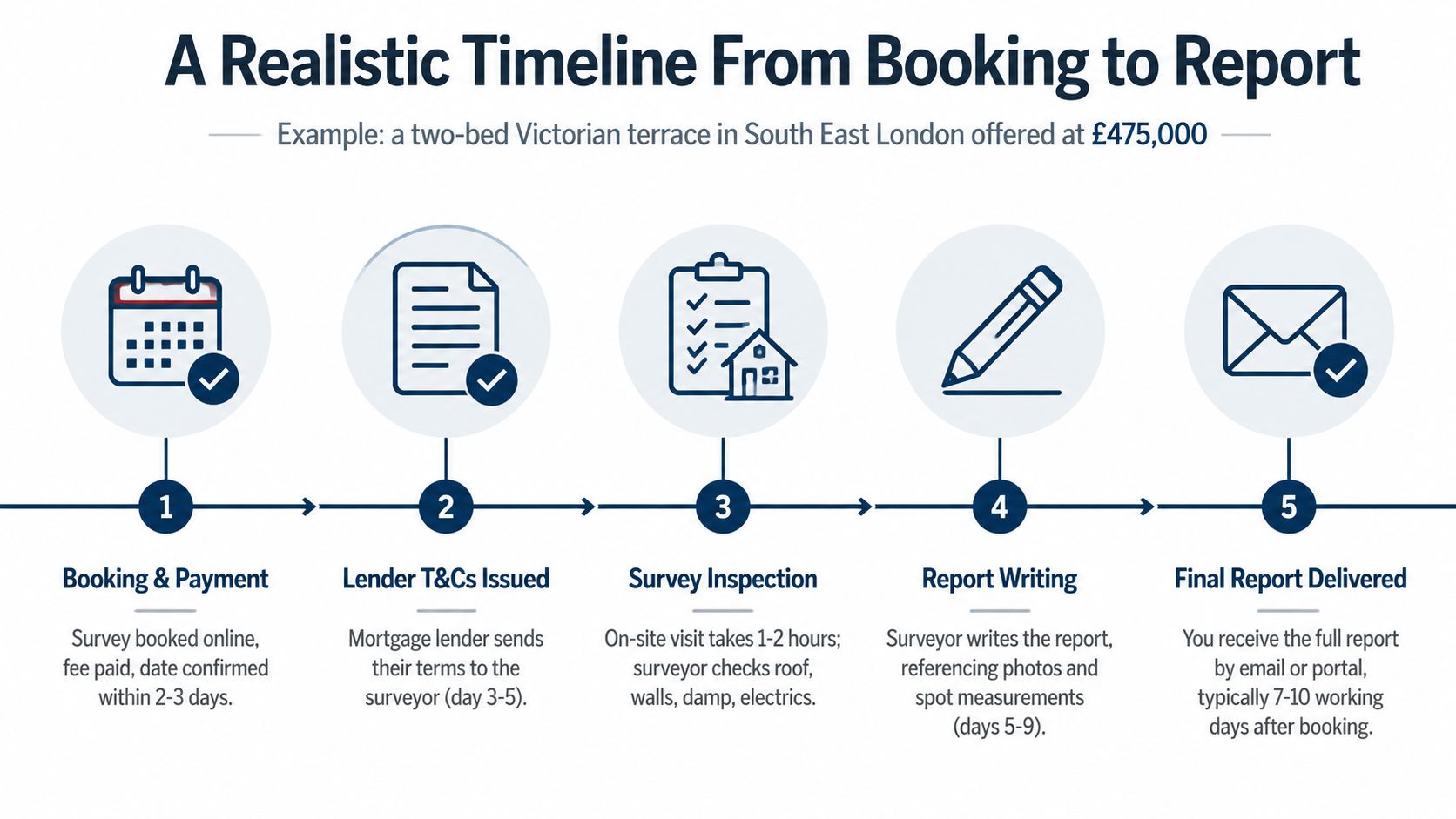
For the example above, the end-to-end period can be roughly 10 to 17 working days, or approximately 2 to 3.5 calendar weeks. The practical delay points are securing the first appointment and dealing with add-ons after the inspection.
The process is similar to other professional work where the visible task is only one part of the delivery time. For useful context on how timelines are shaped by workload, scope and expectations in another professional service, see the Miles Marketing SEO guide on how long SEO takes to work. It isn't a property surveying source, but its distinction between starting work and receiving a meaningful result is relevant here.
For further background on the relationship between inspections and valuations, the Corinthian guide to surveys and valuations is also useful.
What Actually Affects Survey Timing
Property size is the obvious starting point. A small Lewisham studio has fewer rooms, less roof structure and fewer accessible areas to inspect than a large Forest Hill house with a rear extension, loft conversion and detached garden building. RICS says an RICS Home Survey typically takes between two hours and a full day, with very large homes sometimes taking several days because size and complexity change the amount of visible fabric to examine. RICS explains the property factors that affect survey duration.
Age and construction add another layer. A Victorian terrace in Catford may have suspended timber floors, lime mortar, chimney breasts, lath and plaster, later alterations and evidence of movement. A 1990s studio in Lewisham is likely to present a different inspection problem. Neither should be judged by floor area alone.
Access can be just as important. A top-floor warehouse conversion in Bermondsey may involve communal areas, a managing agent, lock-up arrangements and keys held away from the property. A flat in a converted building may require access to a roof void or plant area that the seller cannot open on the day.
Conditions inside and outside the property
Clutter slows a proper inspection. If furniture covers external walls, the boiler, meter cupboards or the loft hatch, the surveyor can only report what is visible and accessible. Bad weather may also restrict roof, chimney and external fabric checks. It doesn't turn a survey into a guess, but it can create limitations or require further inspection.
The report-writing stage is often underestimated. The surveyor must sort photographs, assess defects and decide whether an observation needs further investigation. A busy workload can delay when that work begins, even after the site visit has finished.
Follow-up questions and missing paperwork
A suspected issue can lengthen the process for good reason. Examples include movement cracking, possible Japanese knotweed, a missing Building Regulations certificate or an extension where the available plans don't match the building.
A fast inspection is useful only if the report answers the questions that affect your decision.
If the surveyor needs clarification from the agent or seller, the report may need to record that uncertainty. Chasing an answer can take longer than writing a simple observation, but it gives you a sounder basis for deciding whether to proceed.
When One Survey Becomes Several Reports
A Level 2 survey gives a general view of visible condition. It doesn't replace every specialist investigation. That distinction matters on older London properties, where one defect can lead to several separate instructions.
A damp and timber report may be needed where moisture readings, skirting damage or timber decay require diagnosis. A roof specialist may be needed where the main inspection identifies inaccessible coverings or chimney defects. A CCTV drain survey can examine below-ground drainage that a visual inspection cannot confirm.
Other examples include an asbestos screen in an older property and an electrical test by a qualified electrician. Each specialist may require a separate visit, separate access and a separate report. The main surveyor can identify the need, but shouldn't pretend a general inspection has provided a specialist diagnosis.
| Specialist report | Typical site time | Typical report turnaround |
|---|---|---|
| Damp and timber investigation | Depends on affected areas | Often an additional 1 to 7 days |
| Roof investigation | Depends on roof access and defect | Often an additional 1 to 7 days |
| Drain CCTV survey | Depends on access and drainage layout | Often an additional 1 to 7 days |
| Electrical or other specialist test | Depends on the installation | Often issued separately |
These additional turnaround ranges are identified in UK-facing survey guidance on specialist home survey add-ons. The reports may arrive separately from the main survey, so the decision timeline extends beyond the headline delivery date.
On a complex property, several reports can create a staggered sequence over two or three weeks, rather than one neat handover. That isn't necessarily poor organisation. It reflects different people investigating different building elements.
The quickest sensible approach is to ask the main surveyor what further checks are needed before commissioning several firms independently. Where practical, coordinating the work through one point of contact reduces duplicated access arrangements and gives you a clearer set of findings for negotiations.
Practical Ways to Speed Things Up
You can shorten the timetable without asking for a rushed inspection. Preparation removes avoidable waiting.
Book after acceptance: Instruct the surveyor as soon as the offer is accepted. The diary slot matters more than trying to save a day later.
Send complete details: Provide the full address, agent's contact details, managing agent information and access arrangements in one message. This avoids repeated emails about keys and communal areas.
Prepare the property: Ask the seller to clear the loft hatch, move furniture away from the boiler and meter, and expose external walls where possible. The surveyor can then inspect rather than record an access limitation.
Provide documents early: Previous surveys, extension drawings, planning consents, guarantees for damp or timber work, FENSA certificates and builder invoices may answer questions before they become report delays.
Keep your phone available: The surveyor may need to clarify an alteration or ask about access. Make time on the inspection day for a call.
Ask about early concerns: A verbal indication of significant issues before the surveyor leaves can help you decide which specialist should be instructed next. It doesn't replace the written report.
Choose electronic delivery: Request the final report as a PDF by email or through a secure portal. Postal delivery adds an avoidable handover.
The surveyor's availability still controls the first appointment. Good preparation can't create a slot, but it can prevent a straightforward job becoming an extended exchange of messages. The guide to choosing a building surveyor in London covers questions worth asking before you instruct.
Planning Your Survey Around the Wider Transaction
Survey timing has to fit the purchase, not sit beside it. Tell your solicitor when the inspection is booked and share the report as soon as it arrives. That gives the solicitor time to raise enquiries and gives you a proper opportunity to consider defects before exchange.
A Level 2 survey may fit within a 7 to 14 day transaction window, while a Level 3 survey on a Victorian or pre-1919 property may need 14 to 21 days if specialist checks are included. These are planning windows, not guarantees. Property complexity, access and the availability of specialists can change them.
Keep the sequence clear:
- Instruction: Confirm the survey level and scope as soon as the offer is accepted.
- Inspection: Arrange access to the house, flat, loft, roof spaces and communal areas.
- Specialists: Book damp, timber, roof or drainage investigations immediately if the main survey recommends them.
- Legal work: Send the findings to your solicitor and ask targeted questions about certificates, consents and lease matters.
- Negotiation: Deal with price or remedial requests in one informed conversation where possible.
- Exchange: Don't exchange until you understand the report's material findings and any necessary follow-up.
Mortgage offers often have an expiry period of 6 months, so buyers should keep the wider finance timetable in view rather than treating the survey as an isolated task. The same applies to chain deadlines. A report delivered promptly is of limited use if nobody has allowed time to act on it.
Corinthian Surveyors London LTD is an independent practice based in Forest Hill. Clive Thompson holds RICS and CABE qualifications and has over 30 years' experience in the built environment. An independent RICS surveyor with no ties to lenders, estate agents or developers can discuss early findings by phone where appropriate, while still issuing the formal written report.
Corinthian Surveyors London LTD carries out RICS Level 1, Level 2 and Level 3 surveys for residential buyers across London, including Lewisham, Southwark, Bromley, Greenwich and the wider South East. To discuss the right survey level, access arrangements and any likely specialist follow-up, call 0800 00 16 422 or visit Corinthian Surveyors London LTD before your transaction timetable becomes compressed.