
Value Property London: What Determines Home Worth

London has 3.8 million homes worth an estimated £2.64 trillion, and that makes property valuation here a different job from valuing almost anywhere else in the country. When one city holds 24% of the UK's total residential property value, you don't use broad averages and hope for the best.
That scale is exactly why value property London has to be judged on local evidence, not guesswork. In this market, the street, the station, the flat layout, the borough and the condition all matter, but they don't all matter equally.
Table of Contents
- Introduction What Determines Property Value in London
- Why London Properties Command a Premium
- The Four Valuation Types You Need to Know
- Getting a Professional RICS Valuation
- Understanding Your Valuation Report
- London Location Factors That Move Value
- Improving Your Property's Sale Value
- Why Choose a Local RICS Chartered Surveyor
- FAQ
Introduction What Determines Property Value in London
London value is not just about bedrooms and square footage. Two similar homes can land at very different prices because one has better transport, stronger local amenity, a more desirable borough and a more saleable type of property.
That is the point many owners miss. A flat in Lewisham, a 1930s semi in Bromley and a warehouse conversion in Bermondsey do not sit in the same valuation pool, even if they all look decent on paper.
The right approach is simple. Start with local comparables, then adjust for condition, tenure, layout and the features buyers pay for. National averages are too blunt for London, and estate agent optimism is not a valuation.
Practical rule: if the property can be improved by decorating alone, it probably was never badly valued in the first place. The bigger money is usually in location, access and the type of home you own.
A proper value property London assessment has to respect borough-level differences and the local market cycle. That is why experienced surveyors rely on evidence, not slogans. If you want the figure to stand up in a probate, a separation or a sale, it needs to be defensible from the start.
Why London Properties Command a Premium
London's premium is not a recent trend or a marketing story. It has been baked into the data for years. The official house-price record shows the Greater London average at £160,094 in January 2001, rising to £250,652 by September 2004, then £387,182 in 2014 and £490,495 in 2020 in the Land Registry-linked dataset, while London has consistently sat above the England and Wales average in the same period. The London government's evidence base also says that, since Land Registry records began in 1995, London's average house price has exceeded every other English and Welsh region in each year recorded. See the official UK House Price Index dataset for London for the long-run picture.
That is the context behind every serious valuation conversation in the capital. When London has led the pack for nearly the entire official record, broad UK benchmarks don't cut it.

Why comparables must be local
A London valuation should be built on the immediate area, not the country as a whole. The Greater London market trades at a premium to the rest of England and Wales, so the job is to find sales that match the subject property in borough, type and condition.
That matters because price behaviour changes fast from one district to the next. A family house in one part of south London can be part of a totally different buyer pool from a purpose-built flat in inner London, even if the headline appearance is similar.
The Land Registry methodology is the right benchmark here because it is based on completed sales and adjusted for property type mix and repeat-sales effects, which makes it better for valuation work than asking prices. HM Land Registry explains that the index is designed to measure price change, not just average transaction values, and it is published monthly as the official regional measure for England and Wales, including London. Read the methodology in the official UK House Price Index documentation.
So be direct about it. If you are trying to value property in London, you need borough-level evidence and recent local sales. Anything else is too rough to trust.
The Four Valuation Types You Need to Know
Not every valuation is the same thing, and confusing them causes trouble. A market valuation tells you what a home is worth today in the open market. A mortgage valuation protects the lender, not you. A probate valuation supports inheritance tax reporting. A matrimonial or tax valuation supports legal or HMRC purposes.
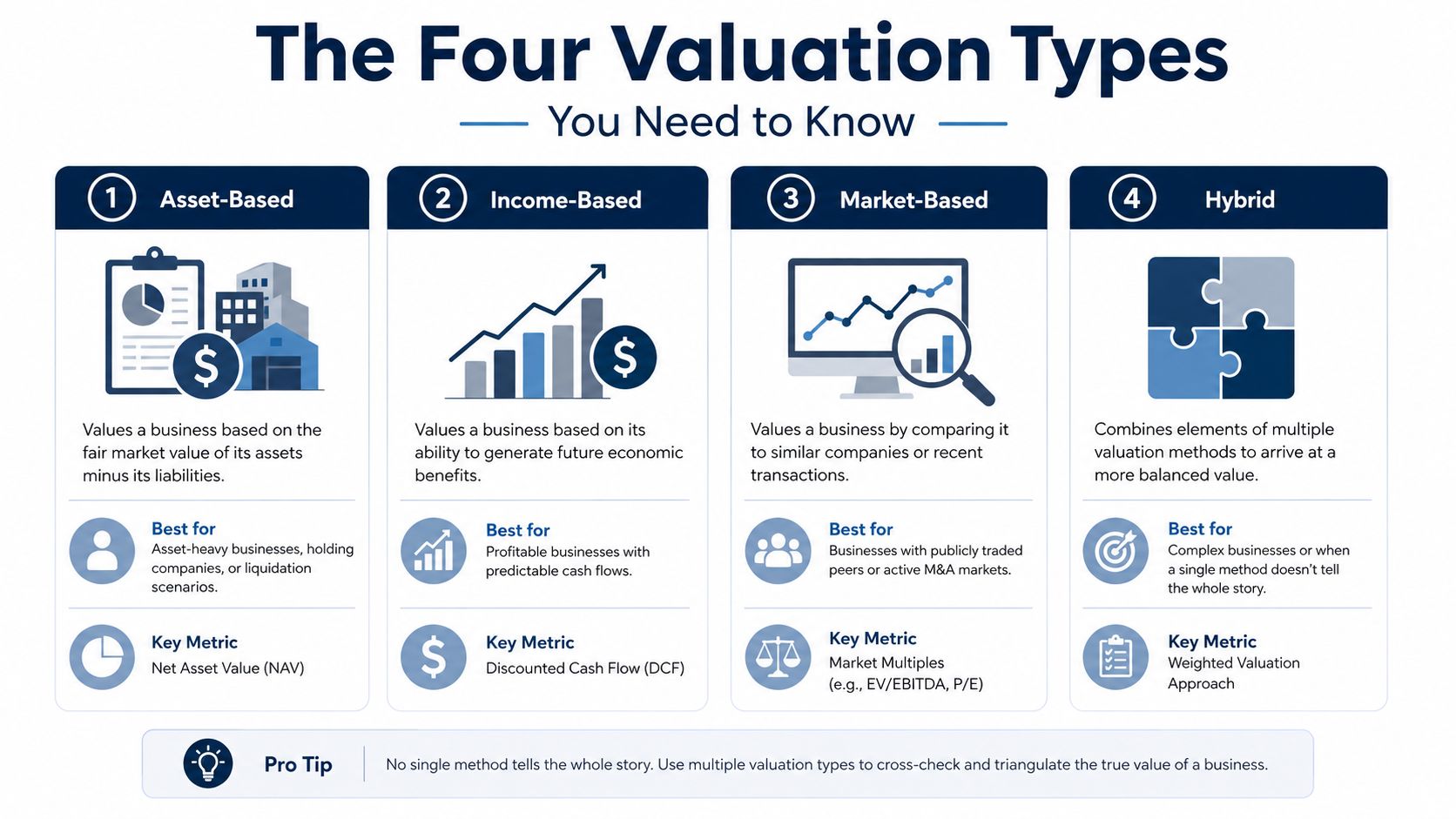
Valuation types compared
| Valuation Type | Purpose | Typical Cost | Who It Serves |
|---|---|---|---|
| Market Valuation | Establishes an opinion of current market value | Varies by property and complexity | Sellers, buyers, executors and solicitors |
| Mortgage Valuation | Assesses lender security | Usually arranged by the lender | The lender |
| Probate Valuation | Supports inheritance tax and estate administration | Varies by property and date required | Executors, beneficiaries and HMRC |
| Matrimonial Separation Valuation | Supports family law proceedings | Varies by instruction | Solicitors, courts and separating parties |
The practical point is simple. If you are selling in Clapham, dealing with probate in Greenwich or sorting a separation in Southwark, you need the right valuation purpose from the outset. A lender's figure won't do the job.
For a straightforward overview of how RICS property valuations are approached in practice, it helps to see the process as evidence-led rather than estimate-led.
What each one actually does
A market valuation is the one most owners want when they need a defensible figure. It can support a sale, a transfer or a legal discussion, and it should be based on comparable evidence and professional judgement.
A mortgage valuation is narrower. It is there to help the lender understand the security, not to give you a full picture of value or condition.
Probate and matrimonial valuations need more care because the figure may be tested later. That is why an independent, RICS-compliant report is the sensible route, especially when the property is unusual, period, leasehold or in a market where local variation is sharp.
Getting a Professional RICS Valuation
A proper valuation starts with instruction and ends with a written report that stands up to scrutiny. The surveyor arranges access, inspects the property, researches nearby comparable sales and then forms an opinion of market value based on the evidence.
A good instruction pack makes the process smoother. Have the title details, lease if there is one, any alteration paperwork, planning consents and recent works information ready before the visit. If there is no paperwork, say so clearly.
A valuation is only as strong as the comparable evidence behind it. If the surveyor has to guess because the local sales data is weak, the figure becomes easier to challenge.
What to expect from a qualified valuer
A RICS Chartered Surveyor will do more than walk round and glance at the decor. They will consider location, tenure, layout, accommodation, condition and the local market context before writing the report.
That is where a firm like Corinthian Surveyors London LTD fits in naturally. The practice is independent, based in Forest Hill and works across London on residential valuations, with RICS and CABE qualifications and no ties to lenders, estate agents or developers. That independence matters when the number may be used in probate, separation or sale negotiations.
If you want a practical guide to fees and scope, read how much a house valuation costs before you instruct. It helps to know whether you need a simple market valuation or something more detailed.
Understanding Your Valuation Report
A valuation report gives you an opinion of market value, not a condition survey. People often expect one document to cover both jobs, but it does not. Treat it as a pricing opinion first and a building health check only if it clearly says so.
A proper valuation report states the figure, the assumptions, the basis of the opinion and any limits on the instruction. It should spell out what was inspected, what was not inspected and what was assumed about tenure, services and legal matters. If that is vague, the report is weaker than it should be.
The report also has to be read against the London market. Official government market-value data says the mean market value of a dwelling in England and Wales was £348,000 on 1 July 2024, with the median at £275,000, and the report states that properties in London were valued higher than those in any other region across all tenures. That is why a generic figure is of little use in the capital. See the 2024 market value survey for the regional finding.
Read the assumptions properly
A flat in Islington and a mansion block in Westminster can be affected by very different assumptions. Lease length, service charge exposure and the condition of the building all change how the figure should be read. Ignore those points and you will misread the report.
Ask the surveyor to explain any assumption you do not understand. If the report depends on a lease being acceptable, or on alterations being satisfactory, you need that stated clearly before you use the figure in negotiations.
For a useful specialist angle, how penthouses are valued shows how top-floor homes can need more careful comparison than standard flats. That is the sort of detail a general estimate usually misses.
Valuation is not a survey
A valuation deals with price. A survey deals with condition. If you need to know about damp, roof failure, movement or timber decay, you need a separate RICS survey such as a Level 2 HomeBuyer Report or a Level 3 Building Survey.
Keep that distinction clear. It avoids arguments later and stops buyers assuming a “good value” property is structurally sound when it may not be.
London Location Factors That Move Value
Location quality beats surface finish. Buyers pay more for access, convenience and neighbourhood strength than they do for fresh paint. Savills found that for homes 20 to 30 minutes from central London, median values rose from £765 per sq ft in a poor quality-of-place area to £1,177 per sq ft in a good one, a 54% uplift. That is a clear sign that transport access and local amenity count more than cosmetic changes. Read the research in Savills' hidden value analysis.
The borough data makes the point even more plainly. In April 2016, average house prices ranged from £1.31 million in Kensington and Chelsea to £272,000 in Barking and Dagenham, with an England average of £220,000. Residential land value per hectare in 2015 ranged from £7.3 million in Havering to £93.3 million in Westminster, according to the London government's evidence base. That spread tells you why a London valuation must be hyperlocal.
| Borough | Average House Price (April 2016) | Residential Land Value per Hectare |
|---|---|---|
| Kensington and Chelsea | £1.31 million | not stated in the cited data |
| Barking and Dagenham | £272,000 | not stated in the cited data |
| Havering | not stated in the cited data | £7.3 million |
| Westminster | not stated in the cited data | £93.3 million |
If you want a broader market comparison framework, the check property value UK guide is useful, but London always needs its own local adjustment.
What really shifts the number
Transport remains one of the big levers. A well-connected flat in Greenwich, Woolwich or Peckham can outpace a prettier but awkwardly placed home elsewhere because buyers value journey times and convenience.
Property type matters too. Flats in boroughs like Southwark or Tower Hamlets may trade on lease terms, building management and specification. A terraced house in Bromley or a semi in Croydon will be judged on different evidence because buyers compare them differently.
For a wider investment perspective, some buyers look at the 2026 guide for STR investors to understand how location and demand shape short-let strategy. That logic is not the same as residential valuation, but the principle is similar, location quality drives value.
Improving Your Property's Sale Value
Buyers in London pay for certainty first. A property that is clean on paper, sound in structure and easy to approve will usually do better than one that only looks smart.
Put your money into the things that reduce doubt. Fix defects, sort the paperwork and deal with anything that gives a cautious buyer or surveyor reason to pause. Damp, roof problems, an unserviced boiler and a messy lease file all drag on price faster than most owners expect.

Spend where buyers notice risk
If a surveyor flags cracked render, poor drainage or altered walls without evidence, deal with that first. Buyers and solicitors react to uncertainty, not just what they can see on the surface.
Presentation still matters, and tidy rooms help a sale feel easier to move forward. Use real estate staging tips if you want the place to show well, but keep the job in proportion. Staging supports value, it does not create it. A smart layout and a calmer first impression help, yet they do not change the borough, the building type or the underlying condition.
Prioritise the unglamorous jobs
- Fix defects first: Deal with damp, leaks, loose tiles, defective gutters and broken fittings before spending on cosmetic work.
- Clear the legal noise: Gather guarantees, planning paperwork, alteration consent and service records so a buyer's solicitor has less to query.
- Make the property readable: Repaint if needed, but do not hide defects. Buyers and surveyors spot that straight away.
- Price from evidence: If the local comparables support a lower figure, accept it early rather than letting the listing go stale.
- Use a survey before you spend: A survey at the right level will show which problems matter and which ones do not. The right report keeps you from wasting money on the wrong repairs.
A property can also look better because the buyer understands what they are looking at. That is why clear information beats cosmetic effort in many London sales.
Timing matters too. If the market is turning against you, extra decoration rarely fixes the core issue. A realistic price, backed by a proper valuation, usually does more for your result than another round of paint and styling.
Why Choose a Local RICS Chartered Surveyor
Choose local knowledge first, then check the credentials. In London, that order matters because the difference between boroughs can be huge, and a surveyor who does not know the local stock will miss things that affect value.
A RICS Chartered Surveyor gives you regulated professional standards, and the RICS Valuers Registration Scheme adds another layer of trust for valuation work. That matters for probate, matrimonial separation and market valuations because the report may be reviewed by solicitors, executors, HMRC or a court.
Independence is not a luxury. If the valuer has no ties to lenders, estate agents or developers, the opinion is easier to trust when money and legal responsibility are on the line.
A local valuer also understands how London stock behaves in practice. A converted Victorian in Lewisham is not a 1930s semi in Bromley, and neither is the same as a flat in a modern block in Southwark. Corinthian Surveyors London LTD works across the capital, the Home Counties and the South of England, and that local residential focus is exactly what this market demands.
If you need a straight answer on value, condition or both, speak to someone who does residential work every day and knows the boroughs properly. Call 0800 00 16 422 and ask for the right valuation or survey for your property.
FAQ
Is a mortgage valuation the same as a RICS valuation?
No. A mortgage valuation is for the lender's security. A RICS market valuation is an independent professional opinion that can be used for sale, probate, matrimonial or tax purposes.
Do I need a survey as well as a valuation?
If you want to know about condition, yes. A valuation gives you a price opinion, but a survey is what flags defects such as damp, roof problems, movement and timber decay.
What type of valuation do I need for probate?
You need a probate valuation that reflects the property's value at the relevant date and is suitable for estate administration and inheritance tax reporting.
Why does London need a local surveyor?
Because the price differences between boroughs, property types and transport locations are too wide for a national template. Local comparables and local judgement make the figure more defensible.
Corinthian Surveyors London LTD handles residential valuations, HomeBuyer Reports, Building Surveys and related advice across London with independent RICS and CABE-qualified judgement. If you need a clear figure for sale, probate or separation, visit Corinthian Surveyors London LTD and instruct a surveyor who knows the capital properly.