
What Is a Party Wall Agreement UK? Essential Guide
You've got the builder lined up, the loft plans are done, and then somebody says, “By the way, you'll need a party wall notice.” That's the moment most homeowners realise this isn't just a building job anymore. In England and Wales, the Party Wall etc. Act 1996 is the legal framework that controls certain works near shared walls, boundaries and excavations, so if your loft conversion, rear extension or basement dig touches a neighbour's interest, you need to deal with it properly before anyone starts breaking out bricks. For a good real-world example of how these projects get tied up with party wall work, the attic conversion at FP Architects Wisteria Road shows the sort of project that often triggers the issue, and the straight practical advice is in our own party wall advice in London.
Table of Contents
- When Most Homeowners First Hear About a Party Wall Agreement
- What a Party Wall Actually Is Under the 1996 Act
- Which Building Works Trigger a Party Wall Agreement
- The Notice Process and What Happens Next
- Surveyors and the Party Wall Award Explained
- Typical Costs and Timelines for London Homeowners
- Common Disputes and How to Avoid Them
- What to Do Next and Where Corinthian Surveyors Can Help
When Most Homeowners First Hear About a Party Wall Agreement
It usually lands on you at the worst possible time. The builder is ready, the architect is happy, and then someone points out that your rear extension in Lewisham, your loft in Bromley or your basement scheme in Southwark affects a neighbour's wall or foundation.
That's when the legal side stops being background noise and becomes part of the build programme.
A party wall agreement in UK practice is not a friendly chat and it's not planning permission. It's the statutory process that sits under the Party Wall etc. Act 1996, and it exists to make sure your neighbour gets notice, has a right to object, and can push the matter into a formal surveyor process if needed. Under the Act, the process is there to manage risk before the first spade goes in, which is exactly why it matters on tight London terraces where one property's work can affect the next one.
If you've only just found this out, don't panic. The job now is to work out three things, what counts as a party wall, when notice is needed, and what happens if the neighbour doesn't sign off. Get those right and the rest becomes routine.
Practical rule: if the work touches a shared wall, a boundary wall or an excavation close to a neighbour, deal with party wall matters before you book the trades.
What a Party Wall Actually Is Under the 1996 Act
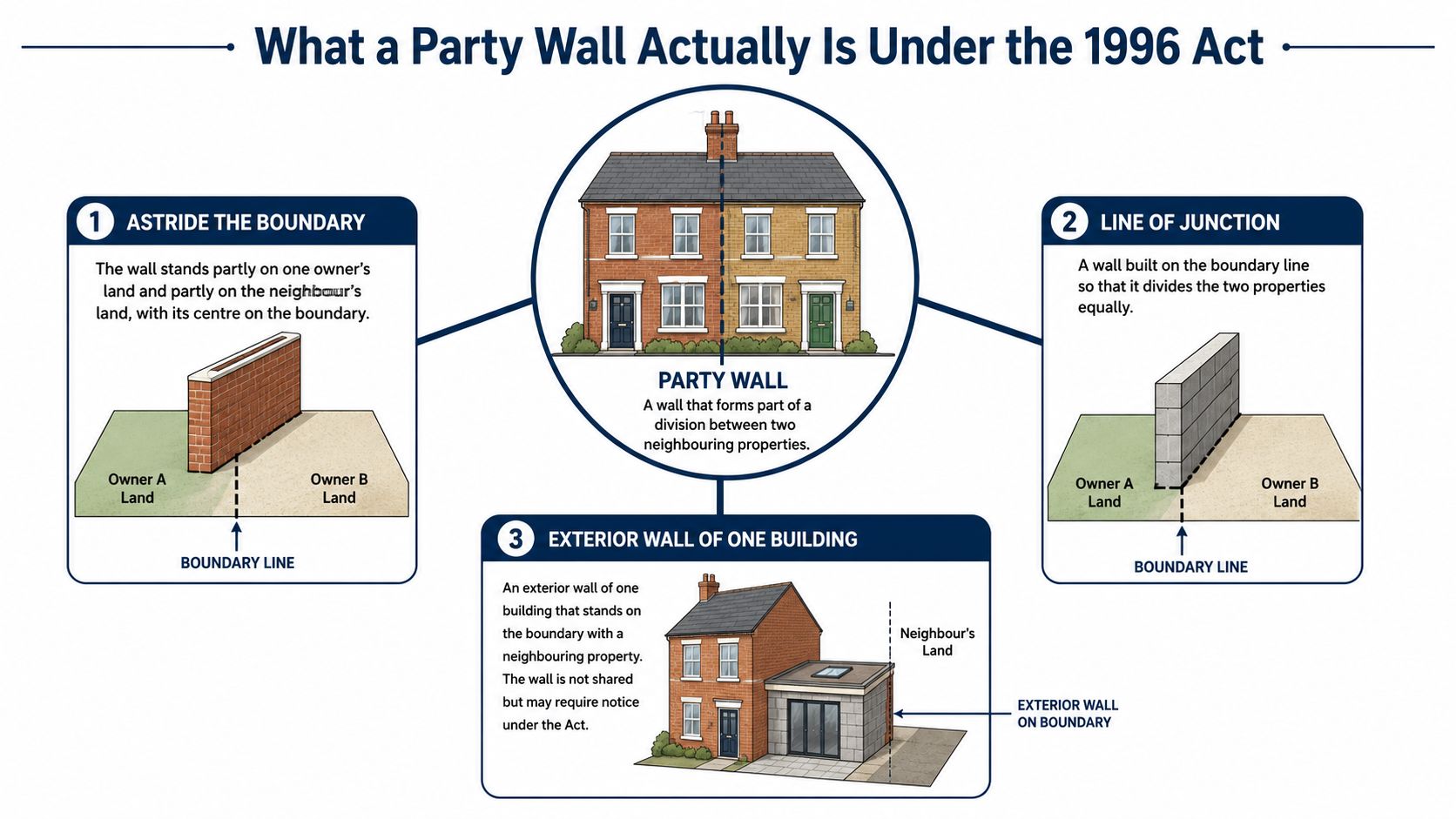
People think of a party wall as the wall between two houses. That's part of it, but the legal definition is wider and more useful than that. Under the Party Wall etc. Act 1996, a party wall is a wall that stands on land belonging to two or more owners, and the Act also covers party structures, boundary walls and excavations near neighbouring buildings in England and Wales. The government's explanatory booklet makes that clear, because the trigger is the legal relationship to the boundary and the work being done, not just whether the wall looks shared on the surface. You can read the official wording in the government's booklet on the Party Wall etc. Act 1996 here.
The boundary seam matters
Think of the boundary line as the seam in a jacket. If the wall sits astride that seam, you're in party wall territory. If the wall is on one side but is used by both owners to separate their buildings, that can still fall within the Act. In practical terms, it's the legal position of the wall and the work planned, not whether there's masonry between you and next door.
What is not covered in the same way
A wooden fence is not treated like a party wall. Neither is every bit of garden boundary kit you can see from the pavement. That distinction matters because too many people overreact and assume any boundary feature needs a formal agreement. It doesn't.
A better plain-English definition is this, a party wall is a wall or structure that the Act treats as shared, or as close enough to a neighbour's building to trigger notice, rights and, if necessary, a formal award. Keep that sentence in mind and you'll avoid most of the common confusion.
Which Building Works Trigger a Party Wall Agreement
The issue becomes practical. The Act doesn't care about every nail or drill hole. It cares about works that affect a party wall, a party structure, a boundary wall or nearby foundations.
A good rule of thumb is simple. If your project involves cutting into shared masonry, building on the line of junction or digging close to a neighbour's building, expect party wall procedure. That is why loft conversions, rear extensions and basement works keep cropping up in the same conversation.
The common triggers
- Cutting into a shared wall: This covers things like inserting steel beams for a loft conversion or opening up a party wall for structural support.
- Excavation near a neighbour's structure: The Act reaches excavations within 3 to 6 metres depending on the relationship between the works and the foundations, which is why basement schemes and some extension footings need notice.
- Building on the boundary line: New walls on the line of junction usually fall within the process.
- Work that affects a party structure: That can include parts of a building that are legally treated as shared, not just the obvious wall between houses.
By contrast, minor internal jobs usually do not need it. Drilling for shelves or fitting kitchen units normally isn't a party wall issue if you're not cutting into the structure. That's the point homeowners should keep in mind, the Act is about structural risk and neighbour rights, not about everyday decorating.
A lot of arguments start because someone assumes “it's only a small job”. If it touches shared structure or foundations, size doesn't save you.
For homeowners in places like Peckham, Forest Hill or Catford, where terraces are tight and older walls can be unforgiving, this matters more than you might realise. You do not want to discover after demolition that your steelwork has triggered a process you should have started weeks earlier.
The Notice Process and What Happens Next
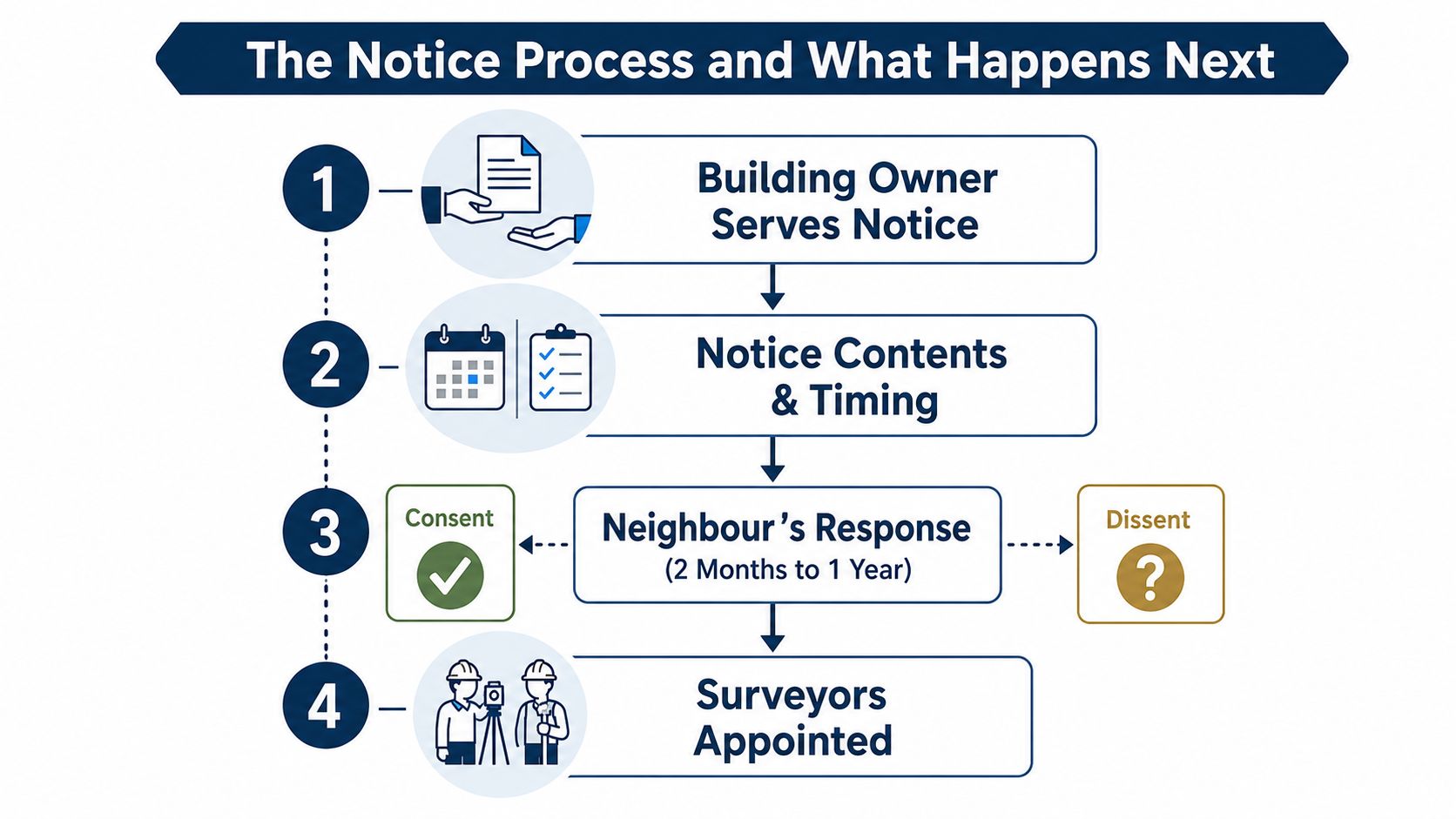
The building owner serves the party wall notice, not the neighbour. It has to go out before work starts, and the timing depends on the type of work. For many schemes, the notice period is two months to one year, with the response window set out in GOV.UK-linked guidance on the notice period and response window. That gives the adjoining owner a proper statutory period to look at the proposal instead of finding out when the scaffold goes up.
The neighbour then has two choices. They can consent in writing, or they can dissent. Under the same guidance, the adjoining owner must respond in writing within 14 days, and a counter-notice must be served within 1 month of the first notice. If they dissent, or do not respond in time, the dispute process starts and surveyors get involved.
What the notice must do
The notice has to say what work is planned, where it will happen, and when the builder intends to start. If the scope changes, the original notice does not magically cover the new works. That is where London projects go off track, the notice was vague, then the builder arrives with something bigger than the neighbour agreed to.
A good notice is specific enough for the adjoining owner to understand the impact on their wall, their structure, and their routine. If you want the practical version of how these notices are put together, our guide to a party wall notice is the one to read before you serve anything.
What happens after dissent
Once there is a dispute, surveyors are appointed. They then prepare a legally binding party wall award that covers the work, access, timing and costs. That is where the financial side starts to matter, because the award is not just about permission, it also sets out who pays for what and whether any extra work benefits the neighbour.
The neighbour-benefits rule is easy to miss. If a counter-notice asks for additional work that the neighbour will benefit from, the cost can fall to the neighbour rather than the building owner. That is why the notice stage matters so much. It frames the scope, and the scope shapes the eventual bill.
On a terrace in Greenwich or a conversion in Camberwell, the right approach is simple. Serve early, be clear, and keep the builder out of the argument. Leave the notice too late, and the programme slips while the neighbour starts thinking you are making it up as you go.
Surveyors and the Party Wall Award Explained
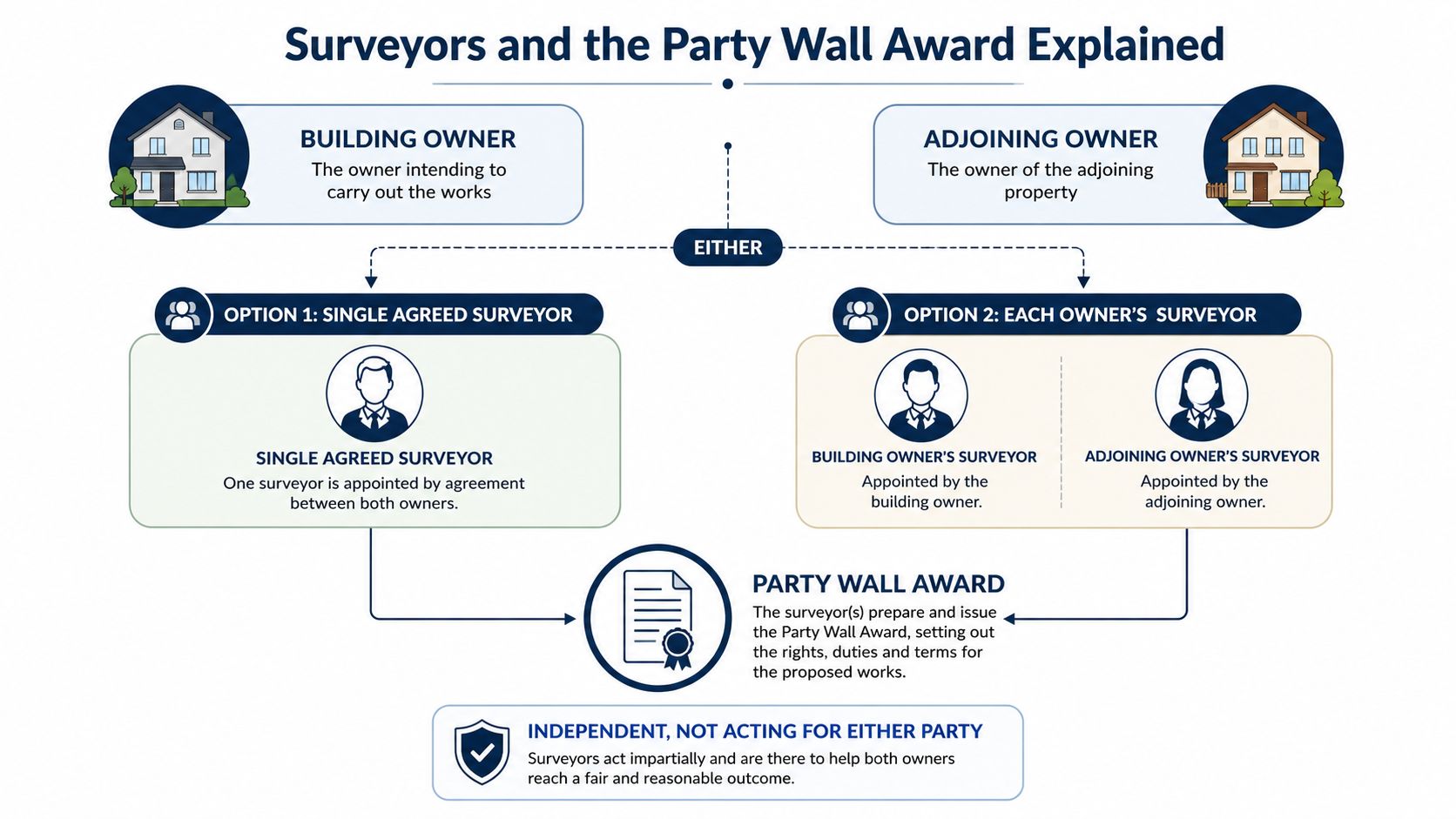
Once the neighbour dissents, the matter moves to surveyors. Each owner can appoint their own surveyor, or both sides can agree on one agreed surveyor. Either route works, but the surveyor is there to apply the Act, not to back the homeowner's side.
The result is the party wall award. GOV.UK says it is a legally binding document issued by appointed surveyors that sets out what work will happen, how and when it will be carried out, and who pays which costs, including surveyors' fees. The same guidance explains that a counter-notice can ask for extra works that the neighbour must pay for if those works benefit them, which is the point many owners miss when they start budgeting. The official guidance on that is here.
What the award usually covers
- The permitted works, so everyone knows exactly what is allowed.
- The method and timing, which helps stop disruptive surprises.
- Access arrangements, if the builders need to come onto adjoining land.
- Protective measures, so damage risk is managed properly.
- Costs and fees, including who pays what.
That is why a proper award matters more than a casual agreement. It fixes the details that cause most arguments later, especially on rear extensions and loft conversions where access, vibration and temporary opening up of walls need to be controlled.
Who pays
The award decides costs, including surveyors' fees. If the neighbour asks for extra works and they benefit from them, they pay for those works. That split is where homeowners get caught out, because they assume every extra item lands on them automatically. It does not.
If you want to understand how that process usually plays out in London, our guide to party wall surveyors in London sets out the practical side clearly. Corinthian Surveyors London LTD handles this sort of residential party wall work in London as an independent, RICS-regulated firm, and that independence matters. No lender tie-ins, no estate agent tie-ins, no developer tie-ins, just the statutory job done properly.
A party wall award can be appealed to the county court, but that should be the last move. In practice, the cleaner route is to get the notice right and keep the draft award tight from the start.
Typical Costs and Timelines for London Homeowners
A plain party wall job in London usually lands around £1,000 in total. Once the matter gets more involved, fees can move into the £700 to £2,000+ per property range, and they can climb above £5,000 if the parties stop agreeing and the surveyors have to spend real time resolving the dispute. London surveyor fees also tend to sit above the national average, so do not treat this as a small admin cost if your extension is already tight on budget.
The timing matters just as much as the fee. You serve the notice, wait for the statutory response period, and then either carry on with consent or move into surveyor appointment and award drafting. If the build needs to start soon, get this sorted before the contractor is booked, because leaving it until after start date turns a paperwork issue into a delay.
| Scenario | Typical cost range | Surveyor setup |
|---|---|---|
| Neighbour consents without dispute | Lower cost end, if any surveyor input is needed | No surveyor, or simple agreed handling |
| Straightforward award | Around £1,000 in total | One agreed surveyor or two surveyors working to a simple award |
| More complex dispute | £700 to £2,000+ per property | Separate surveyors, with costs set in the award |
| Escalated dispute | Above £5,000 | Two surveyors, sometimes with wider disagreement on scope and fees |
A Victorian terrace in Lewisham with a loft conversion usually needs more care than a neat little update in a newer house. A Bromley extension with deeper foundations can bring excavation issues into the picture very quickly. That is why the cost sits on a spectrum rather than in one fixed fee.
Surveyors also look at who gets the benefit. If extra work is only there to help the building owner, the building owner pays. If the neighbour asks for additional works and those works benefit them, they pay for those items. That split catches a lot of London homeowners out, because they assume every extra line on the award falls on them automatically. It does not.
If you want a broader view of how disputes harden once the paperwork goes soft, the analysis at Legitt AI contract dispute insights is a useful read.
Budget for the process early. Leave it out of the numbers and it comes back later as delay, and delay is usually dearer than the surveyor's fee.
Common Disputes and How to Avoid Them
Most party wall disputes are avoidable. They start with sloppy notices, vague drawings or a builder who starts too early and thinks a bit of neighbour goodwill will cover the gap. It won't.
Another common flashpoint is scope creep. The notice covered one thing, the builder wants to do another, and the neighbour quite rightly says the paperwork doesn't match the work. That is when trust falls apart and the surveyors have to clean up a mess that should never have happened.
The usual causes of friction
- Bad notice wording, which leaves the neighbour unsure what is planned.
- Work starting before the deadline, which makes people defensive from day one.
- Changes to the design, which can make the original notice stale.
- Damage or vibration concerns, especially on older Victorian masonry.
- Access disputes, usually when no one agreed the method in advance.
- Cost arguments, which often come down to who benefits from additional works.
The fix is boring, but it works. Serve a proper notice early, keep drawings accurate and make the neighbour part of the conversation before the contractor turns up. If the project is sensitive, use an independent surveyor who has no hidden interest in the outcome.
For anyone who wants a broader read on how disputes harden when the paperwork is weak, the contract dispute overview at Legitt AI contract dispute insights is a useful reminder that bad process always costs more later. The same logic applies here. When the notice is clear and the award is tight, there's less to argue about.
What to Do Next and Where Corinthian Surveyors Can Help

Start with the work, not the paperwork. Check whether the loft conversion, extension or excavation is notifiable, speak to the neighbour early, then get the notice served before anyone starts on site. After that, wait for the statutory response and deal with dissent properly if it comes.
If you want this handled by people who do residential surveying all day, Corinthian Surveyors London LTD is an independent RICS Chartered Surveyors and Valuers practice based in Forest Hill, with CABE qualifications and over 30 years in the built environment. We deal with party wall advice alongside surveys and valuations across Lewisham, Greenwich, Bromley, Southwark and the surrounding boroughs, so the local housing stock and the usual terrace problems are familiar ground.
The point is simple. Get the notice right, keep the neighbour calm and keep the build moving.
Corinthian Surveyors London LTD handles party wall advice, notices, schedules of condition and awards for residential work across London and the South East. If your loft conversion or extension has just crossed into neighbour territory, visit Corinthian Surveyors London LTD and speak to an independent RICS-regulated surveyor who knows the process and the local housing stock.