
Surveyors Near Me: A London Homebuyer’s Guide for 2026
You've had an offer accepted. The estate agent sounds upbeat, the solicitor wants paperwork and you're already thinking about moving vans and paint colours. This is the point where a lot of buyers make a costly mistake. They wait for the mortgage valuation and assume that's enough.
It isn't.
If you're searching for surveyors near me, what you need is a surveyor who can tell you what you're buying, what's wrong with it and what that means for your budget. In London, that matters more than most buyers realise. Parliamentary evidence shows that fewer than 15% of first-time buyers in London commission a full RICS HomeBuyer Report or Building Survey, and the average buyer who skips a survey can face unexpected repair costs of about £5,000 to £10,000 after purchase, according to written evidence submitted to Parliament.
Table of Contents
- Your Offer is Accepted What Happens Next
- The Mortgage Valuation Is Not a Survey
- Choosing the Right RICS Survey for Your London Property
- Key Questions to Ask a Surveyor Before Instructing Them
- Why Local London Expertise Is Required
- From Booking Your Survey to Understanding the Report
- Frequently Asked Questions About Property Surveys
Your Offer is Accepted What Happens Next
Your offer gets accepted on Monday. By Friday, the mortgage application is moving, the solicitor has sent forms, and everyone wants momentum. That is the point where first-time buyers make a mistake. They treat the survey like admin instead of using it to decide whether the property is worth buying.

Instruct your solicitor, then book your survey straight away. Do not wait until the legal work is half done. The survey is often the first clear piece of evidence that tells you whether to proceed, renegotiate, or pull out before you have wasted more time and money.
London properties can look far better than they really are. Fresh paint can hide cracking. Built-in wardrobes can hide damp. A quick viewing will not tell you much about old roof repairs, altered chimney breasts, tired windows, or poor workmanship in a flat conversion. A surveyor who knows your borough will spot the patterns quickly. That is the difference between hiring someone who is merely nearby and hiring someone who understands how homes in Hackney, Southwark, Lewisham, or Bromley tend to go wrong.
Practical rule: Book the survey as soon as the offer is accepted, while you still have room to make decisions.
Buyers who skip a proper survey often end up paying for defects they could have identified before exchange. That is why you should get clear on the difference between a lender's check and a buyer's inspection early. This plain-English guide to a mortgage valuation vs a survey is a good place to start.
What to do in the first few days
- Confirm what you are buying: Flat, terrace, maisonette, period conversion, listed building, or ex-local authority block. Property type affects the level of inspection you need.
- Check the age and history: A newer house and a Victorian conversion do not carry the same risks. Extensions, loft works, and layout changes deserve attention from day one.
- Choose local knowledge over a national booking desk: In London, local expertise is not optional. A surveyor who regularly works in your area is more likely to recognise recurring defects in that patch of housing stock.
- Keep the process organised: Your solicitor, broker, and surveyor need to move together. A practical admin list like the Orange Box first house checklist helps keep everything in order while you focus on the property itself.
Speed helps. Blind speed is expensive.
The Mortgage Valuation Is Not a Survey
This is the misunderstanding that catches buyers out.
A mortgage valuation is for the lender. It tells the bank whether the property is suitable security for the loan. It does not protect you in the way a proper survey does. If the valuation says the property is worth the money, that does not mean the roof is sound, the floors are level or the walls are dry.
A survey is for you. It looks at condition, defects and risk. It gives you evidence you can use before you exchange contracts.
The mortgage company is checking its lending risk. You're checking what you're actually buying.
If you want a plain-English breakdown of that difference, this guide on mortgage valuations and surveyors spells it out well.
What each one is for
| Report | Who it protects | Main purpose | What it won't do |
|---|---|---|---|
| Mortgage valuation | The lender | Confirms the property is broadly worth the loan amount | It won't give you a proper condition assessment |
| RICS survey | The buyer | Identifies defects, risks and likely repair issues | It isn't legal advice or a mortgage product |
In London, this matters because the housing stock is messy. A lender may be content to lend on a Victorian terrace in Catford, but that doesn't tell you if there's historic movement, timber decay in the sub-floor or poor workmanship from an old rear extension. The valuation isn't designed to answer those questions.
What buyers should stop assuming
- “The bank has checked it.” The bank has checked enough for the bank.
- “It looked fine when I viewed it.” Sellers tidy houses for viewings. Defects don't announce themselves.
- “The estate agent said it's in good condition.” The estate agent isn't your surveyor.
RICS guidance also makes clear that survey types have different purposes. A RICS Homebuyer Survey Level 2 is for conventional properties in reasonable condition and can identify issues such as damp, while a RICS Building Survey Level 3 is for older or unusual properties and provides a deeper analysis with repair advice, as described in this overview of RICS survey types.
Choosing the Right RICS Survey for Your London Property
The right survey depends on the building, not on how optimistic you feel about it.
If you're buying a straightforward modern flat in Stratford, you don't need the same report as someone buying a converted Victorian flat in Southwark with cracking above the bay window. Search results for surveyors near me rarely explain that properly. They should.
For a useful background read, this article on what a RICS survey is is worth a look before you instruct anyone.
A simple way to choose
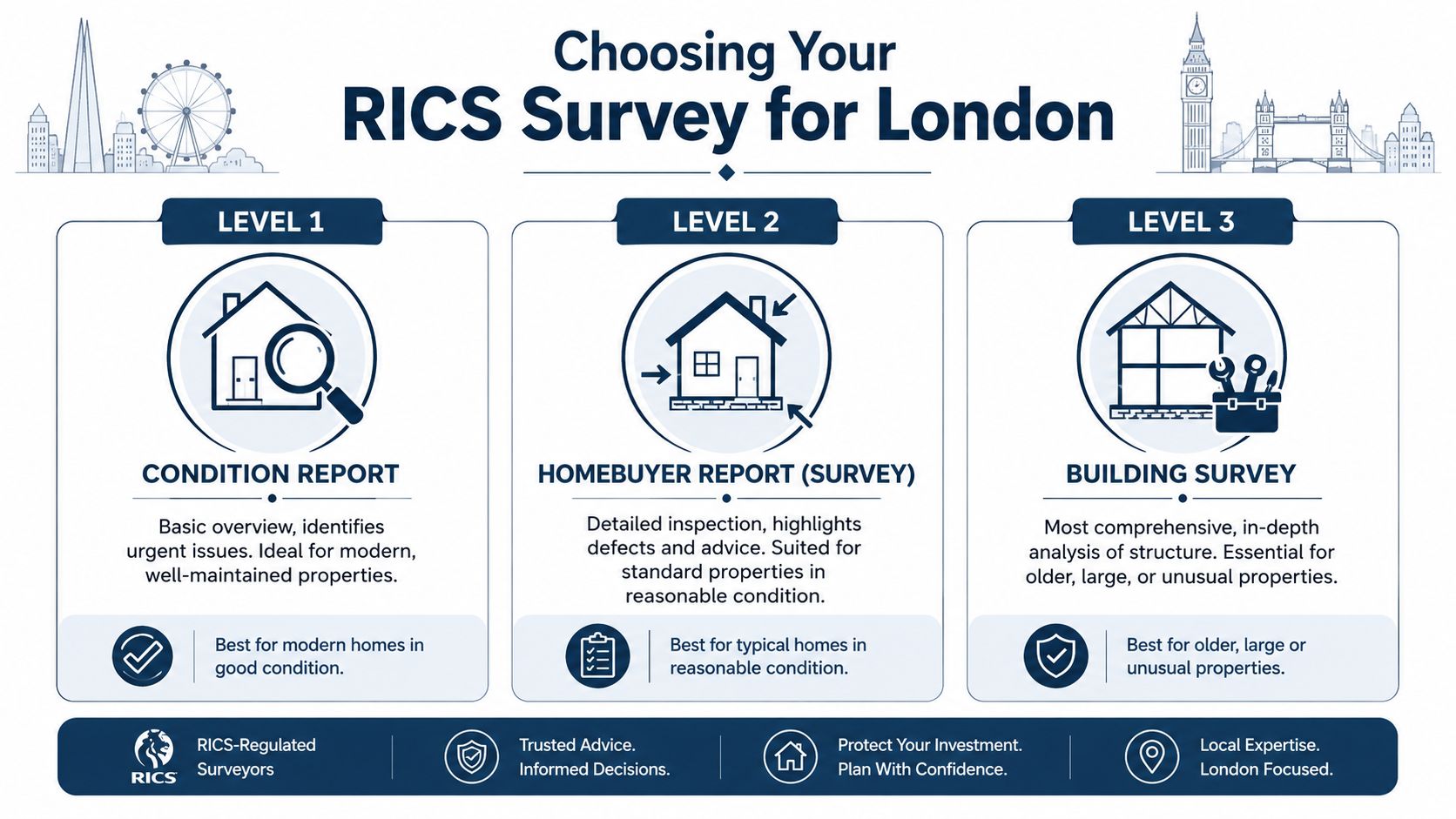
Level 1, Home Condition Survey
This is the most basic option. It suits a fairly modern, apparently well-maintained property where you want an overview of condition rather than a deep investigation. Think newer flats or houses with no obvious warning signs.
Level 2, HomeBuyer Survey
This is usually the sensible choice for a standard property in reasonable condition. RICS Homebuyer Surveys are designed for conventional properties and can identify issues such as damp, with some reports also including a valuation, as explained in this summary of Level 2 and Level 3 surveys. A 1990s terrace in Bromley or a 2000s flat in Greenwich often fits here, assuming there's nothing unusual about the structure.
Level 3, Building Survey
This is the one for older, altered or unusual buildings. RICS Building Surveys provide an in-depth assessment of structural condition and defects, with recommendations for repairs and maintenance. If you're buying a Victorian terrace in Lewisham, an Edwardian house in Dulwich, a period conversion in Camberwell or anything with visible cracking, damp staining, roof spread or signs of poor alterations, this is the right call.
Quick comparison
| Survey type | Best suited to | Typical London example | Main strength |
|---|---|---|---|
| Level 1 | Modern homes with no obvious issues | New-build flat in Stratford | Basic condition overview |
| Level 2 | Conventional homes in reasonable condition | Standard terrace in Bromley | Clear defects report, often with valuation |
| Level 3 | Older, altered or unusual homes | Victorian conversion in Southwark | Detailed analysis and repair advice |
When to upgrade to Level 3
Go up a level if any of these apply:
- The building is old: Period properties often hide historic alterations and ageing materials.
- The construction is unusual: Converted buildings, non-standard construction and heavily extended homes need more scrutiny.
- You've seen warning signs: Cracks, damp marks, sloping floors, roof issues or a musty smell are enough reason.
- The flat sits in a conversion: Shared structures create complications that a lighter report may not explore fully.
If the property is old, altered or odd, don't try to save money by ordering the lighter survey.
Key Questions to Ask a Surveyor Before Instructing Them
A decent surveyor won't be irritated by sensible questions. If anything, they should welcome them. You're trusting them with one of the biggest decisions you'll make.
Ask about qualifications and independence
Start with the basics.
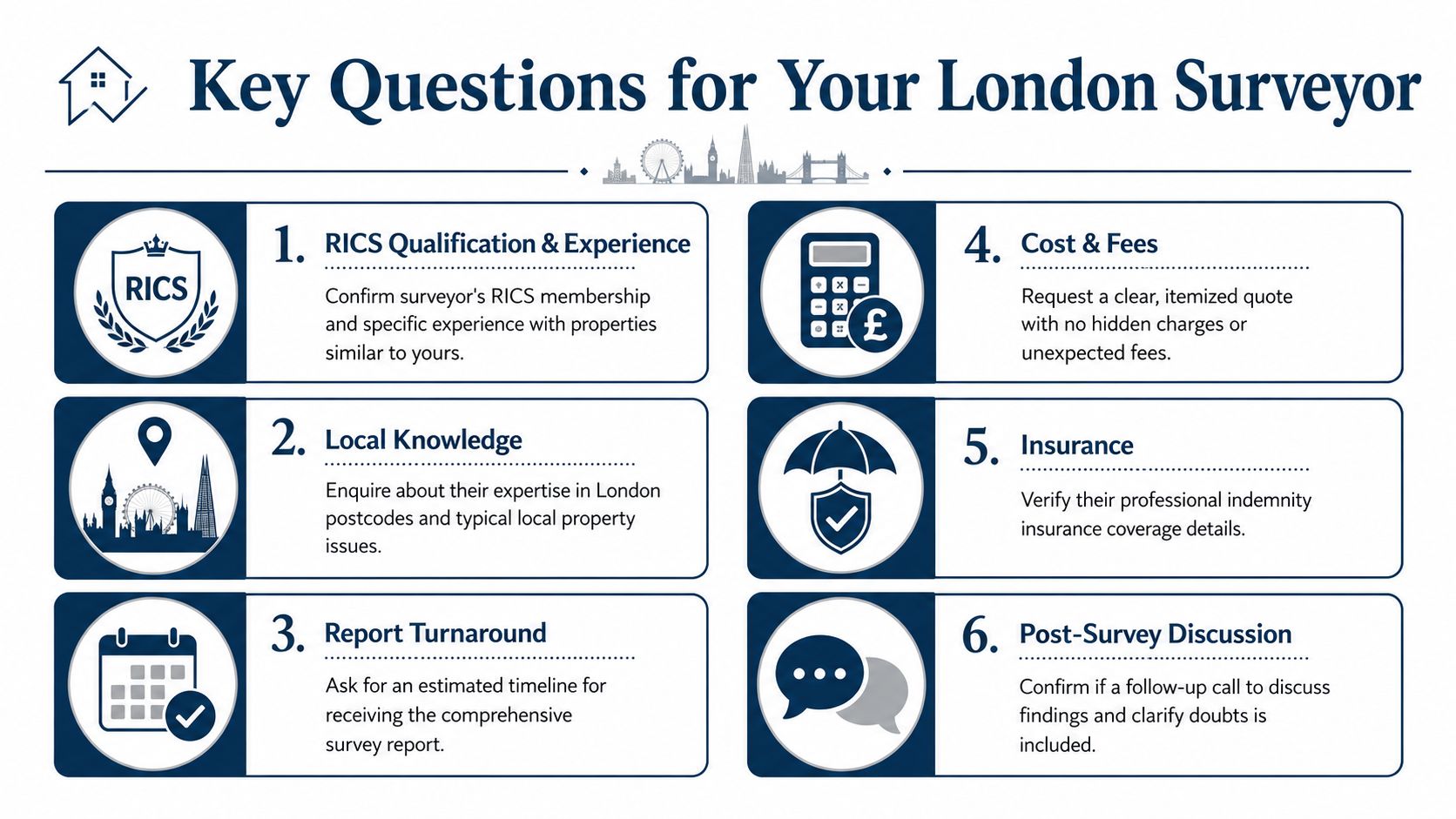
- Are you RICS regulated? That tells you the firm works within recognised professional standards.
- Do you hold relevant qualifications beyond that? CABE is a useful trust signal where building knowledge matters.
- Are you independent? You want a surveyor with no ties to lenders, estate agents or developers.
A good answer is clear and direct. If the reply sounds vague, move on.
One firm example in London is Corinthian Surveyors London Ltd, which states that it is regulated by RICS, is a member of the RICS Valuers Registration Scheme and is insured by Royal Sun Alliance.
Ask how they handle the report
The next questions are about usefulness, not branding.
- What survey type are you recommending, and why? If they can't justify the choice by reference to the building, that's a problem.
- Will the report explain defects plainly? You need plain English, not a page of caveats.
- Can I speak to you after I've read it? A report without a follow-up conversation leaves many buyers stuck.
A report is only useful if you understand what matters now, what can wait and what might affect the price.
Ask about local experience
At this stage, weak firms get exposed.
Ask what they know about the area and the type of stock. A good surveyor should be able to talk sensibly about Victorian terraces in Brockley, 1930s semis in Croydon, ex-local authority flats in Woolwich or warehouse conversions in Bermondsey. They should also recognise common local issues such as damp in lower-ground spaces, movement in older bay-fronted houses or poor workmanship from past loft conversions.
Ask about practicalities
Keep this part simple.
- When can you inspect the property
- When will I get the report
- What does the fee include
- Are you professionally insured
If the answers are muddy, the report may be too.
Why Local London Expertise Is Required
Your offer gets accepted on a flat in Deptford or a terrace in Brockley. The photos look fine, the mortgage is in hand, and the estate agent wants everything moving quickly. This is the point where buyers lose money by picking a surveyor based on postcode distance instead of borough knowledge.
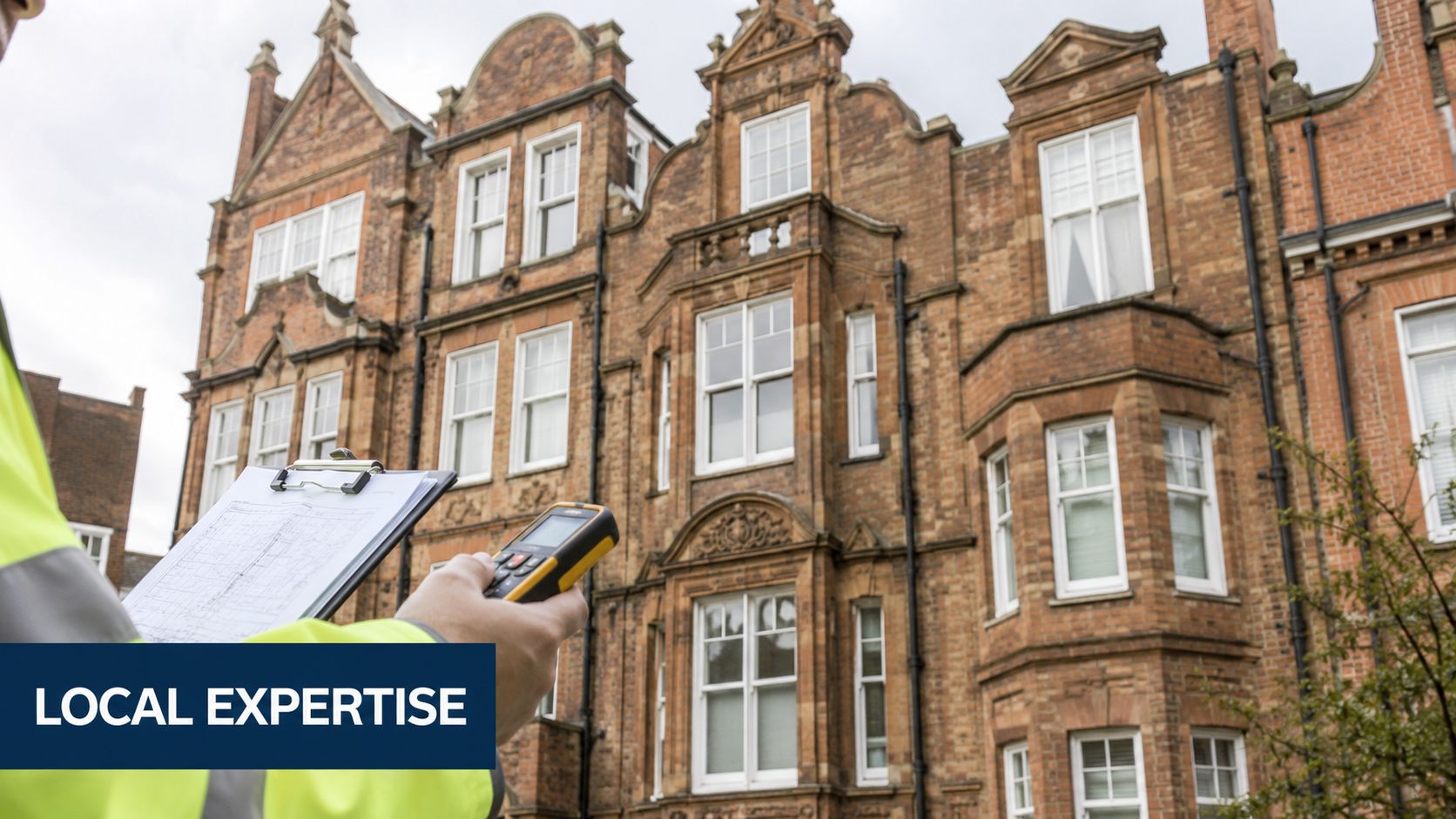
London is not one neat market. It is thousands of streets with different building periods, planning histories, soil conditions and standards of past workmanship. A surveyor who knows South East London will inspect a Victorian house in Forest Hill differently from a new-build flat in Nine Elms or a converted maisonette in Greenwich. That difference shows up in the report. Beyond the report, it shows up in the repairs you avoid or the price you renegotiate.
Borough knowledge changes the quality of the advice
A good London surveyor does more than spot defects. They understand which defects are common in that part of London, which ones are serious, and which ones are often the result of poor alterations.
In Lewisham and Brockley, older terraces often hide years of piecemeal work. Removed chimney breasts, cut roof timbers, patched rear additions and tired suspended timber floors are all worth close attention.
In Bromley and Beckenham, 1930s houses bring different risks. Bay roofs, cavity wall issues, later side extensions and ageing roof coverings need someone who has seen the same pattern many times before.
In Greenwich and Deptford, converted flats and riverside locations need a different approach again. You may be dealing with unclear repair responsibilities, moisture problems, poor sound separation, or communal maintenance that has been ignored for years.
That is why a generic tick-box report is not good enough.
For a fuller comparison, read this guide on local surveyors versus national firms for London buyers.
Nearby is not the same as relevant
Typing surveyors near me is a starting point, nothing more. The right surveyor is the one who knows the stock in your borough and can explain the risks in plain English.
National firms can produce decent reports, but they often work at volume and rely on broad processes. That approach misses the point in London. A crack in a bay wall means one thing in a well-known terrace street with a history of movement and something else in a modern block with recent structural alteration. Local context matters because it changes the advice you act on.
If you are comparing firms across boroughs, a broad directory such as London service areas can help you check who covers what. Then go a step further. Ask who will inspect the property, how often they survey that type of building, and whether they know the common defects in that area.
A short explainer helps here:
Local knowledge saves buyers from bland reports and expensive surprises. In London, that is the difference that matters.
From Booking Your Survey to Understanding the Report
Once you've chosen the survey type, the process is straightforward. The value comes from knowing what to do with the findings.
What the process usually looks like
First, you ask for a quote and confirm the property address, type and age. Then the surveyor books the inspection with the estate agent or seller. After the inspection, you receive the written report and review the key issues before deciding your next move.
If you're buying an older or altered property, a Building Survey usually gives you the clearest basis for decision-making. Under the RICS Home Survey Standard, Level 3 reports use a traffic-light risk rating, and audits show 94% of these reports in London include estimated repair costs. Those reports have been shown to influence purchase price negotiations by an average of 2.8% in high-value areas such as South East London, according to RICS profession standards guidance.
How to read the traffic light ratings
| Rating | Meaning | What you should do |
|---|---|---|
| Green | No immediate action needed | Keep it in mind for routine maintenance |
| Yellow | Repairs or attention advised | Budget for works and ask follow-up questions |
| Red | Urgent or serious issue | Get advice fast and consider renegotiation |
Don't read the report like an exam paper. Read it like a decision document.
Look for three things:
- What needs urgent attention
- What will cost money soon
- What affects the value or your willingness to proceed
If the report identifies major defects, speak to your solicitor and go back to the agent with evidence. If the issues are manageable, use the report to plan repairs properly rather than drifting into ownership with no idea what's coming.
If you want to talk through the likely survey choice before you instruct, call 0800 00 16 422 and have the property details ready.
Frequently Asked Questions About Property Surveys
Can I attend the survey
Usually, the inspection itself is done more efficiently without the buyer following the surveyor around. What matters is having a proper conversation afterwards so you understand the findings.
What if the survey finds major problems
You've then got useful information at the right time. You can renegotiate, ask for specialist reports or decide not to proceed. That's far better than finding the problem after completion.
Do I need a Building Survey for a flat
Sometimes yes. A flat in a modern purpose-built block may suit a lighter survey. A flat in a Victorian or Edwardian conversion often justifies a Level 3 because the wider building fabric matters.
How quickly should I book after my offer is accepted
As soon as the sale is agreed and the memorandum of sale is out. Delay helps nobody and can leave you paying legal fees before you understand the property condition.
If you want independent advice on a London property, Corinthian Surveyors London LTD is an independent firm of RICS Chartered Surveyors and Valuers based in Forest Hill, run by Clive Thompson, who holds RICS and CABE qualifications and has over 30 years of experience in the built environment. The firm covers London, the Home Counties and the South of England, with residential services including Level 2 HomeBuyer Surveys, Level 3 Building Surveys and Level 1 Home Condition Surveys. It is regulated by RICS, is a member of the RICS Valuers Registration Scheme and is insured by Royal Sun Alliance.