
Cracks in Walls of House: Your 2026 Guide to Safety
You spot it while making tea. A line above the kitchen door. Then another near the window reveal. You lean in, run a finger over it and your mind goes straight to subsidence, underpinning and a massive bill.
Slow down.
Most wall cracks are ordinary. Plaster dries. Houses move a touch with the seasons. Newer homes settle in. Older London houses have been shifting gently for decades. The trick is knowing the difference between a harmless plaster crack and one that points to structural movement. That's where people come unstuck. They either panic too early or ignore something that shouldn't be ignored.
This matters even more in London. A Victorian terrace in Lewisham behaves differently from a 1930s semi in Bromley. A converted flat in Peckham has different weak spots from an Edwardian house in Dulwich. Clay soil, old drains, chimney breast alterations and patchwork repairs all leave clues if you know where to look.
Table of Contents
- That Sinking Feeling Discovering a Crack in Your Wall
- Reading the Signs Types of Wall Cracks and What They Mean
- Why Cracks Appear Common Causes in London Properties
- Your Watchlist How to Monitor a Crack Yourself
- When to Stop Watching and Call a Chartered Surveyor
- What Happens Next The Surveyor's Investigation and Repairs
- Understanding the Costs and Making a Sound Investment
- Frequently Asked Questions About Wall Cracks
That Sinking Feeling Discovering a Crack in Your Wall
I get this phone call all the time. Someone in Catford or Blackheath has just noticed a crack in the lounge wall. They've lived there for years and swear it wasn't there last month. Or a buyer in Sydenham has viewed a house twice, then suddenly sees a stepped crack the estate agent somehow forgot to mention.
The first thing I tell them is simple. Don't diagnose it from fear. Diagnose it from what you can see.
A fine line in plaster is one thing. A crack running diagonally from the corner of a window is another. A gap that's opened enough to concern you around a door frame needs a more careful look. Location matters. Shape matters. Whether it's changed matters.
Most cracks are a maintenance issue. A smaller number are a building movement issue. You need to know which camp yours sits in.
London housing stock makes this harder because there's no single pattern. Victorian terraces in Brockley often show age-related cracking around chimney breasts and lath and plaster. Post-war blocks in Southwark can crack around movement joints or concrete elements. Newer houses in Woolwich and Eltham can still produce settlement cracks in the early years.
If you approach it sensibly, cracks in walls of house stop being mysterious. They become something you can sort into categories, monitor properly and act on at the right time.
Reading the Signs Types of Wall Cracks and What They Mean
Start with width, then look at the pattern
Surveyors don't just glance at a crack and guess. We start with width. In the UK, hairline cracks under 1mm and slight cracks between 1mm and 5mm are generally benign, while cracks between 5mm and 15mm usually point to more serious structural movement, and cracks over 25mm can indicate severe subsidence or structural failure, according to guidance on serious wall cracks from Age UK Trading.
That's your first filter. It isn't the whole story, but it's a reliable start.
A crack under 1mm in fresh plaster or at the wall and ceiling junction is usually cosmetic. In many houses, especially after redecoration or minor seasonal movement, that's not unusual. Between 1mm and 5mm, you're still often in repairable territory, filler, redecorating or local repointing outside.
Once you move beyond that, the tone changes. Wider cracks need proper thought. Not panic. Thought.
What the shape usually tells you
The pattern often gives away the cause faster than the width.
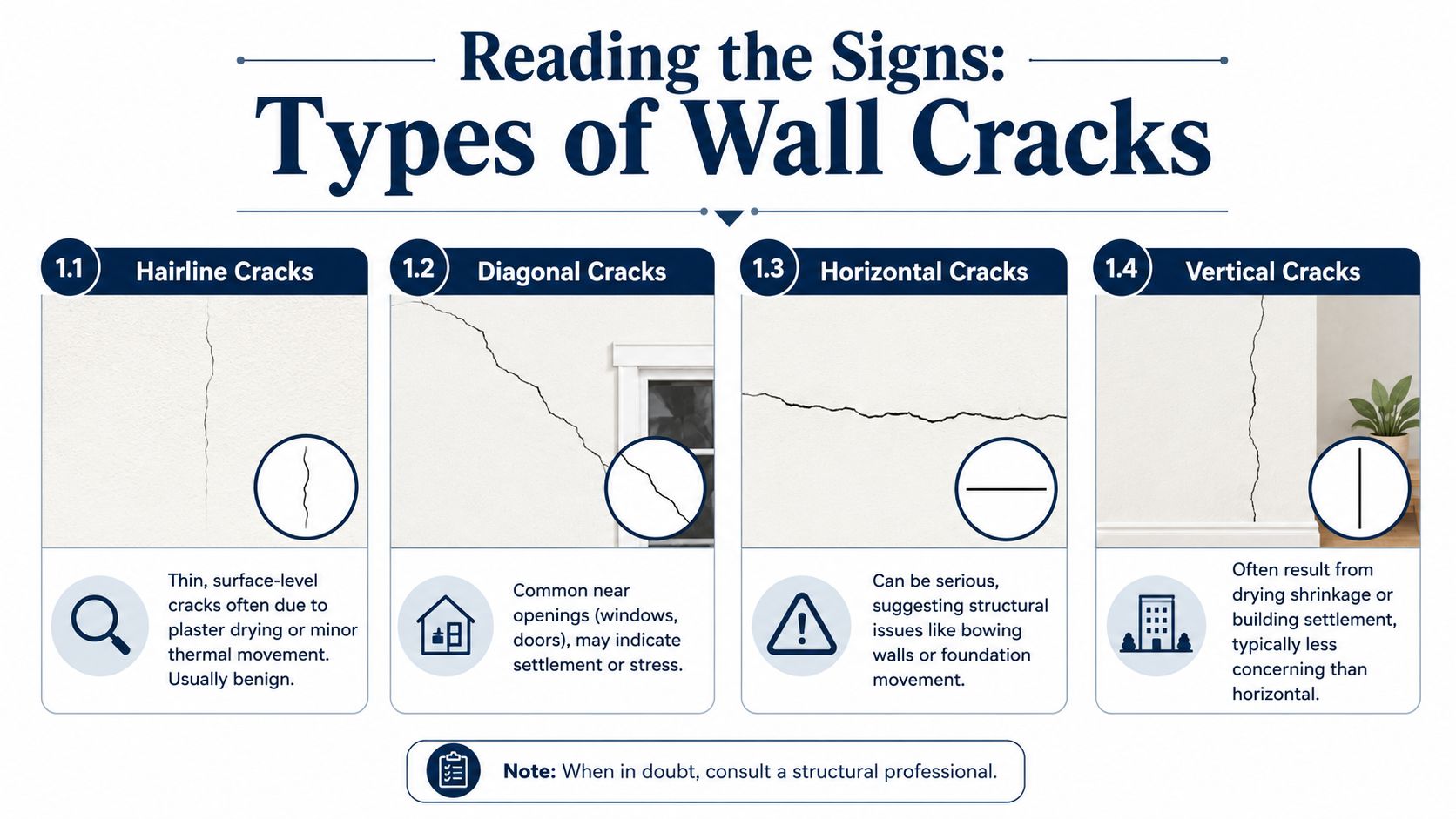
| Crack type | What it often looks like | Usual level of concern | Common explanation |
|---|---|---|---|
| Hairline plaster crack | Fine, shallow, often straight | Usually low | Plaster drying, minor thermal movement |
| Vertical crack | Up and down, sometimes near joins | Often lower than diagonal or horizontal | Drying shrinkage, ordinary settlement |
| Horizontal crack | Runs level across wall | Can be serious | Structural stress, wall movement |
| Diagonal or stepped crack | Angled, often near doors and windows, may follow brick joints | Higher concern | Structural movement, settlement or foundation trouble |
A vertical crack in a newly plastered room in a modern flat in Greenwich may be no more than drying shrinkage. A diagonal crack over a rear extension opening in a Victorian house in Peckham deserves more respect straight away.
A horizontal crack worries me more than a simple fine vertical one. It can suggest that a wall is being pushed or that there's movement affecting a broader section of structure. It needs context, but it isn't one to dismiss casually.
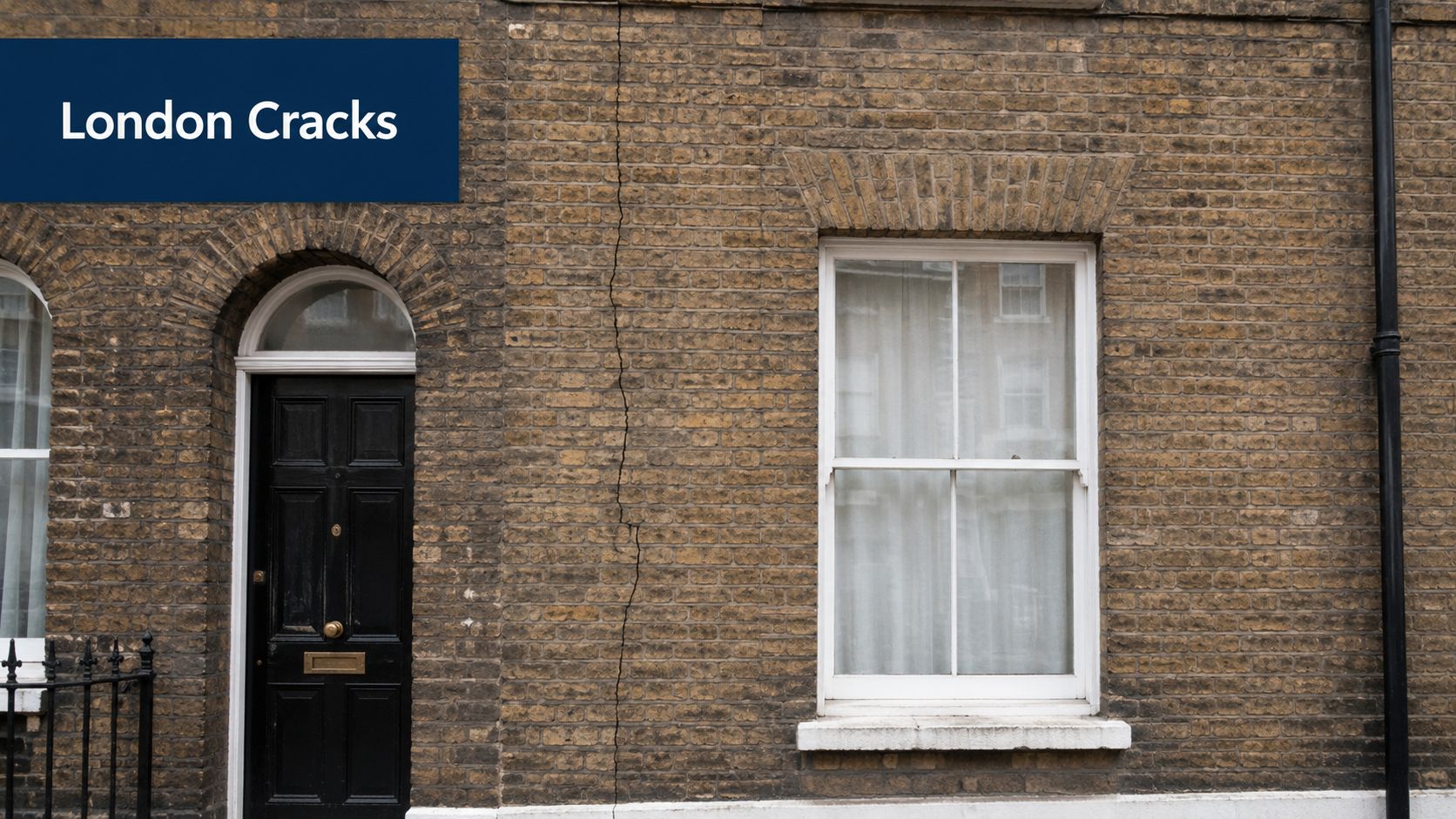
A stepped crack in brickwork is the classic one people associate with subsidence, and for good reason. It often follows the mortar joints because that's the line of least resistance. If it's around a bay window, beside a door opening or tapering along a flank wall, I pay attention.
Practical rule: Measure the width, then stand back and read the pattern. A small crack in the wrong place can matter more than a bigger one in old plaster.
If you want a deeper look at that distinction, I've already covered the warning signs in this guide to structural cracks in walls.
One more point. Don't let fresh paint fool you. I see plenty of houses in Camberwell, Clapham and Walthamstow where sellers have filled and painted over cracking before listing. That doesn't prove dishonesty. It does mean the surface finish may hide the pattern you need to inspect properly.
Why Cracks Appear Common Causes in London Properties
The ordinary causes
Some cracks are just part of a building ageing normally. Thermal expansion and contraction can do it. Humidity changes can do it. In older houses without modern insulation, materials expand and shrink more obviously. New builds often develop settlement cracks in the first few years, especially where walls meet ceilings or floors, as the structure adjusts.
That's routine stuff. It needs decorating, maybe local repair, but not sleepless nights.
Poor ventilation can also play a part. Moisture builds up, finishes deteriorate and weaker plaster surfaces begin to craze or crack. Leaks from roofs or basements can worsen that. In London terraces, especially where maintenance has been deferred for years, one small defect often drags another in behind it.
The London causes people misread
The big London issue is ground movement. Much of London and the South East sits on clay soil. Clay changes with moisture. In dry periods it can shrink. After heavy rainfall or flooding it can swell. That movement can affect foundations and show up as cracking. Diagonal cracks and cracks that let daylight through are widely recognised warning signs of subsidence and need urgent attention, as discussed in Timberwise's guidance on cracks in walls.
But here's the point many people miss. Not every crack that looks like subsidence is caused by classic foundation settlement.
In London's older housing stock, especially Victorian and Edwardian homes in places like Lambeth, Lewisham and parts of Southwark, failing drains are often the primary culprit. Recent Environment Agency data for London indicates that 42% of residential subsidence claims were triggered by blocked or collapsed drains, as noted in Frontier Insurance's discussion of when wall cracks are concerning.
That matters because the remedy can be completely different.
- If the problem is clay shrinkage linked to trees, you may need arboricultural input as well as structural advice. This overview of solutions for tree root foundation problems is useful for understanding why root activity and soil moisture have to be assessed together.
- If the problem is a damaged drain, sending everyone straight to underpinning talk is daft. A CCTV drainage survey may be the sensible first move.
- If the crack sits near an altered chimney breast or removed internal support, the issue may be building work rather than ground movement. That comes up regularly in London terraces, and it's one reason I tell buyers to read up on building regulations for chimney breast removal.
Older London houses are full of layered history. Rear additions, patched drains, old gullies, bridged damp, replaced windows and long-forgotten structural alterations all change how cracks develop. That's why broad internet advice only gets you so far.
Your Watchlist How to Monitor a Crack Yourself
Keep it simple and consistent
If the crack doesn't scream danger, monitor it properly. Don't just glance at it every now and then and rely on memory. Memory is useless for this. You need a dated record.
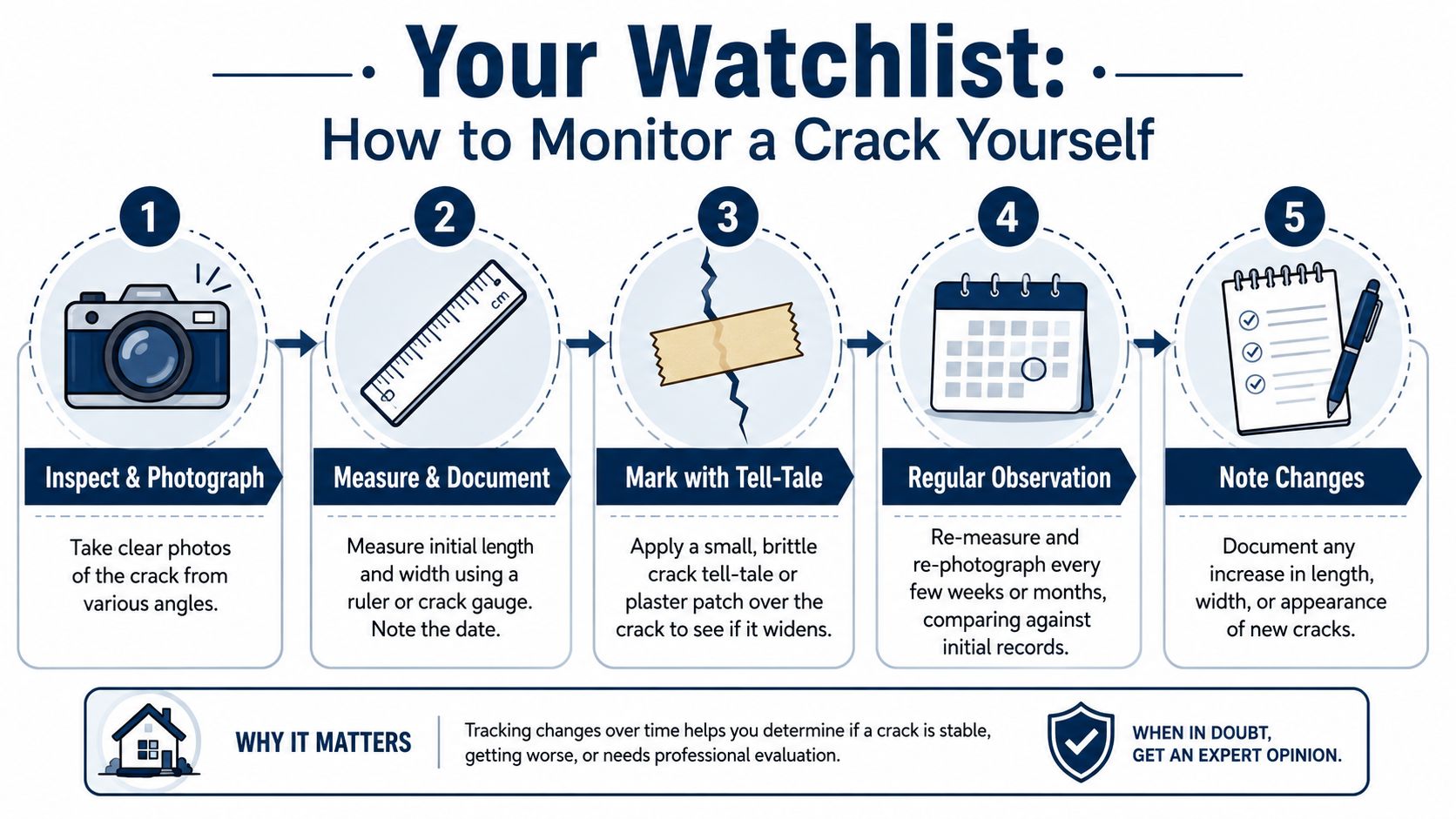
Use a ruler, a notebook and your phone camera. If you want to be a bit more precise, buy a simple crack monitor or gauge. They're straightforward to fit and easier to compare over time than guesswork.
Here's the method I recommend:
- Photograph it clearly. Stand close enough to show the crack shape, then take one from further back so you can see where it sits in the wall.
- Measure the widest point. Note the width and the rough length.
- Mark the date. Every photo and every note needs a date.
- Add a tell-tale. A small plaster patch or a simple brittle marker over the crack can show whether it's still moving.
- Check it at regular intervals. Consistency matters more than fussing.
What your notes should include
People often forget the surrounding signs. Those signs can be as important as the crack itself.
- Openings sticking: Note if doors or windows nearby suddenly catch or won't close cleanly.
- Weather pattern: Write down if the crack appeared after prolonged dry weather, heavy rain or a leak.
- New defects: Record if fresh cracks show up in other rooms, especially around openings.
- External clues: Look outside at the same wall if you can. Internal and external patterns often line up.
If a crack is stable, your log gives reassurance. If it's changing, your log gives a surveyor evidence instead of guesswork.
This short video gives a helpful visual on what homeowners tend to look for when tracking movement:
DIY monitoring has limits. It tells you whether something may be moving. It doesn't tell you why. That part needs experience, and sometimes further investigation.
When to Stop Watching and Call a Chartered Surveyor
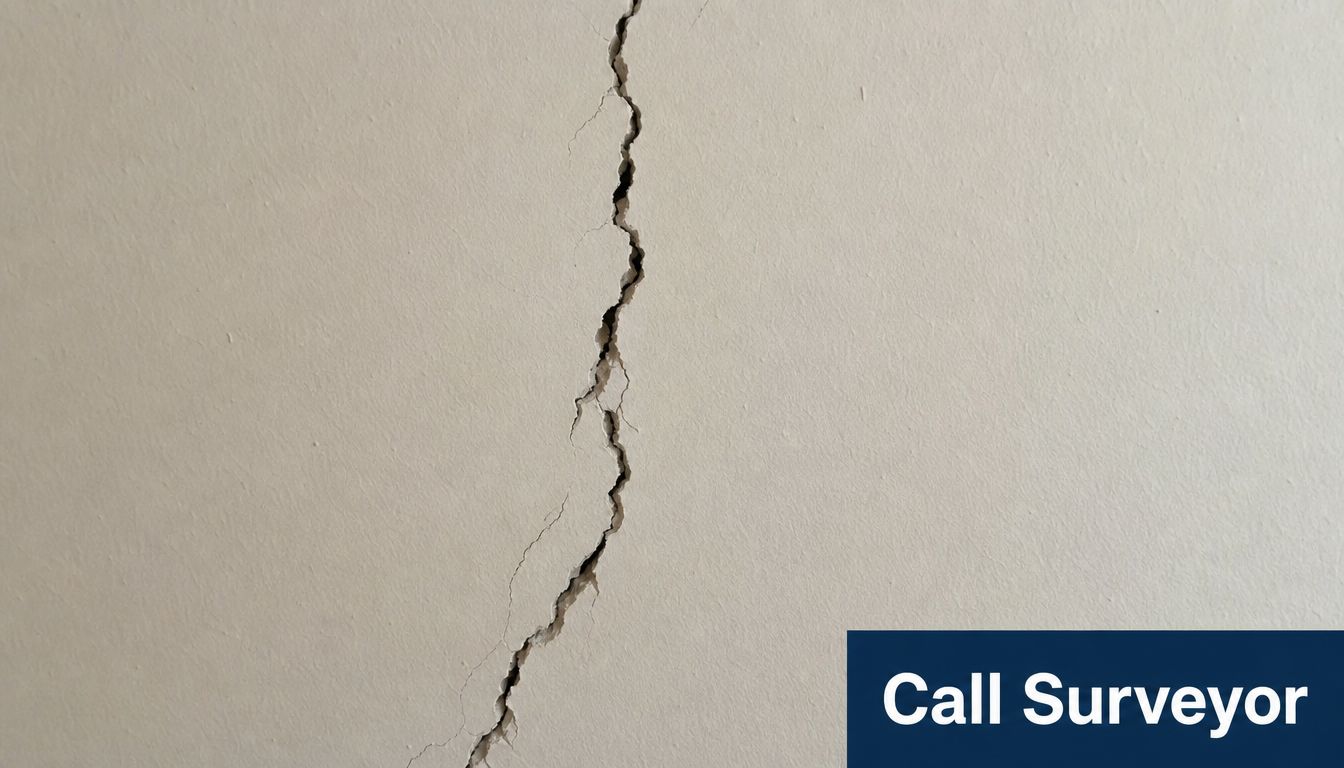
Red flags that need proper advice
There comes a point where watching is just procrastination. If you've got one of the warning signs below, stop monitoring and instruct someone qualified.
- Width beyond the ordinary cosmetic range: Once a crack has moved into the more serious category covered earlier, it needs assessment.
- Diagonal or stepped cracking around openings: Above doors and windows is a common danger area.
- A crack that changes shape: Wider at one end than the other is not random decoration failure.
- Daylight visible through the crack: That's a serious warning sign.
- Other movement symptoms: Sticking doors, sticking windows or sloping feelings underfoot often travel with structural movement.
Cracks linked to structural movement or subsidence are typically marked as Condition Rating 3 in a RICS Level 2 survey, meaning serious defects need urgent repair or investigation. A RICS Level 3 survey goes further by assessing overall movement and subfloor areas to help determine whether the cracks come from structural instability, as set out in the RICS description of the Home Survey Level 2 service.
That distinction matters. A Level 2 flags the concern. A Level 3 is the one I'd usually want where cracking is a real issue, especially in older houses, altered properties and anything with a history you can't properly verify.
Which survey actually helps
For a conventional house in reasonable condition, a Level 2 may be enough to identify that cracking is a problem and push for further checks. For a Victorian terrace in Forest Hill, a large semi in Bromley or a property with visible movement, a full structural survey is often the sensible route.
A proper surveyor doesn't just stare at the crack. He reads the building. He looks at the roof line, the openings, the external brickwork, the floors, the drainage clues and the history of alterations. That's the value. Diagnosis, not just description.
If you want another plain-English example of how structural assessment is approached in a different context, this piece on PA, MD, DE, NJ structural assessments is useful for understanding the principle that visible cracking is only one part of the wider stability picture.
I'd also say this. Use an independent surveyor. Not one tied to a lender, estate agent or developer. Independence matters when the findings may affect negotiations or trigger further investigation. Clive Thompson at Corinthian Surveyors London LTD is a RICS and CABE-qualified surveyor, and that sort of independent residential defect analysis is exactly what buyers and owners in London need when cracks stop looking cosmetic.
What Happens Next The Surveyor's Investigation and Repairs
What a proper investigation looks like
Once a surveyor has identified that the cracking may be significant, the next step is usually to narrow down the cause. You don't jump straight from a crack to a repair contractor with a drill. That's how people spend money in the wrong order.
A surveyor may recommend a CCTV drainage survey if the pattern suggests washed-out ground near old pipe runs. In London, that's particularly relevant with ageing drains around rear additions and side returns. In some cases, engineers may want trial pits to inspect foundation depth and local ground conditions. Where previous alterations are suspected, they may also want opening-up works.
The right sequence is inspect, diagnose, then repair. Reversing that order wastes money.
If a property has suffered a leak, impact damage or another disruptive event, it also helps to understand the broader safety picture after the immediate defect appears. This guide to evaluating home safety after damage is a useful general reference for thinking beyond the obvious crack line.
Repairs depend on the cause, not the crack alone
The repair has to match the reason the crack formed.
A moderate external crack in brickwork may need repointing or masonry repair. If localised movement has stabilised, masonry stitching can help tie cracked sections back together. If the issue is internal plaster only, the answer may be much simpler once the underlying cause is ruled out.
If drains are the problem, drain repair comes first. If tree-related soil movement is involved, the management plan may include arboricultural advice and staged monitoring. If the building has suffered severe subsidence or structural failure, engineers may recommend major works such as foundation stabilisation or rebuilding affected sections.
People hear words like underpinning and assume every bad crack ends there. It doesn't. Some do, many don't. The point of the investigation is to sort the manageable from the major before anyone starts breaking concrete.
Understanding the Costs and Making a Sound Investment
People often ask the wrong cost question. They ask, “How much will this crack cost me?” The better question is, “What will it cost if I guess wrong?”
There are usually three layers of spending. First, the survey. Second, any targeted investigations such as drainage checks. Third, the repair itself, which may range from local making good to significant structural work. The spread is wide, so anyone promising a neat answer before inspection is talking nonsense.
For conventional properties built after 1930 and in reasonable condition, RICS Level 2 Homebuyer Reports are the most common survey type used to identify and document issues such as damp or subsidence that cause wall cracks, because they include a visual inspection of major internal features including walls and ceilings, as explained in this overview of what is included in a RICS Level 2 Homebuyer Survey.
For older, altered or more complex buildings, Level 3 usually makes more financial sense because it gives a clearer repair roadmap. That matters when you're buying in places like Dulwich, Greenwich or Islington where one hidden defect can alter the whole deal.
Ignoring a progressive crack is usually the expensive option. Paying for clear, independent advice is an investment in knowing what you're dealing with. If you need that sort of view across London and the South East, speak to Corinthian Surveyors on 0800 00 16 422.
Frequently Asked Questions About Wall Cracks
Are cracks in old houses normal
Yes, many are. Old houses move a bit, materials age and plaster fails in places. Victorian and Edwardian homes in London often show minor cracking around chimney breasts, ceilings and window reveals. Normal doesn't mean ignore everything. It means judge the pattern, position and behaviour properly.
Is a crack that appears and disappears with the seasons a problem
It can be ordinary seasonal movement, especially in buildings affected by moisture and temperature changes. But if the crack is widening noticeably, appearing alongside sticking doors or showing up with external movement, stop assuming it's harmless. Seasonal movement can still point to an underlying issue that needs checking.
Can I just fill a wide crack and paint over it
You can, but that doesn't solve anything if the crack is active. Filler is for cosmetic defects. It is not a structural repair. If the crack is wide, oddly shaped or returning after redecoration, you need diagnosis before you spend more on patching.
Should I choose Level 2 or Level 3 for cracks in walls of house
If the property is fairly standard and the cracks look minor, Level 2 may be enough to identify concern. If the house is older, altered, visibly moving or the crack pattern is suspicious, Level 3 is usually the better decision. It gives more depth and is better suited to structural questions.
If you need a clear opinion on cracking, movement, damp or other residential defects, Corinthian Surveyors London LTD provides independent RICS-regulated surveying across London, the Home Counties and the South of England. Clive Thompson holds RICS and CABE qualifications, the firm has no ties to lenders, estate agents or developers and the advice is focused on what the building is doing, not on selling you a package.