
Cracks in House Walls: When to Call a London Surveyor
You're standing in the hallway, coffee in hand, and you notice it. A crack that wasn't there before, or one you hoped was old and harmless that now looks a bit wider. Your mind goes straight to subsidence, insurance claims and expensive builders. That reaction is normal.
Most cracks in house walls are not a disaster. Some are plaster shrinkage. Some are old movement that has long since stopped. Some are the sort of minor settlement you expect in a London house that has been through a century of heat, rain and patch repairs. But some cracks are telling you the building is moving now, and that's the point where guessing gets expensive.
In South East London, I see this worry all the time in places like Forest Hill, Catford, Bromley and Greenwich. The right approach is simple. Read the crack properly, monitor it if appropriate, and bring in a surveyor when the signs point to structural movement rather than decoration.
Table of Contents
- That Sinking Feeling Discovering a Crack
- How to Read Wall Cracks Like a Surveyor
- Common Causes of Cracks in London Properties
- How to Monitor a Crack for Movement
- Repairing Wall Cracks Options and Methods
- When You Must Instruct a RICS Surveyor
- What to Expect from a Professional Survey
- FAQ
That Sinking Feeling Discovering a Crack
You notice a jagged crack above the back window in Lewisham after a dry spell. In Bromley, it is a thin line beside the stair landing. In Sydenham, the buyer's surveyor marks a crack in red and the sale suddenly feels at risk. I see this all the time, and the first problem is usually panic.
Here is the truth. A crack is not a diagnosis. It is a clue.
What matters in London is the setting as much as the crack itself. A Victorian terrace on shrinkable clay in Lewisham raises different questions from a 1930s semi in Bromley with altered openings or an old extension tied in badly. The crack may be harmless plaster movement. It may also point to seasonal movement, foundation trouble, or defects from past alterations. Until someone looks at the building properly, you do not know which.
That is why guessing from online photos is a bad habit. You need to connect the mark on the wall to the age of the house, the ground beneath it, and what a surveyor will have to say about it in a Level 2 or Level 3 report. If you are selling or buying, that matters because value is affected by uncertainty as much as by the defect itself. A small crack with no clear explanation can worry a buyer more than a larger crack that has been investigated and properly documented.
My advice is simple. Stay calm, take clear photos, note the date, and resist the urge to fill it before anyone has worked out the cause.
If the crack is wide enough to put a finger in, runs diagonally from a window or door corner, keeps reopening after decoration, or appears with sticking doors or sloping floors, treat it seriously. If you want plain homeowner advice on foundation cracks, that guide gives a useful overview of why delay can make decisions harder.
A worried homeowner usually asks me one question. “Is this subsidence?” Sometimes yes. Often no. The right first step is not to jump to the worst conclusion. The right first step is to read the crack properly and put it in context. That is exactly what a RICS surveyor does, and it is why a clear diagnosis protects both your home and its market value.
How to Read Wall Cracks Like a Surveyor
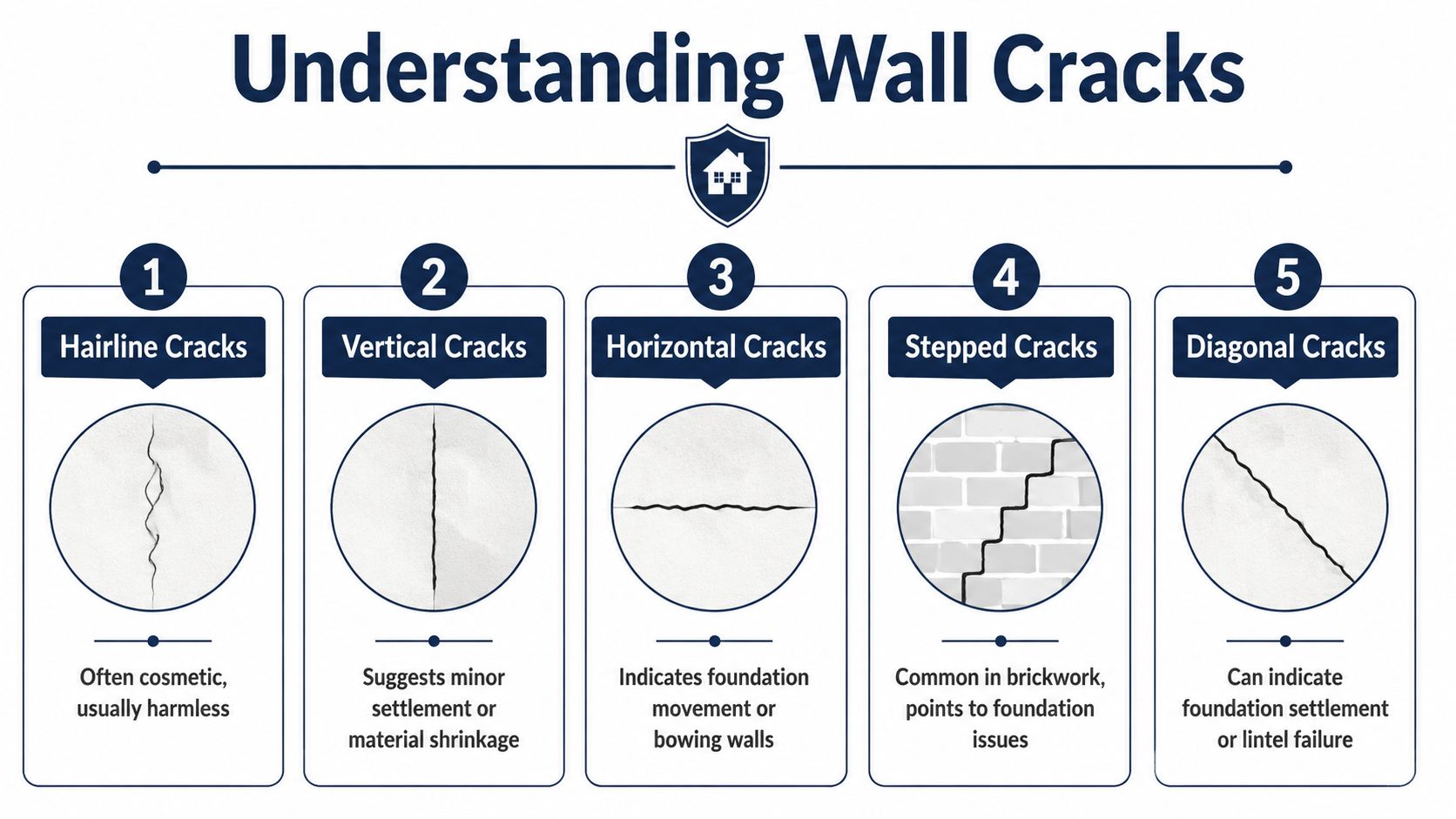
The shape of a crack matters as much as the width. A fine straight crack in fresh plaster is one thing. A stepped crack through brick joints is another. A horizontal crack is a different level of concern again.
Start with width pattern and position
Here's the basic field guide I use when looking at cracks in house walls.
- Hairline cracks: Usually under 1mm. These are often cosmetic and linked to plaster shrinkage or normal thermal movement in the early life of a building, as explained in Age UK Trading's guide to serious wall cracks.
- Vertical cracks: Often less dramatic than they look. They can point to minor settlement or shrinkage, especially around plastered areas and openings.
- Diagonal cracks: These need more respect. Age UK Trading notes that diagonal stair-step cracks, particularly near doorframes or external walls, are red flags for foundation damage and should be assessed by a structural engineer in their guidance on serious cracks.
- Horizontal cracks: These are the pattern I take most seriously. Horizontal cracks in external walls are widely treated as a critical sign because they can indicate lateral pressure or structural failure, as discussed in this explanation of dangerous horizontal wall cracking.
- Stepped cracks in brickwork: These often follow mortar joints and can point to differential movement in the structure or foundations.
If the crack is wider at one end than the other, note it. If it crosses from inside to outside in the same area, note that too. If doors or windows nearby have started sticking, that strengthens the case for movement.
For a fuller look at defect patterns, this guide to structural cracks in walls is worth reading alongside what you can see on site.
Use the BRE categories properly
There is a formal way to look at width. According to the BRE categorisation used in UK defect analysis, crack widths up to 5 mm fall into Categories 0–2 and are classed as aesthetic defects needing only redecoration, while widths above 5 mm in Categories 3–4 become serviceability issues that can affect weathertightness and door operation, and Category 5 indicates stability issues requiring structural intervention, as set out by the BRE crack categorisation guidance.
That's useful, but don't use it lazily.
A small crack in the wrong place can matter more than a larger crack in old plaster.
That matters in London. Width is not the whole diagnosis. Pattern and location still carry real weight.
Common Causes of Cracks in London Properties
You see a crack in a Lewisham terrace and the first question is usually, “How wide is it?” Fair question. It is not the right starting point on its own.
In London, the better question is what is making that part of that building move. That is how a surveyor reads risk, and it is how cracks affect value when a buyer, lender or insurer starts asking awkward questions.
London clay changes the diagnosis
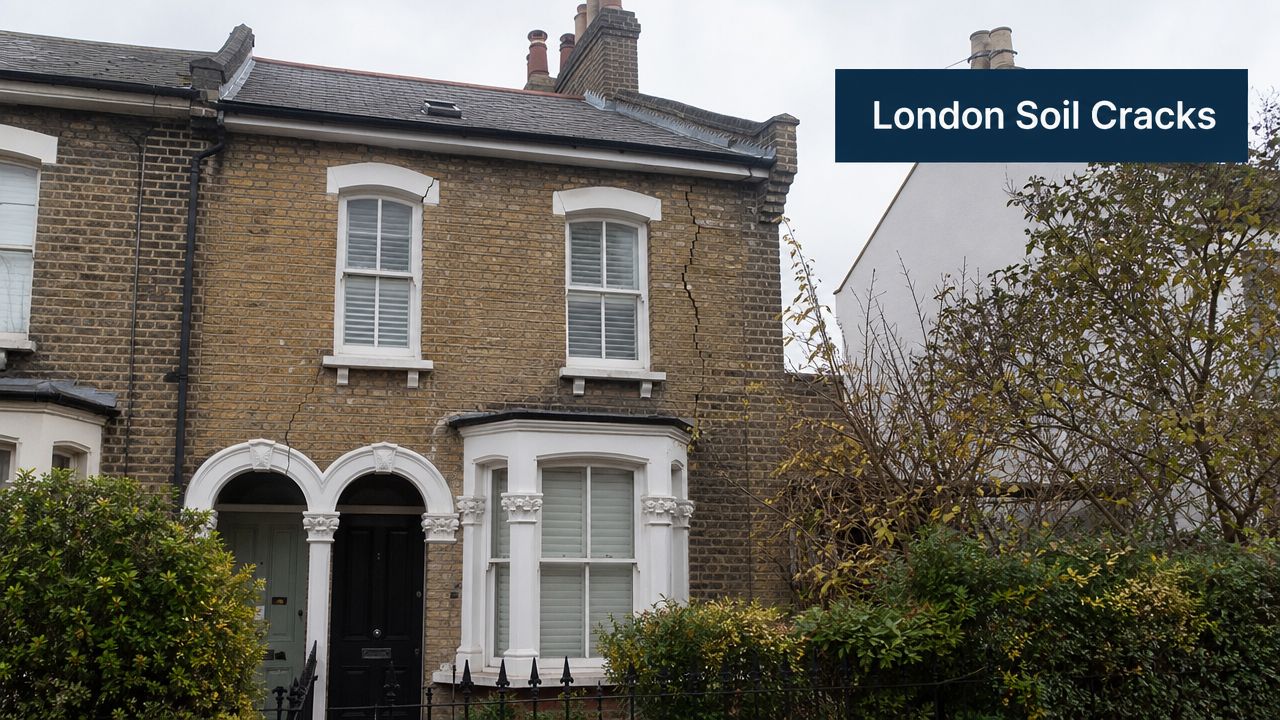
Much of South and South East London sits on shrinkable clay. In dry spells it can contract. When moisture returns, it can swell. That cycle puts stress on shallow foundations and rigid masonry, especially in older houses.
That is why a modest diagonal or stepped crack in Bromley, Lewisham, Croydon or Greenwich can matter more than a wider bit of tired plaster elsewhere. The diagnosis depends on ground conditions, crack pattern, and what else in the building is reacting.
A RICS surveyor will tie those clues together. If the pattern suggests subsidence, he is not just noting a defect. He is judging whether the issue is historic or active, whether drainage or trees may be involved, and whether the crack is likely to affect mortgageability or sale price.
If you want a plain-language explanation of why foundation cracks should never just be filled and forgotten, this piece of homeowner advice on foundation cracks is a sensible companion read.
The building type often gives the answer
London housing stock repeats the same defects because it repeats the same forms of construction.
Victorian and Edwardian houses in places like Forest Hill, Peckham, Camberwell and Dulwich often have solid walls, lime mortar, suspended timber floors and a long history of alterations. A rear addition may settle differently from the original house. A chimney breast may have been removed badly. A loft conversion may have changed load paths without enough support. Cracks often appear where the building has already been meddled with.
A 1930s semi in Bromley is different. So is a converted flat in Bermondsey. Each has its own usual weak points, and that local context matters during a survey because the likely cause affects both the repair advice and the wording in the report.
Old houses often crack where they've been altered, not where they were originally built.
Causes I see repeatedly in London homes
The usual culprits are practical and familiar:
- Clay shrink and swell: Seasonal moisture change in clay soils can cause foundation movement, especially near trees or where drainage has changed.
- Poor past alterations: Removed chimney breasts, widened openings and under-specified loft works often leave masonry carrying loads it was never meant to carry.
- Failed lintels: Cracking above windows and doors often points to a local support problem rather than a foundation problem.
- Differential movement between old and new work: Rear extensions, bay windows and infill sections can move at different rates from the original building.
- Drainage defects: Leaking drains, overflowing gutters and poor water run-off can alter moisture levels in the ground beside the house.
- Normal settlement in newer homes: Newer buildings can develop light cracking as materials dry and the structure beds in, though the pattern still needs reading properly.
For homeowners trying to sort cause from cosmetic damage, this guide to wall crack repair and likely underlying defects gives useful background.
The point is simple. London cracks are rarely just about width. They are about location, construction type, ground conditions and the history of the building. That is the difference between a cheap filler job and a defect that comes back during conveyancing and knocks confidence, or value, out of a sale.
How to Monitor a Crack for Movement
You don't always need to leap straight to invasive work. If the crack doesn't show immediate danger signs, monitoring it can tell you whether it is historic and stable or active and changing.
A simple way to do it yourself
Pick one method and be consistent. Don't overcomplicate it.
- Mark the ends. Use a pencil to mark the end points of the crack and write the date beside it.
- Take clear photos. Stand in the same position each time. Include a ruler or coin for scale.
- Use tape or a simple tell-tale. A small strip of tape across the crack can show tearing if movement continues. A proprietary crack monitor gives a cleaner reading if you want something more reliable.
- Check nearby symptoms. Watch the nearest door, window and skirting. If they start sticking or separating, note that.
- Keep a short log. Date, location, weather conditions and any visible change.
A surveyor doesn't just want to know that a crack exists. They want to know whether it has changed and what else changed with it.
When monitoring is not enough
Don't monitor obvious danger signs and hope for the best. That is where people waste months.
Get professional advice straight away if:
- Daylight is visible through the crack
- The crack is horizontal
- It is stepped or diagonal in brickwork and widening
- You can see the same movement inside and outside
- Doors or windows nearby have started binding
- The crack is wide enough to suggest more than decoration
If those signs are present, monitoring should support the assessment, not replace it.
Repairing Wall Cracks Options and Methods
The right repair depends on the right diagnosis. I see plenty of London homes where someone has filled the crack neatly, painted over it, and missed the true problem beneath. A buyer then instructs a survey, the crack is flagged, and the value takes a knock because the repair has no credibility.
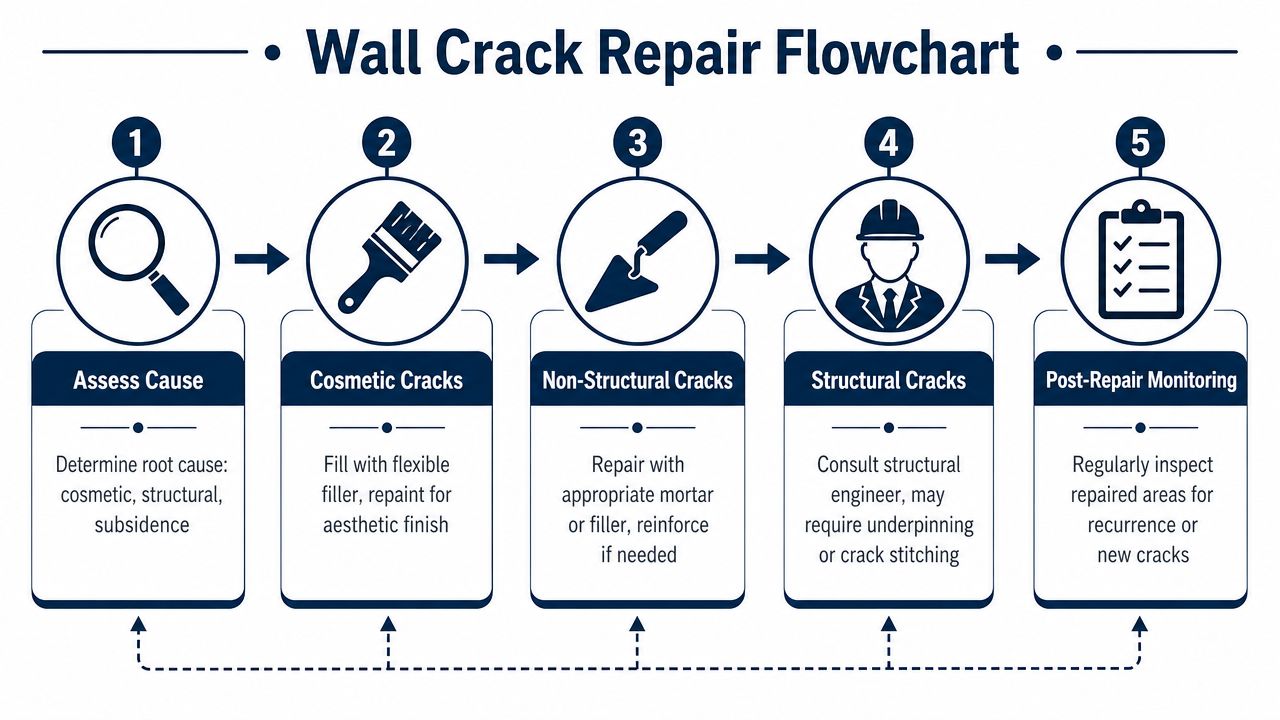
Match the repair to the cause
Start with the wall you have, not the filler you have in the shed.
| Crack type | Likely approach | What matters |
|---|---|---|
| Cosmetic plaster crack | Flexible filler and redecoration | Only if the background is stable |
| Non-structural masonry crack | Local masonry repair and repointing | Match the mortar and deal with moisture |
| Structural crack | Crack stitching, engineering input or deeper structural work | Treat the movement, not just the line in the wall |
Small plaster cracks in a stable wall usually need nothing more than raking out, filling properly, and redecorating. Masonry cracks are different. If the jointing has failed or moisture has got in, the repair often means cutting out damaged mortar, replacing affected bricks if needed, and repointing with the right mix.
Structural cracks need a more serious approach. Crack stitching with stainless steel helical bars is commonly used in brickwork, but it only makes sense where the movement has been assessed and the wall can be stabilised. If the building is still moving, stitching alone is a tidy-looking half measure.
That distinction matters in London. In Lewisham and Bromley, I regularly see valuation issues where an owner has carried out a cosmetic repair to a crack that a surveyor will still read as possible movement. The question in an RICS survey is not whether the wall has been filled. It is whether the cause was identified, whether the repair was suitable, and whether the movement is likely to affect value or mortgageability.
If you want practical examples of proper wall crack repair methods, focus on repairs that deal with both the defect and its cause.
If rain penetration is part of the problem, protecting the masonry after repair can help. This guide to water seal for brickwork is a useful plain-language reference. Use sealers as weather protection only. They do not fix movement.
Period homes need the right materials
Older London houses are often repaired with materials that are too hard for the building. That is a mistake.
Victorian and Edwardian homes in places such as Blackheath, Greenwich and Dulwich often rely on softer brick and lime-rich mortar. Those walls need repairs that let moisture escape and allow slight natural movement. Hard cement mixes, rigid fillers, and resin-heavy patch repairs can force stress into the surrounding area and cause the crack to return beside the repair.
For older masonry, the mortar and repair material should match the age and character of the wall as closely as possible. In conservation areas, that matters for appearance as well as performance. It also matters when a surveyor is judging whether previous works were sensible or whether they may have hidden a bigger defect.
Corinthian's own building conservation work shows the sort of traditional construction details that need this more careful approach.
When You Must Instruct a RICS Surveyor
You spot a crack on a viewing in Lewisham, or one opens up in your own house in Bromley. The estate agent shrugs. A builder says he can fill it. That is the moment to stop guessing and get a surveyor involved.
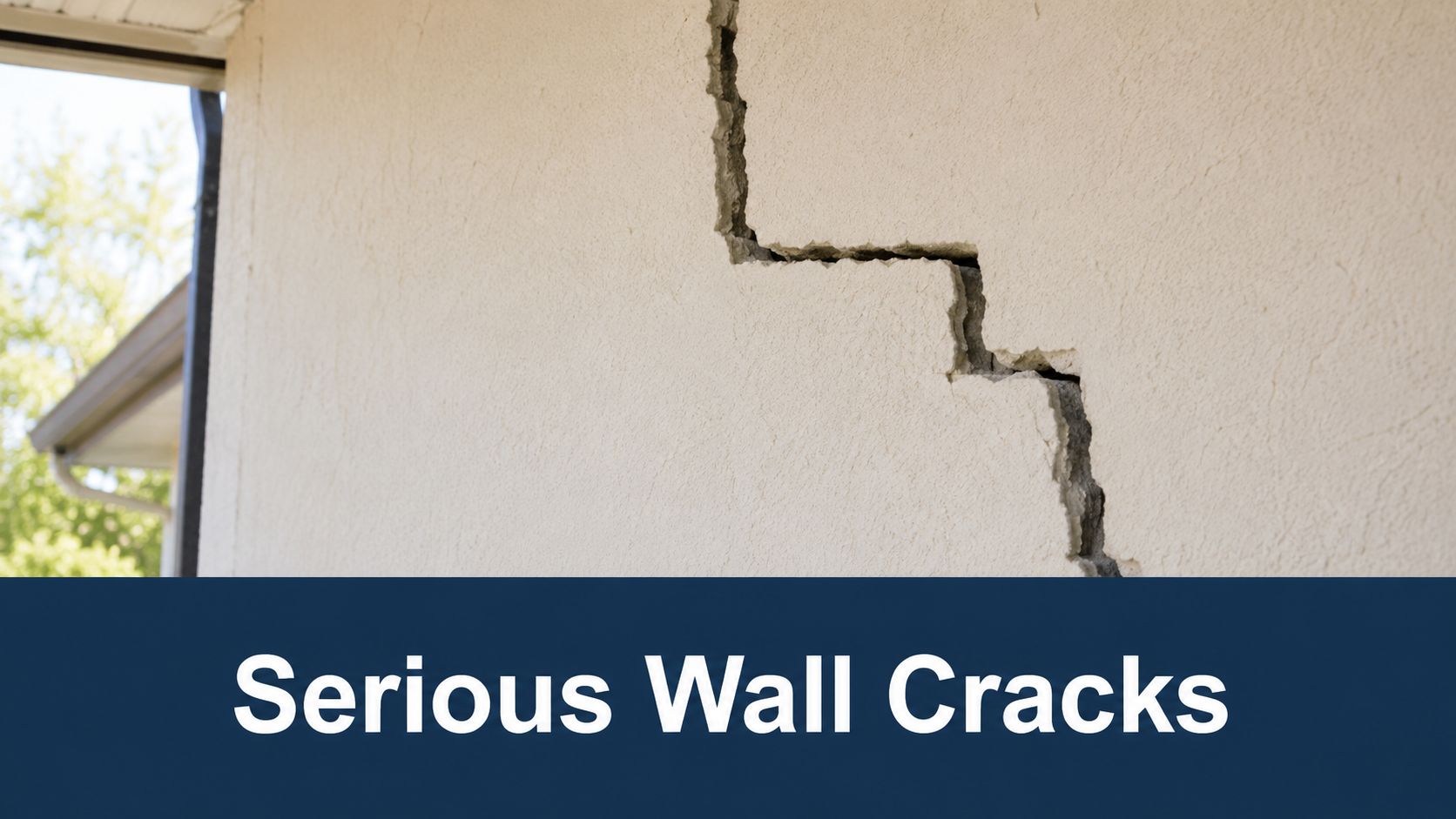
Instruct a RICS surveyor when the crack looks like building movement rather than a failed skim of plaster. The usual warning signs are straightforward. Cracks around 5mm or more, diagonal cracking, horizontal cracking, stepped cracking through brick joints, distortion around doors or windows, and cracking that appears both inside and outside all need proper assessment. So do cases where doors start sticking, floors feel uneven, or the crack has come back after repair.
In London, the setting matters as much as the crack. A Victorian terrace in Blackheath, a 1930s semi in Bromley, and an ex-local authority flat in Lewisham can all crack for different reasons. Clay shrinkage, altered openings, tired lintels, drainage defects, and long-settled movement all show up differently in the survey process. A good survey does not just record the width. It works out what is moving, what is old, what is active, and what that means for value, repair cost, and mortgageability.
If you are buying, do not rely on the lender's valuation. It is not there to diagnose defects. If you have seen cracking before exchange, read whether you need a survey when buying a house.
Level 2 or Level 3
Choose the survey to suit the risk, not the asking price.
- RICS Home Survey Level 2: Right for a conventional home in reasonable condition where the cracking may be limited and the building is not heavily altered. Corinthian's RICS Homebuyer Surveys fit that sort of instruction.
- RICS Building Survey Level 3: The right call for older houses, period homes, properties with visible movement, or buildings that have been extended, opened up, or poorly repaired in the past. Corinthian's RICS Building Surveys are the more detailed option in that situation.
This choice affects more than the report length. It affects what gets investigated, how clearly the defect is explained, and whether a buyer can renegotiate with evidence instead of worry.
Corinthian Surveyors London LTD is an independent firm based in Forest Hill, regulated by RICS, with Clive Thompson holding both RICS and CABE qualifications. Independence matters. A surveyor with no ties to lenders, estate agents, or developers can give you a straight view of the defect and its likely effect on the property.
Here's a useful explainer on what surveyors look for in cracking and movement:
Delay can cost you at sale time
Untested cracks put buyers on edge. In practice, the drop in confidence is often the main problem.
A crack that might have been manageable with a clear diagnosis can become a price chip, a delayed sale, or a mortgage query if it is left hanging without explanation. I see this regularly in South London. Sellers assume a buyer will accept "it's been there for years." Buyers read it as risk. Surveyors have to report what they see, and once cracking appears in a RICS report without supporting evidence, value discussions get harder.
The answer is simple. Get the defect assessed before it becomes a negotiation problem. A sensible survey, backed by a clear repair history where needed, puts you in a far stronger position than vague reassurance from a seller, agent, or contractor.
What to Expect from a Professional Survey
You are paying for a judgement, not a glance at a crack.
A good RICS survey tells you three things clearly. What the crack is likely to mean, what evidence supports that view, and what you should do next. In London homes, that context matters because the same crack can mean very different things in a Victorian terrace in Lewisham, a 1930s semi in Bromley, or a converted flat in Forest Hill.
What the inspection actually covers
A Chartered Surveyor does not look at the crack in isolation. The inspection links the defect to the rest of the building. That means checking the wall type, the age of the property, the crack pattern, nearby doors and windows, floor levels, signs of roof spread, external ground levels, and any visible drainage defects. Previous alterations also matter. Removed chimney breasts, widened openings, loft conversions, and rear extensions often explain cracking in South London properties far better than a vague fear of subsidence.
The surveyor should also place the defect in the right RICS route. A Level 2 survey may be enough if the property is fairly conventional and the cracking appears limited. A Level 3 survey is usually the better choice for older homes, altered buildings, or cases where movement needs fuller explanation. If the evidence points beyond the surveyor's role, the report should say so plainly and recommend the next step, such as monitoring, a structural engineer, or targeted drainage checks.
That is what gives the report value.
How the report helps you decide
The report should be easy to read. RICS condition ratings help you see what needs prompt attention and what can be dealt with later, but the primary value sits in the written comments. You want a surveyor who explains whether the crack looks historic, progressive, seasonal, or linked to a specific defect such as lintel failure or movement at an extension junction.
Where movement looks serious, the report should say so without dressing it up. Wide cracks, stepped brick cracks, horizontal cracking, or distortion around openings usually justify urgent follow-up. A decent report will also explain what was not visible on the day, because that affects how much weight you can place on the conclusion.
For buyers and sellers in places like Catford, Beckenham, Lewisham, and Bromley, this has a direct effect on value. A crack with a clear diagnosis is far easier to deal with than a crack left unexplained in a survey report. Lenders, buyers, and solicitors all respond better when the defect has been properly assessed and the next step is obvious.
Corinthian Surveyors London LTD is an independent RICS-regulated firm based in Forest Hill. Clive Thompson holds both RICS and CABE qualifications. If you need an inspection, the advice should be straight. What the crack is, how serious it looks, and whether it is likely to affect price, saleability, or further investigation. You can speak to the office on 0800 00 16 422.
FAQ
Are cracks in house walls always a sign of subsidence
No. Many are cosmetic. Hairline plaster cracks and minor settlement cracks are common. The concern rises when the crack is diagonal, stepped, horizontal, widening or linked to distortion elsewhere in the building.
What crack pattern is most worrying
Horizontal cracks are the pattern I treat most seriously because they can point to lateral pressure or structural instability. Diagonal stair-step cracks in brickwork also deserve prompt assessment, especially around external walls and openings.
Should I fill a crack before a survey
Usually not. If you fill it first, you hide evidence. Photograph it, measure it and let the surveyor see it in its current state.
Is a mortgage valuation enough if I can see cracks
No. A mortgage valuation is for the lender. If visible cracking concerns you, you need a proper RICS survey.
If you've found a crack and you want a calm, independent view before it turns into a bigger worry, Corinthian Surveyors London LTD can advise on the right survey for the property, from a Level 2 Homebuyer Survey to a Level 3 Building Survey, and explain the findings in plain English so you know what needs doing.