
Do I Need a Survey When Buying a House: Your Essential Guide
No, a survey isn't a legal requirement when buying a house in the UK, but skipping one is how buyers walk into £12,000 to £25,000 of repair costs in London. And no, your lender's valuation isn't the same thing, it's a basic check for the bank, not a proper inspection for you.
You're probably at the point where the offer's been accepted, the solicitor has started, and everyone seems to want another payment from you. This is usually when buyers ask, do I need a survey when buying a house, or can I save the money and push on.
My advice is simple. Get the survey. Especially in London.
A flat conversion in Peckham, a Victorian terrace in Lewisham, a 1930s semi in Bromley, they can all look tidy on a viewing. Fresh paint hides damp. New carpet hides uneven floors. A quick lender check won't tell you if there's roof spread, old wiring, chimney breast alterations or movement.
That's exactly why buyers use independent RICS surveyors. You need someone looking for your problems, not the lender's risk.
Table of Contents
- Is a Survey Really Necessary When Buying a House
- Mortgage Valuation vs RICS Survey What Is the Difference
- Choosing the Right Survey for Your London Property
- What Surveyors Actually Look For During an Inspection
- How to Use Your Survey Report to Renegotiate the Price
- How to Choose a Reputable Surveyor in London
- A Survey Is Your Best Financial Protection
- Frequently Asked Questions
Is a Survey Really Necessary When Buying a House
Yes. If you're spending hundreds of thousands on a property, trying to save a few hundred by skipping the survey is the wrong economy.
The point isn't paperwork. The point is finding the defects before they become your bill. RICS-linked figures reported here say that properties with unseen structural issues found after purchase average repair costs of £12,000 to £25,000 in London, and buyers with an RICS Building Survey negotiated price reductions averaging £8,500.
That's the whole argument in one go. You pay for information now, or you pay for repairs later.
What buyers usually get wrong
It's a common misconception that a survey is only needed if the house looks rough. That's not how property works. Some of the worst defects sit in homes that present very well.
A neat terrace in Catford can still have damp trapped behind recent plaster. A smart maisonette in Camberwell can still have roof defects above the top floor. A tidy semi in Bromley can still have movement, poor drainage or old electrics.
Practical rule: If the cost of being wrong would hurt, get the survey.
Why London buyers need to be stricter
London stock is mixed. You can walk down one street in Forest Hill and see Victorian houses, post-war infill, converted flats and recent extensions all side by side. That means hidden risk.
Older properties often have layers of alteration. Chimney breasts removed without proper support, lofts converted badly, suspended floors with decay, cement render trapping moisture in solid walls. None of that is obvious from a viewing.
A proper survey also gives you an advantage. If the report shows roof repair, damp treatment, timber decay or defective windows, you can go back to the seller with evidence instead of guesswork.
- It protects your budget: You find out what needs doing before exchange.
- It protects your negotiating position: The report gives you a basis for reducing the price or asking for works.
- It protects your judgement: Buyers fall in love with kitchens. Surveyors look at structure, fabric and risk.
If you're asking do I need a survey when buying a house, the plain answer is yes, unless you're happy to buy blind.
Mortgage Valuation vs RICS Survey What Is the Difference
Buyers often get caught out by a misunderstanding. A mortgage valuation is for the lender. A RICS survey is for you.
This guide on lender requirements states that approximately 85% of mortgage lenders in England and Wales require a professional property survey before approving a home loan, but this is often a basic valuation, not a substitute for a detailed RICS report commissioned by the buyer.
Let's use a car as an example. A mortgage valuation is someone checking that the car exists and is worth roughly what the bank is lending. A proper survey is the mechanic putting it up on the lift and telling you the brakes are shot and the chassis is corroded.
What a valuation does
A valuation is brief. Its purpose is to confirm the property is suitable security for the loan.
That means the valuer isn't there to give you a shopping list of defects, maintenance advice or repair priorities. Sometimes the inspection is limited. Sometimes it won't tell you much at all beyond the lender's position.
If you're still unsure about that side of the process, it's worth reading more about property valuation reports and what they actually cover.
What a survey does
A survey looks at condition. It flags visible defects, likely causes and what needs further investigation.
That's where the value is for buyers in places like Greenwich, Blackheath and Southwark, where buildings may have age, alterations and shared elements that don't show up in the estate agent's details.
A valuation helps the bank decide whether to lend. A survey helps you decide whether to buy.
Why this matters in practice
If the lender is satisfied, the mortgage can still go ahead on a property with issues that are expensive for you but acceptable as lending security. That's the gap buyers need to understand.
So don't say, "The bank's done a survey." Usually, it hasn't done the sort of survey you mean. It has done the sort of check it needs.
Those are two very different things.
Choosing the Right Survey for Your London Property
The right survey depends on the building, not your optimism. Choose the report that matches the age, construction and level of alteration.
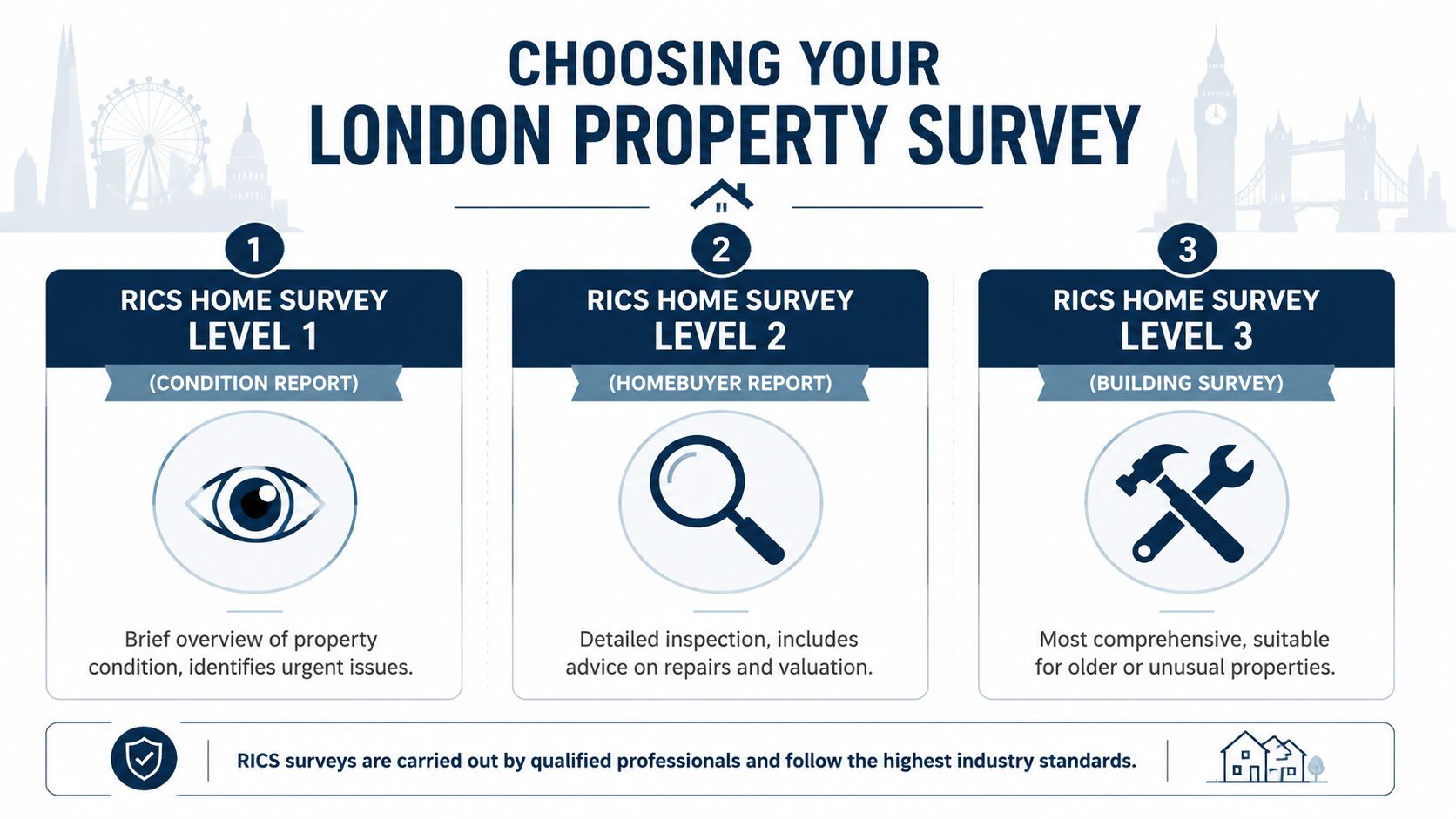
If you want a straightforward explanation of the formats, this overview of what a RICS survey is is useful. The short version is below.
Level 1 for newer and simpler homes
RICS Home Survey Level 1 gives a basic snapshot of condition. It's the lightest option.
It suits newer, more conventional homes where there are fewer obvious complications. A modern flat in Woolwich or a newer house on a standard estate may fit this category, provided there haven't been unusual alterations.
You get a general condition overview, but not the depth of advice that many London buyers need.
Level 2 for standard houses and flats
RICS HomeBuyer Survey Level 2 is the report many buyers need for conventional property in reasonable condition. Think 1930s semis in Bromley, standard purpose-built flats in Eltham or a fairly typical terrace that hasn't been heavily altered.
Reported London pricing for RICS surveys here puts a Level 2 HomeBuyer Survey at £400 to £600, while a Level 3 Building Survey is typically £600 to £1,200.
Level 2 is a good middle ground if the property is standard construction and you want practical advice on condition, defects and repairs without going to the fullest level of detail.
Level 3 for older altered or unusual property
RICS Building Survey Level 3 is the right choice for many London buildings. Older Victorian and Edwardian stock often needs it. So do listed buildings, heavily extended houses, non-standard construction and flats in converted buildings.
If you're buying a Victorian terrace in Lewisham, a period property in Dulwich, a conversion in Peckham or a house with a loft conversion and rear extension in Sydenham, Level 3 is usually the sensible call.
This is the report to choose when the property has age, complexity or visible warning signs.
If the building has a story, you want the fuller survey.
A simple way to choose
| Survey type | Best suited to | Typical use in London | Cost range |
|---|---|---|---|
| Level 1 | Newer, simpler homes | Modern flats and straightforward houses | Qualitative quote basis |
| Level 2 | Conventional homes in reasonable condition | 1930s semis, standard flats, typical terraces | £400 to £600 |
| Level 3 | Older, altered or unusual homes | Victorian terraces, conversions, listed property | £600 to £1,200 |
My rule of thumb
Use the lightest survey only when the property is straightforward. Most older London homes are not straightforward.
Corinthian Surveyors London LTD, based in Forest Hill, handles RICS Home Condition Surveys, RICS HomeBuyer Surveys and RICS Building Surveys across London, the Home Counties and the South of England. The firm is independent, regulated by RICS, and Clive Thompson holds both RICS and CABE qualifications, which matters when you need plain advice on an awkward property rather than a box-ticking exercise.
What Surveyors Actually Look For During an Inspection
A good survey isn't a glance around. The surveyor is reading the building. They're looking at how it has been built, how it has moved, where it has been altered and what might fail next.
Reported findings from RICS HomeBuyer Survey reports show that 94% identify at least one significant defect, with the most common findings in London properties being damp in 45% of homes, roof issues in 32% and electrical problems in 28%.
The defects that matter most
The inspection usually starts with the outside. Roof coverings, flashings, chimney stacks, gutters, brickwork, render, joinery and ground levels all tell a story.
Then the surveyor works through the inside. Floors that slope, cracking around openings, staining, blown plaster, failed seals to windows, poor ventilation, timber decay and signs of historic movement all matter.
In London, certain problems come up again and again:
- Damp: Common in solid-wall period homes, basement areas and poorly ventilated flats.
- Roof defects: Loose coverings, failed flashings and tired felt are standard trouble spots.
- Unsafe alterations: Removed walls, cut roof timbers and chimney breast changes need careful scrutiny.
- Electrical concerns: Older consumer units and outdated wiring are common in older stock.
If you're buying an older property, it also helps to understand how building age affects services. Harrlie Plumbing's advice for Eastbourne homeowners gives a useful plain-English look at the sort of plumbing issues older homes can hide. The same principle applies in many London houses, especially where pipework has been altered in stages.
Older homes don't fail in neat categories. Defects overlap. Damp may be a roof issue, a drainage issue, a ventilation issue or all three.
How the traffic light ratings help
Most RICS reports use a traffic light system. That's useful because buyers need to know what matters now.
- Green: No repair currently needed.
- Amber: Defects need repair or replacement, but not urgent emergency action.
- Red: Serious or urgent matters need attention and may affect value, safety or further decision-making.
A red rating on roof spread, movement, damp ingress or unsafe alteration is the point where you slow down and make decisions properly. That may mean specialist reports, repair estimates or renegotiation.
A surveyor isn't there to frighten you. The job is to separate the normal maintenance from the expensive problems.
How to Use Your Survey Report to Renegotiate the Price
A survey report isn't just a warning document. It's a bargaining tool if you use it properly.
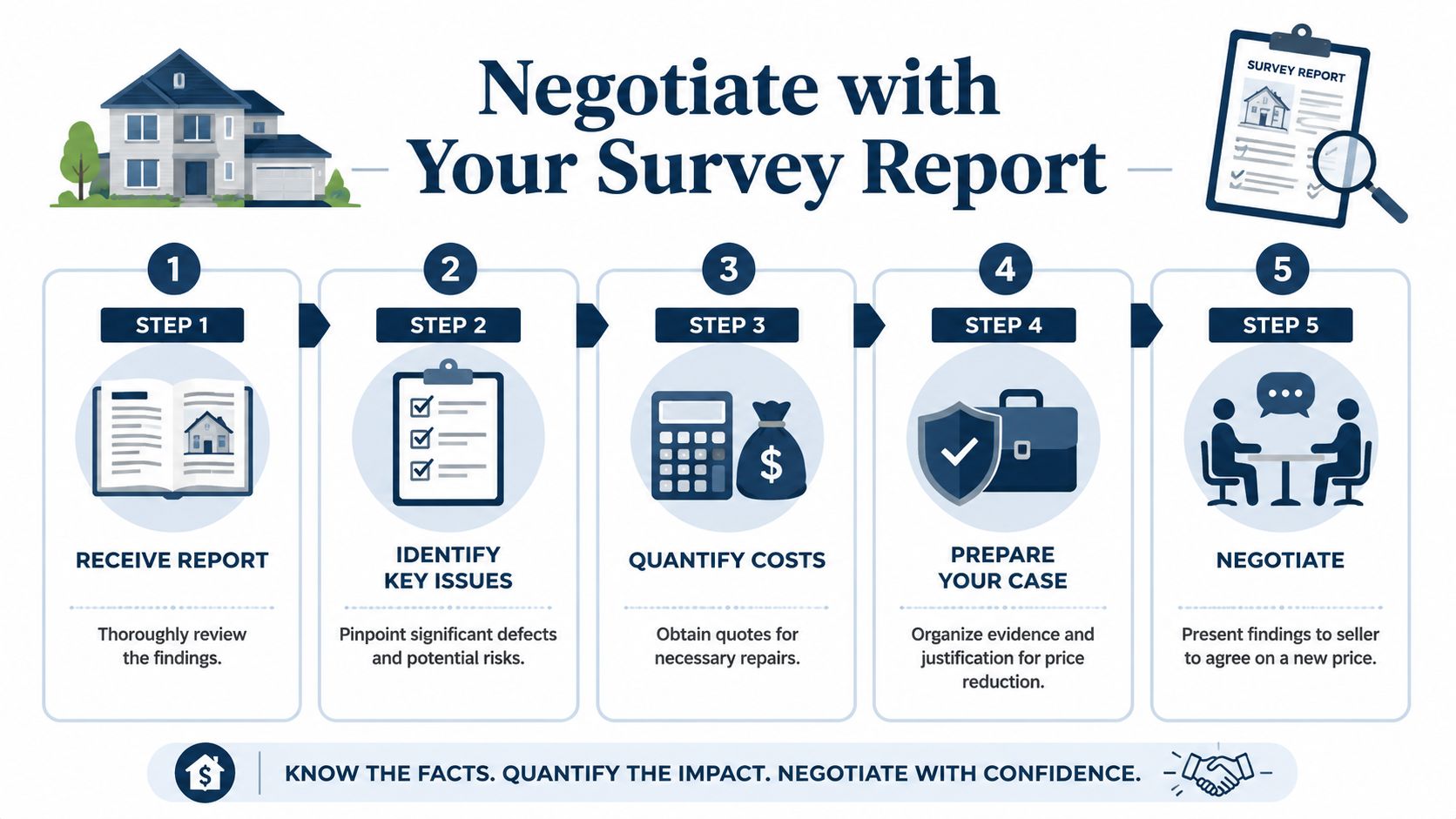
This buyer guidance states that first-time buyers in London and the South of England who skip a professional survey face estimated unforeseen repair costs of £5,000 to £10,000 immediately after purchase. That's why you don't file the report away and carry on as if nothing happened.
What to do when the report lands
Read the summary first. Then isolate the issues that affect cost, safety or mortgageability.
Don't argue about every loose tile or stiff window. Focus on the defects that justify a change in price or a pause in the transaction.
- Mark the major items: Roof repairs, damp ingress, movement, timber decay, unsafe electrics and poor alterations.
- Get repair quotes: One or two sensible contractor estimates are usually enough to frame the discussion.
- Speak to your solicitor or agent: Keep the request factual and evidence-based.
Later in the process, this sort of practical breakdown can help:
How to make a sensible case to the seller
If the report identifies defects with real cost attached, go back with a revised offer and the reasons behind it. Keep emotion out of it.
A short, clear note works better than a rant. State the issue, attach the relevant page or summary from the survey, attach quotes if you have them, and propose the reduction.
Buyer advice: Ask for a reduction that matches evidence, not a random figure you hope will stick.
Keep your eye on the right defects
Negotiation works best when the issues are objective. A cracked render patch might not move the needle. Roof covering failure, damp penetration or structural movement usually will.
Independent reports help here because they aren't written to please the seller, the estate agent or the lender. They're written so you can make a decision with your eyes open.
How to Choose a Reputable Surveyor in London
Not all surveyors are the same. Some know London housing properly. Some don't. Some work independently. Some are tied too closely to the transaction.
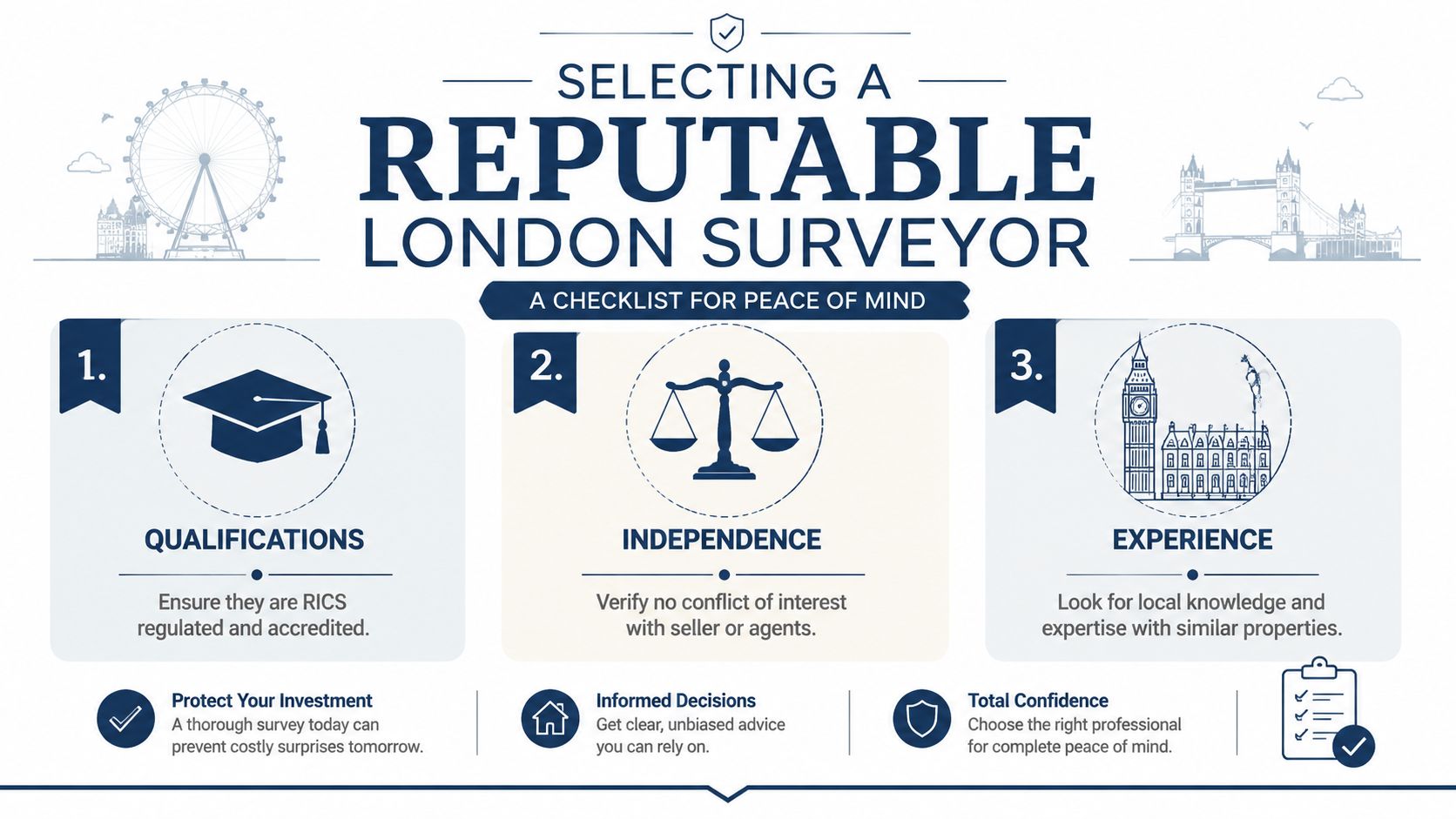
London buyers need three things from a surveyor: qualification, independence and local knowledge.
What to check before you instruct anyone
Start with regulation. If the survey is meant to carry weight, the surveyor should be RICS regulated. If they also hold CABE credentials, that adds useful building expertise, especially on older or altered homes.
Then check independence. You want someone with no ties to the lender, estate agent or developer. That matters because the advice needs to be for you, not shaped by anyone else's interests.
Local knowledge comes next. A surveyor who regularly works in Lewisham, Greenwich, Southwark, Bromley, Croydon and the surrounding boroughs will know the common defects in Victorian terraces, inter-war semis and converted flats.
Ask these questions before you instruct:
- Are you RICS regulated: If the answer is vague, move on.
- Do you know this property type: A listed house in Blackheath isn't the same as a 1990s flat in Docklands.
- Are you independent: You want a clear no-ties answer.
- Who will inspect the property: Make sure the named surveyor has the right experience.
- Which report do you recommend and why: A decent surveyor will justify the level clearly.
If you want a sharper checklist before deciding, this guide to choosing a building surveyor in London without wasting time or money is worth reading.
Good survey advice sounds calm, specific and plain. If it sounds slippery, keep looking.
A Survey Is Your Best Financial Protection
Buying a house without a survey is like signing a contract for repairs you haven't seen yet. That's the blunt version.
The survey gives you three things. It tells you what's wrong, what needs further checking and where you've got room to renegotiate. That's why it's one of the few costs in the buying process that can pay for itself.
It also gives you clarity. You may still decide to buy a property with defects. Plenty of buyers do. The difference is that you're choosing it with open eyes and a realistic budget.
Once the purchase is moving, practical planning matters as well. If you're organising the move itself, Emmanuel Transport's Perth guide is a decent example of the sort of logistical checklist people often forget until the last minute. Different market, same lesson. Property transactions go better when you plan the awkward bits early.
If you want plain advice, use an independent surveyor who knows London stock and isn't trying to keep the deal sweet for someone else. That's the sensible route.
If you need to talk it through before you instruct the right report, call 0800 00 16 422 and ask the practical questions first. That's always better than ordering the wrong survey.
Frequently Asked Questions
Do I need a survey on a new-build house
Yes, I would still advise it. New doesn't mean fault-free.
A new-build can still have poor finishes, defects in workmanship, drainage issues or items that were missed before handover. A warranty is useful, but it isn't the same as having an independent professional inspect the property for your benefit.
Can I use the seller's old survey
No, not as a basis for your own decision.
An old report may be out of date, it may not reflect later alterations and it wasn't prepared for you. If work has been done since the report was written, the risk changes. You need current advice tied to the property as it stands now.
Do I need a survey when buying a flat
Yes. Buyers often assume the freeholder or managing agent deals with the building, so the survey matters less. That's a mistake.
With flats, you still need to know about internal defects, signs of movement, damp, roof issues affecting top-floor flats, condition concerns in common parts and clues that expensive works may be coming.
Which survey is usually right for a Victorian house in London
Usually a Level 3 Building Survey.
Victorian houses in places like Lewisham, Brockley, Nunhead and Crystal Palace often have age-related defects, later alterations and materials that need experienced interpretation. That's not the place to economise on the report.
If you're buying in London and want plain, independent advice from an RICS-regulated practice, Corinthian Surveyors London LTD is based in Forest Hill and covers all London boroughs, the Home Counties and the South of England. Clive Thompson holds RICS and CABE qualifications, the firm has no ties to lenders, estate agents or developers, and the job is simple: help you understand the property's condition before you commit.