
Full Structural Survey: 2026 Guide to London Home
If you search for a full structural survey, most of the advice online starts in the wrong place. It treats that phrase as if it's still the proper name for a standard survey product. It isn't.
In plain English, what most London buyers mean by a full structural survey is usually a RICS Level 3 Building Survey. That's the one you want to ask about first. If you ask for the wrong thing, you can end up paying for a report that doesn't answer the specific question you have.
Table of Contents
- The 'Full Structural Survey' Terminology Trap
- What a RICS Level 3 Building Survey Includes
- Building Survey Level 3 vs HomeBuyer Report Level 2
- The Survey Process From Enquiry to Report
- Common Defects Found in London Properties
- Costs, Timescales and Survey Limitations
- How to Choose Your RICS Surveyor
- Frequently Asked Questions
The 'Full Structural Survey' Terminology Trap
The term full structural survey is old-fashioned. Buyers still use it all the time, but the industry has moved on. In current UK guidance, the intended meaning is a RICS Level 3 Building Survey.
That matters because a Building Survey and a structural engineer's report are not the same thing. Public guidance makes that distinction clearly: many consumers use “full structural survey” to mean a RICS Level 3 Building Survey, but a true structural survey by an engineer is narrower and focuses on structural integrity rather than the whole condition of the property, as explained by Allcott Associates on structural surveys.
What buyers usually mean
If you're buying a house in Forest Hill, Greenwich, Peckham or Bromley and you say, “I want a full structural survey,” you're usually asking for a survey that looks at the whole property, not just whether a wall is load-bearing or whether a crack is movement.
You want someone to inspect the visible and accessible parts of the building, tell you what's wrong, what's risky, what needs repair and what needs another specialist involved.
Practical rule: If you want advice on the overall condition of the home before exchange, ask for a RICS Level 3 Building Survey.
When you actually need an engineer
If the property already has a known issue, that's different. Say a rear wall is bowing, a chimney breast has been removed without obvious support, or a loft conversion raises questions about load paths. In that case, you may need a structural engineer's report after the surveyor flags the concern.
That's the trap. Buyers often order the narrower report first, then realise it doesn't cover the rest of the property. They still don't know about damp, timber decay, roof defects, drainage warning signs or poor alterations.
In London, where so much stock is Victorian, Edwardian, converted or altered, that's a mistake.
What a RICS Level 3 Building Survey Includes
A RICS Level 3 Building Survey is the closest modern equivalent to what buyers call a full structural survey. It's the most thorough pre-purchase survey, giving you a detailed technical report on the property's construction, condition, serious risks and repair options. Consumer guidance also notes typical pricing from £630 to £1,500+ for this level of survey, reflecting the depth involved, according to the HomeOwners Alliance guide to survey types.
What the surveyor is actually looking at
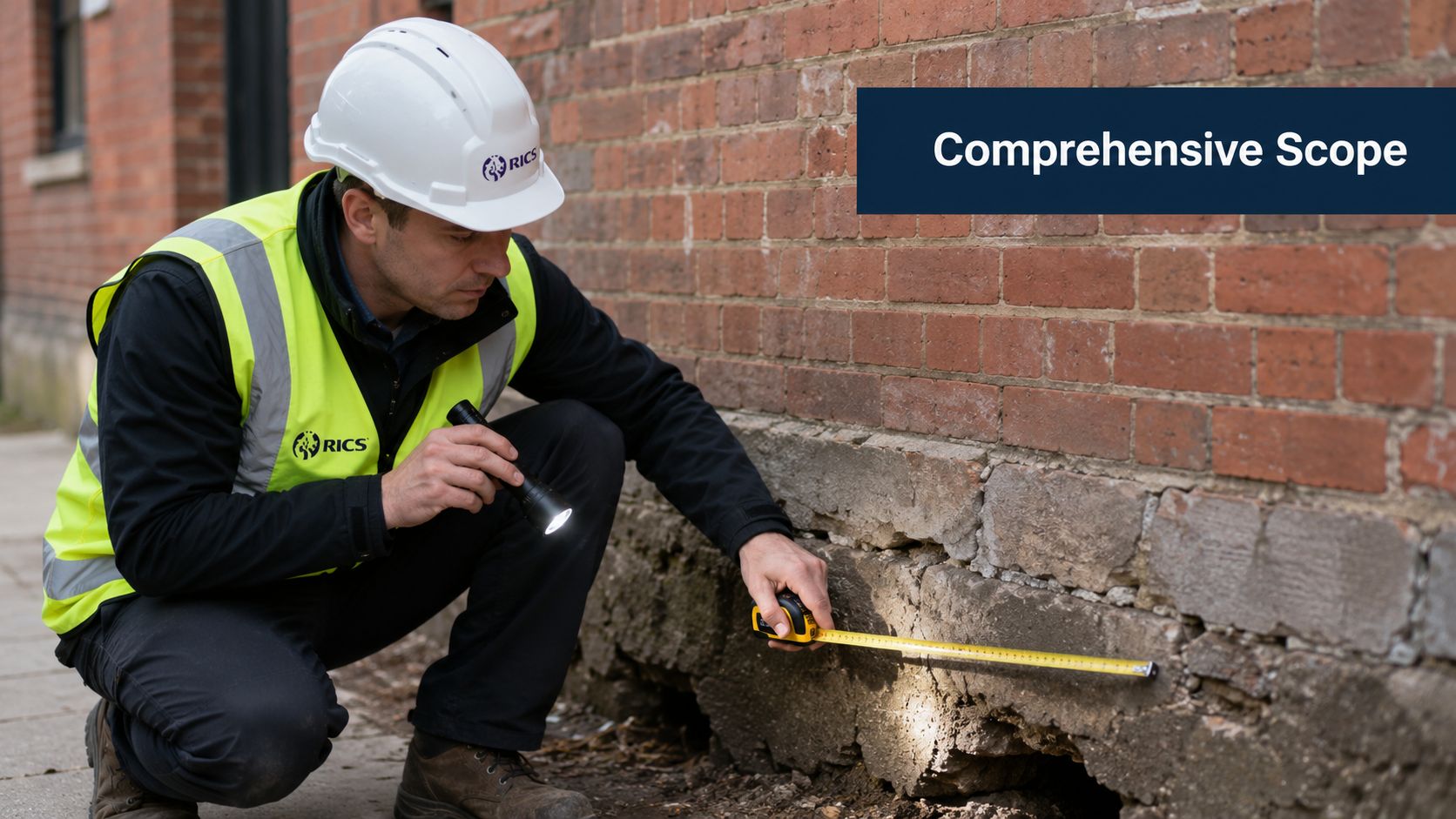
This isn't a quick glance with a clipboard. A proper Level 3 looks in depth at the visible and accessible parts of the building, including the structure, external fabric, internal condition, services and grounds.
That means things such as:
- Roof coverings and structure, including signs of ageing, failure, patch repairs and water entry
- Walls and movement, including cracking patterns, distortion and past alteration
- Floors and timber, looking for spring, decay, poor support and ventilation issues
- Moisture defects, such as damp penetration, condensation risk and possible hidden moisture paths
- Joinery and finishes, where defects can point to larger underlying problems
- Alterations and extensions, especially where workmanship or approval history looks questionable
A lot of buyers confuse this with a mortgage valuation. Don't. A mortgage valuation is for the lender. It tells you very little about the actual condition of the building.
Why this level matters in London
In London, the awkward jobs are common. Split-level conversions in Southwark. Basement flats in Lambeth. Victorian terraces in Lewisham with a loft conversion, steelwork hidden in boxed ceilings and chimney breasts removed at some point by somebody with more confidence than judgement.
That's exactly where a Level 3 earns its keep. It goes beyond a condition tick-box and gives you practical advice on defects, likely causes, repair priorities and what happens if you leave things alone.
A good Building Survey should help you decide whether to proceed, renegotiate or walk away.
If you want a plain-English overview of survey types before choosing, this explanation of what a RICS survey is is a sensible place to start.
What it does not do
It's still a visual, non-intrusive inspection. The surveyor won't start opening up walls or lifting fitted floor finishes just to satisfy curiosity.
That doesn't make the survey weak. It makes it realistic. The point is to identify the warning signs early enough for you to make a sound buying decision.
Building Survey Level 3 vs HomeBuyer Report Level 2
Most buyers don't need more jargon. They need the right survey for the right property.
If the home is older, altered or a bit of an unknown, a Level 3 Building Survey is usually the correct call. Guidance on survey choice makes that clear. A Level 3 is designed for larger, older or significantly altered properties because the wider scope increases defect detection and makes it more suitable where condition risk needs to inform negotiation or repair planning, as set out by Hogbens on Level 3 vs structural survey differences.
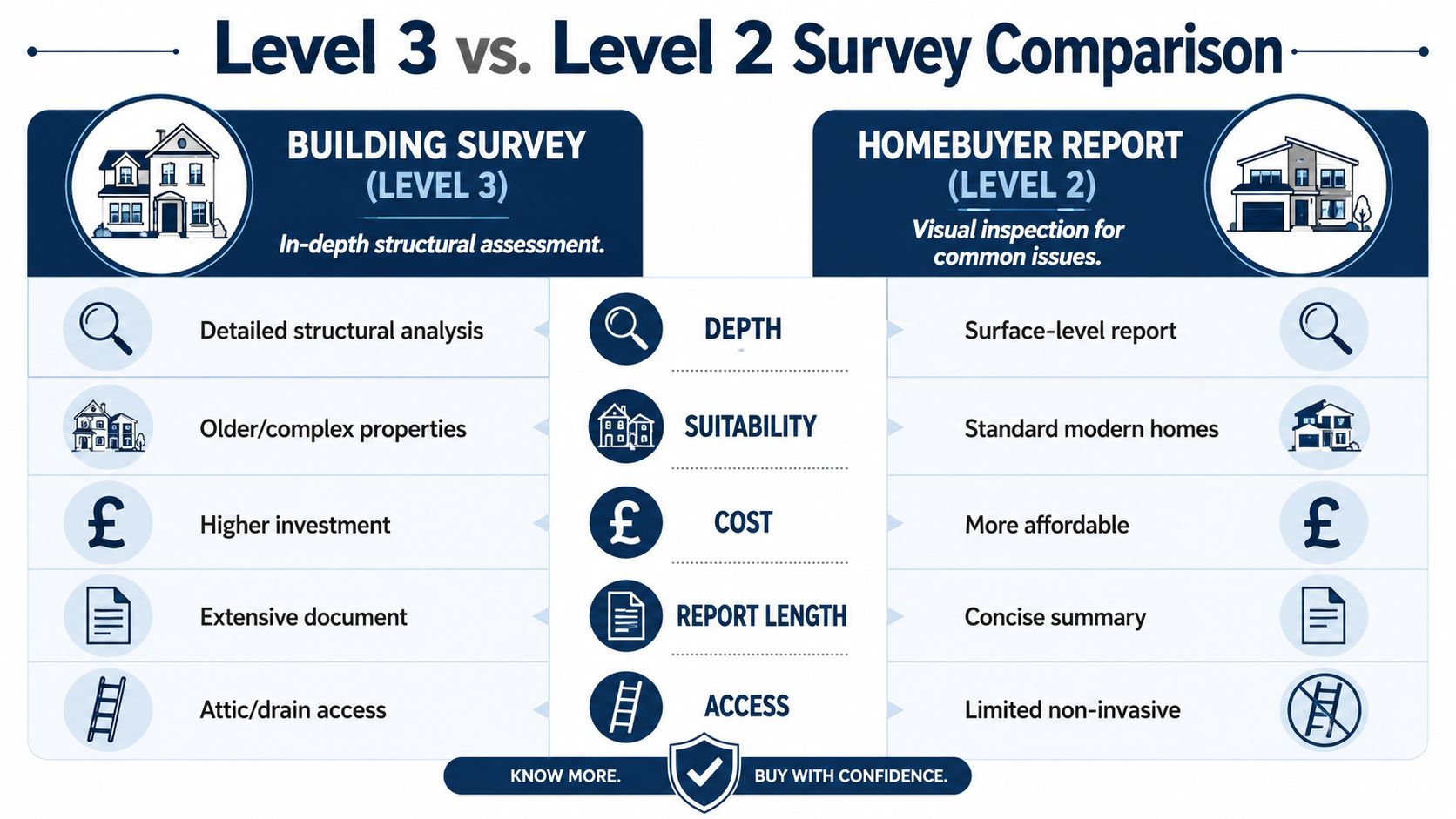
RICS Survey Level 2 vs Level 3 at a Glance
| Feature | RICS Level 2 HomeBuyer Report | RICS Level 3 Building Survey |
|---|---|---|
| Best for | Conventional homes in reasonable condition | Older, altered, larger or more complex homes |
| Depth of inspection | Visual inspection for common issues | Far more detailed inspection of visible and accessible elements |
| Report detail | Briefer and more standardised | Detailed technical reporting with explanation |
| Repair advice | Limited | More developed advice on risks, repairs and priorities |
| Ideal London examples | Modern flat in a standard block | Victorian terrace, conversion flat, period house with alterations |
Here's the simple version.
A Level 2 is often enough for a straightforward flat in a modern Croydon block, or a fairly standard house where construction is conventional and the place hasn't been heavily messed about with.
A Level 3 is the better choice for things like:
- Victorian terraces in Lewisham or Brockley, especially with loft conversions
- Edwardian houses in Dulwich or Blackheath, where age and detailing matter
- Converted flats in Peckham or Camberwell, where structure and fire separation can raise concerns
- Houses with extensions or chimney alterations anywhere in London
This short video helps if you want a visual explanation before you decide:
Don't buy the cheaper survey just because it's cheaper
I'll be blunt. Buyers often try to save money by choosing a Level 2 on a property that plainly needs a Level 3. That's false economy.
If the building is old, heavily altered or clearly carrying risk, the cheaper report can leave you with too many unanswered questions. Then you pay again for more advice later, usually when the transaction has become stressful and time is tight.
If you're already worried enough to type “full structural survey” into Google, you're usually not looking for a Level 2.
The Survey Process From Enquiry to Report
The process is simpler than people think. You don't need to know the whole building pathology of a Victorian terrace before making the call. You just need to give clear property details and say what concerns you have.
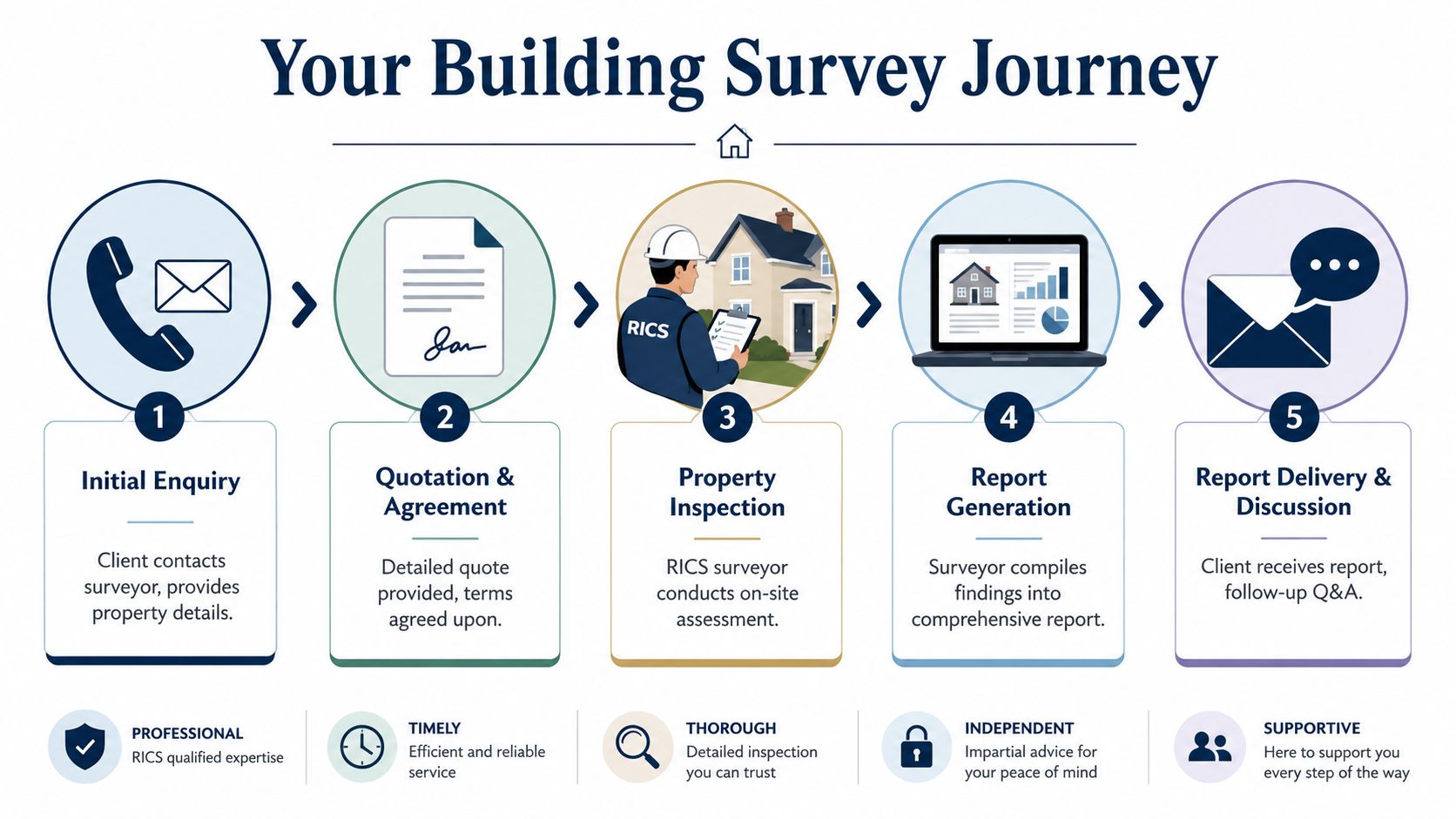
Step by step
Initial enquiry
You give the address, property type, estate agent details and any known concerns. If it's a flat conversion in New Cross or a 1930s semi in Bromley, say so. Construction type matters.Quotation and instruction
You receive the fee, terms and scope. Read them. A proper instruction should tell you what type of survey is being carried out and what it covers.Access arrangement
The surveyor or office contacts the estate agent or seller to arrange access. Buyers don't usually need to attend.Inspection day
The surveyor inspects the property. On a more involved house, that can take several hours. Large or complicated buildings take longer because there's more to inspect and more to think through.Report and follow-up
You receive the report, then you ask questions. You should ask questions. A report isn't there to frighten you. It's there to help you decide what to do next.
What happens on site
A competent surveyor doesn't just note defects. He interprets them. Is that crack old and stable, or part of an ongoing pattern. Is the damp likely condensation, penetration or something more awkward. Is the rear addition serviceable, or does it look like a rushed build with weak detailing.
That judgement is the value.
For clients using a firm like Corinthian Surveyors London LTD, the practical difference is that the survey is carried out by an independent RICS-regulated practice with residential focus across London, rather than a lender panel system tied to someone else's priorities.
What you should do after the report lands
Don't stare at the worst photograph and panic. Read the summary first. Then pull out the points that affect:
- Safety
- Cost
- Negotiation
- Further reports needed
- Your appetite for work after purchase
That's how buyers keep control of the process.
Common Defects Found in London Properties
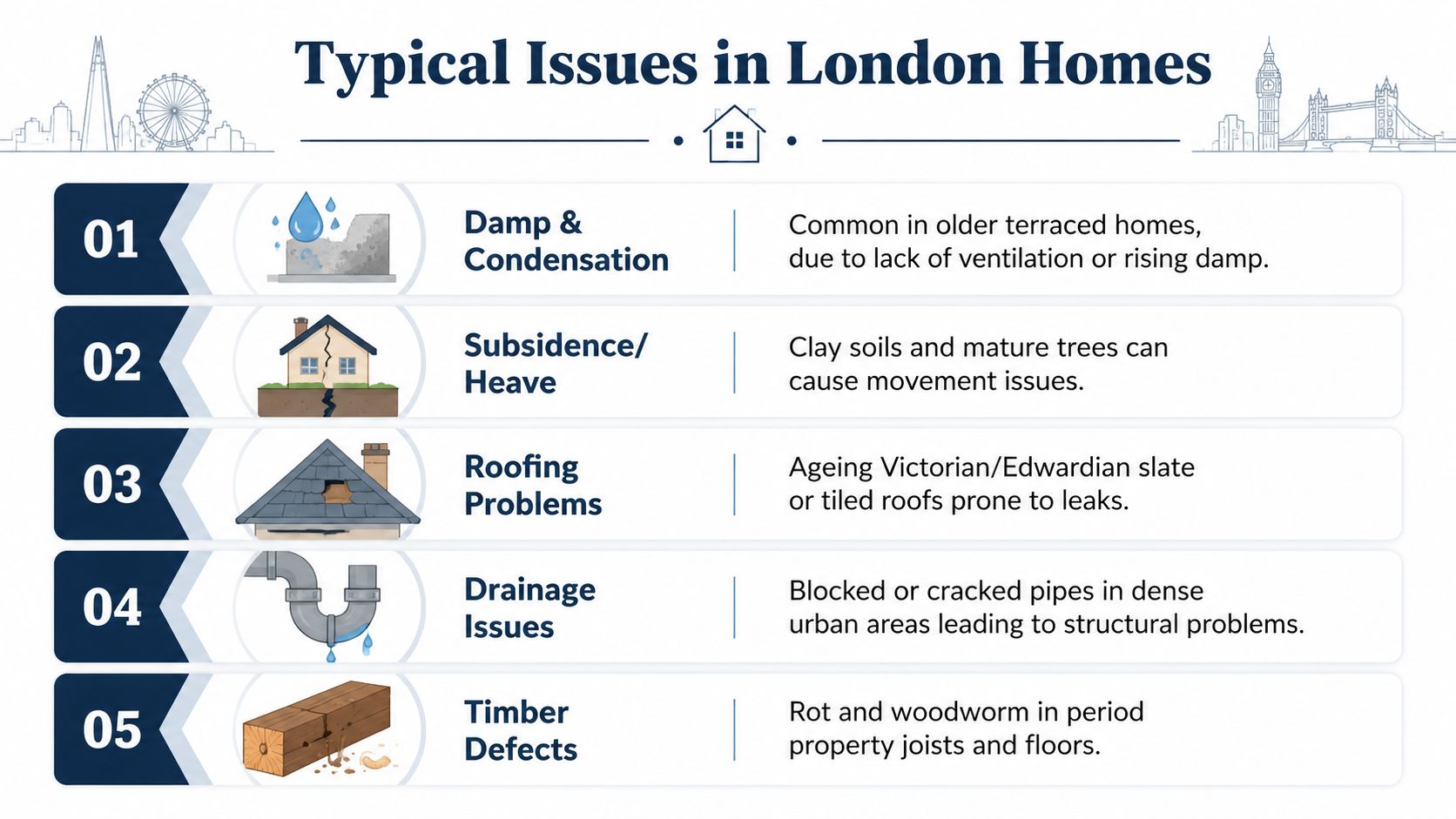
London property is never just “a house”. It's a housing type, a period, a borough, a ground condition and a long history of alterations piled on top of each other.
That's why local knowledge matters. The defects you expect in a Victorian terrace in Catford are different from the ones you'd look for in a Bermondsey warehouse conversion or a 1930s semi in Sidcup.
Damp and moisture problems
Basement and lower-ground properties in Lambeth, Southwark and parts of Greenwich often show some form of moisture trouble. Sometimes it's true penetration. Sometimes it's condensation caused by poor heating and ventilation. Sometimes it's bridging or external ground levels set too high.
The danger is not just the damp mark itself. It's the hidden consequence, timber decay, damaged finishes and a house that has been cosmetically dressed for sale.
Structural movement and clay soil issues
Movement turns up across London in different forms. You see it in stepped cracking, sloping floors, distorted openings and old repairs that may or may not have addressed the cause.
Areas with clay subsoil and mature trees need careful reading. So do houses where extensions have been bolted on years later with different foundations and mixed workmanship.
Old movement isn't always a crisis. Ongoing movement is a different matter. A surveyor's job is to tell the difference as far as visible evidence allows.
Roof defects and neglected maintenance
On period terraces in places like Greenwich, Sydenham and Brockley, roof defects are common. Slipped coverings, ageing flashings, tired parapet details and poor patch repairs all let water in eventually.
Buyers often miss roof problems because they're looking at kitchens and bathrooms. The roof can be causing hidden damage that is more expensive than the whole of the cosmetic work downstairs.
Alterations done badly
London's properties offer a wide range of challenges for surveyors: Removed chimney breasts. Knocked-through reception rooms. Loft conversions with awkward support assumptions. Rear additions where drainage, ventilation or roof detailing wasn't thought through properly.
If you're planning works after purchase, this guide on dealing with renovation structural problems is useful background because it shows how structural concerns can escalate once work starts. And if a property has had chimney alterations, it's worth understanding the compliance side through this note on building regulations for chimney breast removal.
Timber and floor issues
Period homes across Peckham, Forest Hill and Camberwell often conceal timber defects under coverings and furniture. Suspended timber floors can suffer from poor ventilation, damp sub-floor conditions and localised decay. You may only see the clues, not the full extent, during a pre-purchase inspection.
That's one reason a Level 3 survey is so useful. It helps you spot the pattern, not just the isolated symptom.
Costs, Timescales and Survey Limitations
Let's deal with the practical side.
UK pricing guidance puts a building survey around £500 to £1,500, depending on property size and complexity, and notes that costs rise on the homes with the greatest structural uncertainty, according to the Checkatrade guide to structural survey costs. That fits real life. A larger, older or materially altered London property takes more inspection time and more reporting time.
Why one quote is higher than another
Survey fees aren't pulled from thin air. The price reflects the work involved.
A small, straightforward flat is one thing. A tall Victorian house in Nunhead with a rear return, converted loft, signs of movement and patchy maintenance is another. The second property creates more risk for the buyer and more work for the surveyor.
That's exactly where trying to shop on fee alone goes wrong.
How long it usually takes
The inspection is not the whole job. The report writing is where much of the professional judgement is set out properly.
A more involved property can take several hours to inspect. The written report then follows after the surveyor has reviewed notes, photographs and defect patterns. If specialist input is needed, the report should say so clearly rather than pretending certainty where there isn't any.
The limits buyers need to understand
A Building Survey is a visual and non-intrusive inspection. That means there are things a surveyor cannot confirm without opening up the structure or bringing in a specialist.
Common examples include:
- Concealed structure behind finishes or built-in joinery
- Drainage condition, unless there are visible clues that justify a CCTV recommendation
- Electrical testing, which needs a qualified electrician
- Gas and heating checks, beyond visible inspection and general comment
- Hidden damp routes where access is restricted
A survey is a decision tool, not a hidden-defects guarantee.
There's nothing weak about that. It's the honest limit of a pre-purchase inspection. Good surveyors say where the boundary is, then tell you what to do next.
How to Choose Your RICS Surveyor
Don't overcomplicate this. Choose the person, not just the logo.
You want a surveyor who is RICS regulated, properly insured and experienced with the sort of property you're buying. In London, local knowledge is not a bonus. It's part of the job.
What to check before you instruct
Use this checklist:
- Qualifications: Look for RICS membership, and where relevant built environment credentials such as CABE
- Independence: Avoid anyone tied to the estate agent, lender or developer if you want impartial advice
- Local experience: Ask whether they regularly inspect the kind of stock you're buying in your borough
- Report style: Ask if the report is written plainly enough for a non-technical buyer to use in negotiation
- Insurance and regulation: Proper professional cover matters
On insurance, many buyers understand buildings insurance but not professional risk. If you want a plain-English explanation of liability cover in the wider trades context, this note from Electricians London 247 on public liability is a useful primer on why insured professionals matter.
The question I'd ask first
Ask this: Do you regularly inspect this exact type of property in this area?
A surveyor with decades of London experience will read a Victorian conversion in Brockley differently from a modern flat in Stratford. That judgement comes from repetition, not theory.
Clive Thompson of Corinthian holds RICS and CABE qualifications and has more than 30 years in the built environment. If you want a sensible checklist before appointing anyone, this guide on how to choose a building surveyor in London without wasting time or money is worth reading.
The final point is simple. An independent surveyor with no ties to lenders, estate agents or developers is far more likely to tell you the truth you need, not the version that keeps a transaction moving.
Frequently Asked Questions
Is a full structural survey the same as a Level 3 survey
Most of the time, yes, that's what buyers mean. The modern term is RICS Level 3 Building Survey. The phrase full structural survey is still widely used, but it's outdated and can cause confusion with engineer-only reports.
Should I get a structural engineer instead of a surveyor
Not as your first step in most purchases. Start with a Building Survey if you need an overall condition assessment. Bring in a structural engineer when the survey identifies a specific structural concern that needs deeper analysis or design input.
Will a Level 3 survey include repair costs
It should give repair advice, priorities and the likely implications of defects. It is not the same as a builder's quotation or a schedule of works priced line by line.
Can a survey miss hidden problems
Yes. Any pre-purchase survey has access limits. If floors are covered, loft areas are blocked, or alterations hide critical parts of the structure, the surveyor can only comment on what is visible and accessible. That's also why buyers planning major remodelling should look at the design side early. For broader renovation thinking, the articles on FP Architects' design solutions are useful reading.
If you're buying in London and you're not sure whether you need a Level 2, a Level 3 or a separate engineer's report, speak to Corinthian Surveyors London LTD before you instruct the wrong service. A short conversation can usually sort that out quickly. Call 0800 00 16 422 and explain the property, the borough and any concerns you already have.