
How Long Does a RICS Valuation Last in the UK
There is no single expiry date for a RICS valuation. The figure is fixed to a stated valuation date, and its usable life depends on the purpose, the lender or client's rules and how quickly local market evidence changes.
So, how long does a RICS valuation last if a buyer, executor or solicitor needs to rely on it later? The plain answer is that you must look beyond the date printed on the report. A valuation of a Victorian terrace in Forest Hill, a converted flat in Peckham or a 1930s semi in Bromley is an opinion of value at a particular point in time, not a permanent certificate.
I'm Clive Thompson, a RICS Chartered Surveyor and Valuer with over 30 years in the built environment. I'll explain what the valuation date means, how different instructions are treated and when you should commission an update.
Table of Contents
- Why There Is No Single Expiry Date for a RICS Valuation
- The Valuation Date and Why It Matters
- How Long Different Valuation Types Last in Practice
- What Shortens or Extends the Life of a Valuation
- Mortgage Valuation Versus Full Market Valuation
- Regulated Purpose Valuations and Rotation Rules
- When to Commission a Revaluation and How to Extend One
- Getting the Right Advice on Valuation Validity
Why There Is No Single Expiry Date for a RICS Valuation
A RICS valuation doesn't come with one universal shelf life. The RICS UK National Supplement took effect on 1 May 2024 and applies to valuations where the valuation date is on or after that day. The rule anchors the opinion to a date, rather than creating a nationwide expiry period.
That distinction matters. A report prepared for a mortgage lender serves a different purpose from one prepared for probate, Capital Gains Tax, matrimonial proceedings or a shared ownership staircasing application. The person or organisation relying on the report may impose its own freshness requirements.
Three questions usually decide whether an existing figure remains usable:
- What was the instruction? A formal tax or court valuation needs to meet the requirements of that specific purpose.
- Who will rely on it? A lender, solicitor, court, HMRC or housing provider may have its own rules.
- Has the evidence moved? Recent comparable sales can make an older opinion less persuasive, particularly in a tightly traded London micro-market.
Practical rule: A valuation can remain a valid record of value at its stated date while becoming unsuitable for a later transaction.
A quiet market may leave comparable evidence broadly consistent for some time. A fast-moving market can make a figure feel dated much sooner. That's why I'm wary when someone asks for a simple answer such as “six months” without saying what the valuation is for.
The report's formal status and its practical usefulness aren't always the same thing. The formal date remains fixed. Reliance on the figure must be judged against the purpose and the evidence available when it's needed.
The Valuation Date and Why It Matters
The valuation date is the date to which the surveyor's opinion of value applies. RICS guidance describes it as the date on which the opinion of value applies, including the relevant time where that's necessary. The figure therefore reflects the property, market conditions and evidence considered at that point.
The date should be clear in the report. It may correspond with the inspection, although the instruction can require a different date. That's common in retrospective work, such as a Capital Gains Tax valuation or a valuation connected with an earlier probate event.
Two reports on the same house can produce different figures a month apart without either surveyor having made an error. The evidence may have changed. A nearby sale may have completed. The property may have been altered. Buyer demand may have shifted. The surveyor's conclusion belongs to the relevant date, not to every later date.
The date anchors formal work
For probate, the date connects the valuation to the estate's circumstances at the relevant point. For matrimonial work, it helps the parties and their advisers understand what the property was worth at the instructed date. For HMRC-related work, the report must be prepared for the correct tax purpose and date.
A lender uses the date differently. It wants confidence that the security remains adequate for the lending decision. A buyer may want to know what the property is worth now. Those are related questions, but they aren't identical.
Read an old valuation as historical evidence first. Treat it as a current figure only after the intended recipient confirms it can still be relied upon.
The RICS valuation standards reinforce the point that the opinion applies to a specific valuation date. The longer the gap before reliance, the more carefully you should test the market evidence, the property's condition and the requirements of the recipient.
How Long Different Valuation Types Last in Practice
Different valuation instructions have different practical expectations. There isn't one answer that covers a lender's security check, a probate report and a shared ownership application.
The clearest published benchmark comes from GOV.UK. For a UK Help to Buy transaction, the Help to Buy valuation guidance says the report is valid for 3 months from the date it was produced and must be sent within 5 days. If it expires, the guidance allows an extension by 1 month or a desktop valuation that is also valid for 3 months. It also allows an expired report to be extended for 3 more months from the date it expired when updated evidence is accepted.
That can create a practical maximum window of up to 6 months in some Help to Buy cases. It's a transaction rule, not a universal RICS rule.
| Valuation type | Typical usable window | Common trigger for revaluation |
|---|---|---|
| Mortgage valuation | Set by the lender and mortgage offer | The offer expires, the lender requests a refresh or market evidence changes |
| Help to Buy valuation | 3 months from production, subject to the published process | The report expires or the transaction is delayed |
| Probate and Inheritance Tax valuation | Depends on the estate process and market stability | A significant delay, changed property condition or request from the adviser or authority |
| Shared ownership staircasing valuation | Set by the housing provider and the scheme rules | The report falls outside the provider's acceptance period |
| Matrimonial separation valuation | Set by the solicitor, court timetable or instruction | The hearing or settlement is delayed or the property changes |
| Capital Gains Tax valuation | Tied to the instructed tax date | The date or purpose changes, or a later transaction needs a current figure |
The table gives working guidance, not guarantees. A probate valuation may remain useful as evidence of value at the required date even when it shouldn't be reused as a current sale valuation. A staircasing provider may reject a report that another recipient would still regard as professionally sound.
Ask the recipient before commissioning the report. That single step prevents many avoidable revaluations.
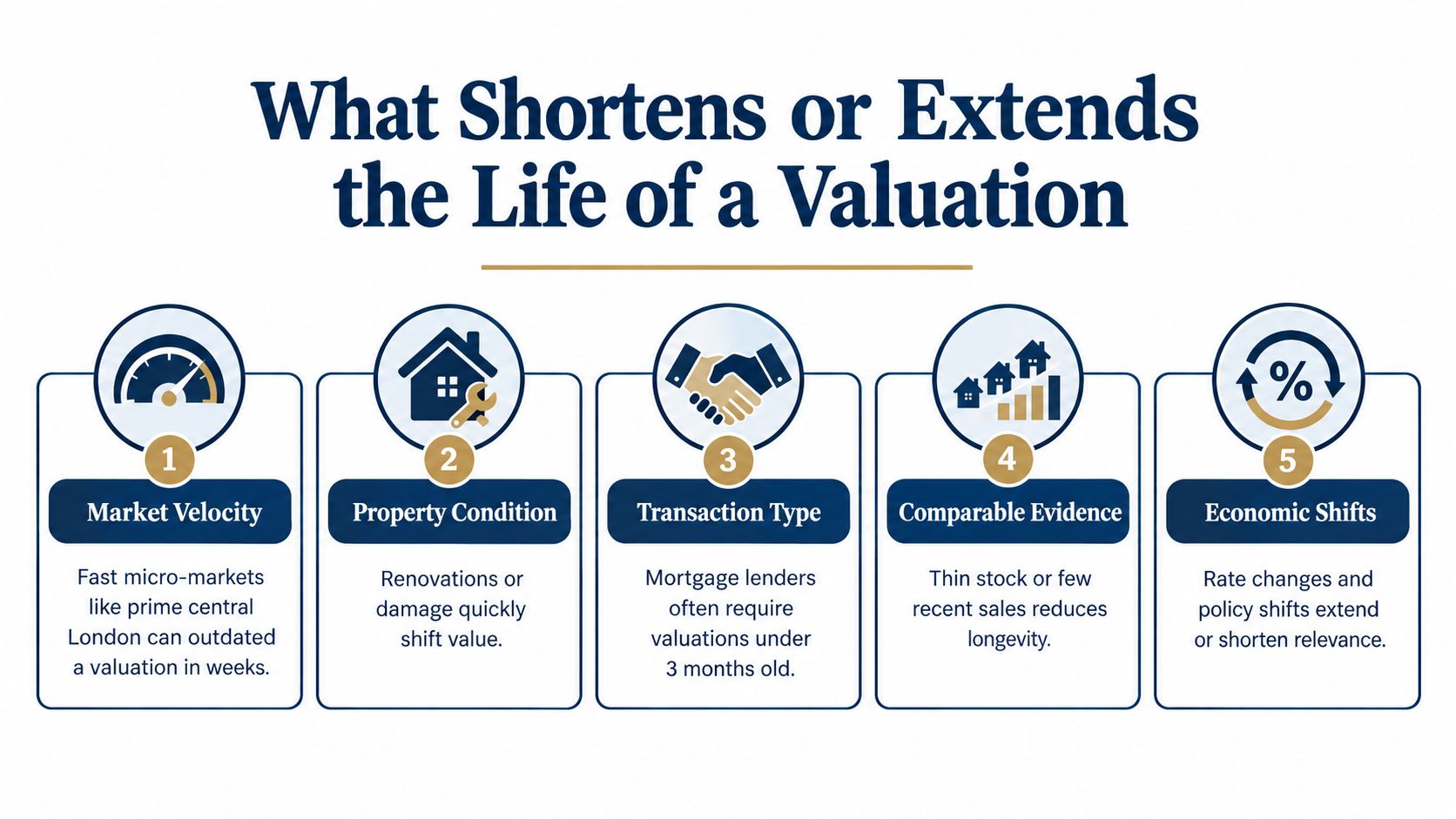
What Shortens or Extends the Life of a Valuation
A valuation stays useful when three things remain aligned: the local evidence, the physical property and the purpose of the instruction. Change one of them and the figure may need a closer look.
Market movement is only part of the answer
London evidence can vary sharply from one street to the next. A Victorian terrace in Brockley may not track a converted warehouse flat in Bermondsey. A period house in Blackheath may have a different buyer pool from a modern apartment in Woolwich.
The number and quality of comparable sales matter. Thin evidence makes a valuation more dependent on professional judgement. Several relevant, recent transactions in a stable market can support reliance for longer.
The property itself can also change:
- Alterations: An extension, loft conversion or basement excavation can alter accommodation and value.
- Condition: Subsidence, serious damp, flooding or timber decay can change the risk profile.
- Improvements: A kitchen refit or energy upgrade may affect the comparison with the inspected property.
- Legal or planning matters: A new planning restriction, enforcement issue or reclassification can affect reliance.
Macroeconomic and policy changes can shorten relevance quickly. A lender may change its requirements. A housing scheme may impose a different process. Planning or taxation rules may alter the reason the valuation was commissioned.
A desktop update is not the same as a fresh inspection. An update may be suitable where the property is unchanged and the original surveyor can verify current evidence. A new inspection is the safer route where condition, layout or legal circumstances have changed.
The embedded explanation below provides another way to think about the issue.
RICS doesn't set one clock that overrides these factors. The practical life of the report comes from the intersection of market conditions, property facts and purpose.
Mortgage Valuation Versus Full Market Valuation
People often use “mortgage valuation” and “RICS valuation” as if they mean the same thing. They don't.
A mortgage valuation is commissioned for the lender. Its central question is whether the property provides suitable security for the proposed loan. It may be arranged through a lender's panel or supported by an automated process, and it may not give the buyer a detailed account of damp, roof defects, timber decay or structural movement.
A full market valuation is prepared for a named client and a defined purpose. It may support a purchase, remortgage, probate matter, matrimonial settlement or tax instruction. The report explains the basis of the opinion and identifies the date to which it applies.
| Feature | Mortgage valuation | Full RICS market valuation |
|---|---|---|
| Primary user | The lender | The instructed client or defined recipient |
| Main question | Is the property adequate security? | What is the property's market value for the stated purpose? |
| Inspection | May be limited or supported by other methods | Appropriate to the instruction and property |
| Defects | Not necessarily reported in detail to the buyer | Considered where relevant to the valuation |
| Reliance | Governed by the lender's process | Governed by the report purpose, terms and valuation date |
A lender's report may be current enough for its own offer but useless for a probate solicitor. A formal market valuation may be defensible as a historical opinion while still being too old for a lender's current decision.
For a fuller explanation of the distinction, see this guide to mortgage surveyors and valuations.
Don't assume the lender's valuation protects your interests. It protects the lender's lending decision.
If you're buying a period property in Lewisham, a converted maisonette in Sydenham or a flat with unusual lease terms in Southwark, you may need a survey and valuation prepared for you, not just the bank's security check.
Regulated Purpose Valuations and Rotation Rules
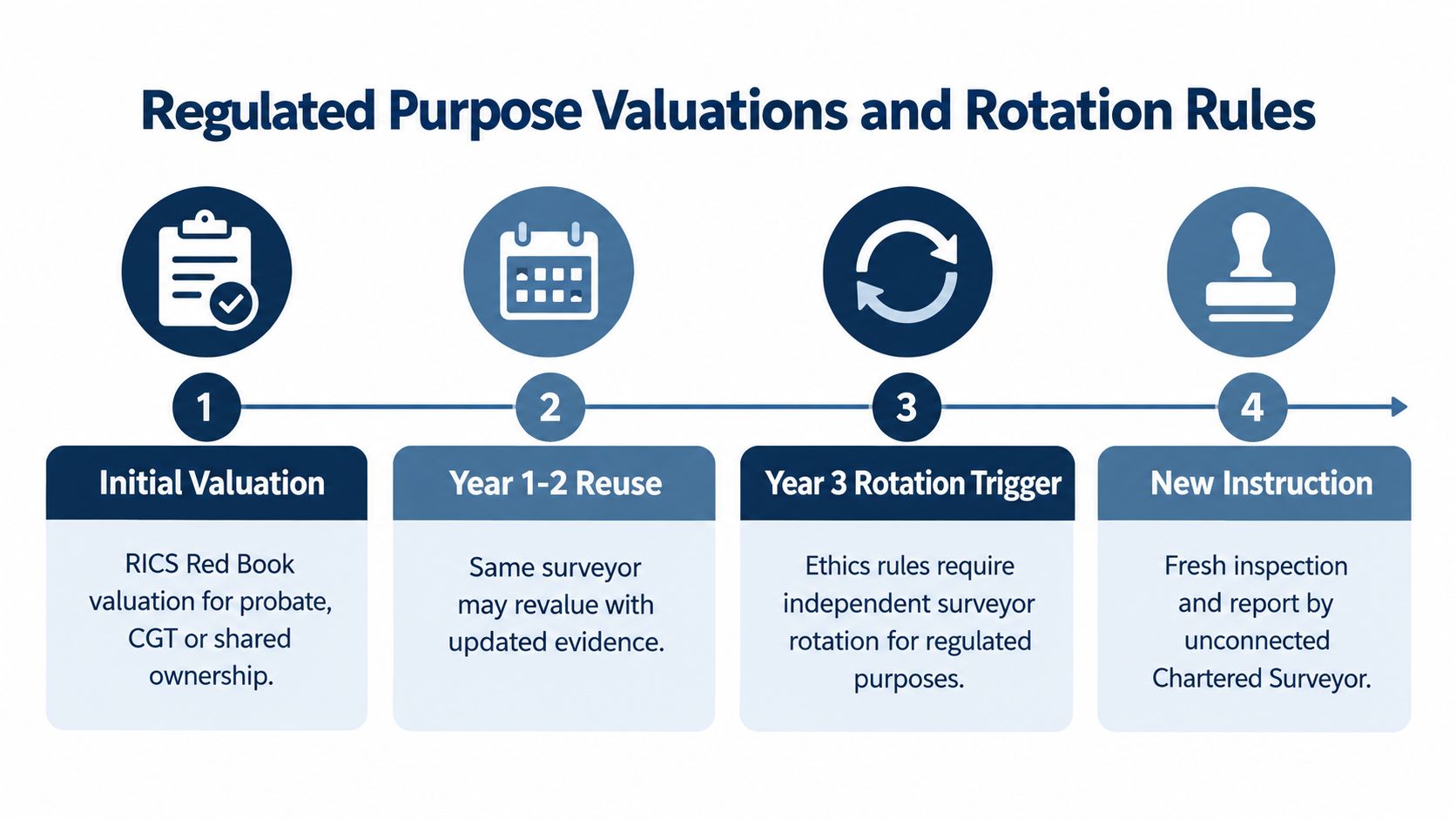
Some valuation work carries additional independence requirements. RICS provides a rotation policy for certain regulated purpose valuations. The RICS Red Book UK guidance states a maximum single engagement period of 5 years, a maximum of 10 years before the valuation firm must rotate and a minimum 3-year break after rotation.
These are rotation rules, not expiry rules. They control who may undertake or sign certain future instructions. They don't mean that an existing report automatically becomes worthless after the engagement period.
Why rotation exists
Rotation protects objectivity. A surveyor who has repeatedly valued the same property or portfolio may become too familiar with earlier assumptions. An independent valuer can challenge the evidence instead of carrying forward a previous conclusion.
The rule can affect probate, Capital Gains Tax, shared ownership and other regulated purpose work. It may also matter where a lender or other institution has its own panel requirements. Your solicitor or scheme administrator should confirm the exact requirement for the instruction.
For probate matters, this explanation of RICS valuation for probate sets out why the purpose and recipient matter.
The practical sequence is straightforward:
- Check the original instruction. Find out whether the work falls within a regulated purpose.
- Check the engagement history. Ask whether the same firm or surveyor has reached the relevant rotation limit.
- Check the recipient's requirements. A solicitor, lender or housing provider may require a new report.
- Commission independent work if required. A fresh instruction may be necessary even where the previous report looks recent.
Clive Thompson holds both RICS and CABE qualifications. Corinthian Surveyors London LTD is regulated by RICS and is a member of the RICS Valuers Registration Scheme. Those credentials matter because formal valuation work requires more than a figure copied from an online estimate.
When to Commission a Revaluation and How to Extend One
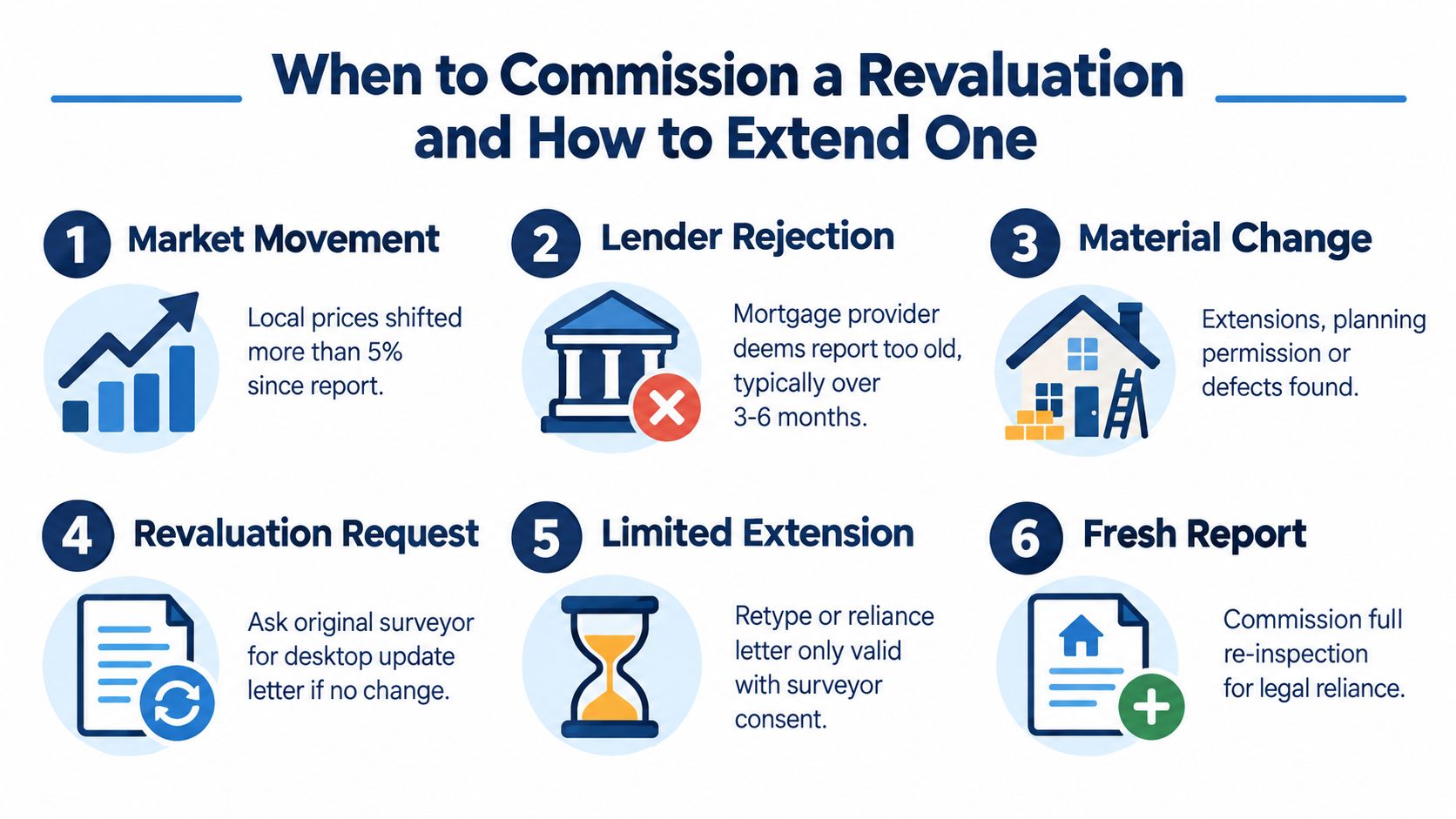
Commission a fresh valuation when the original figure no longer answers the question being asked. Don't wait for a solicitor or lender to reject it if the report is plainly out of date for the transaction.
Start with the recipient. A lender may want a new valuation because its offer has lapsed. A Help to Buy administrator follows the published 3-month validity period and its extension process. A housing provider may have its own staircasing requirements. A court or tax adviser may need the figure tied to a particular date and purpose.
A sensible decision sequence
For probate, keep the original report and ask the executor's adviser whether the valuation date and report remain suitable. If the estate needs a current sale figure, that's a different instruction.
For remortgage, ask the lender whether it accepts the existing report. A lender's valuation process may require its own inspection or update, even when you already have a formal report.
For Help to Buy, work to the published period rather than assuming the report remains usable. Send the report promptly and follow the extension route if the transaction is delayed.
For matrimonial work, ask the solicitor or court timetable whether the original date remains appropriate. A fresh valuation may be needed if negotiations or proceedings have moved on.
For Capital Gains Tax, confirm the required valuation date with the tax adviser. A current market figure can't replace a correctly dated retrospective valuation.
Update or full report
An update letter or confirmation may be possible when the property is unchanged, the original surveyor is satisfied with the evidence and the recipient accepts that format. It isn't something you can create by retyping the old figure.
A full inspection is more appropriate after an extension, major refurbishment, flood, suspected subsidence or material defect. It's also the sensible choice where another professional must rely on the report for legal or tax purposes.
The original surveyor should decide whether an update is adequate. If the recipient won't accept an update, commission a new report and avoid a last-minute dispute.
Getting the Right Advice on Valuation Validity
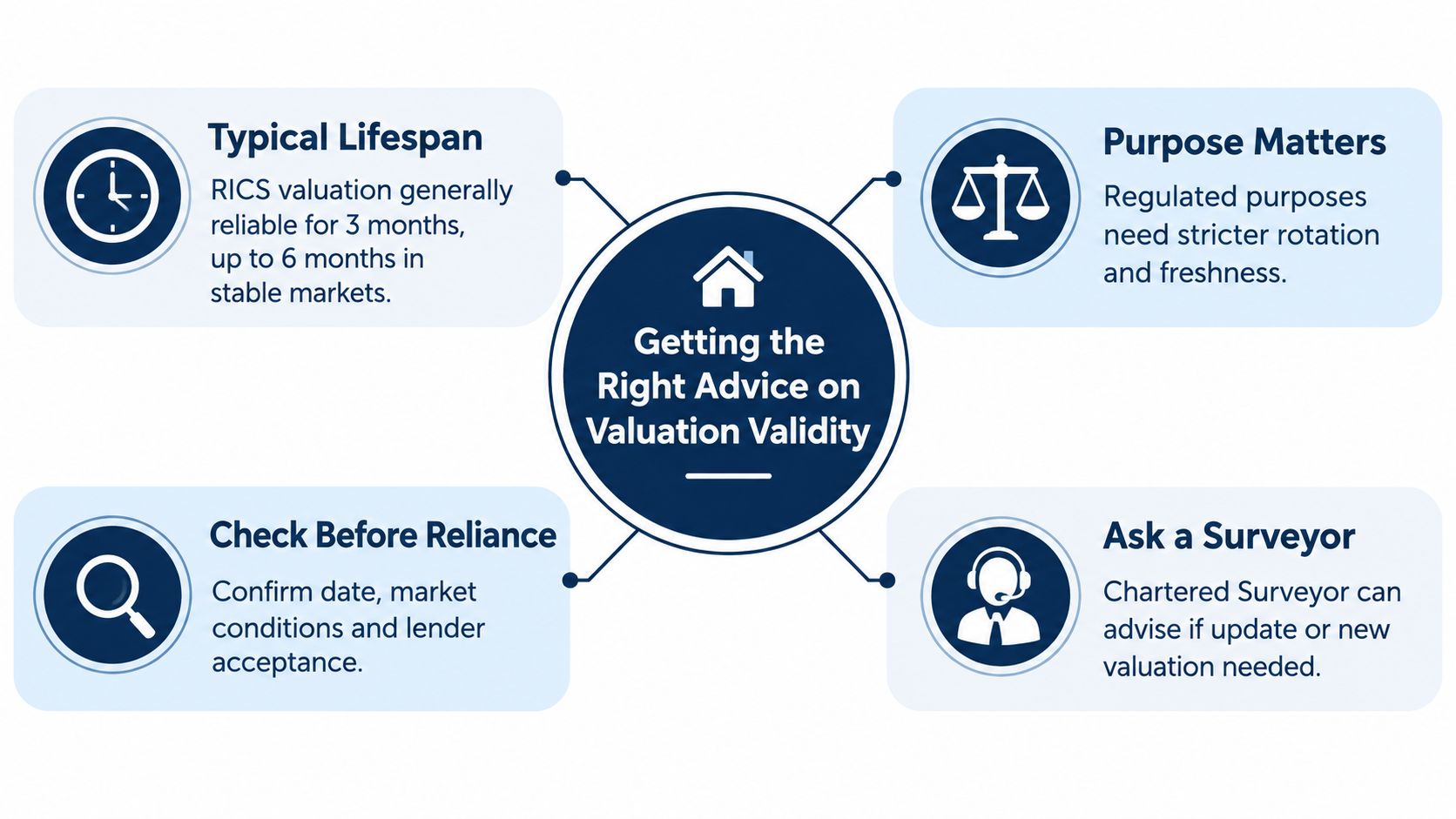
When a client asks me whether an old RICS valuation is still valid, I apply four tests.
- Is the valuation date right for the purpose? A report can be accurate for a historic date and wrong for a current transaction.
- Has the property changed? Check extensions, alterations, damage, repairs and planning matters.
- Does local evidence support the figure? Look at relevant sales, not broad online estimates.
- Will the recipient accept it? The lender, solicitor, court, HMRC or housing provider has the final practical say.
Keep the original report, comparable evidence and correspondence together. That gives the surveyor a proper audit trail and makes it easier to decide whether an update is possible.
A quick call to the original firm is usually the most efficient first step. The surveyor can check the instruction, valuation date, assumptions and whether the property remains materially unchanged. If the report was prepared for a narrow purpose, don't assume it can be transferred to another one.
You can read more about the role in this guide to what a valuation surveyor does. It's particularly relevant if you're unsure whether you need a market valuation, a survey-based valuation or a lender-only assessment.
Corinthian Surveyors London LTD is an independent practice based in Forest Hill, serving residential clients across London, the Home Counties and the South of England. The firm has no ties to lenders, estate agents or developers and can advise on market, probate, matrimonial, Capital Gains Tax and shared ownership valuations, as well as Level 1, Level 2 and Level 3 surveys.
If you have an existing valuation and need to know whether it can still be used, ask Corinthian Surveyors London LTD to review the purpose, valuation date, property changes and recipient's requirements. Visit Corinthian Surveyors London LTD or call 0800 00 16 422 before relying on an old figure.