
What Is a Valuation Surveyor and When Do You Need One

A valuation surveyor is typically an RICS-registered professional who provides an independent, Red Book-compliant opinion of a property's market value, based on comparable evidence rather than a condition survey. In the UK, most valuation work is carried out under the RICS Valuer Registration Scheme, a mandatory framework for RICS members undertaking valuation services.
You might need that opinion because you're buying a Victorian terrace in Lewisham, dealing with a probate property in Forest Hill or deciding how much a shared ownership flat in Greenwich is worth for staircasing. The question isn't, “What might someone pay for it?” The question is, “What is this property worth for this specific purpose, at this specific date, using evidence that can be checked?”
That distinction matters. An estate agent's estimate can help set an asking price. A mortgage valuation helps a lender decide whether its loan is adequately secured. An independent valuation prepared by a qualified surveyor answers a different question and follows a defined professional framework.
A valuation report also isn't a survey of the building's condition. It may note matters that affect value, such as poor repair or a short lease, but it isn't designed to identify every defect. If you need to know whether a roof is failing, damp is active or a chimney breast has been removed safely, you'll need a separate condition survey.
Table of Contents
- Introduction What a Valuation Surveyor Actually Does
- How Valuation Surveyors Are Qualified and Regulated in the UK
- Valuation Surveyor Versus Condition Surveyor and Other Survey Types
- How a Valuation Surveyor Reaches a Market Value Figure
- When Homeowners Buyers and Lenders Need a Valuation Surveyor
- What to Expect From a RICS Valuation Report and Inspection
- Choosing an Independent Valuation Surveyor in London
Introduction What a Valuation Surveyor Actually Does
Suppose you're buying a two-bedroom flat near Catford Broadway. The lender's mortgage valuation supports the loan, but you want to know whether the agreed price reflects the property's actual market position. Or perhaps your parent has died and the estate includes a Victorian house in Sydenham. The executors need a defensible figure for probate, not an informal opinion from a local selling agent.
A valuation surveyor inspects the property, studies relevant evidence and gives an opinion of value for a defined purpose. The report normally identifies the basis of value, the valuation date, the assumptions used and the evidence supporting the conclusion. The figure is professional advice. It isn't a promise that the property will sell for exactly that amount.
In the UK, a valuation surveyor is typically a Royal Institution of Chartered Surveyors professional who must follow the RICS Valuer Registration Scheme, usually called VRS. The scheme is mandatory for RICS members undertaking most valuation services and requires compliance with the RICS Red Book. It also includes risk-based auditing and quality assurance, under RICS's independently led regulatory structure. The UK government's profession profile describes the role and its regulatory setting.
The practical distinction: a valuation tells you what the property is worth. A condition survey tells you what may be wrong with it.
That distinction prevents an expensive mistake. A market valuation might take account of a damp smell, visible cracking or poor decoration if those matters affect value. It won't normally investigate the cause of damp, open up construction or provide a repair schedule. For that, a buyer might need a RICS HomeBuyer Survey or, for an older or altered building, a RICS Building Survey.
The role covers more than house purchases. RICS says valuation surveyors work across residential, commercial, industrial and rural assets, although a residential specialist in London may focus on houses, flats, maisonettes and mixed-use surroundings that affect residential value. The same professional discipline applies to a sale, probate, tax calculation, family dispute or rent assessment.
How Valuation Surveyors Are Qualified and Regulated in the UK
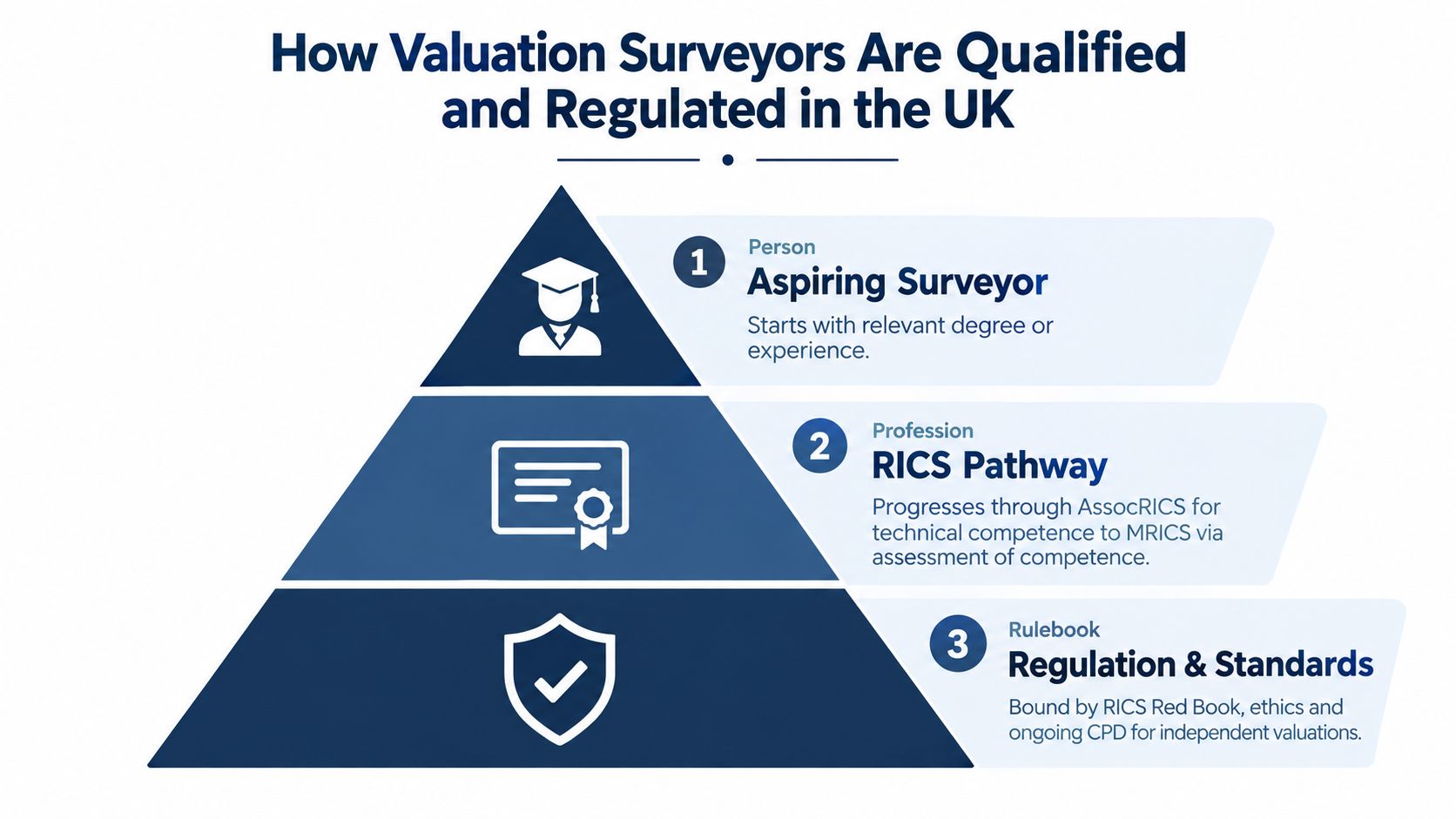
Qualification is only the first layer. A person may understand buildings and property markets, but a formal valuation also requires competence, ethics, independence and compliance with the applicable standards.
The professional route
RICS positions valuation surveying as a structured career path that commonly runs through AssocRICS and MRICS status. The route depends on education and experience. For chartered status, RICS says candidates may qualify through an RICS-accredited degree, through 5 years of relevant experience plus any bachelor's degree or through 10 years of advanced-level experience. RICS explains the valuation surveying career path.
Those routes don't make every surveyor identical. One may have started with a property degree. Another may have developed technical knowledge through extensive work on buildings and valuation instructions. What matters to the client is that the valuer can demonstrate the required competence and works within the relevant professional rules.
You can read more about the qualification pathway in this guide to how to become a chartered surveyor.
The regulatory check
The Valuer Registration Scheme adds a further control. RICS says it is mandatory for members undertaking most valuation services, with listed exceptions. The scheme includes risk monitoring and quality assurance checks for compliance with the Red Book and other applicable standards. RICS sets out how Valuer Registration works.
That gives a client something more useful than a badge on a website. It creates a framework in which valuation work can be monitored, reviewed and challenged. A registered valuer still has to exercise judgement, but that judgement isn't supposed to operate outside professional controls.
The Red Book framework
The RICS Valuation, Global Standards, known as the Red Book, contains mandatory rules, best-practice guidance and commentary. For residential valuations, the current 2025 edition became effective on 31 January 2025, as RICS's valuation standards page confirms.
RICS valuation work in the UK also uses the UK National Supplement. That supplement was published on 19 October 2023 and took effect on 1 May 2024, so a UK valuation surveyor works with the global standards alongside the UK-specific requirements. The Red Book overview from RICS explains this relationship.
Corinthian Surveyors London LTD is an independent RICS-regulated firm and a member of the RICS Valuers Registration Scheme. Clive Thompson holds RICS and CABE qualifications and has more than 30 years of experience in the built environment. The practice is insured by Royal Sun Alliance. Those details don't remove the need to ask questions, but they give a client clear points to verify before instruction.
Valuation Surveyor Versus Condition Surveyor and Other Survey Types
People often use “survey” to mean several different things. That creates trouble because the documents answer different questions.
A valuation surveyor answers, “What is the property's market value for this purpose?” A condition survey answers, “What is the state of the building, what defects can be seen and what might need attention?” A mortgage valuation answers, “Does the property provide suitable security for the lender's loan?”
| Service | Primary Purpose | What You Receive | When to Choose It |
|---|---|---|---|
| Market valuation | Establish value for a defined purpose and date | RICS valuation report with basis, assumptions and supporting evidence | Sale, purchase advice, probate, tax, family settlement or other formal need |
| Level 1 Home Condition Survey | Describe visible condition at a basic level | Concise condition report with limited detail | Conventional property in reasonable condition where a simple overview is enough |
| Level 2 HomeBuyer Survey | Identify significant visible defects and risks in a standard property | Condition report, traffic light ratings and repair or investigation advice | Typical houses and flats, including many properties in London |
| Level 3 Building Survey | Examine a building in greater depth | Detailed report on construction, defects, alterations and recommended investigations | Older, altered, listed or unusual properties, including period houses and non-standard construction |
| Mortgage valuation | Protect the lender's security position | Lender-focused valuation or assessment | Mortgage approval, as required by the lender |
| Estate agent estimate | Help set a marketing price | Informal market opinion based on local sales knowledge | Early sale discussions, not usually a substitute for a formal valuation |
A Level 2 report may be suitable for a modern flat in Woolwich. A Level 3 survey is more likely to be appropriate for a Georgian house in Blackheath, a Victorian terrace in Brockley or a property with a basement conversion. The right choice depends on the building, not on its age.
Traffic light ratings in a condition report help you prioritise visible problems. They don't turn a Level 2 survey into a valuation and they don't guarantee that hidden defects have been found. A surveyor may recommend a specialist damp inspection, structural engineer's assessment or legal review where the evidence isn't enough.
The lender's valuation sits apart from all of this. It may be a short inspection or a desk-based assessment, depending on the lender's process and the property. It is prepared for the lender, not to give you a detailed account of the roof, drainage, timber or structure.
A mortgage valuation can support your loan and still tell you very little about the building you are buying.
The VRS applies to most RICS valuation services and includes checks for Red Book compliance, but it doesn't mean every lender valuation provides the independent condition advice a buyer needs. If you want both value and condition information, ask for both services and check that each report's purpose is clear.
How a Valuation Surveyor Reaches a Market Value Figure
The figure usually starts with comparable evidence. A surveyor doesn't search for the largest nearby sale, add up the prices and divide by the number of properties. The work lies in deciding which transactions compare and how much weight each deserves.
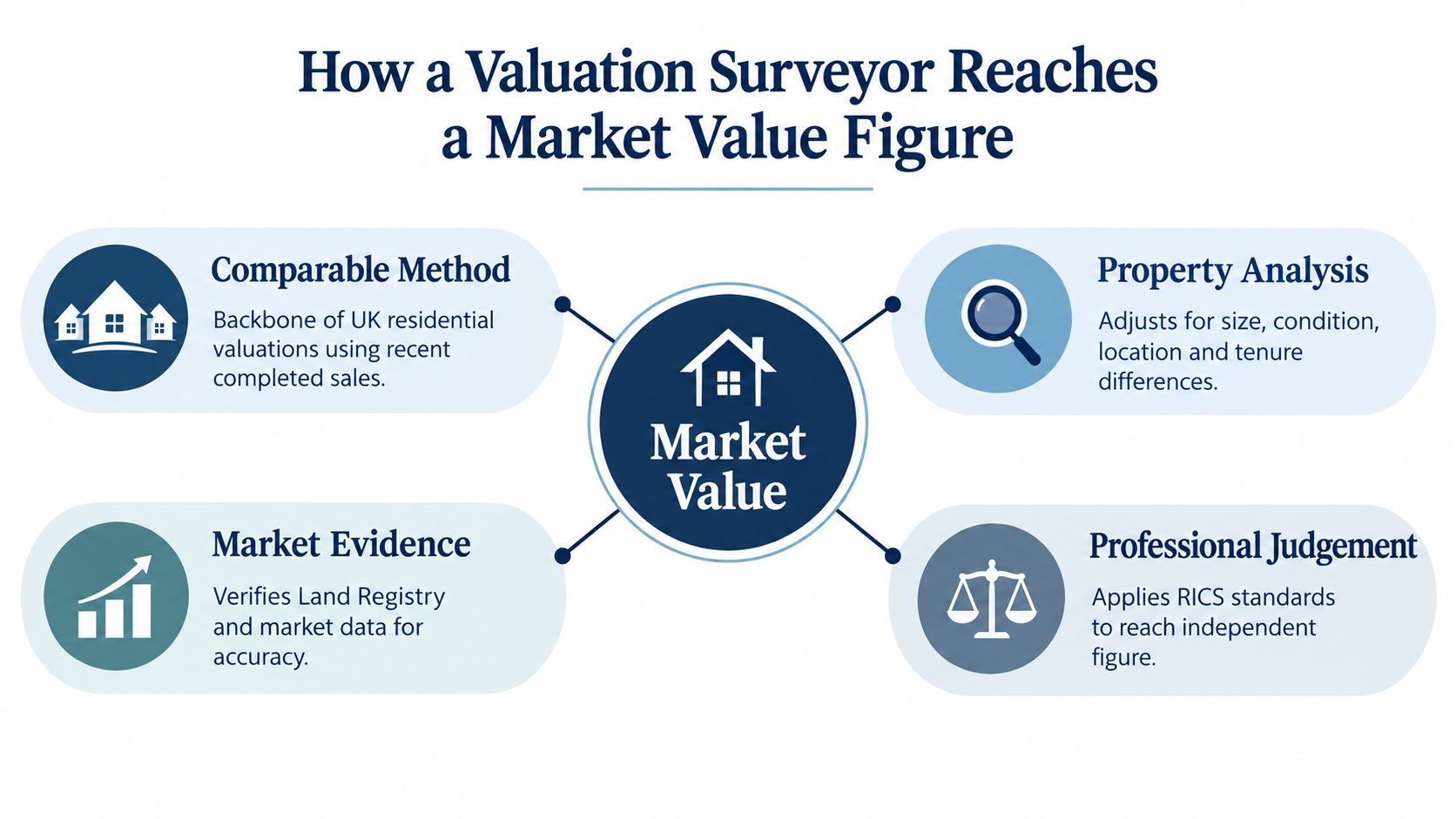
The strongest evidence normally comes from recent, completed and verifiable sales of similar properties in the same locality. A completed sale is more useful than an asking price because it shows an actual transaction. A similar property in the same street may still need careful adjustment if it has a larger garden, a longer lease or better natural light.
The surveyor considers differences such as:
- Size and layout: Floor area, bedroom arrangement and usable space can affect comparison.
- Condition: A refurbished flat in Dulwich isn't directly equivalent to one needing rewiring and roof work.
- Position: Floor level, outlook, noise and access can matter greatly in a London block.
- Outside space: A private garden, balcony or roof terrace may distinguish otherwise similar homes.
- Tenure: Lease length, service charge obligations and other lease matters can affect a flat's value.
- Timing: The surveyor considers market movement between the comparable sale date and the valuation date.
London needs particularly careful filtering. A flat beside a busy road in Lewisham may not compare well with one on a quiet residential road in Forest Hill. The distance between properties can be less important than the micro-location, but in dense London markets, comparables should be much closer than 1 mile where possible because local effects can materially change value. This explanation of Red Book valuation and comparable evidence sets out the role of close, adjusted evidence.
A useful way to think about the process is as a panel of witnesses. Each comparable tells the surveyor something, but some witnesses are more reliable than others. The surveyor filters, weights and reconciles the evidence rather than applying a simple average.
RICS has also separated valuation approaches and methods from valuation models in the current structure. VPS 3 now covers valuation approaches and methods, while VPS 5 covers valuation models. RICS's Red Book Global page explains that technical separation.
If you're trying to understand the wider process of researching a property market without access to a multiple listing system, this guide to market analysis without MLS provides useful background. It isn't a substitute for a formal RICS valuation, but it helps explain why evidence quality matters.
The final figure is therefore professional judgement supported by evidence and standards. It isn't personal guesswork, even though no valuation can remove every element of judgement from a property market.
When Homeowners Buyers and Lenders Need a Valuation Surveyor
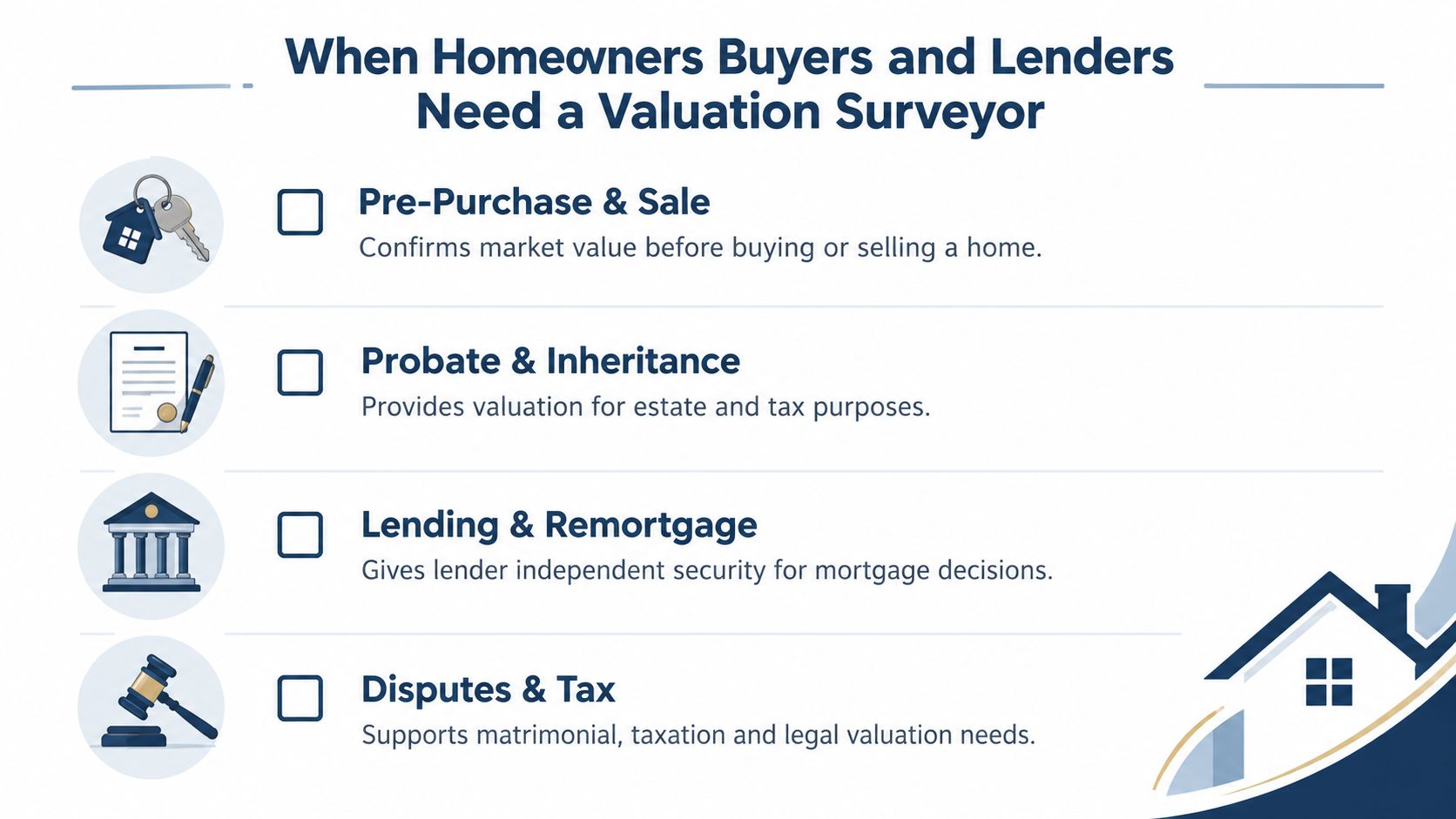
The purpose comes first. Before instructing anyone, identify the decision the figure will support.
Buying or selling
A market valuation can give an owner a reasoned view of value before marketing a house in Forest Hill or a flat in Greenwich. For a buyer, it can provide independent evidence when the agreed price looks out of step with similar completed sales.
It won't replace a condition survey. A buyer considering a Victorian terrace in Peckham may need a valuation for price advice and a Level 3 Building Survey to examine alterations, roof structure, damp and movement.
Probate and inheritance tax
A probate valuation records the property's value at the relevant date for estate administration. Executors may need a formal report for tax and legal purposes, particularly where the property is unusual, has development potential or is difficult to compare.
A house in Bromley, a converted flat in Deptford and a listed property in Greenwich can each require different evidence. The surveyor must understand the property and the purpose of the instruction rather than treating probate as a standard estate agent appraisal. Corinthian's probate valuation and inheritance tax service is intended for this type of residential instruction.
Family and tax matters
A matrimonial separation valuation helps establish a property's value for discussion between spouses and for solicitors or courts where required. It should be independent of either party's preferred outcome.
A capital gains tax valuation may require a value at an earlier date. That is a retrospective instruction, so the surveyor must assemble appropriate historical evidence and explain the basis used. Current condition and later improvements may also need careful treatment.
Shared ownership and rent
A shared ownership staircasing valuation supports the calculation of the price for buying a greater share of a home. A flat in Lewisham or Bromley may require attention to the lease, the existing ownership arrangement and the valuation rules applying to that transaction.
A market rent valuation answers a different question. It concerns the rent the property might command, not the property's capital value. The same applies to a building reinstatement cost assessment, which estimates the cost of rebuilding for insurance rather than the property's market worth.
Corinthian works across all London boroughs, the Home Counties and the South of England, with a primary focus on residential property. You can see how valuation work differs from lender-focused advice in this explanation of mortgage surveyors and valuation.
What to Expect From a RICS Valuation Report and Inspection
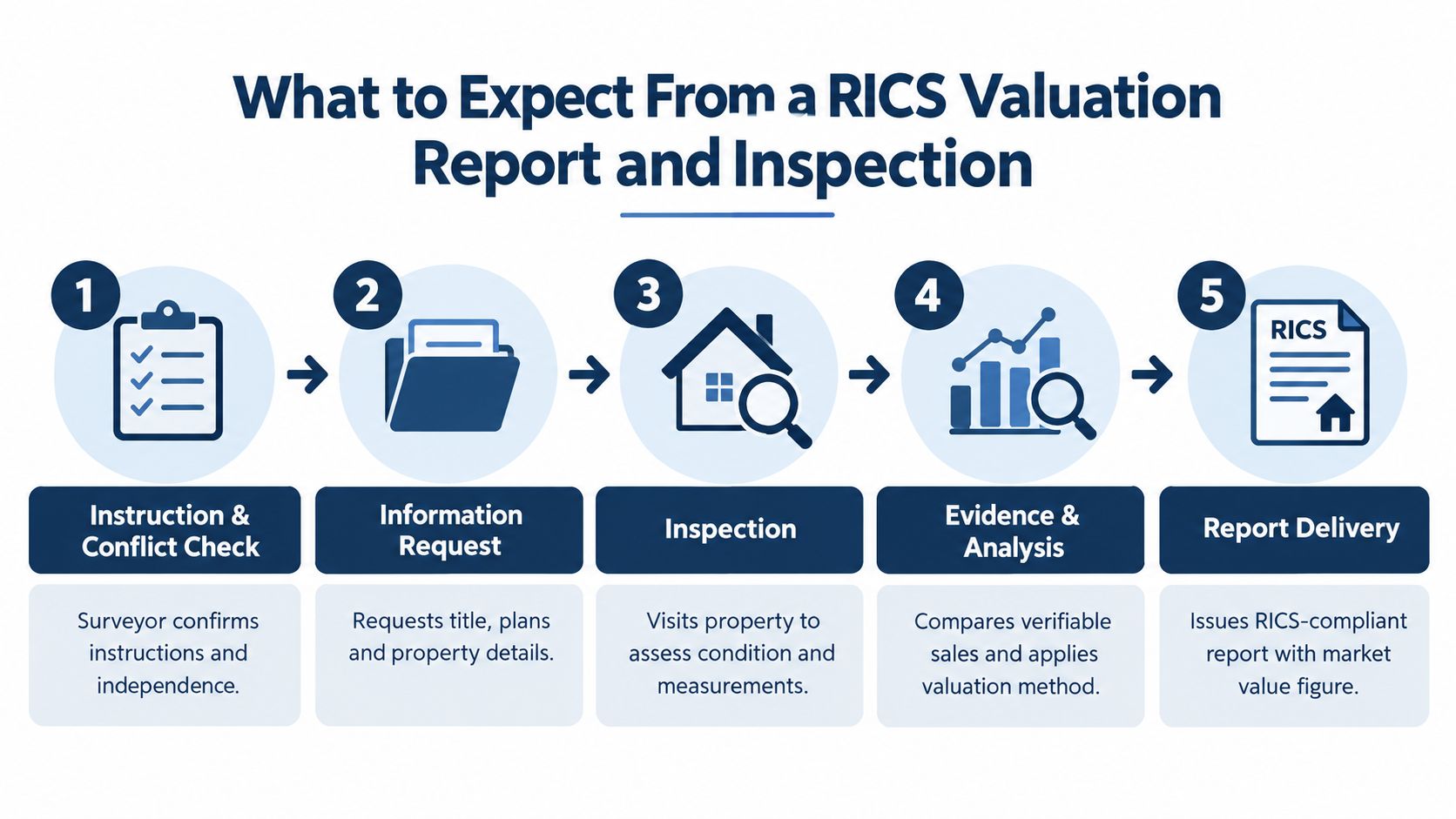
A good instruction starts with the purpose. Tell the surveyor whether the report is for sale advice, probate, inheritance tax, matrimonial separation, capital gains tax, staircasing, rent or another defined need.
Before the inspection
The surveyor should check the instruction and consider conflicts of interest. You may be asked for title information, plans, lease details, previous reports, tenancy information and details of alterations. The more accurate the background information, the less likely it is that an important assumption will go unnoticed.
The inspection is not always an intrusive building survey. The surveyor examines the property in the manner appropriate to the valuation, records relevant characteristics and considers matters that may affect value. For a flat in Bermondsey, that may include the lease and building context. For a house in Eltham, the plot, extensions and surrounding development may be material.
Evidence and the report
The surveyor then analyses comparable transactions and applies the appropriate valuation method. The report should explain the basis of value, the valuation date, assumptions, any special assumptions, relevant evidence and limitations.
RICS expects UK valuation surveyors to work to RICS Valuation, Global Standards, the Red Book. It contains mandatory rules, best-practice guidance and commentary. The residential 2025 edition became effective on 31 January 2025. RICS's guide to RICS property valuations provides further context for clients commissioning this type of report.
The UK-specific requirements also matter. The UK National Supplement was published on 19 October 2023 and took effect on 1 May 2024, as outlined in the Red Book material cited earlier. The report should make its scope clear so you know what it does and doesn't cover.
Reading the conclusion
Don't look only at the final figure. Check the valuation date and basis, then read the assumptions and limitations. A figure based on vacant possession may not answer the same question as a figure based on an occupied property. A market value may not answer a rebuilding-cost or market-rent instruction.
If the surveyor identifies uncertainty, ask what would reduce it. The next step could be a title review by your solicitor, a structural engineer's inspection, a specialist damp investigation or further lease information. A careful report doesn't pretend that every question can be answered from one inspection.
Choosing an Independent Valuation Surveyor in London
Start with the credentials, then test the independence. Ask whether the valuer is RICS-qualified, registered for valuation work under the VRS and experienced with the type of property and purpose involved. CABE qualifications can also indicate a strong built-environment background.
For London property, local knowledge matters because a Victorian terrace in Lewisham, a 1930s semi in Bromley and a converted warehouse flat in Bermondsey don't present the same valuation questions. Ask how the surveyor selects comparable evidence and whether they regularly work in the borough where the property is located.
Check these points before instructing:
- Independence: Confirm there are no ties to your lender, estate agent or developer.
- Insurance: Ask whether the firm carries suitable professional indemnity insurance.
- Scope: Confirm whether you need a valuation, a condition survey or both.
- Purpose: Make sure the report is suitable for probate, tax, court, lender or private decision-making.
- Report format: Ask what assumptions, limitations and supporting evidence will be included.
Be cautious if someone promises a figure before understanding the purpose, refuses to explain their qualifications or treats an estate agent estimate as interchangeable with a formal valuation. You should also be wary of a report that gives a number without a clear valuation date or basis.
A property owner comparing independent practices may find it useful to understand how a boutique home advisory firm positions its service. The important point remains the same: check the firm's actual qualifications, regulation, insurance and relevant experience rather than relying on presentation.
Corinthian Surveyors London LTD is based in Forest Hill and is led by Clive Thompson, who holds RICS and CABE qualifications. The firm is independent, with no ties to lenders, estate agents or developers, and provides residential valuations and surveys across London, the Home Counties and the South of England.
Frequently asked questions
Is a valuation survey the same as a homebuyer survey?
No. A valuation gives an opinion of value for a defined purpose. A HomeBuyer Survey examines visible condition and highlights defects and risks. You may need both when buying a property.
Can an estate agent provide a formal valuation?
An estate agent can provide a market appraisal for selling advice. A formal RICS valuation for probate, tax, matrimonial separation or another defined purpose should be carried out by a suitably qualified and registered valuation surveyor.
Does a valuation surveyor check for defects?
The surveyor may observe defects that affect value, but a valuation isn't a replacement for a Level 2 or Level 3 condition survey. Ask for the service that matches the decision you need to make.
Corinthian Surveyors London LTD provides independent RICS market valuations, probate valuations, matrimonial separation valuations, capital gains tax valuations and shared ownership staircasing valuations, alongside Level 2 and Level 3 residential surveys. To discuss the right report for a London property, call 0800 00 16 422 or visit Corinthian Surveyors London LTD.