
Rental Property Valuation: London Factors & Surveyor Guide

You've got a flat in Lewisham, a terrace in Bromley or maybe a probate property in Forest Hill, and the rent number needs to do more than sound reasonable. It has to hold up against service charges, empty periods, lease terms, compliance costs and the actual yield a buyer will accept. That's what rental property valuation is really about, turning future income into a figure you can defend, not just a rent you hope to achieve.
Table of Contents
- What Rental Property Valuation Actually Means
- The Four Main Valuation Methods Explained
- Key Factors That Move Rental Value in London
- How to Estimate Rent Yourself With Real Data
- When to Commission a RICS Valuation and What to Expect
- London Case Studies That Show Why the Headline Yield Can Mislead
- Your Landlord and Seller Checklist With Frequently Asked Questions
What Rental Property Valuation Actually Means
A landlord at the kitchen counter usually wants one thing. A rent that covers the mortgage, the repairs, the service charge and still leaves the asset looking decent on paper. The problem is that the rent you charge and the value the property carries are not the same question, even though they are tied together.
Rental property valuation is the process of converting expected rent into a capital value a buyer or lender can understand. In UK practice that sits inside the investment method, where the valuer looks at income, deducts relevant outgoings and applies a capitalisation rate, or cap rate, to arrive at value. That is the approach RICS treats as technically appropriate where the property's worth comes mainly from rent, not just from comparable sales, and the UK government's rating practice also normalises rental evidence before it is capitalised, which is the right discipline to apply in London too. See the related service on market rent valuation.
The key point is simple. Value is a snapshot of three assumptions, achievable rent, occupancy and yield. Change any one of them and the number moves. A flat in Peckham with strong rent but regular voids may underperform a steadier Bromley semi even if the headline asking rent looks similar. That is why landlords who only chase gross rent often get the valuation wrong.
Practical rule: if the income stack is weak, the value is weak. Gross rent is only the starting point.
If you want a quick way to sanity-check those assumptions, use a rent return calculator such as compare rental property returns. It will not replace a valuation, but it will show you how sensitive the figure is to rent, cost and yield.
The Four Main Valuation Methods Explained
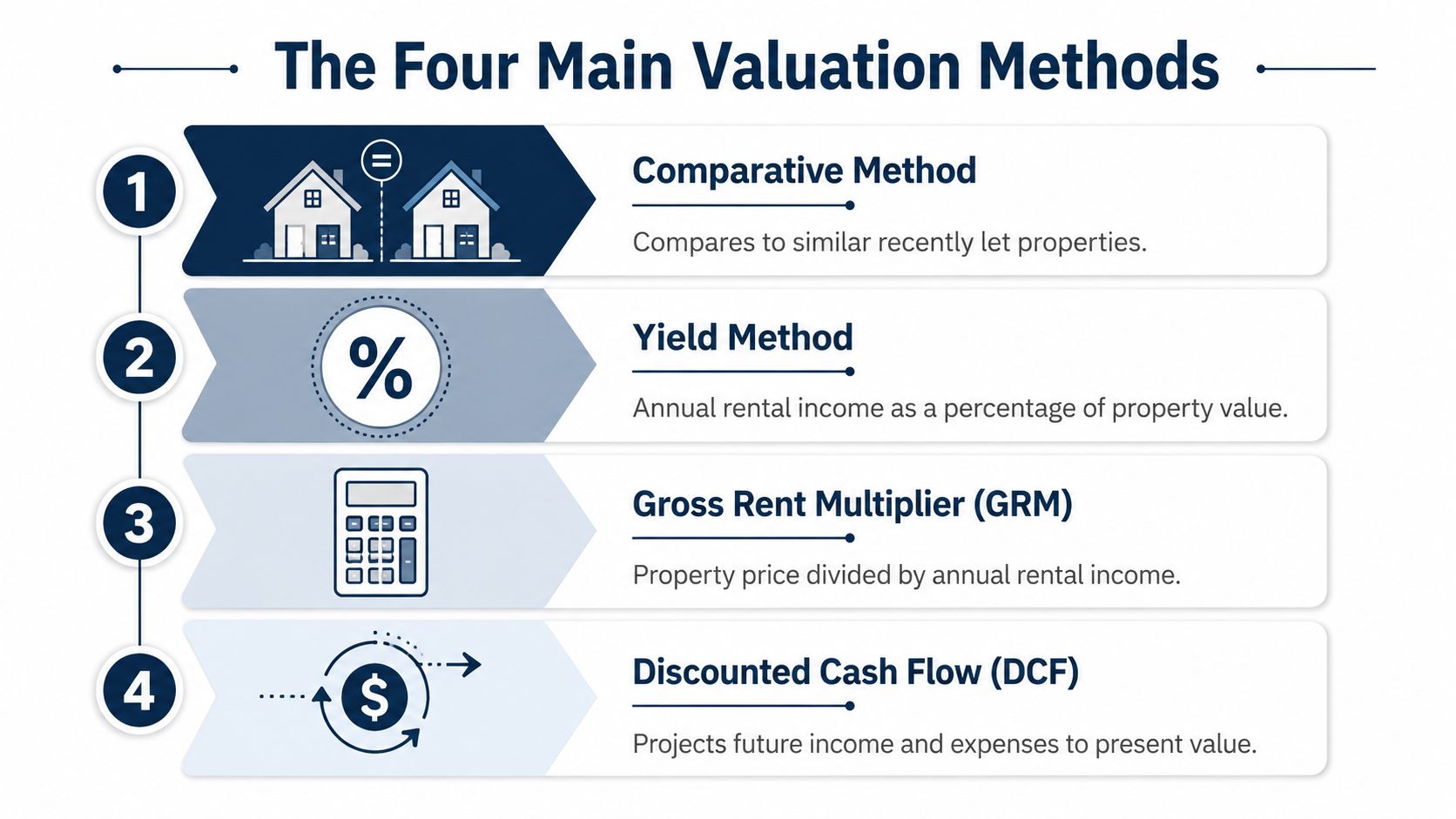
A competent valuer does not throw one formula at a property and call it done. They test the number from more than one angle, then decide which method carries the most weight for that particular asset. That is what separates a proper report from a quick guess.
First comes the comparative method. You look at similar flats or houses recently let in the same part of London, then adjust for condition, lease length, size and EPC position. For a hypothetical £450,000 flat in Battersea, that means checking what comparable properties in the same micro-area have achieved, not what a glossy listing promised. This method is strongest when the local evidence is clean. It fails when the stock is unusual, the lease is awkward or the service charge makes the headline rent misleading. For a useful contrast with estate agent thinking, see estate agents' valuations.
Second is the yield method, which is the workhorse for buy-to-let and income-led residential valuation. The logic is blunt. Annual rental income is divided by the yield the market will accept. If that same £450,000 flat produces stronger net income, the capital value can sit higher. If costs bite into income, the value falls. RICS and the UK income approach both point you back to yield, because yield is what tells you how hard the income is working.
Third is GRM, the gross rent multiplier. That is just price divided by annual rent. It's quick, and it's rough. If the £450,000 flat rents for £24,000 a year, the GRM is 18.75. Useful for screening, yes. Good enough for a serious decision, no. It ignores operating costs, lease frictions and voids, so it can flatter a weak asset.
Fourth is DCF, discounted cash flow. That one projects future rent, expenses and exit value back to present value. It matters more where income changes over time, for example a block with rising service charge risk or planned works. It's more detailed, but it only works if the assumptions are solid. Garbage assumptions in, polished nonsense out.
| Method | Formula in plain English | Best use | Weak point |
|---|---|---|---|
| Comparative | Similar evidence, adjusted | Ordinary flats and houses | Can blur cost differences |
| Yield | NOI divided by cap rate | Investment valuation | Sensitive to yield choice |
| GRM | Price divided by annual rent | Quick screening | Too blunt for real advice |
| DCF | Future cash flows to present value | Complex income streams | Assumption heavy |
The video below is useful if you want to see how these methods sit together in practice.
A proper RICS valuer blends these methods. They don't marry one number just because it is neat. They weigh the evidence, then defend the adopted figure. That's the difference between valuation and wishful arithmetic.
Key Factors That Move Rental Value in London

A landlord at the kitchen counter wants a rent figure that pays the mortgage, covers repairs and service charge, and still leaves the asset looking sound on paper. In London, that figure lives or dies on the details that sit behind the headline rent. A RICS valuer starts there, because the brochure never tells the full story.
Location and transport links
A flat close to a station in Greenwich or Southwark will not be priced the same way as a similar flat buried deeper in outer borough stock. Transport access drives tenant demand, and tenant demand drives rent, void risk and the speed at which a unit lets. Ignore that, and you end up comparing borough averages that have little to do with the property in front of you.
The same logic applies street by street. A property with a short, reliable commute into central London holds a different position from one that looks similar but sits awkwardly for rail, Tube or bus access. That difference shows up in rent before it shows up in the asking price.
Property condition and EPC position
A tired Victorian terrace in Lewisham does not compete on the same terms as a cleaner 1930s semi in Bromley if the maintenance burden and energy performance are different. Tenants notice comfort, running costs and the overall feel of the place. So does the valuer.
A better EPC band can support stronger lettability because lower utility bills matter to renters and weaker energy performance can narrow the buyer pool. Condition matters twice. It affects the rent you can charge now, then it hits again when the buyer starts pricing in future repair spend.
Amenities, service charge and leasehold friction
A Bermondsey flat with concierge, lift and tidy common parts may show a decent gross figure and still disappoint once service charge and ground rent are stripped out. That is the part too many owners miss. The valuation has to follow the cash, not the marketing copy.
Leasehold costs can bite hard in London. Service charge can rise, ground rent can drag on net income, and planned works can turn a seemingly strong flat into a weak income asset. A RICS valuer looks at the lease terms, the charge history, and any hint of remediation liability before treating the income as reliable. That is where headline rent gets humbled.
Tenancy law and compliance burden
Deposit protection, Right to Rent, licensing and the wider compliance load all sit behind the rent number. So does the Renters' Rights Bill, because landlord risk changes how some buyers price income. A valuer does not wave these away as admin.
EPC compliance risk matters in the same way. If a property looks likely to need spend before it can stay lettable on current terms, the market discounts that risk fast. Where there are cladding issues, fire safety concerns or broader remediation liabilities, the valuer has to reflect the exposure rather than pretend it is a side note.
Market microclimate
Void periods, local tenant demand and supply pressure matter. Forest Hill can behave differently from Crystal Palace. Peckham can behave differently from Bromley. A rent pulled from the wrong pocket of London can make the valuation look neater than it is.
That is why a good valuer checks the market at a local level, not just the borough level. If you want wider reading on how property conditions shift and why the market keeps moving, use real estate market trend articles as background only. They help you read direction. They do not override local evidence.
Practical rule: if you cannot prove the rent, the charges and the compliance burden, you cannot prove the value.
How to Estimate Rent Yourself With Real Data
Start with comparable asking rents, then strip out the junk. Use Rightmove and Zoopla listings for similar homes within about half a mile, then compare floor area, condition, EPC and whether the property is a flat, terrace or semi. Don't mix a renovated Forest Hill two-bed with a tired top-floor conversion and pretend they are the same asset.
Cross-check that with broader evidence. HM Land Registry price-paid data helps you understand the sale side of the equation, while the ONS private rental index shows the general direction of rents, not the value of a single unit. The point is not to get a magic answer. The point is to avoid being fooled by one shiny listing.
Here is a simple example for a two-bed flat in Forest Hill.
| Comparable | Type | Distance | Monthly Rent | Adjustment | Adjusted Rent |
|---|---|---|---|---|---|
| Comparable 1 | Two-bed flat | 0.3 miles | £1,425 | Similar condition | £1,425 |
| Comparable 2 | Two-bed flat | 0.4 miles | £1,450 | Better EPC | £1,435 |
| Comparable 3 | Two-bed flat | 0.5 miles | £1,475 | Slightly larger | £1,440 |
Take the median of those adjusted figures, which is £1,450 per calendar month. That gives an annual rent of £17,400. If the property were valued off a rough net yield assumption, you would then test whether the resulting figure makes sense against the local sales evidence and the income risk. You do not stop at the rent number.
For a landlord, the mistake is usually obvious in hindsight. They forget service charge anomalies, lease restrictions or cladding-related costs, then wonder why the value the market gives them is thinner than expected. A professional valuation earns its keep when the income looks straightforward but the building does not.
The best practical reference on how operational costs bite into the picture is Receipt Router's sole trader tax guide, because it shows the same basic principle in another setting, income only means something after the costs have been dealt with.
When to Commission a RICS Valuation and What to Expect
A proper valuation is the move when the number has to stand up in the world. Use it for setting the first rent on a better flat in Westminster or Bromley, for probate, capital gains tax, matrimonial work, or for sorting a dispute where nobody will accept a casual figure.
A free estate agent appraisal is a sales tool. It is written to win instruction or keep a landlord satisfied. A lender's mortgage valuation is narrower still, because it protects the lender's position, not yours. A RICS-regulated market rent valuation is the right tool when the figure may be challenged later, and for more detail on how that process works, see our guide to RICS property valuations.
Corinthian Surveyors London LTD handles this work as an independent practice with no ties to lenders, estate agents or developers. That matters. Independence is what lets the valuer call the number when a block in Southwark carries awkward service charges, a leasehold flat in Lewisham has a weak income profile, or the building brings EPC compliance risk and remediation liabilities into the picture.
If you instruct a firm like Corinthian, the process should be plain. The documents are reviewed, the property is inspected where required, comparable evidence is tested, and the adopted yield is justified. The final report should set out the income assumptions, the operating cost schedule, and the reasoning behind the capital figure. It should also show how leasehold ground rent, service charge pressure, and any repair or remediation exposure were handled. If it does not, you have not bought a valuation. You have bought a headline.

London Case Studies That Show Why the Headline Yield Can Mislead
A leasehold flat in a converted Victorian house in Lewisham can look attractive on paper. Say the gross yield appears to be 5.8 percent, which sounds decent enough to a casual buyer. Then the service charge, ground rent and short lease start cutting into the actual income. The net yield can fall hard, and the buyer pool narrows because not everyone wants to take on that baggage.
A freehold 1930s semi in Bromley often tells a different story. The gross yield might look lower at first glance, but the outgoings are lighter and the occupancy picture is steadier. That sort of property can deserve a firmer valuation per pound of rent because the income is cleaner and the risk is easier to underwrite.
That is the bit most online calculators miss. They treat rent as if it arrives untouched. It doesn't. In London, leasehold costs, maintenance, legal friction and resale liquidity all sit between the tenant's payment and the owner's real return.
The headline yield is not the valuation. It's the starting point for a proper argument about value.
Your Landlord and Seller Checklist With Frequently Asked Questions

Get the paperwork straight before anyone starts talking numbers. A valuer cannot give a clean figure if the file is full of gaps, guesswork, or stale documents.
- Gather title documents: Prove ownership and show the legal boundaries.
- Collect recent accounts and rent schedules: Show the income stream and the costs going out of it.
- Compile the current tenancy agreement: Set out the rent, term, deposits, break clauses, and tenant obligations.
- Secure a valid EPC certificate: Show the current energy position and any compliance risk attached to it.
- Assemble service charge demands and ground rent papers: These matter on leasehold stock because they can strip value out of net income fast.
- Note any legal notices, disputes, or remediation issues: Works in dispute, arrears, tribunal action, cladding concerns, or other liabilities can cut value sharply.
If you are self-employed or running a rental portfolio through simple accounts, keep your tax paperwork tidy as well. A practical guide such as the Receipt Router sole trader tax guide is a useful reminder that clean records make valuation work easier to check and easier to defend.
FAQ
How long is a RICS valuation valid for?
It is only valid for the market at the date it was inspected or assessed. Once rents, vacancies, comparable evidence, or building risk change, the figure can go stale quickly.
Can a valuation be challenged?
Yes. If the evidence is thin, the assumptions are loose, or the valuer has ignored leasehold costs, EPC exposure, or remediation liabilities, the figure should be tested. A proper RICS report should show its working clearly enough for a solicitor, lender, or executor to follow.
How much does a valuation typically cost?
That depends on the property and the purpose. Corinthian quotes per property, which is the sensible way to do it because a probate flat in Catford is not the same job as a leasehold maisonette in Greenwich.
What if a lender's valuation comes back lower than the purchase price?
Treat it seriously. Either renegotiate, increase your deposit, or get a proper independent valuation to see whether the lender has been conservative or whether the deal is too dear.
Corinthian Surveyors London LTD covers all London boroughs and the Home Counties, and the firm provides quotes per property rather than guessing from a distance. If you want a proper view of rent, yield, and the costs that sit behind them, call 0800 00 16 422 or visit Corinthian Surveyors London LTD and ask for a market rent valuation that stands up to scrutiny.
If you want a valuation that looks beyond the headline rent and deals properly with service charges, leasehold friction, EPC risk, and remediation exposure, Corinthian Surveyors London LTD can help. They carry out market rent valuations across London with the sort of local judgement that matters in Lewisham, Bromley, Greenwich, and the surrounding boroughs. Start with Corinthian Surveyors London LTD and ask for the right valuation, not the easy one.