
Probate House Valuation: London Guide 2026
You've got the keys, a stack of paperwork and a solicitor asking for a value on the house. That's usually the moment people realise probate isn't just form filling. The property figure you submit can affect tax, the estate accounts and what happens later if the house is sold.
A probate house valuation is not a rough estimate and it's not whatever an estate agent thinks the property might achieve if marketed next week. It is a formal opinion of the open market value on the exact date of death, and HMRC uses that figure when dealing with Inheritance Tax. Get it wrong and you can create a mess for yourself and the beneficiaries.
I've spent more than 30 years valuing residential property across London, from Victorian terraces in Forest Hill and Brockley to ex-local authority flats in Bermondsey and large houses in Bromley. The same problem comes up again and again. Families are given informal numbers early on, then discover those numbers don't stand up when HMRC starts asking questions.
That's why this needs to be dealt with properly from the outset.
Table of Contents
- Introduction What Is a Probate Valuation
- The Date of Death Rule Explained
- Probate Valuation vs Market Valuation
- Understanding HMRC and Inheritance Tax
- Why You Need a RICS Chartered Surveyor
- The Valuation Process and Required Documents
- London Probate Valuation Scenarios
- Probate Valuation FAQs
Introduction What Is a Probate Valuation
A probate valuation is the figure used to place the property into the estate. It has to reflect what a willing buyer would reasonably have paid for the house or flat on the date the owner died. That date matters more than anything else.
People often think the task is simple. Look at a portal, ask a local agent, choose a number and move on. That approach causes trouble because probate isn't based on a sales pitch. It's based on evidence.
In practice, the valuer has to look backwards. We inspect the property as it now stands, then assess what it would have been worth at that earlier date, allowing for condition, location, tenure and comparable sales from the relevant period. If the property had defects, those defects matter. If it had a short lease, that matters. If the kitchen was tired, the roof poor or the loft conversion questionable, all of that feeds into the valuation.
Practical rule: Probate is about defensible evidence, not optimism.
For executors, this is one of the first important decisions. The valuation feeds into the tax return, helps keep the estate accounts straight and sets the base figure for later tax considerations if the property is sold. It also reduces the risk of arguments between beneficiaries, because everyone can see the figure was reached by a proper method rather than guesswork.
The Date of Death Rule Explained
This is the rule people struggle with most. HMRC doesn't want today's value. It doesn't want the asking price your neighbour achieved this spring. It wants the open market value at the date of death. That is the legal valuation date for probate.
As noted in the BTG Eddisons probate guide and the Premier Solicitors probate guide, in the UK the probate valuation of a house must represent its open market value specifically at the date of the owner's death, not the current market value at the time of the probate application, because HMRC requires that retrospective figure for Inheritance Tax.
Why this catches people out
Say someone died months ago and the market has since moved. That later movement may matter when you eventually sell. It does not change the probate figure. The tax exercise is tied to that earlier date.
The easiest way to understand it is this. Probate valuation is like a freeze-frame. You are asking, “What was this property worth on that day, in that market, in that condition?” Nothing that happened afterwards gets to rewrite that answer.
How a surveyor works it out
A proper valuer doesn't pluck a figure from thin air. We look at:
- Comparable sales: Similar properties that sold around the relevant period.
- Property condition: Repairs, wear, structural concerns, outdated fittings and layout issues.
- Tenure details: Freehold, leasehold, lease length and restrictions.
- Local market evidence: What buyers were paying in that part of London at that time.
For a flat in Greenwich, a Victorian house in Camberwell or a 1930s semi in Sidcup, the evidence base will differ. The principle stays the same. The date is fixed. The evidence must match it.
If the number can't be explained clearly, it's not ready for HMRC.
Probate Valuation vs Market Valuation
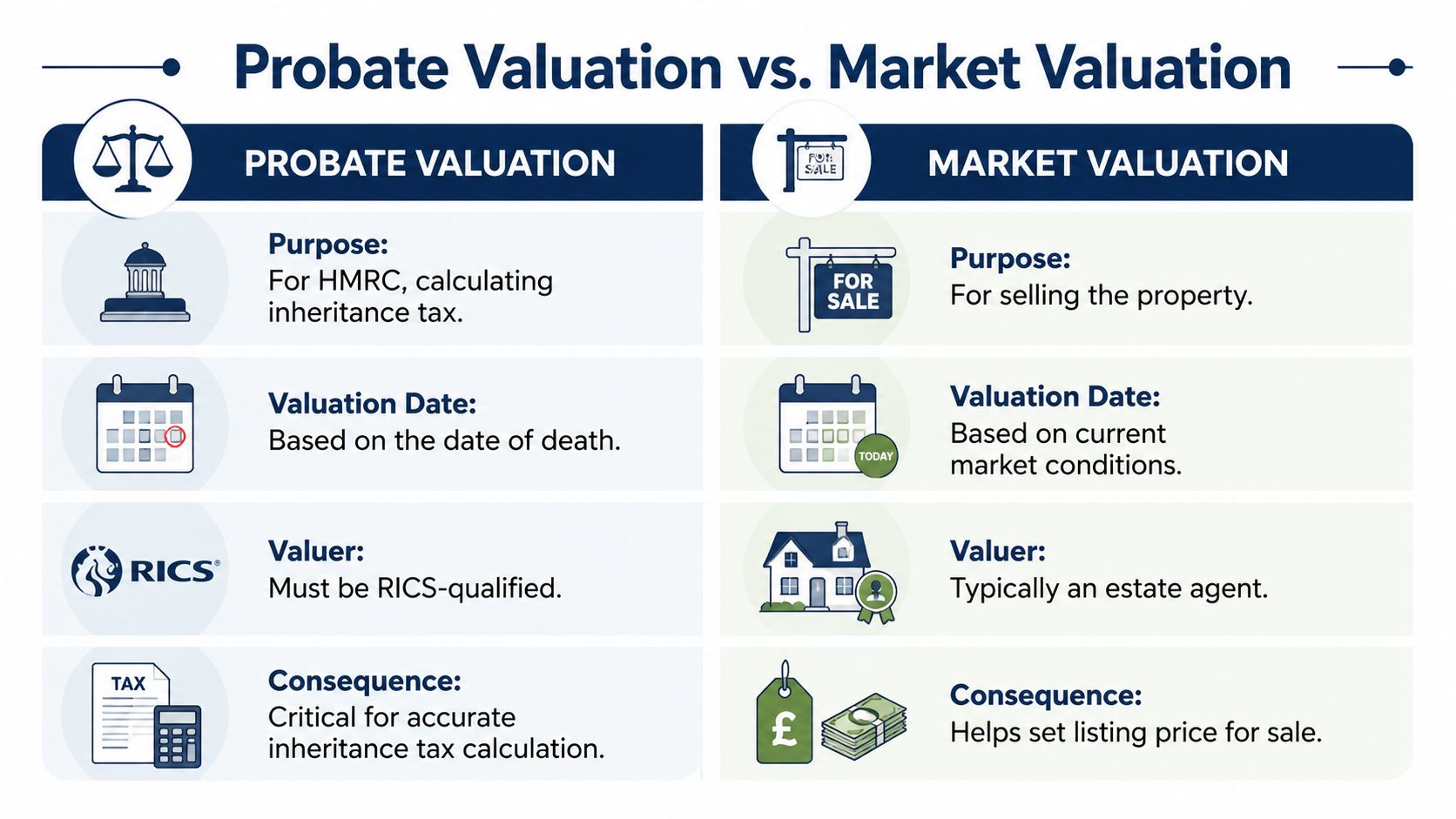
An estate agent's market appraisal and a probate valuation are not the same job. They are built for different audiences and different purposes.
Different jobs, different evidence
| Point of comparison | Probate valuation | Market valuation |
|---|---|---|
| Purpose | For estate administration and HMRC | For marketing and sale |
| Valuation date | Fixed at date of death | Based on current conditions |
| Method | Retrospective evidence and formal reporting | Pricing advice for launch |
| Audience | HMRC, executors, solicitors, beneficiaries | Seller and potential buyers |
| Standard | Must be capable of scrutiny | Often broader and more commercial |
An agent is trying to advise on saleability. That often includes presentation, buyer demand and where to pitch the asking price. None of that is wrong. It's just a different exercise.
A probate valuer has to provide a figure that can be defended later. That means showing why the number reflects historical market evidence, not today's sentiment. If you want current sale advice as a separate exercise, that's a standard market valuation. Don't confuse it with probate.
Later in the process, some people find a short video explanation easier than pages of text:
Why the gap matters in London
London is where loose figures tend to unravel. A flat in Peckham, a terrace in Sydenham and a period house in Dulwich can all sit in very different micro-markets. Add lease issues, condition problems or unusual layouts and the gap between a quick estimate and a supportable valuation can widen sharply.
That matters because 34% of probate valuations submitted by non-RICS registered valuers are amended by HMRC upon review, according to the RICS and UK Government's 2025 Probate Statistics cited in the verified data. That is the veracity gap in plain English. A lot of informal figures don't survive scrutiny.
Estate agent estimates are useful for selling strategy. They are not a safe substitute for a formal probate report.
If you're an executor, don't save a small amount at the start and risk a larger problem later. The cheap route often turns expensive once the paperwork starts coming back with questions.
Understanding HMRC and Inheritance Tax
HMRC is not interested in vague comfort. It wants a value it can rely on because the property figure feeds directly into the tax position of the estate.
What HMRC is actually looking at
If the estate's total net value exceeds £325,000, the standard Inheritance Tax threshold for 2023/2024, 40% tax is applied to the excess, based on the verified HMRC guidance summary provided. There may also be a potential residence nil-rate band of £175,000 in some cases, but the central point is simple. The house value can change the tax bill materially.
That's why paperwork matters. Keep records tidy, keep copies and keep dates clear. Executors often underestimate how much administration follows a death. If you're organising the wider estate file, this UK business record retention guide is a useful prompt on document discipline, even though probate has its own legal context.
For the property side of the Inheritance Tax process, a dedicated probate valuation for inheritance tax gives the figure HMRC expects to see supported.
Too low is a problem, too high is also a problem
People understand the risk of undervaluing. Submit too low a figure and HMRC may challenge it, revise the value and pursue the difference. That can also mean interest and delay.
What many people miss is the other side. If you overvalue the house, the estate may pay more tax than it should. Executors then have to try to sort out a correction, usually when everyone is already tired of the process.
- Undervalue the property: You risk HMRC scrutiny, extra tax and delay.
- Overvalue the property: The estate can pay too much and beneficiaries lose out.
- Use weak evidence: You leave yourself exposed if anyone asks how the number was reached.
The sensible route is a figure that is careful, evidenced and proportionate to the property.
Why You Need a RICS Chartered Surveyor
If the estate is liable for Inheritance Tax, treat this as essential. A proper valuation report should be prepared by a RICS Chartered Surveyor to Red Book standards.
What Red Book compliance means
For estates liable for IHT, a formal report by a RICS Chartered Surveyor adhering to the RICS Valuation – Professional Standards, known as the Red Book, is mandatory, and informal estimates are legally insufficient for HMRC and can be rejected, delaying probate, according to RICS Valuation – Professional Standards.
That matters because the Red Book is not just a badge. It requires method, evidence and proper reporting. A compliant valuation should show the basis of value, the relevant date, the property details and the reasoning behind the conclusion.
A decent report isn't long for the sake of it. It is clear enough that a solicitor, beneficiary or HMRC officer can understand how the valuer arrived at the number.
Independence matters
An estate agent wants an instruction to sell. That creates a commercial angle. A RICS valuer's job is different. The duty is to provide an impartial opinion based on evidence.
Corinthian Surveyors London LTD is one example of that approach. It is an independent firm of RICS Chartered Surveyors and Valuers based in Forest Hill, run by Clive Thompson, who holds RICS and CABE qualifications. The practice has no ties to lenders, estate agents or developers, which is exactly how probate work should be handled.
If you want to see what a formal property report looks like in practice, this guide to property valuation reports is worth reading before you instruct anyone.
Bottom line: if the figure needs to stand up later, use someone qualified to produce a report that can stand up later.
The Valuation Process and Required Documents
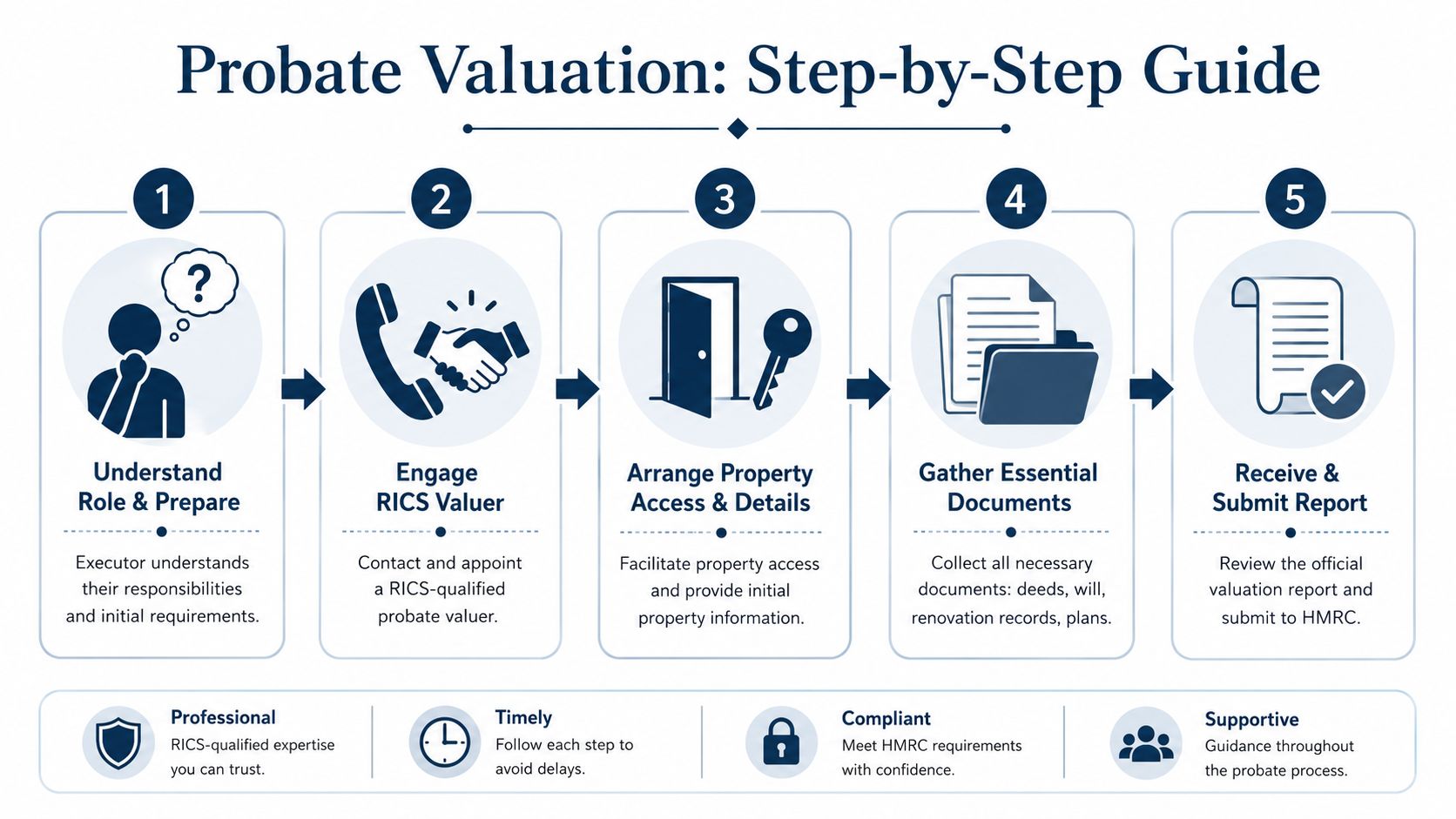
Most executors feel better once the process is broken into steps. It's not mysterious. It just needs doing in the right order.
What you should gather first
Before the valuer attends, pull together the documents that help show what the property was and what burdens sit on it. Executors should gather property deeds, property tax records, mortgage information and records of home improvements, as set out in the verified data from Premier Solicitors.
You may also want to have to hand:
- Tenancy paperwork: If the property was let, the rent and terms matter.
- Lease documents: For flats, lease length and terms can affect value.
- Planning and building paperwork: Especially for extensions, loft conversions and structural alterations.
- Basic estate papers: The grant may not be through yet, but any available probate documents help everyone stay aligned.
If you're handling the wider administration, this guide for estate executors gives a practical overview of the broader estate settlement process.
How the job usually runs
A straightforward probate house valuation usually follows this pattern:
- Instruction is agreed. The valuer confirms the property address, tenure and date of death.
- Inspection takes place. The property is inspected to note size, layout, condition and any obvious defects.
- Research is carried out. Comparable sales from the relevant historic period are analysed.
- Valuation is written. The report is prepared for probate and tax use.
- Executor submits the figure. The valuation is then used in the estate's tax and probate paperwork.
The inspection is important. If a house in Catford has damp, dated services and a tired roof covering, the valuation should reflect that. If a flat in Rotherhithe has river views but a weak lease position, that also needs to be reflected. Good valuers don't iron out awkward facts. They price them in.
Costs vary by property type, tenure, size and complexity. A leasehold flat with straightforward evidence is one thing. A large period house with title issues, poor condition or retrospective dating complications is another. If you want a clearer feel for what affects the fee, this note on how much a house valuation costs is useful.
London Probate Valuation Scenarios
The principles make more sense when you attach them to real London housing stock.
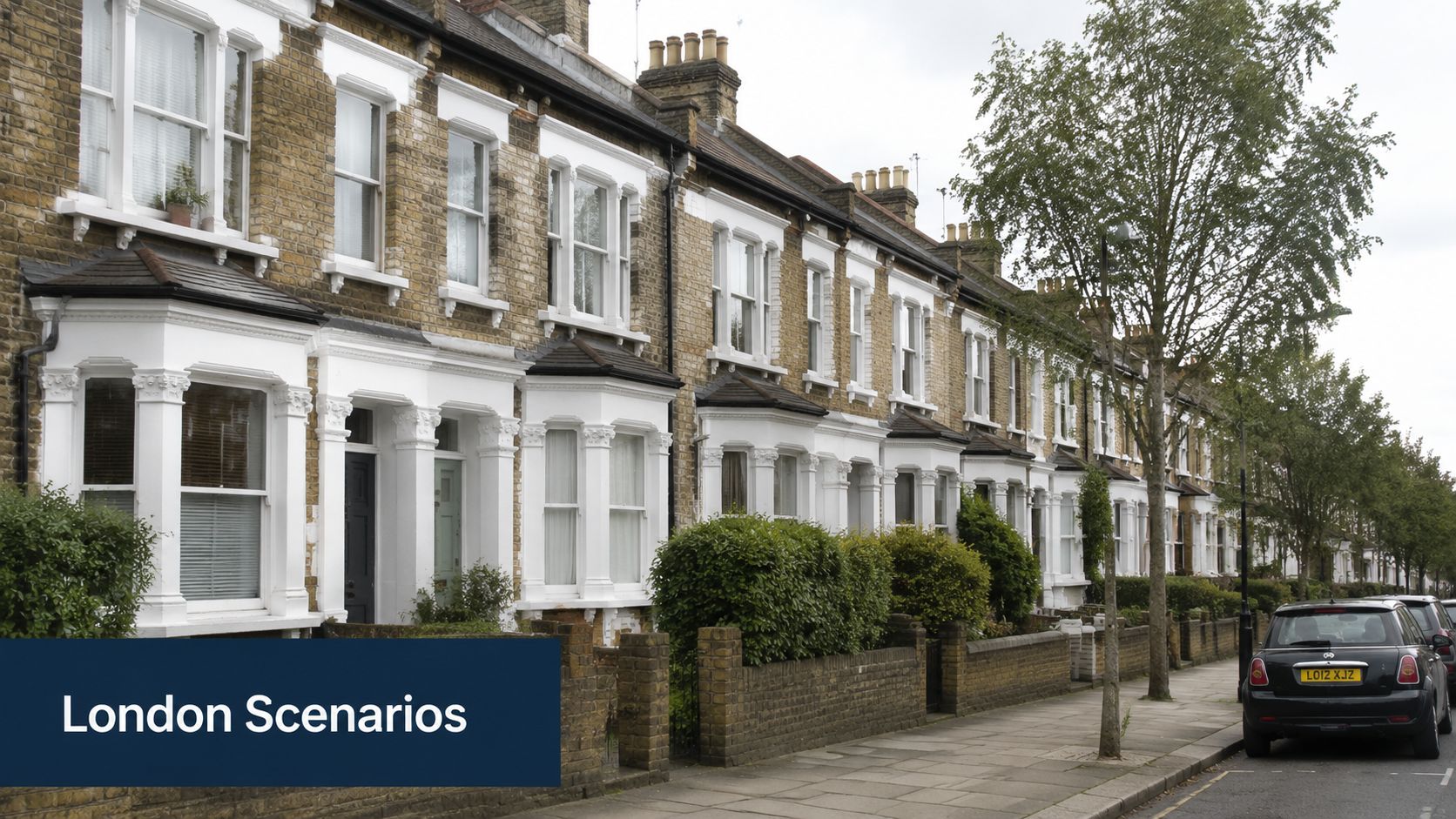
Lewisham terrace with a loft issue
A Victorian terrace in Lewisham or Brockley often looks straightforward from the pavement. Then you go inside and find a loft conversion with uncertain paperwork. For probate, that matters.
A surveyor would consider whether the loft space adds full value, partial value or raises questions that a buyer at the date of death would have reflected in their offer. The location may be strong, but defects or missing approvals can still hold the figure back.
Bermondsey flat with a short lease
Ex-local authority flats in Bermondsey, Deptford and parts of Southwark need careful handling. A short lease can weigh heavily on value, even when the flat itself is in decent order and the block is well placed.
The valuer has to consider the tenure as part of the asset, not as an afterthought. Looking only at sale prices of longer-lease flats would give the wrong answer. Probate values fall apart when lease details are treated casually.
Bromley semi needing full modernisation
A 1930s semi in Bromley, Beckenham or Orpington can have generous space and a good plot but still need extensive updating. Original wiring, old windows, dated kitchens and tired roofs are common.
In that case, the valuation reflects what buyers at the relevant time would have paid for a house requiring work, not what the house might be worth after refurbishment. Executors sometimes drift into end-value thinking. Probate doesn't work like that.
London property isn't one market. It's hundreds of local markets with different housing stock, defects and buyer behaviour.
That's why local knowledge matters. A valuer who understands Victorian stock in Forest Hill, mansion blocks in Westminster and suburban semis in Croydon won't treat them as interchangeable.
Probate Valuation FAQs
What happens if the house sells for more or less than the probate value
That can happen. A probate valuation is tied to the date of death. A later sale reflects the market and property position on the sale date. If there is a large gap, keep the paperwork that explains it. Condition changes, market shifts and sale timing can all be relevant.
Can I do the valuation myself for a small estate
For a very modest estate, people sometimes start with estimates. The risk is that the figure may not be reliable if questioned. If the property is in London, if the estate may be taxable or if the title or condition is not straightforward, use a proper valuer.
How long is a probate valuation valid for
The report values the property on a fixed historic date, so the valuation date itself does not change. What changes is relevance to later events. If HMRC raises queries, or if fresh information comes to light, the executor may need further explanation or updated advice.
Does the valuer need to inspect the inside
In most cases, yes, that's sensible. Condition affects value. You can't assess tired interiors, structural movement, damp or poor alterations properly from the pavement.
A formal probate house valuation needs to be accurate, independent and capable of standing up to scrutiny. If you need that for a property in London or the Home Counties, call 0800 00 16 422 and make sure the report you submit is one you won't have to defend twice.
If you need a formal probate valuation for a London property, Corinthian Surveyors London LTD provides independent RICS valuation work for residential estates, including retrospective date-of-death assessments prepared for HMRC and probate purposes.